
The Dual-PolyelectrolyteDual-Polyelectrolyte Adaptive Release Mechanistic Outlook (D-PARMO) Adaptive Release Mechanistic Outlook (D-PARMO) is an as an advanced mathematical and thermodynamic framework designed to predict drug release kinetics in complex biomaterials, particularly chitosan-alginate polyelectrolyte systems. Moving beyond the limitations of classical, retrospective curve-fitting equations (such as the Higuchi or Korsmeyer-Peppas models), D-PARMO integrates dual-polymer ionization equilibria, Flory-Rehner swelling thermodynamics, Donnan partitioning, and multi-modal transport kinetics. By translating release data into physically meaningful operational parameters—including diffusion rate, erosion amplitude, and electrostatic coupling coefficients—this mechanistic approach enables the a priori prediction of drug release profiles. Ultimately, the D-PARMO framework provides a robust computational tool to bridge the translational gap in nanomedicine, allowing researchers to rationally engineer targeted, stimuli-responsive delivery systems. Furthermore, D-PARMO provides the exact mathematical boundary conditions required to train Physics-Informed Neural Networks (PINNs). This computational integration overcomes the "black-box" generalization failures of conventional artificial intelligence, establishing a predictive digital twin architecture that fulfills regulatory Quality by Design (QbD) mandates and accelerates clinical translation.
- D-PARMO framework
- predictive modeling
- chitosan-alginate
- Flory-Rehner theory.
- D-PARMO
- Polyelectrolyte Complexes
- Drug Release Kinetics
- Physics-Informed Neural Networks
- Quality by Design
- Machine Learning.
- drug release kinetics
- polyelectrolyte complexes
- nanomedicine
- mechanistic mathematical models
1. Introduction
The successful translation of nanomedicine from laboratory formulation to clinical application remains one of the most significant challenges in pharmaceutical sciences. A primary bottleneck in this translational pipeline is the lack of robust, predictive mathematical models capable of describing drug release kinetics from complex, stimuli-responsive biomaterials. Historically, formulation scientists have relied on empirical or semi-empirical equations to describe drug dissolution and release.[1][2] While these classical models are highly accessible, they are fundamentally descriptive rather than predictive.
The Dual-Polyelectrolyte Adaptive Release Mechanistic Outlook (D-PARMO) framework represents a paradigm shift in the evaluation of controlled release systems, particularly for polyelectrolyte complexes such as chitosan-alginate (CS/ALG) hydrogels and nanoparticles.[1] By transitioning away from retrospective curve-fitting and moving toward a unified mechanistic physics-based approach, D-PARMO allows for the a priori prediction of drug release profiles. The framework integrates dual-polymer ionization equilibria, swelling thermodynamics, osmotic partitioning, and multi-modal transport kinetics. Consequently, it translates complex physicochemical phenomena into physically meaningful operational parameters, enabling researchers to rationally engineer targeted delivery systems with intent rather than relying on trial-and-error methodologies.
2. Limitations of Classical Release Models
To appreciate the utility of the D-PARMO framework, it is necessary to understand the structural limitations of the classical models that have dominated the literature for decades, most notably the Higuchi, Korsmeyer-Peppas, and Peppas-Sahlin equations.[2][3][4]
2.1. The "R² Illusion"
Modern pharmaceutical literature frequently evaluates the validity of a drug release model based solely on the coefficient of determination (R2). High R2 values derived from non-linear regression are often misinterpreted as proof of a model's mechanistic accuracy. However, fitting experimental data to a power law (Mt/M∞ = ktn) or polynomial equation after the experiment has concluded is a strictly retrospective exercise. This phenomenon, teoften termed the "R² Illusion," obscures the fact that semi-empirical models lack the thermodynamic and electrostatic parameters necessary to predict how a formulation will behave if the polymer ratio, crosslinking density, drug payload, oor physiological pH is altered.[1]
2.2. Shortcomings in Complex Biomaterials
Classical equations were originally derived for simple, single-mechanism systems—for example, pure Fickian diffusion from a planar matrix.[2] When applied to stimuli-responsive polyelectrolyte complexes like CS/ALG, these models fall short. They cannot account for the dynamic, simultaneously occurring processes of polymer relaxation, pH-dependent ionization, erosion, and electrostatic drug-polymer interactions. The Korsmeyer-Peppas exponent (n) can indicate whether diffusion is Fickian or non-Fickian[3], but it provides no actionable data regarding the internal thermodynamic state of the hydrogel.
3. Mechanistic Foundations of D-PARMO
The D-PARMO framework overcomes the limitations of semi-empirical models by computationally unnifying the four distinct physical chemistryochemical phenomena that govern the behavior of polyelectrolyte drug carriers.[1]
3.1. Dual-Polymer Ionization Equilibria
In systems utilizing opposing polyelectrolytes, (e.g.,such as the cationic amine groups of chitosan and the anionic carboxylic groups of alginate), the degree of structural crosslinking is ionization is entirely dependent on the pH of the surrounding medium. D-PARMO integcorporates the specific pKa pKa values of bothe polymers via the Henderson-Hasselbalch equation to to calculate the precise fraction of ionized binding sites, dynamically. This predictings the structural integrityength of the cpolyionic complex across the highlynd its susceptibility to disruption in specific physiological environments, such as the acidic gastric fluid toor the neutral intestinal tract.
3.2. Flory-Rehner Swelling Thermodynamics
Unlike rigid matrices, hydrogels absorb significant solvent, leading to volumetric expansion. D-PARMO utilizes Flory-Rehner theory to balance the total change in free energy (Δμ):
This balances the entropy of polymer-solvent mixing against the opposing elastic retraction of the crosslinked chains and the ionic osmotic pressure.
Unlike simple matrices, hydrogels absorb significant amounts of solvent, leading to volumetric expansion. D-PARMO relies on Flory-Rehner theory
[5] By calculating this differential, the framework accurately models the time-dependent expansion of the polymer mesh size (ξ), which physically dictates the spatial diffusion of the drug.
to balance the thermodynamic forces of swelling: the entropy of polymer-solvent mixing and the opposing elastic retraction of the crosslinked polymer chains. By calculating the osmotic pressure differential between the gel interior and the external sink, the framework accurately models the swelling profile, which dictates the mesh size available for drug diffusion.
3.3. Donnan Partitioning
Because polyelectrolyteCS/ALG systems possess a net charge, mobile bions from the biological buffer ions do not distribute equally across the hydrogel boundary. D-PARMO utilizes the Donnan equilibrium theory to quantify the influx ofaccount for the uneven distribution of ions.[1] pThysiological is is critical for predicting drug release, as the influx of counter-ions.[1] This influx screens the internal elelectrostatic interactions between the drug and the mpolymer matrix, frequently ttriggering the accelerated "burst rrelease" phase (often observed in high-ionic-strength media as an initial burst phase).
3.4. Multi-Modal Transport Kinetics
Rather than forcing drug release into a single mathematical box, D-PARMO acknowledges that macroscopic release is the sum of multiple transport vectors. The framework couples Fickian diffusion (driven by concentration gradients) with case-II transport (driven by polymer relaxation and swelling) and surface/bulk erosion kinetics.[1][4]
4. Key Operational Parameters
By mathematically coupling the phenomena detailed above, the D-PARMO framework extracts specific, physically meaningful variables from in vitro release data. These variables serve as the foundational parameters for predictive formulation engineering.[1]
-
Diffusion Rate Constant (kd): This parameter quantifies the intrinsic mobility of the drug molecule through the hydrated polymer mesh, independent of matrix degradation. It is heavily influenced by the steric hindrance of the polyelectrolyte network and the molecular weight of the encapsulated therapeutic.
-
Swelling Amplitude and Rate (ks): Swelling parameters denote the maximum volumetric expansion of the carrier and the kinetic velocity at which hydration occurs. A high ks indicates rapid water ingress, which typically precedes a phase of accelerated drug diffusion.
-
Erosion Amplitude and Rate (ke): In biodegradable systems, ke quantifies the mass loss of the polymer matrix over time due to chain cleavage and dissolution. It allows formulators to predict the late-stage release profile as the carrier structurally collapses.
-
Electrostatic Coupling Coefficient (α): This is one of the most critical parameters introduced by D-PARMO. It quantifies the magnitude of the electrostatic affinity between the ionized drug and the charged polymer backbone. A high α value indicates strong ionic tethering, which suppresses burst release and extends the therapeutic half-life of the formulation.
-
Diffusion Rate Constant (kd): This parameter quantifies the intrinsic mobility of the drug molecule through the hydrated polymer mesh, independent of matrix degradation. It is heavily influenced by the steric hindrance of the polyelectrolyte network and the molecular weight of the encapsulated therapeutic.
-
Swelling Amplitude and Rate (ks): Swelling parameters denote the maximum volumetric expansion of the carrier and the kinetic velocity at which hydration occurs. A high ks indicates rapid water ingress, which typically precedes a phase of accelerated drug diffusion.
-
Erosion Amplitude and Rate (ke): In biodegradable systems, ke quantifies the mass loss of the polymer matrix over time due to chain cleavage and dissolution. It allows formulators to predict the late-stage release profile as the carrier structurally collapses.
-
Electrostatic Coupling Coefficient (α): This is one of the most critical parameters introduced by D-PARMO. It quantifies the magnitude of the electrostatic affinity between the ionized drug and the charged polymer backbone. A high α value indicates strong ionic tethering, which suppresses burst release and extends the therapeutic half-life of the formulation.
5. Applications in Biomaterial Engineering
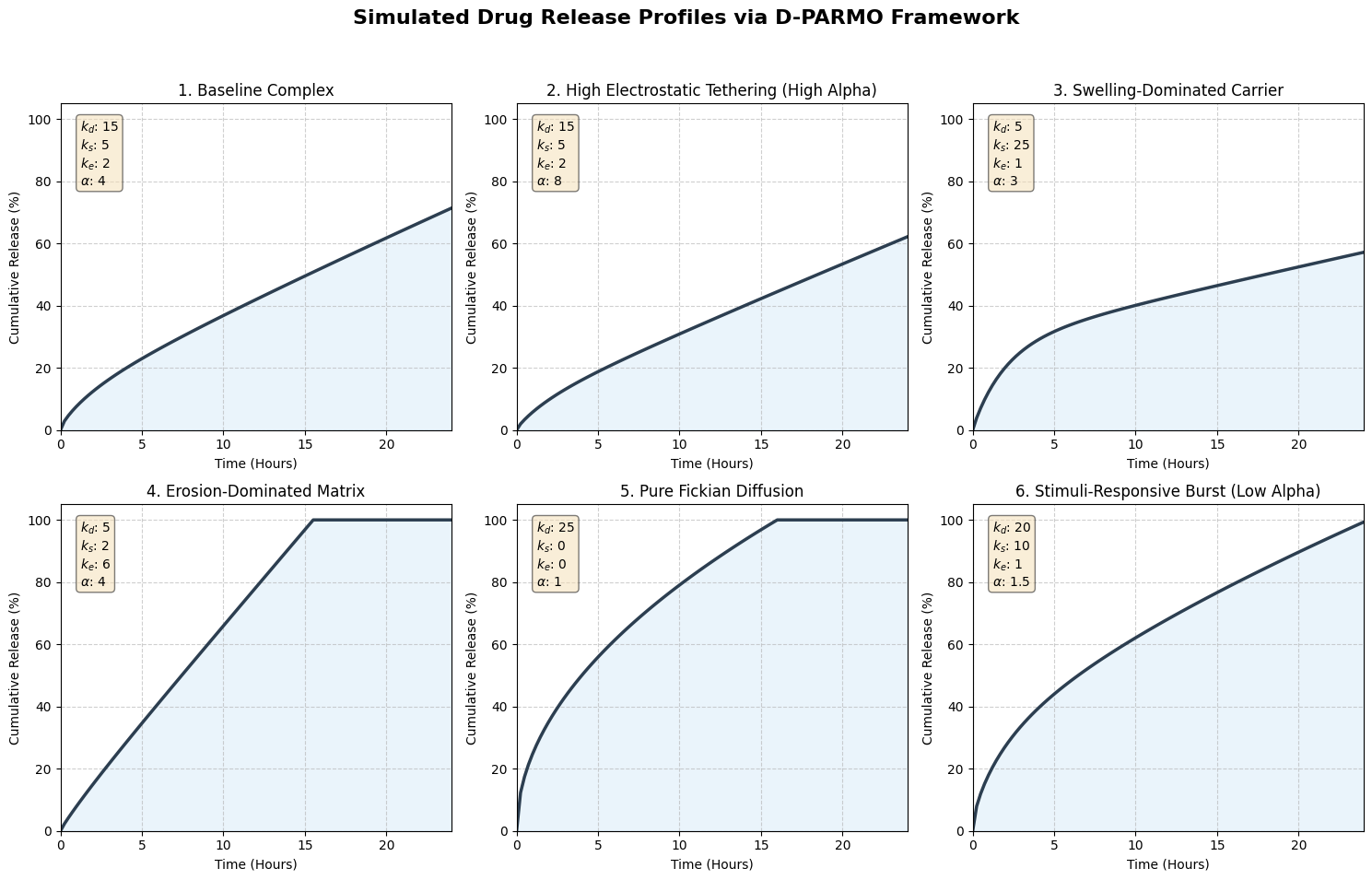
Figure 1. Simulated drug release profiles illustrating the predictive utility of the D-PARMO framework across six distinct parametric cases. By isolating variables such as the electrostatic coupling coefficient (α) and the erosion rate (ke), formulators can visually map the shift from pure Fickian diffusion to complex, erosion-dominated release kinetics.
The operational parameters generated by D-PARMO provide actionable intelligence for biomaterial engineering. Formulators can utilize these parameters to conduct in silico optimizations before moving to the laboratory bench. For example, if an oral drug delivery system exhibits an undesirable burst release in simulated gastric fluid, an analysis of the D-PARMO parameters might reveal a remarkably low α coefficient combined with a high ks. To correct this, scientists can rationally increase the crosslinking density or adjust the chitosan-to-alginate stoichiometric ratio to optimize the thermodynamic stability of the complex, thereby tuning the release profile without relying on exhaustive empirical iterations.
5. Applications in Biomaterial Engineering
The parameters generated by D-PARMO provide actionable intelligence for pre-clinical development. For example, if an oral delivery system exhibits an undesirable premature burst release of insulin in simulated gastric fluid, a D-PARMO analysis might reveal a critically low α coefficient combined with a high ks. To correct this without exhaustive in vitro trial-and-error, scientists can in silico model an increase in the chitosan-to-alginate stoichiometric ratio, rationally optimizing the thermodynamic stability of the complex.[6][7] This allows for the precise tuning of systems designed for the acidic tumor microenvironment or localized colonic delivery as demonstrated in Figure 2.
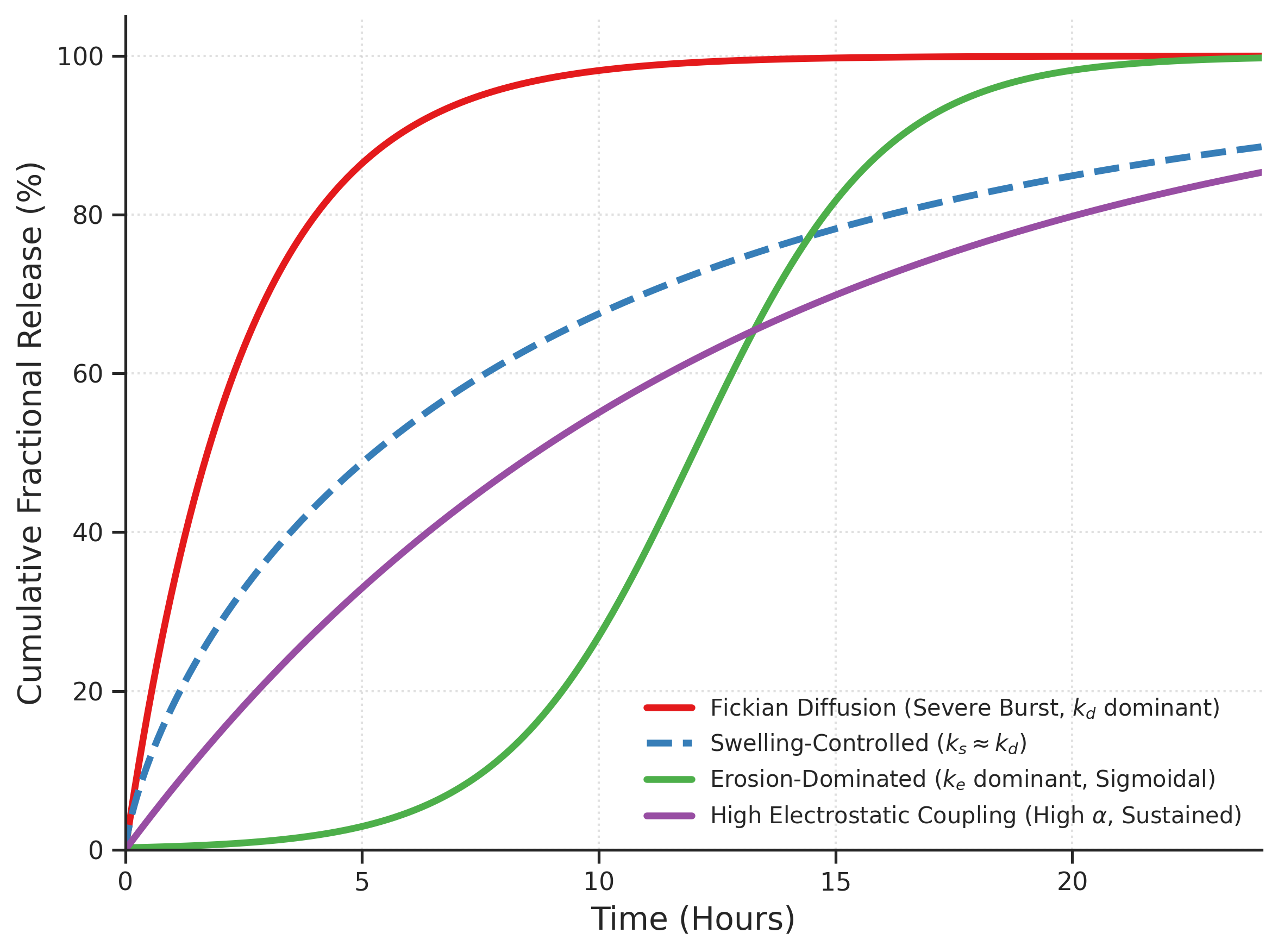
Figure 2. Predictive utility of the D-PARMO framework. By isolating specific variables such as the electrostatic coupling coefficient (α) and the erosion rate (ke), formulators can visually map and predict the shift from pure Fickian diffusion (red) to highly controlled, sustained release kinetics (purple).
6. Computational Integration: Physics-Informed Machine Learning (PIML)
The integration of artificial intelligence into pharmaceutical formulation has historically been impeded by standard deep learning architectures functioning as "black-box" interpolators. While conventional neural networks can achieve high accuracy on standardized datasets, they suffer catastrophic generalization failure when predicting release kinetics across out-of-distribution physiological regimes (e.g., dynamic pH shifts). This empirical vulnerability is a modern iteration of the "R² Illusion," where data-hungry models overfit without acquiring any fundamental representation of mass transport physics.[8] D-PARMO resolves this by serving as the mechanistic foundation for Physics-Informed Neural Networks (PINNs). In a D-PARMO-guided PINN, the underlying physical laws act as strict regularization boundaries within the network's optimization landscape.
6.1. Multi-Objective Loss Function Formulation
In a conventional neural network, the loss function (Lstandard) quantifies only the mean squared error between the predicted fractional drug release and the experimental in vitro data (Mt /M∞):
In contrast, a D-PARMO-guided PINN introduces a multi-objective loss function ($\mathcal{L}_{total}$) that couples empirical data fidelity with physical residual loss terms derived from the four foundational phenomena of the framework:
where λphys represents a dynamic weighting hyperparameter that balances empirical fitting against physical compliance. The physics loss term (LD-PARMO) is constructed from the residuals of the governing partial differential equations (PDEs) for osmotic swelling, electrostatic binding, and multi-modal transport:
Each component forces the hidden layers of the neural network to satisfy specific thermodynamic boundary conditions:
-
Swelling Residual (Lswelling): Penalizes predictions that violate the Flory-Rehner osmotic pressure equilibrium (ΔΠ = 0), ensuring that the predicted mesh size (ξ) scales realistically with solvent ingress (ks).
-
Donnan Residual (LDonnan): Constrains the mobile ion distribution across the hydrogel boundary, preventing the network from predicting physical impossibilities such as sustained electrostatic tethering in high-ionic-strength media without counter-ion screening.
-
Transport Residual (Ltransport): Enforces mass conservation by penalizing deviations from the coupled Fickian-erosion transport equation governed by the intrinsic diffusion rate (kd) and matrix erosion velocity (ke).
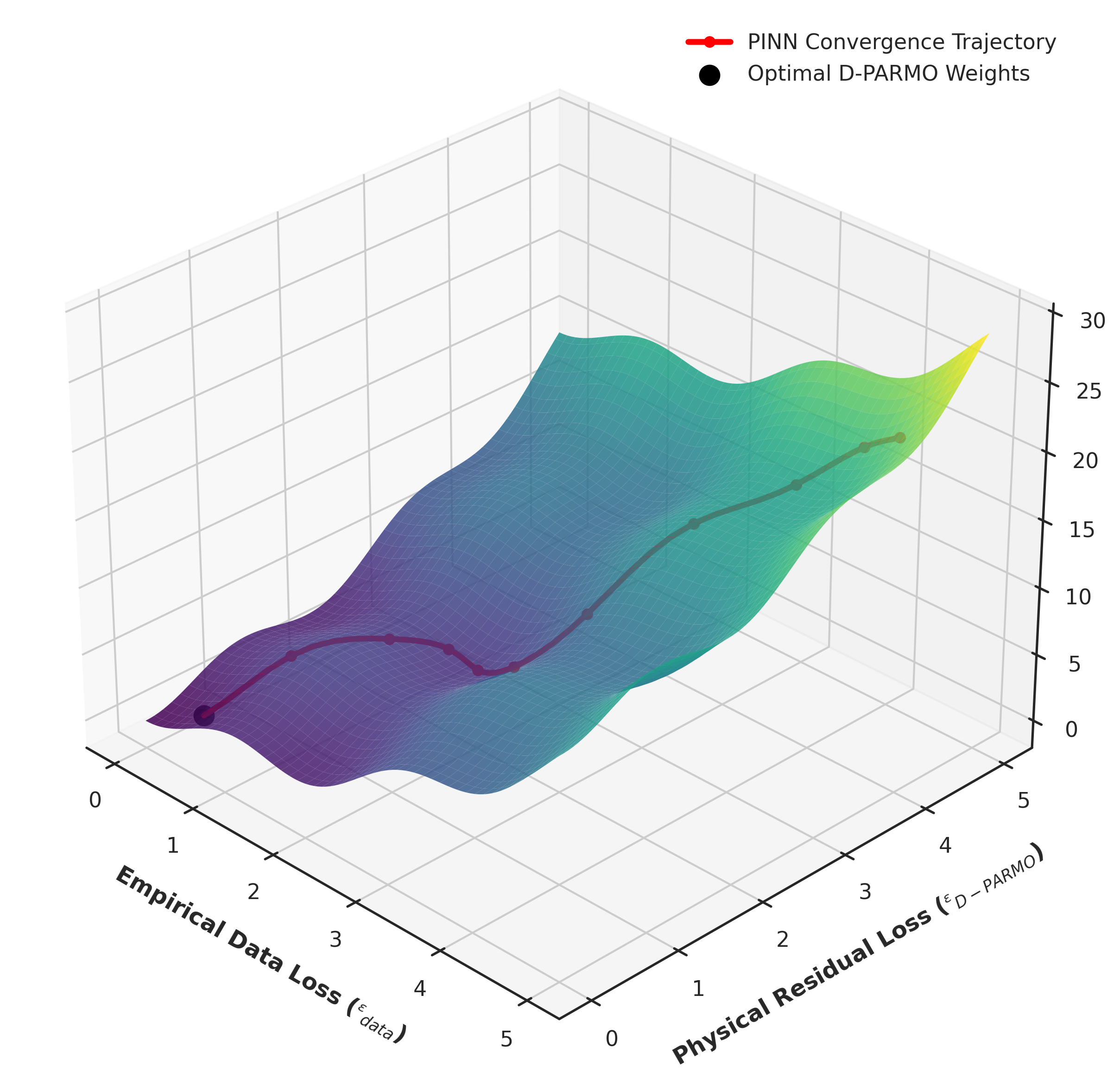
Figure 3. 3D Loss Landscape of the D-PARMO Physics-Informed Neural Network (PINN). The red trajectory illustrates the convergence of the algorithm as it dynamically optimizes the network weights, descending into the Pareto optimum by successfully balancing empirical data fidelity (Ldata) with strict thermodynamic and transport constraints (LD-PARMO).
6.2. Sparse-Data Optimization and Digital Twins
By embedding the parameters (kd, ks, ke, α) into the network's loss topology, the data requirements for model convergence drop by orders of magnitude. A D-PARMO PINN can accurately reconstruct complex profiles from highly sparse experimental time points.[9] Furthermore, linking this PINN to Process Analytical Technology (PAT) sensors during continuous manufacturing enables the deployment of real-time Digital Twins, instantaneously simulating the in vivo dissolution profile of a specific nanoparticle batch.
76. Implications for Clinical Translation
RThegulatory agencies, including the FDA and EMA, ultimate goal of pharmaceutical modeling is the acceleration of clinical translation. Regulatory agencies increasingly mandate advocate for Quality by Design (QbD) frameworks in pharmaceutical and Process Analytical Technology (PAT) approaches in drug manufacturing.[6] D-PARMO aligns perfectly with QbD principles by establishing absolute mechanistic control overunderstanding of the product lifecycle. By accurately describing the thermodynamics and kinetics of the formulation, D-PARMO reduces the reliance on costly in vivo animal models for preliminary screening. It serves as a robust computational bridge, ensuring that in vitro dissolution profiles hold true predictive powvaluer for in vivo pharmacokinetic behavior.[10]
87. Conclusion
The D-PARMO framework establishes a new bestanchmarkdard for the mathematical evaluation of targeted drug delivery systems. By unifyiintegrating ionization equilibria, swelling thermodynamics, Donnan partitioning, and multi-modal transport, it definitively into a cohesive model, it moves the field beyond the descriptive limitations of classical equations. For complex, stimuli-responsive carrierss such as chitosan-alginate polyelectrolytes, D-PARMO provides the physicoperational parameters requirednecessary to rationally engineer biomaterials. Its seamless integration into Physics-Informed Neural Networks establishes a powerful digital twin architecture, drastical, ultimately de-risking formulation development and accelerating the pathway toward clinical translation.
References
- Rekab. P, Oladipo A.A. Chitosan–Alginate Polyelectrolyte Systems: From Classical Release Models to the D-PARMO Framework. Macromolecular Materials and Engineering. 2026, 311, e70232.
- Higuchi. T. Rate of Release of Medicaments from Ointment Bases Containing Drugs in Suspension. Journal of Pharmaceutical Sciences. 1961, 50, 874-875.
- Korsmeyer, R.W.; Gurny, R.; Doelker, E.; Buri, P.; Peppas, N.A. Mechanisms of solute release from porous hydrophilic polymers. International Journal of Pharmaceutics. 1983 , 15, 25-35.
- Peppas, N.A.; Sahlin, J.J. j. j. 1989, 57, 169-172.
- Flory, P.J.; Rehner, J.Jr. Statistical mechanics of cross-linked polymer networks II. Swelling. The Journal of Chemical Physics . 1943, 11, 521–526.
- Yu, L.X.; Amidon, G.; Khan, M.A.; Hoag, S.W.; Polli, J.; Raju, G.K.; Woodcock, J. Understanding pharmaceutical quality by design. The AAPS Journal . 2014, 16, 771–783.
- Kamaly, N.; Yameen, B.; Wu, J.; Farokhzad, O. C. Degradable Controlled-Release Polymers and Polymeric Nanoparticles: Mechanisms of Controlling Drug Release. Chem. Rev.. 2016, 116 (4), 2602–2663..
- Raissi, M.; Perdikaris, P.; Karniadakis, G. E. Physics-informed neural networks: A deep learning framework for solving forward and inverse problems involving nonlinear partial differential equations.. J. Comput. Phys.. 2019, 378, 686–707.
- Wang, S.; Teng, Y.; Perdikaris, P. Understanding and Mitigating Gradient Flow Pathologies in Physics-Informed Neural Networks. SIAM J. Sci. Comput.. 2021, 43 (5), A3055–A3081.
- Yu, L. X.; Amidon, G.; Khan, M. A.; Hoag, S. W.; Polli, J.; Raju, G. K.; Woodcock, J. Understanding pharmaceutical quality by design. AAPS J.. 2014, 16 (4), 771–783.