Immersive methods and biometric tools provide a rigorous, context-rich way to study how people perceive and choose food. Immersive methods use extended reality, including virtual, augmented, mixed, and augmented virtual environments, to recreate settings such as homes, shops, and restaurants. They increase participants’ sense of presence and the ecological validity (realism of conditions) of experiments, while still tightly controlling sensory and social cues like lighting, sound, and surroundings. Biometric tools record objective signals linked to attention, emotion, and cognitive load via sensors such as eye-tracking, galvanic skin response (GSR), heart rate (and variability), facial electromyography, electroencephalography, and functional near-infrared spectroscopy. Researchers align stimuli presentation, gaze, and physiology on a common temporal reference and link these data to outcomes like liking, choice, or willingness-to-buy. This approach reveals implicit responses that self-reports may miss, clarifies how changes in context shift perception, and improves predictive power. It enables faster, lower-risk product and packaging development, better-informed labeling and retail design, and more targeted nutrition and health communication. Good practices emphasize careful system calibration, adequate statistical power, participant comfort and safety, robust data protection, and transparent analysis. In food science and consumer behavior, combining immersive environments with biometrics yields valid, reproducible evidence about what captures attention, creates value, and drives food choice.
The disciplines of food science and consumer behavior are undergoing a transformative integration of advanced technologies, leading to a deeper understanding of how humans interact with food products. Within this evolving landscape, immersive methods and biometric tools have emerged as critical innovations, offering enhanced ecological validity and objective measurement capabilities in research
[1]. This entry systematically explores the theoretical underpinnings, historical evolution, core technologies, applications, methodological considerations, and future directions of these converging approaches. To set the stage, the first step is to define key concepts in sensory and consumer science that provide context for the rise of immersive and biometric techniques.
1.1. Sensory Science
Sensory science is a multidisciplinary field within food science that is dedicated to understanding human sensory perceptions and affective responses to foods, beverages, and their components
[2]. Sensory and consumer science has been defined as an interdisciplinary field encompassing both purely sensory research and consumer-oriented studies, focusing on responses to specific products as well as consumer behavior in general
[3]. The Institute of Food Technologists (IFT) defined sensory evaluation as a scientific discipline used to evoke, measure, analyze, and interpret reactions to the characteristics of foods and materials as perceived through the senses of sight, smell, taste, touch, and hearing. The field extends beyond food to include non-food items, and employs both quantitative and qualitative methods
[3]. This discipline encompasses a wide array of established and novel tests designed to systematically document human responses to stimuli
[4]. Sensory evaluation techniques have proven critical in product development, production, and quality control of food products
[5]. The primary goal of sensory analysis is to evaluate and understand the human perception of foods and drinks, considering both intrinsic properties (physicochemical attributes) and extrinsic factors (consumer expectations and context)
[6]. Sensory tests are broadly categorized into analytical tests (product-focused) and affective tests (consumer-focused)
[4]. The field continues to evolve by incorporating technologies from diverse disciplines, moving toward more objective and precise data acquisition
[7][8][7,8].
1.2. Consumer Sensory Science
Building upon sensory science, consumer sensory science specifically integrates sensory science principles with a primary focus on understanding consumer perceptions, preferences, and behaviors related to food products
[9]. This sub-discipline examines how consumers interact with products across various stages (from purchase to consumption), which is essential for measuring consumer attitudes and behaviors in realistic contexts
[10]. Consumer sensory science provides objective information on the consumer acceptance or rejection of food stimuli, and even captures the emotional responses such stimuli evoke
[7]. It plays a crucial role in new product development, from initial design through to commercialization
[10][11][10,11].
1.3. Consumer Behavior
Consumer behavior refers to the study of the processes by which individuals, groups, or organizations select, buy, use, and dispose of goods, services, or ideas to satisfy their needs and desires
[12]. In the context of food, this behavior is influenced by a complex interplay of internal factors (psychological, personal) and external factors (social, cultural, environmental)
[13]. Understanding consumer preferences is paramount for the food industry, yet it is inherently challenging due to the multitude of factors influencing food choices
[14][15][14,15]. These factors span cognitive dimensions (e.g., knowledge), affective dimensions (attitudes and feelings), and conative dimensions (purchase intentions and actual purchase behavior)
[14]. Key determinants of food choice are often categorized into food-internal factors (sensory and perceptual attributes of the product), food-external factors (information provided, social and physical environment), and individual differences (values, personality traits, habits)
[16][17][18][16,17,18]. Consumer food behavior has garnered significant attention from marketers, researchers, and public health officials, particularly in efforts to understand the drivers of healthy versus unhealthy food choices
[19][20][21][19,20,21]. After all, food choices directly determine nutrient intake and thereby impact health status
[21].
1.4. Immersive Methods
Immersive methods refer to advanced technologies that generate simulated environments designed to deeply engage users’ senses, evoking a strong sense of presence and closely mirroring real-world scenarios
[22]. These methodologies are critical for enhancing the ecological validity of consumer data, providing a rich multisensory context that influences perception, liking, and behavior
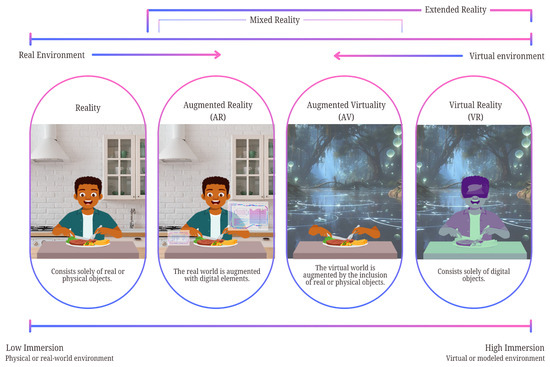
[22][23][22,23]. The overall category for these technologies is extended reality (XR), which encompasses a spectrum of mixed real-and-virtual environments
[24][25][24,25].
Figure 1 illustrates Milgram and Kishino’s reality–virtuality continuum
[26], which describes the progression between physical reality and completely virtual environments, and is used here to classify immersive methods.
Figure 1. Classification of immersive methods, adapting the reality–virtuality continuum by Milgram and Kishino
[26].
1.4.1. Virtual Reality (VR)
Virtual Reality (VR) immerses users in a completely synthetic, computer-generated environment, typically delivered via a head-mounted display, thereby isolating the user from the physical world
[27][28][27,28]. VR aims to provide a fully consistent and encompassing virtual experience
[29]. It allows for the creation of three-dimensional digital imagery and environments to simulate authentic visual experiences
[24]. In food science, VR is increasingly recognized as a novel tool for evaluating various aspects of food products, including product design, labeling, placement, and store layouts offering deeper insights into consumer psychology
[29][30][29,30]. VR has also demonstrated potential for improving sensory evaluations, influencing perceptual research outcomes, and enhancing educational experiences related to food
[31].
1.4.2. Augmented Reality (AR)
Augmented Reality (AR) superimposes digital information, such as text, images, or 3D models, onto the real-time view of the physical world
[24][27][32][24,27,32]. This technology enhances the perception of reality without fully replacing the surrounding physical environment
[27]. The unique ability of AR to overlay virtual objects onto real scenes increases the capacity of consumers to mentally simulate consuming a pictured food, which in turn can heighten desire and purchase likelihood
[32][33][32,33]. Furthermore, AR offers a dynamic, interactive platform for consumer engagement, supporting informed decision-making by providing contextual, real-time information as shoppers interact with products
[27].
1.4.3. Mixed Reality (MR)
Mixed Reality (MR) occupies the space between AR and VR, blending real and virtual elements in interactive ways
[26][34][26,34]. It allows seamless interaction between physical and digital objects; virtual elements in MR not only overlay the real world, but also respond to and integrate with real-world objects
[34]. MR systems use advanced sensors and spatial mapping to merge digital content with the physical environment in real time
[35]. This capability can significantly improve the ecological validity of consumer research, as MR enables the evaluation of real food items within context-rich virtual settings while maintaining interaction, effectively bridging laboratory control and real-world realism
[1].
1.4.4. Augmented Virtuality (AV)
Augmented Virtuality (AV) is essentially the inverse of AR. It involves a predominantly virtual environment into which real-world elements or objects are incorporated
[26]. AV merges aspects of AR and VR by bringing physical elements, for example actual food samples, into a virtual space, with the goal of improving product evaluation through sensory analysis
[36]. The objective of AV is to create immersive sensory environments that closely resemble real-world scenarios, offering accurate insights into consumer perceptions and preferences. This is achieved by allowing participants to experience genuine food products within a virtual environment, thereby observing real foods under controlled yet immersive conditions
[36].
1.5. Biometric Tools
Complementing immersive environments, biometric tools are technologies for objectively measuring physiological and behavioral responses, often subconscious, to food-related stimuli
[37]. These tools overcome the limitations of self-report by capturing real-time, non-invasive data on emotional, cognitive, and physical states during consumer responses
[38][39][38,39]. Biometric approaches are increasingly utilized in agri-food marketing and consumer research to gain deeper insight into decision-making processes
[37]. The growing availability of psychophysiological sensing devices, along with advances in interpreting these signals for affective state assessment, represents a natural evolution of sensory evaluation methods
[39].
1.5.1. Eye Tracking
Eye tracking measures eye movements to determine where, how, and for how long a person looks at visual stimuli, yielding objective data on visual attention and cognitive processing
[40][41][40,41]. Key metrics include fixations, meaning how long the gaze lingers on a point; dwell time, meaning total time spent on a specific area; saccades, meaning quick eye movements between points, and heatmaps, meaning visual maps of attention distribution
[42]. In the food domain, eye tracking has been widely applied, particularly in packaging research, to assess how package elements and food labels capture consumer attention
[42][43][44][42,43,44]. The use of mobile eye tracking now also enables researchers to study visual attention toward foods in more natural, real-life environments, for example buffet settings or grocery stores with real products, outside of the laboratory
[45].
1.5.2. Galvanic Skin Response
Galvanic skin response (GSR), also known as electrodermal activity or skin conductance, measures changes in the electrical conductivity of the skin caused by sweat gland activity
[46][47][46,47]. GSR is a reliable indicator of emotional arousal, stress, or cognitive load in response to various stimuli, including food-related stimuli
[48][49][50][48,49,50]. When a person encounters a significant stimulus that evokes an emotional response, the sympathetic nervous system activates the sweat glands, leading to a measurable increase in skin conductance
[46]. By monitoring these changes, researchers can infer levels of excitement or stress triggered by food products, advertisements, or sensory experiences.
1.5.3. Heart Rate and Heart Rate Variability
Heart Rate (HR) is the number of heart beats per minute, whereas Heart Rate Variability (HRV) is the variation in the time intervals between successive heartbeats
[51][52][53][51,52,53]. These cardiovascular metrics are associated with emotional states, cognitive effort, and stress levels, providing insight into physiological responses during food experiences or exposure to marketing messages
[37][39][50][37,39,50]. In particular, HRV reflects the balance between sympathetic and parasympathetic nervous system activity; a reduced HRV is often linked to conditions such as high stress, cardiovascular disease, or obesity
[52][53][54][52,53,54]. In consumer research, tracking HR and HRV helps reveal how tasting a food or viewing a food advertisement might induce stress or relaxation responses.
1.5.4. Facial Expression Analysis
Facial expression analysis involves automatically analyzing facial movements to identify basic emotions (e.g., happiness, sadness, anger) based on subtle muscle activity. This provides an objective, real-time readout of a consumer’s emotional response to food products or marketing stimuli
[8][30][8,30]. A more specialized technique, facial electromyography (fEMG), measures the electrical activity produced by facial muscles, and can detect very subtle muscle contractions associated with emotional expressions, even when no obvious facial change is visible
[55][56][55,56]. For example, fEMG signals from the brow (corrugator supercilia) or cheek (zygomaticus major) muscles can reveal slight negative or positive reactions, respectively, during food consumption that might not be evident from outward behavior
[57]. Using these tools, researchers capture spontaneous affective reactions that consumers themselves may not articulate.
1.5.5. Electroencephalography
Electroencephalography (EEG) records the brain electrical activity via electrodes placed on the scalp, offering very high temporal resolution
[47][58][47,58]. In food and consumer research, EEG is used to investigate cognitive processes such as attention, memory, and decision-making, as well as emotional engagement and overall brain states (e.g., relaxation or arousal) in response to food stimuli
[39][41][59][39,41,59]. For instance, EEG can detect changes in certain brainwave frequencies when a person views or tastes a product, indicating levels of interest or mental effort. While EEG provides direct measures of brain activity, its data can be complex and must be carefully interpreted in conjunction with behavioral or sensory responses.
1.5.6. Functional Near-Infrared Spectroscopy (fNIRS)
Functional Near-Infrared Spectroscopy (fNIRS) is a non-invasive neuroimaging technique that measures changes in blood oxygenation levels in the brain as a proxy for neural activity
[60]. In the context of food science, fNIRS is increasingly used to examine brain activity related to food perception, preferences, and decision-making, serving as a more portable alternative to functional MRI
[47]. Notably, fNIRS can capture low- to intermediate-level brain responses and has the ability to detect processes that occur below the level of conscious awareness
[39][60][61][39,60,61]. Although it only monitors cortical (near-surface) brain regions and has lower spatial resolution than MRI, fNIRS offers the advantage of being usable in realistic environments (even moving or dining settings), since it is relatively tolerant of movement and easy to wear during food tasting sessions.
1.6. Overview of Their Relevance
The integration of immersive methods with biometric tools is profoundly relevant for consumer research because food experiences are heavily influenced by the context in which they occur
[22]. Traditional consumer testing environments, for example isolated sensory booths, often remove crucial contextual information, such as visual, auditory, and social cues, that would normally shape perceptions and preferences
[23][62][23,62]. Immersive methods and biometric measurements together address this limitation by creating more realistic, engaging testing environments and capturing how contextual variables influence food choice, sensory perception, and emotional responses
[1][23][1,23]. By combining the rich contextual control of immersive environments with objective, real-time physiological data from biometric sensors, researchers obtain a far more comprehensive and ecologically valid understanding of consumer behavior than traditional methods alone could provide
[37][39][63][37,39,63]. This multidisciplinary approach allows for the detailed measurement and interpretation of human responses to sensory properties in context, effectively bridging the gap between controlled sensory tests and real-world consumption
[14].