
This research paper presents a hybrid 2D Conv-RBM & LSTM model for efficient human action recognition. Achieving 97.3% accuracy with optimized frame selection, it surpasses traditional 2D RBM and 3D CNN techniques. Recognizing human actions through video analysis has gained significant attention in applications like surveillance, sports analytics, and human–computer interaction. While deep learning models such as 3D convolutional neural networks (CNNs) and recurrent neural networks (RNNs) deliver promising results, they often struggle with computational inefficiencies and inadequate spatial–temporal feature extraction, hindering scalability to larger datasets or high-resolution videos. To address these limitations, we propose a novel model combining a two-dimensional convolutional restricted Boltzmann machine (2D Conv-RBM) with a long short-term memory (LSTM) network. The 2D Conv-RBM efficiently extracts spatial features such as edges, textures, and motion patterns while preserving spatial relationships and reducing parameters via weight sharing. These features are subsequently processed by the LSTM to capture temporal dependencies across frames, enabling effective recognition of both short- and long-term action patterns. Additionally, a smart frame selection mechanism minimizes frame redundancy, significantly lowering computational costs without compromising accuracy. Evaluation on the KTH, UCF Sports, and HMDB51 datasets demonstrated superior performance, achieving accuracies of 97.3%, 94.8%, and 81.5%, respectively. Compared to traditional approaches like 2D RBM and 3D CNN, our method offers notable improvements in both accuracy and computational efficiency, presenting a scalable solution for real-time applications in surveillance, video security, and sports analytics.
- action recognition
- convolutional restricted Boltzmann machine
- long short-term memory
- spatial–temporal feature extraction
- video processing
Abstract: Recognizing human actions through video analysis has gained significant attention in applications like surveillance, sports analytics, and human–computer interaction. While deep learning models such as 3D convolutional neural networks (CNNs) and recurrent neural networks (RNNs) deliver promising results, they often struggle with computational inefficiencies and inadequate spatial–temporal feature extraction, hindering scalability to larger datasets or high-resolution videos. To address these limitations, we propose a novel model combining a two-dimensional convolutional restricted Boltzmann machine (2D Conv-RBM) with a long short-term memory (LSTM) network. The 2D Conv-RBM efficiently extracts spatial features such as edges, textures, and motion patterns while preserving spatial relationships and reducing parameters via weight sharing. These features are subsequently processed by the LSTM to capture temporal dependencies across frames, enabling effective recognition of both short- and long-term action patterns. Additionally, a smart frame selection mechanism minimizes frame redundancy, significantly lowering computational costs without compromising accuracy. Evaluation on the KTH, UCF Sports, and HMDB51 datasets demonstrated superior performance, achieving accuracies of 97.3%, 94.8%, and 81.5%, respectively. Compared to traditional approaches like 2D RBM and 3D CNN, our method offers notable improvements in both accuracy and computational efficiency, presenting a scalable solution for real-time applications in surveillance, video security, and sports analytics.
1. Introduction
Keywords:
- Introduction
The field of video-based human action recognition has garnered significant attention due to its wide-ranging applications in domains such as surveillance, sports analytics, human–computer interaction, and healthcare monitoring [1,2]. Recognizing human actions in real-time from video data is challenging because of the high dimensionality of video frames, complex motion patterns, and the need for effective spatial–temporal data understanding [3]. Traditional approaches using handcrafted features often fail to capture the intricate spatial–temporal relationships inherent in human actions [4].
Recent advancements in deep learning have revolutionized video analysis by enabling automated feature extraction directly from raw data. However, these methods face challenges in computational efficiency and scalability, especially for high-resolution or long-duration video sequences [5,6]. As noted in [7], deep learning’s pivotal role in machine and robotic vision has driven significant progress in areas such as object detection, semantic segmentation, and action recognition. This underscores the necessity for models capable of robustly handling the spatial–temporal complexities of video data.
Among the most successful approaches are hybrid models leveraging convolutional neural networks (CNNs) and recurrent neural networks (RNNs), particularly long short-term memory (LSTM) networks [8]. CNNs are effective in extracting spatial features from individual video frames, learning local patterns such as edges and textures [9]. Meanwhile, LSTMs excel at capturing temporal dependencies, retaining information about past frames to recognize sequential patterns [1].
Despite their promise, CNN-LSTM architectures often encounter challenges with computational inefficiency due to the high number of parameters and resource demands. These challenges become particularly pronounced with high-resolution data or extended video sequences [2]. Additionally, CNNs, while powerful for static image analysis, may not fully capture the dynamic nature of motion over time, limiting their effectiveness in spatial–temporal feature extraction [10]. This has driven the exploration of alternative architectures that balance accuracy and computational efficiency [11].
Recently, vision transformers (ViTs) have emerged as a promising alternative for action recognition tasks. Unlike CNNs, which rely on local receptive fields, ViTs utilize self-attention mechanisms to model global dependencies across spatial and temporal dimensions. This enables them to capture complex relationships between features that span across the entire video frame [12]. ViTs have demonstrated state-of-the-art performance in several visual tasks due to their ability to process sequences of image patches as tokens, treating each patch as an individual input unit [13]. For video action recognition, models such as ViViT (video vision transformer) [14] and TimeSformer [15] have extended the transformer framework to temporal data, effectively learning spatial–temporal representations. However, ViT-based models often require significant computational resources and large-scale pretraining on video datasets, which can limit their scalability and accessibility [16].
Restricted Boltzmann machines (RBMs), particularly two-dimensional RBMs (2D RBMs), have recently been revisited for their ability to learn complex distributions and hierarchical features in an unsupervised manner [4]. Unlike traditional RBMs, 2D RBMs can better preserve local pixel relationships, making them suitable for spatial data such as video frames. However, their inability to model temporal dependencies across frames limits their application in action recognition tasks where motion dynamics are essential [4].
To address these limitations, this paper proposes a novel hybrid architecture combining two-dimensional convolutional RBMs (2D Conv-RBMs) and LSTM networks. The 2D Conv-RBM incorporates convolutional filters into the RBM framework, enabling efficient extraction of spatial features such as edges, textures, and motion cues while reducing parameters through weight sharing. These spatial features are then processed by an LSTM layer, which captures temporal dependencies across frames, enabling robust recognition of both short-term and long-term action patterns.
-
We introduce a novel hybrid 2D Conv-RBM + LSTM architecture that efficiently captures both spatial and temporal features for action recognition tasks. By leveraging the strengths of unsupervised spatial feature learning through Conv-RBM and temporal modeling through LSTM, the proposed method achieves robust and effective action recognition.
-
We incorporate a smart frame selection mechanism that reduces computational complexity by selecting only the most relevant frames in each video sequence. This innovation minimizes redundancy while preserving critical temporal information, enabling the network to focus on the most informative portions of the video.
-
We conduct extensive evaluations on three benchmark datasets: KTH [17], UCF Sports [18], and HMDB51 [19]. On the KTH and UCF Sports datasets, our method achieves state-of-the-art accuracy, surpassing all competing methods in the literature. On the HMDB51 dataset, while our method achieves competitive accuracy, certain other approaches demonstrate higher performance, particularly those leveraging transformer-based architectures or highly complex deep learning frameworks. Despite this, our method balances accuracy and computational efficiency, making it a promising solution for real-time action recognition tasks.
A notable aspect of this work is the adoption of a smart frame selection mechanism, originally introduced in prior research, which has been effectively integrated into our proposed method. This mechanism reduces redundancy by selecting only the most informative frames for processing, significantly lowering computational costs without sacrificing model accuracy. By focusing on key temporal transitions, this method enhances the network’s ability to capture critical dynamics in video sequences.
The primary contributions of this paper are as follows:
2. Related Work
- We introduce a novel hybrid 2D Conv-RBM + LSTM architecture that efficiently captures both spatial and temporal features for action recognition tasks. By leveraging the strengths of unsupervised spatial feature learning through Conv-RBM and temporal modeling through LSTM, the proposed method achieves robust and effective action recognition.
- We incorporate a smart frame selection mechanism that reduces computational complexity by selecting only the most relevant frames in each video sequence. This innovation minimizes redundancy while preserving critical temporal information, enabling the network to focus on the most informative portions of the video.
- We conduct extensive evaluations on three benchmark datasets: KTH [17], UCF Sports [18], and HMDB51 [19]. On the KTH and UCF Sports datasets, our method achieves state-of-the-art accuracy, surpassing all competing methods in the literature. On the HMDB51 dataset, while our method achieves competitive accuracy, certain other approaches demonstrate higher performance, particularly those leveraging transformer-based architectures or highly complex deep learning frameworks. Despite this, our method balances accuracy and computational efficiency, making it a promising solution for real-time action recognition tasks.
The remainder of this paper is organized as follows: Section 2 reviews related work in video-based action recognition and spatial–temporal feature extraction. Section 3 presents the detailed architecture of the proposed model and the smart frame selection mechanism. Section 4 describes the experimental setup, including datasets and metrics. Section 5 discusses the results and analysis, and Section 6 and Section 7 concludes the paper with potential future directions.
2.1. CNN-Based Approaches for Spatial Feature Extraction
- Related Work
Human action recognition from video sequences has long been a challenging problem in the field of computer vision. Early methods relied on handcrafted features such as histogram of oriented gradients (HOG) and optical flow to extract motion and appearance cues from videos. While effective in some cases, these traditional techniques often struggle to capture the complex spatial–temporal dynamics present in human actions. With the rise of deep learning, convolutional neural networks (CNNs) and recurrent neural networks (RNNs), especially long short-term memory (LSTM) networks, have dominated the field, offering more robust and automatic feature extraction and sequence modeling capabilities [1,6]. Additionally, the integration of mobile and embedded sensors, as demonstrated by [20] in their smartphone-based motion detection model, has opened new avenues for real-time and mobile applications of human activity recognition, further highlighting the adaptability of deep learning in diverse environments.
2.2. LSTM Networks for Temporal Dependencies
2.1. CNN-Based Approaches for Spatial Feature Extraction
CNNs have been widely adopted in human action recognition due to their powerful capability in extracting spatial features from video frames. The foundational work by [21] introduced the two-stream CNN model, which processes both spatial (static frame) and temporal (optical flow) streams to recognize actions, emphasizing the importance of combining spatial and temporal information for video analysis [22]. Recent advancements have expanded on CNN-based approaches, with models like inflated 3D ConvNet [23] inflating 2D CNNs into 3D convolutions to capture spatial–temporal features simultaneously across video frames [24]. While these models exhibit strong performance, they come with increased computational complexity due to the higher number of parameters associated with 3D convolutions, which can limit real-time applicability [25]. The proposed method by [26] fuses spatial and temporal features learned from a principal component analysis network (PCANet) with bag-of-features (BoF) and vector of locally aggregated descriptors (VLAD) encoding schemes for human action recognition. The method described in [27] is a spatial–temporal interaction learning two-stream (STILT) network for action recognition, which integrates an alternating co-attention mechanism within a two-stream structure (spatial and temporal streams) to optimize spatial and temporal feature interactions, enabling improved recognition accuracy by leveraging complementary information from RGB frames and optical flow.
2.3. Restricted Boltzmann Machines (RBMs) and Conv-RBM Variants
2.2. LSTM Networks for Temporal Dependencies
Although CNNs are effective for spatial feature extraction, they have inherent limitations in modeling temporal dependencies across video frames. LSTM networks, designed to capture long-term dependencies, address these limitations through their internal memory units. Ref. [28] introduced the LRCN (long-term recurrent convolutional networks) model, combining CNNs for feature extraction with LSTMs for sequence modeling. This approach demonstrated the power of LSTMs in learning temporal dependencies across sequences, and since then, CNN-LSTM combinations have become a standard in video action recognition tasks [1]. More recently, ref. [29] proposed an attention-enhanced CNN-LSTM model that focuses on both key spatial features and significant temporal segments within a video. This use of attention mechanisms helps to filter out irrelevant information, which aligns with the smart frame selection concept utilized in our proposed model [30].
2.3. Restricted Boltzmann Machines (RBMs) and Conv-RBM Variants
2.4. Comparison Between Conv-RBM and CNN
Restricted Boltzmann machines (RBMs) have seen varied applications in deep learning, especially for unsupervised feature learning. While traditional RBMs were originally used to capture dependencies within static images by learning latent representations from raw pixel data, they are limited by their fully connected nature, which hinders spatial coherence and computational efficiency for large-scale image and video data [4]. To overcome these challenges, two-dimensional RBMs (2D RBMs) were introduced, preserving local pixel relationships in video frames to maintain spatial coherence [4]. However, standard 2D RBMs still suffer from inefficiencies due to the lack of parameter sharing. Convolutional RBMs (Conv-RBMs) improve upon this by applying convolutional filters within the RBM framework, generating multiple feature maps, and capturing various spatial patterns with fewer parameters through weight sharing.
Conv-RBMs thus present an efficient method for tasks like action recognition, where spatial structure is critical, as they generate localized feature maps that efficiently handle large-scale data [31,32]. While Conv-RBMs are relatively new in video-based action recognition, our proposed architecture combines Conv-RBMs with LSTM networks to enhance both spatial and temporal dependencies. This combination aligns well with recent advancements in skeleton-based activity recognition, such as [33], who used autoencoders for feature extraction, further reinforcing the potential of unsupervised learning models in human action recognition.
2.4. Comparison Between Conv-RBM and CNN
Convolutional restricted Boltzmann machines (Conv-RBMs) and convolutional neural networks (CNNs) are widely utilized for spatial feature extraction in image and video analysis. Despite their shared reliance on convolutional operations, the two approaches differ significantly in their architecture, learning paradigms, and applications.
Conv-RBMs, a variant of restricted Boltzmann machines (RBMs), are generative energy-based models designed to learn hierarchical representations in an unsupervised manner [34]. They model the joint probability distribution of visible and hidden units using an energy function, as described in Equation (1) in Section 3.2. By incorporating convolutional filters into their structure, Conv-RBMs enable efficient extraction of localized spatial features while preserving critical relationships between neighboring pixels. These models employ weight sharing across receptive fields, significantly reducing the number of parameters compared to traditional RBMs or fully connected networks [35]. As described in Equation (4), Section 3.2, the probabilistic activation of hidden units depends on the convolutional interaction between the input and the learned filters. The unsupervised nature of Conv-RBMs makes them particularly advantageous for tasks where labeled data is scarce or expensive to obtain, as they can effectively learn meaningful features directly from raw data.
In contrast, CNNs are discriminative, supervised models that excel in classification tasks by optimizing parameters through backpropagation based on labeled data [36]. CNNs use convolutional layers to extract spatial hierarchies of features, such as edges and textures, followed by pooling layers to reduce spatial dimensions. While highly effective in feature extraction, CNNs require substantial labeled data and computational resources to achieve optimal performance. Furthermore, CNNs are inherently limited by their focus on learning task-specific features, making them less flexible for unsupervised or semi-supervised learning scenarios.
One of the key differences lies in their learning mechanisms. Conv-RBMs optimize an energy function to learn latent representations, enabling them to capture generalizable and compact features. This generative approach contrasts with the purely discriminative nature of CNNs, which focus on minimizing classification error. As a result, Conv-RBMs tend to produce more interpretable and transferable feature representations [37]. Additionally, Conv-RBMs are better suited for capturing localized pixel dependencies, which are crucial for understanding motion patterns and spatial relationships in video frames. This capability is especially beneficial for human action recognition tasks, where subtle variations in motion and appearance play a critical role.
2.5. Smart Frame Selection in Video Analysis
From a computational perspective, Conv-RBMs are lightweight due to their parameter-sharing mechanism, making them more suitable for scenarios with limited resources. In contrast, CNNs typically require higher computational power, especially when working with high-resolution images or large-scale datasets. However, CNNs benefit from a mature ecosystem of pre-trained models and frameworks, which can be fine-tuned for specific applications.
In the context of this work, Conv-RBM was chosen over CNN for spatial feature extraction due to its ability to operate in an unsupervised manner while preserving local spatial coherence. This property is critical for human action recognition, where spatial features need to be generalized across diverse video frames before temporal dependencies can be modeled. Moreover, Conv-RBM’s efficient parameterization aligns well with the smart frame selection mechanism employed in the proposed method, further enhancing computational efficiency without sacrificing accuracy.
2.5. Smart Frame Selection in Video Analysis
2.6. Benchmark Datasets and Evaluation
One of the major challenges in video-based action recognition is the large number of frames in video sequences, many of which are redundant or uninformative. Processing every frame is computationally costly, especially for real-time applications. Smart frame selection techniques address this by identifying and selecting only the most informative frames, reducing computational cost without compromising accuracy [38]. Ref. [20] demonstrated the impact of frame selection in mobile action recognition, where computational efficiency is crucial due to hardware constraints.
Several methods have been proposed for smart frame selection. Dynamic selection techniques have been employed to optimize key frame selection based on motion clustering, enabling efficient video abstraction and representation [39]. Techniques such as clustering wavelet coefficients and using Jensen–Shannon divergence have proven effective in segmenting video content and extracting representative key frames [40,41]. Our proposed model extends the smart frame selection approach presented in [42] with a Conv-RBM + LSTM architecture, ensuring that the network focuses on the most relevant temporal information and reducing the computational overhead, making it suitable for real-time applications [42].
3. Proposed Method
2.6. Benchmark Datasets and Evaluation
Performance in action recognition is often evaluated on benchmark datasets such as KTH, UCF Sports, and HMDB51. These datasets provide a diverse range of human activities, from simple actions (e.g., walking and clapping in KTH) to complex sports activities (e.g., in UCF Sports) and varied real-world actions (HMDB51). Ref. [43] demonstrated high accuracy on these datasets using 3D CNNs combined with attention mechanisms, highlighting the strength of deep learning approaches for complex video analysis [44]. However, the high computational cost of these methods underscores the need for more efficient architectures, like the one proposed in this paper.
- Proposed Method
This section presents a novel architecture for video-based human action recognition, integrating smart frame selection, two-dimensional convolutional restricted Boltzmann machine (2D Conv-RBM) for spatial feature extraction, and long short-term memory (LSTM) for temporal modeling. The final features are classified through a fully connected network. This pipeline addresses the challenges of redundant video frames, ensuring efficient computational processing and enhanced accuracy for real-time action recognition.
The input to the network pipeline is a sequence of video frames with dimensions [s, c, h, w], where s represents the number of frames, c is the number of channels (converted to grayscale, c = 1), and h × w denotes the spatial resolution of each frame. First, the sequence undergoes preprocessing, where each frame is resized to 64 × 64 for uniformity and computational efficiency. Following this, the smart frame selection mechanism identifies the top K frames based on their discriminative importance, reducing the sequence length from s to K. These selected frames, now of dimensions [K, 1, h’, w’], are passed into the 2D Conv-RBM layer, where convolutional filters extract spatial features, producing f feature maps for each frame. After max pooling is applied to reduce spatial dimensions, the output feature maps are transformed into [K, f, h′, w′], where h′ × w′ are the reduced dimensions after pooling. The feature maps are then flattened into a compact representation of size [K, f], where f = n × h′ × w′. This sequence is processed by the LSTM
, which captures temporal dependencies, generating a hidden state of size [U], where U is the number of LSTM units. Finally, the hidden state is fed into a fully connected layer with a softmax activation function, producing a probability distribution over the action classes and outputting the final classification result of size [C]. This pipeline ensures efficient spatial and temporal feature extraction while maintaining computational efficiency. The described pipeline is illustrated in Figure 1.

Figure 1. Overview of the proposed action recognition with respect to data dimension changes throughout the network. The pipeline of the proposed method, including preprocessed video frames, smart frame selection, 2D Conv-RBM for spatial feature extraction, LSTM for temporal modeling, and a fully connected layer for action classification.
3.1. Preprocessing and Frame Selection
i
i
1
N
i
i
ri
Zi
i
ri
1
2
N
i
i

Figure 2.
i
i, combining them to score frame importance and selecting the top n frames based on these scores. The method reduces the number of frames passed to the network while retaining those most critical for action recognition.
3.2. Two-Dimensional Convolutional Restricted Boltzmann Machine (2D Conv-RBM)
The relationship between the visible and hidden layers is defined through an energy function E(V, H), which measures the compatibility between the two layers. The joint probability distribution of the visible and hidden units is given by Equation (1):
|
, |
(1) |

where Z is the partition function, summing over all possible configurations of V and H:
Enough for deep architectures like Conv-RBM + LSTM |
| Parameter | Value/Description | Reference |
|---|---|---|
| K (smart frame selection) | 32 frames | based on [38] |
| Frame dimensions | 64 × 64 (grayscale, black-and-white) | Common practice in video action recognition models |
| Visible layer size (Conv-RBM) |
64 × 64 (corresponding to the frame dimensions) | Based on RBM architecture for spatial extraction |
| Hidden layer size (Conv-RBM) |
64 × 32 × 32 (after pooling) | Reduced spatial dimensions with 64 feature maps |
| Convolutional filter size (Conv-RBM) |
3 × 3 (with stride 1) | Standard in CNNs, balances spatial locality and depth |
| Pooling layer (Conv-RBM) | 2 × 2 (max pooling) | Reduces feature map dimensions by half |
| LSTM units | 256 units | Suitable for temporal modeling of moderate complexity |
| Number of LSTM layers | 2 layers | Allows capturing both short- and long-term dependencies |
| Optimizer | Adam optimizer (learning rate: 0.001) | Adaptive learning rate method for efficient convergence |
|
, |
(2) |

The energy function E(V, H), shown in Equation (3), is expressed as
| Loss function | ||
| Cross-entropy loss | ||
| Commonly used in classification tasks | ||
| Regularization (dropout) | ||
| Dropout rate: 0.4 (LSTM layer and FC layer) | Prevents overfitting by dropping 40% of neurons | |
| Learning rate | 0.001 | Default for Adam, tuned for stability |
| Batch size | 32 | Balances between computational load and convergence |
| Epochs | 100 | Enough for deep architectures like Conv-RBM + LSTM |
|
|
(3) |

where 𝑾𝑓𝑘,𝑙 represents the convolutional filter connecting the visible and hidden layers, bi,j is the bias for visible units, and cf is the bias for the hidden feature maps. The activation of hidden units is governed by the conditional probability of a hidden unit 𝑯𝑓𝑖,𝑗 being active (set to 1) given the visible layer V, as shown in Equation (4):
|
|
(4) |

where 𝜎(𝑥)=1/1+𝑒−𝑥 is the sigmoid activation function. Similarly, the visible layer can be reconstructed from the hidden units using the conditional probability in Equation (5):
|
|
(5) |

The feature map Fi,j extracted at location (i, j) is computed as Equation (6):
|
|
(6) |
where W

The model learns its parameters (weights and biases) using contrastive divergence, an efficient gradient-based learning approach. The weight updates are computed as shown in Equation (7):
|
|
(7) |

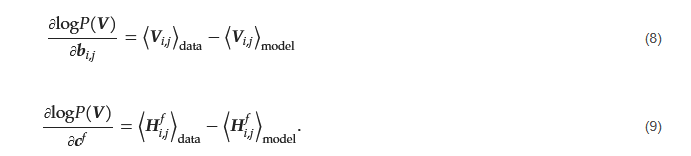
where ⟨⋅⟩data and ⟨⋅⟩model represent expectations under the data distribution and the model distribution, respectively. Similarly, the updates for visible and hidden biases are computed using Equations (8) and (9):
|
|
(8) |
|
|
(9) |
To further enhance efficiency, the feature maps generated by the Conv-RBM layer are processed using a pooling layer, such as max-pooling, to downsample the spatial dimensions. This step reduces computational complexity while preserving the most salient features, ensuring that critical information is retained for downstream tasks. Overall, the 2D Conv-RBM effectively captures localized spatial features such as edges and textures, making it highly suitable for action recognition tasks where preserving spatial coherence is essential. This approach is informed by foundational work on energy-based models and convolutional adaptations of RBMs, including studies by [34,35,45,46].
3.3. Long Short-Term Memory (LSTM) for Temporal Modeling
t
t
−1
t
−1 should be retained. The forget gate is computed as Equation (10):
|
|
(10) |
where W

f
Next, the input gate decides how much new information should be written to the memory cell. The input gate is computed as
|
|
(11) |

and the candidate cell state 𝑪̃𝑡, which represents new information to be added, is calculated as
|
|
(12) |

The cell state Ct is then updated by combining the retained information from the previous cell state (modulated by the forget gate) with the newly computed candidate cell state (modulated by the input gate):
|
|
(13) |

The output gate determines the information to be propagated to the hidden state ht, which is used for the next time step or for making predictions. The output gate is calculated as
|
|
(14) |

and the hidden state is then updated using the current cell state and the output gate:
|
|
(15) |
In these equations, W

i
WC
Wo
i
C
o
3.4. Feature Classification Using Fully Connected Network
c
c. The result of this linear transformation is then fed into a softmax activation function, which outputs a probability distribution over the possible action classes. The classification process is mathematically defined as follows:
|
|
(16) |

where y represents the predicted probability distribution over all action classes. The network is trained to minimize the cross-entropy loss, which measures the difference between the predicted probability distribution and the true labels. The cross-entropy loss function is given by
|
|
(17) |
where y

i
i
3.5. Proposed Architecture Specifications
Table 1. Specifications of the proposed architecture, detailing the parameter configurations for each stage of the pipeline, including 2D Conv-RBM and LSTM layers, optimization settings, and training configurations.
|
Parameter |
Value/Description |
Reference |
|
K (smart frame selection) |
32 frames |
based on [38] |
|
Frame dimensions |
64 × 64 (grayscale, black-and-white) |
Common practice in video action recognition models |
|
Visible layer size (Conv-RBM) |
64 × 64 (corresponding to the frame dimensions) |
Based on RBM architecture for spatial extraction |
|
Hidden layer size (Conv-RBM) |
64 × 32 × 32 (after pooling) |
Reduced spatial dimensions with 64 feature maps |
|
Convolutional filter size (Conv-RBM) |
3 × 3 (with stride 1) |
Standard in CNNs, balances spatial locality and depth |
|
Pooling layer (Conv-RBM) |
2 × 2 (max pooling) |
Reduces feature map dimensions by half |
|
LSTM units |
256 units |
Suitable for temporal modeling of moderate complexity |
|
Number of LSTM layers |
2 layers |
Allows capturing both short- and long-term dependencies |
|
Optimizer |
Adam optimizer (learning rate: 0.001) |
Adaptive learning rate method for efficient convergence |
|
Loss function |
Cross-entropy loss |
Commonly used in classification tasks |
|
Regularization (dropout) |
Dropout rate: 0.4 (LSTM layer and FC layer) |
Prevents overfitting by dropping 40% of neurons |
|
Learning rate |
0.001 |
Default for Adam, tuned for stability |
|
Batch size |
32 |
Balances between computational load and convergence |
|
Epochs |
100 |
References
- References1. Mihanpour, A.; Rashti, M.J.; Alavi, S.E. Human Action Recognition in Video Using DB-LSTM and ResNet. In Proceedings of the 2020 IEEE International Conference on Wireless Research (ICWR), Tehran, Iran, 22 April 2020. https://doi.org/10.1109/ICWR49608.2020.9122304.2. Ma, M.; Marturi, N.; Li, Y.; Leonardis, A.; Stolkin, R. Region-Sequence Based Six-Stream CNN Features for General and Fi-ne-Grained Human Action Recognition in Videos. Pattern Recognit. 2018, 76, 545–558. https://doi.org/10.1016/j.patcog.2017.11.026.3. Dai, C.; Liu, X.; Zhong, L.; Yu, T. Video-Based Action Recognition Using Spatial and Temporal Features. In Proceedings of the 2018 IEEE Cybermatics Congress, Halifax, NS, Canada, 30 July 2018. https://doi.org/10.1109/Cybermatics_2018.2018.00129.4. Johnson, D.R.; Uthariaraj, V.R. A Novel Parameter Initialization Technique Using RBM-NN for Human Action Recognition. Comput. Intell. Neurosci. 2020, 1, 30. https://doi.org/10.1155/2020/8852404.5. Cob-Parro, A.C.; Losada-Gutiérrez, C.; Marrón Romera, M.; Gardel Vicente, A.; Muñoz, I.B. A New Framework for Deep Learning Video-Based Human Action Recognition on the Edge. Expert Syst. Appl. 2023, 238, 122220. https://doi.org/10.1016/j.eswa.2023.122220.6. Silva, D.; Manzo-Martinez, A.; Gaxiola, F.; Gonzales-Gurrola, L.C.; Alonso, G.R. Analysis of CNN Architectures for Human Action Recognition in Video. Comput. Sist. 2022, 26, 67–80. https://doi.org/10.13053/cys-26-2-4245.7. Manakitsa, N.; Maraslidis, G.S.; Moysis, L.; Fragulis, G.F. A Review of Machine Learning and Deep Learning for Object Detec-tion, Semantic Segmentation, and Human Action Recognition in Machine and Robotic Vision. Technologies 2024, 12, 15. https://doi.org/10.3390/technologies12020015.8. Soentanto, P.N.; Hendryli, J.; Herwindiati, D. Object and Human Action Recognition from Video Using Deep Learning Models. In Proceedings of the 6th International Conference on Signal and Image Processing Systems (ICSIGSYS), Bandung, Indonesia, 16 July 2019; pp. 88–93. https://doi.org/10.1109/ICSIGSYS.2019.8811081.9. Begampure, S.; Jadhav, P.M. Intelligent Video Analytics for Human Action Detection: A Deep Learning Approach with Trans-fer Learning. Int. J. Comput. Dig. Syst. 2022, 11, 57–72. https://doi.org/10.12785/ijcds/110105.10. Li, C.; Huang, Q.; Li, X.; Wu, Q. Human Action Recognition Based on Multi-Scale Feature Maps from Depth Video Sequences. Multimed. Tools Appl. 2021, 80, 32111–32130. https://doi.org/10.1007/s11042-021-11193-4.11. Liu, X.; Yang, X. Multi-Stream with Deep Convolutional Neural Networks for Human Action Recognition in Videos. In Pro-ceedings of the Neural Information Processing: 25th International Conference, ICONIP 2018, Siem Reap, Cambodia, 13 De-cember 2018; Proceedings, Part I 25 (pp. 251–262); Springer International Publishing. https://doi.org/10.1007/978-3-030-04167-0_23.12. Ulhaq, A.; Akhtar, N.; Pogrebna, G.; Mian, A. Vision Transformers for Action Recognition: A Survey. arXiv 2022, arXiv:2209.05700.13. Dosovitskiy, A. An Image Is Worth 16×16 Words: Transformers for Image Recognition at Scale. arXiv 2020, arXiv:2010.11929.14. Arnab, A.; Dehghani, M.; Heigold, G.; Sun, C.; Lučić, M.; Schmid, C. ViViT: A Video Vision Transformer. In Proceedings of the IEEE/CVF International Conference on Computer Vision, Montreal, QC, Canada, 11 October 2021; pp. 6836–6846.15. Bertasius, G.; Wang, H.; Torresani, L. Is Space-Time Attention All You Need for Video Understanding? In Proceedings of the 38th International Conference on Machine Learning (ICML), Virtual, 18 July 2021; Volume 2, p. 4.16. Khan, S.; Naseer, M.; Hayat, M.; Zamir, S.W.; Khan, F.S.; Shah, M. Transformers in Vision: A Survey. ACM Comput. Surv. 2022, 54, 1–41.17. Schüldt, C.; Laptev, I.; Caputo, B. Recognizing Human Actions: A Local SVM Approach. In Proceedings of the 17th Internation-al Conference on Pattern Recognition (ICPR), Cambridge, UK, 23 August 2004; pp. 32–36. https://doi.org/10.1109/ICPR.2004.747.18. Rodriguez, M.D.; Ahmed, J.; Shah, M. Action mach a spatio-temporal maximum average correlation height filter for action recognition. In Proceedings of the 2008 IEEE Conference on Computer Vision and Pattern Recognition, Anchorage, AK, USA, 23 June 2008. 19. Kuehne, H.; Jhuang, H.; Garrote, E.; Poggio, T.; Serre, T. HMDB: A Large Video Database for Human Motion Recognition. In Proceedings of the 2011 International Conference on Computer Vision (ICCV), Barcelona, Spain, 6 November 2011. https://doi.org/10.1109/ICCV.2011.6126543.20. Raza, A.; Al Nasar, M.R.; Hanandeh, E.S.; Zitar, R.A.; Nasereddin, A.Y.; Abualigah, L. A Novel Methodology for Human Kin-ematics Motion Detection Based on Smartphones Sensor Data Using Artificial Intelligence. Technologies 2023, 11, 55. https://doi.org/10.3390/technologies11020055.21. Simonyan, K.; Zisserman, A. Two-Stream Convolutional Networks for Action Recognition in Videos. In Advances in Neural Information Processing Systems (NeurIPS); 2014; Volume 27, pp. 568–576.22. Zhu, J.; Zou, W.; Zhu, Z.; Xu, L.; Huang, G. Action Machine: Toward Person-Centric Action Recognition in Videos. IEEE Signal Process. Lett. 2019, 11, 1633–1637. https://doi.org/10.1109/LSP.2019.2942739.23. Carreira, J.; Zisserman, A. Quo Vadis, Action Recognition? A New Model and the Kinetics Dataset. In Proceedings of the IEEE Conference on Computer Vision and Pattern Recognition (CVPR), Honolulu, HI, USA, 21 July 2017. https://doi.org/10.1109/CVPR.2017.502.24. Kulkarni, S.S.; Jadhav, S. Insight on Human Activity Recognition Using the Deep Learning Approach. In Proceedings of the International Conference on Emerging Smart Computing and Informatics (ESCI), Pune, India, 1 March 2023. https://doi.org/10.1109/ESCI56872.2023.10099759.25. Yang, C.; Mei, F.; Zang, T.; Tu, J.; Jiang, N.; Liu, L. Human Action Recognition Using Key-Frame Attention-Based LSTM Net-works. Electronics 2023, 12, 2622. https://doi.org/10.3390/electronics12122622.26. Abdelbaky, A.; Aly, S. Two-Stream Spatiotemporal Feature Fusion for Human Action Recognition. Vis. Comput. 2021, 37, 1821–1835. https://doi.org/10.1007/s00371-020-01913-y.27. Liu, T.; Ma, Y.; Yang, W.; Ji, W.; Wang, R.; Jiang, P. Spatial-Temporal Interaction Learning Based Two-Stream Network for Action Recognition. Inf. Sci. 2022, 606, 864–876. https://doi.org/10.1016/j.ins.2021.12.065.28. Donahue, J.; Anne Hendricks, L.; Guadarrama, S.; Rohrbach, M.; Venugopalan, S.; Saenko, K.; Darrell, T. Long-Term Recurrent Convolutional Networks for Visual Recognition and Description. In Proceedings of the IEEE Conference on Computer Vision and Pattern Recognition (CVPR), Boston, MA, USA, 7 June 2015; pp. 2625–2634. https://doi.org/10.1109/CVPR.2015.7298878.29. Zheng, T.; Liu, C.; Liu, B.; Wang, M.; Li, Y.; Wang, P.; Qin, X.; Guo, Y. Scene Recognition Model in Underground Mines Based on CNN-LSTM and Spatial-Temporal Attention Mechanism. In Proceedings of the 2020 International Symposium on Computer, Consumer, and Control (IS3C), Taichung City, Taiwan, 13 November 2020; pp. 513–516. https://doi.org/10.1109/IS3C50286.2020.00139.30. Saoudi, E.M.; Jaafari, J.; Andaloussi, S.J. Advancing Human Action Recognition: A Hybrid Approach Using Attention-Based LSTM and 3D CNN. Sci. Afr. 2023, 21, e01796. https://doi.org/10.1016/j.sciaf.2023.e01796.31. Liu, D.; Yan, Y.; Shyu, M.; Zhao, G.; Chen, M. Spatio-Temporal Analysis for Human Action Detection and Recognition in Un-controlled Environments. Int. J. Multimed. Data Eng. Manag. (IJMDEM) 2015, 1, 1–18. https://doi.org/10.4018/ijmdem.2015010101.32. Su, Y. Implementation and Rehabilitation Application of Sports Medical Deep Learning Model Driven by Big Data. IEEE Ac-cess 2019, 7, 156338–156348. https://doi.org/10.1109/ACCESS.2019.2949643.33. Hossen, M.A.; Naim, A.G.; Abbas, P.E. Deep Learning for Skeleton-Based Human Activity Segmentation: An Autoencoder Ap-proach. Technologies 2024, 12, 96. https://doi.org/10.3390/technologies12070096.34. Lee, H.; Grosse, R.; Ranganath, R.; Ng, A.Y. Convolutional Deep Belief Networks for Scalable Unsupervised Learning of Hier-archical Representations. In Proceedings of the 26th Annual International Conference on Machine Learning, Montreal, QC, Canada, 14 June 2009; pp. 609–616.35. Osadchy, M.; Miller, M.; Cun, Y. Synergistic Face Detection and Pose Estimation with Energy-Based Models. In Advances in Neural Information Processing Systems 17; MIT Press: Cambridge, MA, USA, 2005.36. LeCun, Y.; Bengio, Y.; Hinton, G. Deep Learning. Nature 2015, 521, 436–444. https://doi.org/10.1038/nature14539.37. Salakhutdinov, R.; Hinton, G. Deep Boltzmann Machines. In Proceedings of the 12th International Conference on Artificial In-telligence and Statistics (AISTATS), Clearwater Beach, FL, USA, 16 April 2009; pp. 448–455.38. Gowda, S.N.; Rohrbach, M.; Sevilla-Lara, L. Smart Frame Selection for Action Recognition. In Proceedings of the AAAI Con-ference on Artificial Intelligence, Virtual, 2 February 2021; Volume 35, pp. 1451–1459. https://doi.org/10.1609/aaai.v35i2.16235.39. Zhang, X.; Liu, T.; Lo, K.; Feng, J. Dynamic Selection and Effective Compression of Key Frames for Video Abstraction. Pattern Recognit. Lett. 2003, 24, 1523–1532. https://doi.org/10.1016/S0167-8655(02)00391-4.40. Hasebe, S.; Nagumo, M.; Muramatsu, S.; Kikuchi, H. Video Key Frame Selection by Clustering Wavelet Coefficients. In Pro-ceedings of the 12th European Signal Processing Conference (EUSIPCO), Vienna, Austria, 6 September 2004. https://doi.org/10.5281/ZENODO.38540.41. Xu, Q.; Wang, P.; Long, B.; Sbert, M.; Feixas, M.; Scopigno, R. Selection and 3D Visualization of Video Key Frames. In Proceed-ings of the IEEE International Conference on Systems, Man, and Cybernetics (ICSMC), Istanbul, Turkey, 10 October 2010. https://doi.org/10.1109/ICSMC.2010.5642204.42. Kulbacki, M.; Segen, J.; Chaczko, Z.; Rozenblit, J.; Klempous, R.; Wojciechowski, K. Intelligent Video Analytics for Human Ac-tion Recognition: The State of Knowledge. Sensors 2023, 9, 4258 https://doi.org/10.3390/s23094258.43. Feichtenhofer, C.; Pinz, A.; Wildes, R.P.; Zisserman, A. Deep Insights into Convolutional Networks for Video Recognition. Int. J. Comput. Vis. 2020, 128, 420–437. https://doi.org/10.1007/s11263-019-01244-w.44. Tsai, J.K.; Hsu, C.; Wang, W.Y.; Huang, S.K. Deep Learning-Based Real-Time Multiple-Person Action Recognition System. Sen-sors 2020, 17, 4857. https://doi.org/10.3390/s20174758.45. Fischer, A.; Igel, C. An Introduction to Restricted Boltzmann Machines. In Progress in Pattern Recognition, Image Analysis, Computer Vision, and Applications, 17th Iberoamerican Congress, CIARP, Buenos Aires, Argentina, 2012; Springer: Ber-lin/Heidelberg, Germany, 2012; pp. 14–36. https://doi.org/10.1007/978-3-642-33275-3_2.46. Srivastava, N.; Salakhutdinov, R. Multimodal Learning with Deep Boltzmann Machines. J. Mach. Learn. Res. 2012, 15, 2949–2980. https://doi.org/10.5555/2627435.2697059.47. Taylor, G.W.; Fergus, R.; LeCun, Y.; Bregler, C. Convolutional Learning of Spatio-Temporal Features. In Proceedings of the 11th European Conference on Computer Vision, Heraklion, Greece, 5 September 2010. https://doi.org/10.1007/978-3-642-15567-3_11.48. Laptev, I.; Marszałek, M.; Schmid, C.; Rozenfeld, B. Learning Realistic Human Actions from Movies. In Proceedings of the IEEE Conference on Computer Vision and Pattern Recognition (CVPR), Anchorage, AK, USA, 23 June 2008. https://doi.org/10.1109/CVPR.2008.4587580.49. Nazir, S.; Yousaf, M.H.; Velastin, S.A. Evaluating a Bag-of-Visual Features Approach Using Spatio-Temporal Features for Action Recognition. Comput. Electr. Eng. 2018, 72, 660–669. https://doi.org/10.1016/j.compeleceng.2018.01.028.50. Niebles, J.C.; Wang, H.; Fei-Fei, L. Unsupervised Learning of Human Action Categories Using Spatial-Temporal Words. Int. J. Comput. Vis. 2008, 79, 299–318. https://doi.org/10.1007/s11263-007-0122-4.51. Jhuang, H.; Serre, T.; Wolf, L.; Poggio, T. A Biologically Inspired System for Action Recognition. In Proceedings of the IEEE 11th International Conference on Computer Vision (ICCV), Rio De Janeiro, Brazil, 14 October 2007. https://doi.org/10.1109/ICCV.2007.4408903.52. Le, Q.V.; Zou, W.Y.; Yeung, S.Y.; Ng, A.Y. Learning Hierarchical Invariant Spatio-Temporal Features for Action Recognition with Independent Subspace Analysis. In Proceedings of the IEEE Conference on Computer Vision and Pattern Recognition (CVPR), Colorado, CO, USA, 20 June 2011. https://doi.org/10.1109/CVPR.2011.5995513.53. Ji, S.; Xu, W.; Yang, M.; Yu, K. 3D Convolutional Neural Networks for Human Action Recognition. IEEE Trans. Pattern Anal. Mach. Intell. 2013, 35, 221–231. https://doi.org/10.1109/TPAMI.2012.59.54. Sun, L.; Jia, K.; Chan, T.H.; Fang, Y.; Wang, G.; Yan, S. DL-SFA: Deeply-Learned Slow Feature Analysis for Action Recognition. In Proceedings of the IEEE Conference on Computer Vision and Pattern Recognition (CVPR), Columbus, OH, USA, 23 June 2014. https://doi.org/10.1109/CVPR.2014.336.55. Zhang, K.; Zhang, L. Extracting Hierarchical Spatial and Temporal Features for Human Action Recognition. Multimed. Tools Appl. 2018, 77, 16053–16068. https://doi.org/10.1007/s11042-017-4944-4.56. Han, Y.; Zhang, P.; Zhuo, T.; Huang, W.; Zhang, Y. Going Deeper with Two-Stream ConvNets for Action Recognition in Video Surveillance. Pattern Recognit. Lett. 2018, 107, 83–90. https://doi.org/10.1016/j.patrec.2017.07.004.57. Chou, K.P.; Prasad, M.; Wu, D.; Sharma, N.; Li, D.L.; Lin, Y.F.; Blumenstein, M.; Lin, W.C.; Lin, C.T. Robust Feature-Based Auto-mated Multi-View Human Action Recognition System. IEEE Access 2018, 6, 15283–15296. https://doi.org/10.1109/ACCESS.2018.2805354.58. Liu, L.; Shao, L.; Zhen, X.; Li, X. Learning Discriminative Key Poses for Action Recognition. IEEE Trans. Cybern. 2013, 43, 1860–1870. https://doi.org/10.1109/TCYB.2013.2263374.59. Rodriguez, M.; Orrite, C.; Medrano, C.; Makris, D. One-Shot Learning of Human Activity with an MAP Adapted GMM and Simplex-HMM. IEEE Trans. Cybern. 2016, 47, 1769–1780. https://doi.org/10.1109/TCYB.2016.2555901.60. Shi, Y.; Tian, Y.; Wang, Y.; Huang, T. Sequential Deep Trajectory Descriptor for Action Recognition with Three-Stream CNN. IEEE Trans. Multimed. 2017, 19, 1510–1520. https://doi.org/10.1109/TMM.2017.2702071.61. Klaser, A.; Marszałek, M.; Schmid, C. A Spatio-Temporal Descriptor Based on 3D-Gradients. In Proceedings of the 19th Brit-ish Machine Vision Conference (BMVC), Leeds, UK, 7 September 2009;62. Rahmani, H.; Mian, A.; Shah, M. Learning a Deep Model for Human Action Recognition from Novel Viewpoints. IEEE Trans. Pattern Anal. Mach. Intell. 2017, 40, 667–681. https://doi.org/10.1109/TPAMI.2017.2657460.63. Yuan, C.; Li, X.; Hu, W.; Ling, H.; Maybank, S. 3D R-Transform on Spatio-Temporal Interest Points for Action Recognition. In Proceedings of the IEEE Conference on Computer Vision and Pattern Recognition (CVPR), Portland, OR, USA, 25 June 2013; pp. 724–730. https://doi.org/10.1109/CVPR.2013.101.64. Wang, L.; Xu, Y.; Cheng, J.; Xia, H.; Yin, J.; Wu, J. Human Action Recognition by Learning Spatio-Temporal Features with Deep Neural Networks. IEEE Access 2018, 6, 17913–17922. https://doi.org/10.1109/ACCESS.2018.2820079.65. Ahmed, A.; Aly, S. Human Action Recognition Using Short-Time Motion Energy Template Images and PCANet Features. Neural Comput. Appl. 2020, 16, 12561–12574. https://doi.org/10.1007/s00521-020-05189-8.66. Girdhar, R.; Deva, R. Attentional Pooling for Action Recognition. In Advances in Neural Information Processing Systems (Neu-rIPS); 2017; 30. 67. Meng, L.; Zhao, B.; Chang, B.; Huang, G.; Sun, W.; Tung, F.; Sigal, L. Interpretable Spatio-Temporal Attention for Video Action Recognition. In Proceedings of the IEEE International Conference on Computer Vision Workshops (ICCV), Seoul, Republic of Korea, 27 October 2019. https://doi.org/10.1109/ICCVW.2019.00368.68. Du, T.; Bourdev, L.; Fergus, R. Learning Spatiotemporal Features with 3D Convolutional Networks. In Proceedings of the IEEE International Conference on Computer Vision (ICCV), Santiago, Chile, 7 December 2015. https://doi.org/10.1109/ICCV.2015.510.69. Qiu, Z.; Yao, T.; Mei, T. Learning Spatio-Temporal Representation with Pseudo-3D Residual Networks. In Proceedings of the IEEE International Conference on Computer Vision (ICCV), Venice, Italy, 22 October 2017. https://doi.org/10.1109/ICCV.2017.588.70. Wang, L.; Qiao, Y.; Tang, X. Action Recognition with Trajectory-Pooled Deep-Convolutional Descriptors. In Proceedings of the IEEE Conference on Computer Vision and Pattern Recognition (CVPR), Boston, MA, USA, 7 June 2015. https://doi.org/10.1109/CVPR.2015.7299050.71. Feichtenhofer, C.; Pinz, A.; Zisserman, A. Convolutional Two-Stream Network Fusion for Video Action Recognition. In Pro-ceedings of the IEEE Conference on Computer Vision and Pattern Recognition (CVPR), Las Vegas, NV, USA, 27 June 2016. https://doi.org/10.1109/CVPR.2016.213.72. Wang, L.; Yuan, X.; Zhe, W.; Qiao, Y.; Lin, D.; Tang, X.; Van Gool, L. Temporal Segment Networks: Towards Good Practices for Deep Action Recognition. In Proceedings of the European Conference on Computer Vision (ECCV), Amsterdam, The Nether-lands, 11 October 2016. https://doi.org/10.1007/978-3-319-46484-8_2.73. Yudistira, N.; Kurita, T. Correlation Net: Spatiotemporal Multimodal Deep Learning for Action Recognition. Signal Process. Image Commun. 2020, 82, 115731. https://doi.org/10.1016/j.image.2019.115731.74. Zong, M.; Wang, R.; Chen, X. Motion Saliency Based Multi-Stream Multiplier ResNets for Action Recognition. Image Vis. Comput. 2021, 107, 104108. https://doi.org/10.1016/j.imavis.2020.104108.75. Soomro, K.; Zamir, A.R.; Shah, M. UCF101: A Dataset of 101 Human Actions Classes from Videos in the Wild. arXiv 2012, arXiv:1212.0402.76. Liu, S.; Ma, X. Attention-Driven Appearance-Motion Fusion Network for Action Recognition. IEEE Trans. Multimed. 2022, 25, 2573–2584. https://doi.org/10.1109/TMM.2022.3148588.77. Du, W.; Wang, Y.; Qiao, Y. Recurrent Spatial-Temporal Attention Network for Action Recognition in Videos. IEEE Trans. Image Process. 2018, 27, 1347–1360. https://doi.org/10.1109/TIP.2017.2779836.78. Chen, S.; Ge, C.; Tong, Z.; Wang, J.; Song, Y.; Wang, J.; Luo, P. AdaptFormer: Adapting Vision Transformers for Scalable Visual Recognition. In Advances in Neural Information Processing Systems (NeurIPS); 2022; Volume 35, pp. 16664–16678.79. Ranasinghe, K.; Naseer, M.; Khan, S.; Khan, F.S.; Ryoo, M.S. Self-Supervised Video Transformer. In Proceedings of the IEEE/CVF Conference on Computer Vision and Pattern Recognition (CVPR), New Orleans, LA, USA, 18 June 2022. https://doi.org/10.1109/CVPR52688.2022.00369.80. Xing, Z.; Dai, Q.; Hu, H.; Chen, J.; Wu, Z.; Jiang, Y.G. SvFormer: Semi-Supervised Video Transformer for Action Recognition. In Proceedings of the IEEE/CVF Conference on Computer Vision and Pattern Recognition (CVPR), Vancouver, British Columbia, Canada, 18 June 2023; pp. 18816–18826.81. Khowaja, S.A.; Lee, S.L. Semantic Image Networks for Human Action Recognition. Int. J. Comput. Vis. 2020, 128, 393–419. https://doi.org/10.1007/s11263-019-01241-z.82. Cong, G.; Domeniconi, G.; Yang, C.C.; Shapiro, J.; Zhou, F.; Chen, B. Fast Neural Network Training on a Cluster of GPUs for Action Recognition with High Accuracy. J. Parallel Distrib. Comput. 2019, 134, 153–165. https://doi.org/10.1016/j.jpdc.2019.05.009.83. Kalfaoglu, M.E.; Kalkan, S.; Alatan, A.A. Late Temporal Modeling in 3D CNN Architectures with BERT for Action Recogni-tion. In Proceedings of the Computer Vision–ECCV 2020 Workshops; Springer International Publishing. Glasgow, UK, 23 Au-gust 2020; pp. 731–747. https://doi.org/10.1007/978-3-030-68821-9_43.84. Wang, L.; Huang, B.; Zhao, Z.; Tong, Z.; He, Y.; Wang, Y.; Wang, Y.; Qia, Y. Videomae v2: Scaling video masked autoencoders with dual masking. In Proceedings of the IEEE/CVF Conference on Computer Vision and Pattern Recognition, Vancouver, Brit-ish Columbia, Canada, 18 June 2023; pp. 14549–14560.85. Hochreiter, S.; Schmidhuber, J. Long Short-Term Memory. Neural Comput. 1997, 9, 1735–1780.Mihanpour, A.; Rashti, M.J.; Alavi, S.E. Human Action Recognition in Video Using DB-LSTM and ResNet. In Proceedings of the 2020 IEEE International Conference on Wireless Research (ICWR), Tehran, Iran, 22 April 2020.
- Ma, M.; Marturi, N.; Li, Y.; Leonardis, A.; Stolkin, R. Region-Sequence Based Six-Stream CNN Features for General and Fine-Grained Human Action Recognition in Videos. Pattern Recognit. 2018, 76, 545–558.
- Dai, C.; Liu, X.; Zhong, L.; Yu, T. Video-Based Action Recognition Using Spatial and Temporal Features. In Proceedings of the 2018 IEEE Cybermatics Congress, Halifax, NS, Canada, 30 July 2018.
- Johnson, D.R.; Uthariaraj, V.R. A Novel Parameter Initialization Technique Using RBM-NN for Human Action Recognition. Comput. Intell. Neurosci. 2020, 1, 30.
- Cob-Parro, A.C.; Losada-Gutiérrez, C.; Marrón Romera, M.; Gardel Vicente, A.; Muñoz, I.B. A New Framework for Deep Learning Video-Based Human Action Recognition on the Edge. Expert Syst. Appl. 2023, 238, 122220.
- Silva, D.; Manzo-Martinez, A.; Gaxiola, F.; Gonzales-Gurrola, L.C.; Alonso, G.R. Analysis of CNN Architectures for Human Action Recognition in Video. Comput. Sist. 2022, 26, 67–80.
- Manakitsa, N.; Maraslidis, G.S.; Moysis, L.; Fragulis, G.F. A Review of Machine Learning and Deep Learning for Object Detection, Semantic Segmentation, and Human Action Recognition in Machine and Robotic Vision. Technologies 2024, 12, 15.
- Soentanto, P.N.; Hendryli, J.; Herwindiati, D. Object and Human Action Recognition from Video Using Deep Learning Models. In Proceedings of the 6th International Conference on Signal and Image Processing Systems (ICSIGSYS), Bandung, Indonesia, 16 July 2019; pp. 88–93.
- Begampure, S.; Jadhav, P.M. Intelligent Video Analytics for Human Action Detection: A Deep Learning Approach with Transfer Learning. Int. J. Comput. Dig. Syst. 2022, 11, 57–72.
- Li, C.; Huang, Q.; Li, X.; Wu, Q. Human Action Recognition Based on Multi-Scale Feature Maps from Depth Video Sequences. Multimed. Tools Appl. 2021, 80, 32111–32130.
- Liu, X.; Yang, X. Multi-Stream with Deep Convolutional Neural Networks for Human Action Recognition in Videos. In Neural Information Processing, Proceedings of the 25th International Conference, ICONIP 2018, Siem Reap, Cambodia, 13 December 2018; Proceedings, Part I 25; Springer International Publishing: Cham, Switzerland, 2018; pp. 251–262.
- Ulhaq, A.; Akhtar, N.; Pogrebna, G.; Mian, A. Vision Transformers for Action Recognition: A Survey. arXiv 2022, arXiv:2209.05700.
- Arnab, A.; Dehghani, M.; Heigold, G.; Sun, C.; Lučić, M.; Schmid, C. ViViT: A Video Vision Transformer. In Proceedings of the IEEE/CVF International Conference on Computer Vision, Montreal, QC, Canada, 11 October 2021; pp. 6836–6846.
- Bertasius, G.; Wang, H.; Torresani, L. Is Space-Time Attention All You Need for Video Understanding? In Proceedings of the 38th International Conference on Machine Learning (ICML), Virtual, 18 July 2021; Volume 2, p. 4.
- Khan, S.; Naseer, M.; Hayat, M.; Zamir, S.W.; Khan, F.S.; Shah, M. Transformers in Vision: A Survey. ACM Comput. Surv. 2022, 54, 1–41.
- Khan, S.; Naseer, M.; Hayat, M.; Zamir, S.W.; Khan, F.S.; Shah, M. Transformers in Vision: A Survey. ACM Comput. Surv. 2022, 54, 1–41.
- Schüldt, C.; Laptev, I.; Caputo, B. Recognizing Human Actions: A Local SVM Approach. In Proceedings of the 17th International Conference on Pattern Recognition (ICPR), Cambridge, UK, 23 August 2004; pp. 32–36.
- Rodriguez, M.D.; Ahmed, J.; Shah, M. Action mach a spatio-temporal maximum average correlation height filter for action recognition. In Proceedings of the 2008 IEEE Conference on Computer Vision and Pattern Recognition, Anchorage, AK, USA, 23 June 2008.
- Kuehne, H.; Jhuang, H.; Garrote, E.; Poggio, T.; Serre, T. HMDB: A Large Video Database for Human Motion Recognition. In Proceedings of the 2011 International Conference on Computer Vision (ICCV), Barcelona, Spain, 6 November 2011.
- Raza, A.; Al Nasar, M.R.; Hanandeh, E.S.; Zitar, R.A.; Nasereddin, A.Y.; Abualigah, L. A Novel Methodology for Human Kinematics Motion Detection Based on Smartphones Sensor Data Using Artificial Intelligence. Technologies 2023, 11, 55.
- Simonyan, K.; Zisserman, A. Two-Stream Convolutional Networks for Action Recognition in Videos. In Advances in Neural Information Processing Systems (NeurIPS); Curran Associates, Inc.: Newry, UK, 2014; Volume 27, pp. 568–576.
- Zhu, J.; Zou, W.; Zhu, Z.; Xu, L.; Huang, G. Action Machine: Toward Person-Centric Action Recognition in Videos. IEEE Signal Process. Lett. 2019, 11, 1633–1637.
- Carreira, J.; Zisserman, A. Quo Vadis, Action Recognition? A New Model and the Kinetics Dataset. In Proceedings of the IEEE Conference on Computer Vision and Pattern Recognition (CVPR), Honolulu, HI, USA, 21 July 2017.
- Kulkarni, S.S.; Jadhav, S. Insight on Human Activity Recognition Using the Deep Learning Approach. In Proceedings of the International Conference on Emerging Smart Computing and Informatics (ESCI), Pune, India, 1 March 2023.
- Yang, C.; Mei, F.; Zang, T.; Tu, J.; Jiang, N.; Liu, L. Human Action Recognition Using Key-Frame Attention-Based LSTM Networks. Electronics 2023, 12, 2622.
- Abdelbaky, A.; Aly, S. Two-Stream Spatiotemporal Feature Fusion for Human Action Recognition. Vis. Comput. 2021, 37, 1821–1835.
- Liu, T.; Ma, Y.; Yang, W.; Ji, W.; Wang, R.; Jiang, P. Spatial-Temporal Interaction Learning Based Two-Stream Network for Action Recognition. Inf. Sci. 2022, 606, 864–876.
- Donahue, J.; Anne Hendricks, L.; Guadarrama, S.; Rohrbach, M.; Venugopalan, S.; Saenko, K.; Darrell, T. Long-Term Recurrent Convolutional Networks for Visual Recognition and Description. In Proceedings of the IEEE Conference on Computer Vision and Pattern Recognition (CVPR), Boston, MA, USA, 7 June 2015; pp. 2625–2634.
- Zheng, T.; Liu, C.; Liu, B.; Wang, M.; Li, Y.; Wang, P.; Qin, X.; Guo, Y. Scene Recognition Model in Underground Mines Based on CNN-LSTM and Spatial-Temporal Attention Mechanism. In Proceedings of the 2020 International Symposium on Computer, Consumer, and Control (IS3C), Taichung City, Taiwan, 13 November 2020; pp. 513–516.
- Saoudi, E.M.; Jaafari, J.; Andaloussi, S.J. Advancing Human Action Recognition: A Hybrid Approach Using Attention-Based LSTM and 3D CNN. Sci. Afr. 2023, 21, e01796.
- Liu, D.; Yan, Y.; Shyu, M.; Zhao, G.; Chen, M. Spatio-Temporal Analysis for Human Action Detection and Recognition in Uncontrolled Environments. Int. J. Multimed. Data Eng. Manag. (IJMDEM) 2015, 1, 1–18.
- Su, Y. Implementation and Rehabilitation Application of Sports Medical Deep Learning Model Driven by Big Data. IEEE Access 2019, 7, 156338–156348.
- Hossen, M.A.; Naim, A.G.; Abbas, P.E. Deep Learning for Skeleton-Based Human Activity Segmentation: An Autoencoder Approach. Technologies 2024, 12, 96.
- Lee, H.; Grosse, R.; Ranganath, R.; Ng, A.Y. Convolutional Deep Belief Networks for Scalable Unsupervised Learning of Hierarchical Representations. In Proceedings of the 26th Annual International Conference on Machine Learning, Montreal, QC, Canada, 14 June 2009; pp. 609–616.
- Osadchy, M.; Miller, M.; Cun, Y. Synergistic Face Detection and Pose Estimation with Energy-Based Models. In Advances in Neural Information Processing Systems 17; MIT Press: Cambridge, MA, USA, 2005.
- LeCun, Y.; Bengio, Y.; Hinton, G. Deep Learning. Nature 2015, 521, 436–444.
- Salakhutdinov, R.; Hinton, G. Deep Boltzmann Machines. In Proceedings of the 12th International Conference on Artificial Intelligence and Statistics (AISTATS), Clearwater Beach, FL, USA, 16 April 2009; pp. 448–455.
- Gowda, S.N.; Rohrbach, M.; Sevilla-Lara, L. Smart Frame Selection for Action Recognition. In Proceedings of the AAAI Conference on Artificial Intelligence, Virtual, 2 February 2021; Volume 35, pp. 1451–1459.
- Zhang, X.; Liu, T.; Lo, K.; Feng, J. Dynamic Selection and Effective Compression of Key Frames for Video Abstraction. Pattern Recognit. Lett. 2003, 24, 1523–1532.
- Hasebe, S.; Nagumo, M.; Muramatsu, S.; Kikuchi, H. Video Key Frame Selection by Clustering Wavelet Coefficients. In Proceedings of the 12th European Signal Processing Conference (EUSIPCO), Vienna, Austria, 6 September 2004.
- Xu, Q.; Wang, P.; Long, B.; Sbert, M.; Feixas, M.; Scopigno, R. Selection and 3D Visualization of Video Key Frames. In Proceedings of the IEEE International Conference on Systems, Man, and Cybernetics (ICSMC), Istanbul, Turkey, 10 October 2010.
- Kulbacki, M.; Segen, J.; Chaczko, Z.; Rozenblit, J.; Klempous, R.; Wojciechowski, K. Intelligent Video Analytics for Human Action Recognition: The State of Knowledge. Sensors 2023, 9, 4258.
- Feichtenhofer, C.; Pinz, A.; Wildes, R.P.; Zisserman, A. Deep Insights into Convolutional Networks for Video Recognition. Int. J. Comput. Vis. 2020, 128, 420–437.
- Tsai, J.K.; Hsu, C.; Wang, W.Y.; Huang, S.K. Deep Learning-Based Real-Time Multiple-Person Action Recognition System. Sensors 2020, 17, 4857.
- Fischer, A.; Igel, C. An Introduction to Restricted Boltzmann Machines. In Progress in Pattern Recognition, Image Analysis, Computer Vision, and Applications, Proceedings of the 17th Iberoamerican Congress, CIARP, Buenos Aires, Argentina, 3–6 September 2012; Springer: Berlin/Heidelberg, Germany, 2012; pp. 14–36.
- Srivastava, N.; Salakhutdinov, R. Multimodal Learning with Deep Boltzmann Machines. J. Mach. Learn. Res. 2012, 15, 2949–2980.