

This entry introduces five kinds of established internal surface finishing technologies.
- Internal surface finishing
- Additive manufacturing (AM)
- Surface integrity
- Abrasive flow machining (AFM)
- Fluid jet machining (FJM)
- Magnetic abrasive finishing (MAF)
- Fluidized bed machining (FBM)
The requirements of components with complex internal surfaces are increasing for gas and fluid flow applications in aerospace and automotive industries. Turbine spray nozzles, cooling channels and hydraulic manifolds are some of the examples which have complex internal surface with curved feature, narrow portion and fluctuating volume[1][2]. However, for certain applications in aerospace and automotive industries[3], the surface condition is not satisfactory especially fabricated by 3D additive manufacturing (AM) technology. Therefore, a post-polishing process is essential for these 3D AM complex internal surfaces to achieve high quality internal surface finish.
For internal surface finishing, in general, there are major five kinds of established finishing processes which are internal cylindrical grinding, abrasive flow machining (AFM), fluid jet machining (FJM), magnetic abrasive finishing (MAF) and fluidized bed machining (FBM).
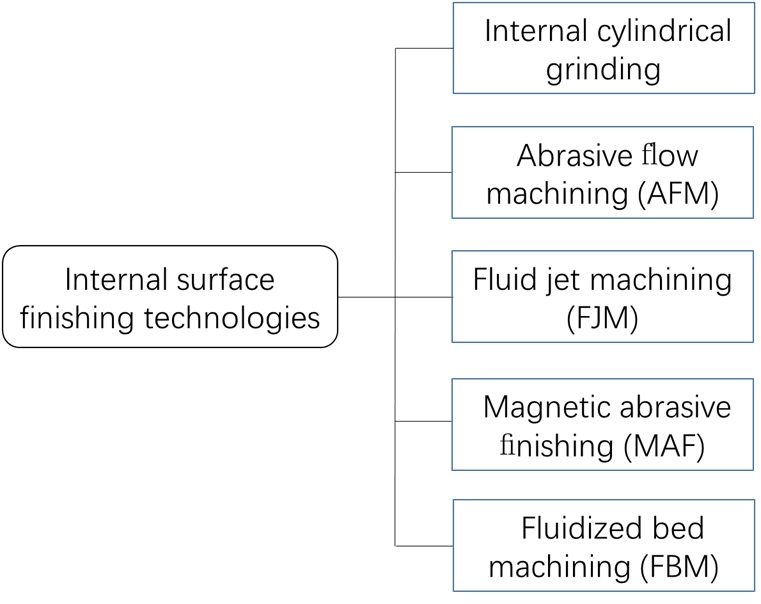
Internal cylindrical grinding, as a conventional technology, has been widely used in industry for many years, but it is limited to straight internal structures with relatively large diameters considering tool size and coolant supply. AFM is one of the most prominent process for finishing inaccessible surfaces with a wide range of materials. In AFM, the pressurized semi-solid-laden media with hard abrasive particles is forced to flow in a restricted area and abrade the target surface in repeated cycles. The finishing pressure depends on the fluid dynamics of the media. However, it is limited to some geometries such as blind holes. It is also difficult to achieve uniform material removal on channels with varied geometries or features. Furthermore, contamination issues arise from abrasive particles embedding onto the workpiece surface, and removed materials mixing into the abrasives[4]. FJM pumps abrasives towards target surfaces through an adjustable nozzle at certain pressures to remove materials, and it has been widely used in mold, ceramics and optics finishing. Kim et al. developed a magnetic abrasive jet machining system for precision internal polishing of circular tubes[5]. Cheung et al. presented a multi-jet polishing process for inner surfaces finishing through adopting a rod-shaped nozzle[6]. Compared with AFM, it has the unique advantages of high machining accuracy and flexibility, undergoes no contamination issues, but it is still limited to deep and bind holes with narrow gaps. MAF is a precision non-traditional finishing process that the finishing is controlled by magnetic field. In MAF, the media is pressed against the surface by magnetic force and is dragged along the surface for finishing. Magnetic abrasive particles acting on a workpiece are influenced by magnetic poles, thus forming a flexible magnetic abrasive brush. However, MAF’s biggest limitation is the restriction of the materials that can be processed.
FBM is a recently developed non-traditional finishing process utilizing fluidized bed hydrodynamics[7]. Fluidized bed is formed when a bed of solid abrasive particles is controlled under fluid flow and material is removed by the flow of an abrasive solid emulsion over the internal surface. Due to the fluid-like behavior, internal surfaces are achievable and can be finished. The limitation of FBM is the existence of debris remaining on the machined surfaces. The embedding of abrasive splinters onto the machined surfaces for soft and ductile workpieces such as aluminum and polyvinyl chloride (PVC) was indicated[1]. Furthermore, in FBM, the surface improvement on the internal surface is significantly less than the external surface[7]. For fluidized bed assisted abrasive jet machining (FB-AJM), it is further concluded that the integration of abrasive jet principles results in the incapability on bent internal surface finishing[8][9].
Compared with the other technologies, MAF does not require complex facilities, making it easier to be realized, and more reliable and applicable to industry. In the past years, some research work has been done to understand the MAF process behaviour and surface pattern generation[10][11]. Shinmura et al. [12] and Shinmura and Yamagushi [13] firstly presented a new finishing process and through modification demonstrated its feasibility on finishing of stainless steel tube and clean gas bomb. Kim and Choi [14] analysed magnetic pole arrangement and pole number variations. Kang and Yamaguchi [15] developed a multiple pole tip system to increase the finishing area, thus efficiency. Besides, Yoon et al.[16] proposed a few possible pole arrangements which vary from a conventional single north (N)-south (S) pole system. Additionally, Yamaguchi and Kang[17] explored and demonstrated MAF’s capability to finish the internal surfaces on the tubes of various sizes and materials. Guo et al.[18] presented a novel rotating-vibrating magnetic abrasive polishing method for double-layered internal surface finishing.
References
- Kai Liang Tan; Chin Hwee Ong; Swee-Hock Yeo; Nontraditional finishing processes for internal surfaces and passages: A review. Proceedings of the Institution of Mechanical Engineers, Part B: Journal of Engineering Manufacture 2016, 231, 2302-2316, 10.1177/0954405415626087.
- Fukuo Hashimoto; Hitomi Yamaguchi; Peter Krajnik; Konrad Wegener; Rahul Chaudhari; Hans-Werner Hoffmeister; Friedrich Kuster; Abrasive fine-finishing technology. CIRP Annals 2016, 65, 597-620, 10.1016/j.cirp.2016.06.003.
- Giovanni Strano; Liang Hao; Richard M. Everson; Kenneth E. Evans; Surface roughness analysis, modelling and prediction in selective laser melting. Journal of Materials Processing Technology 2013, 213, 589-597, 10.1016/j.jmatprotec.2012.11.011.
- Vijay K. Jain; P.M. Dixit; Rajendra K. Jain; Modeling of material removal and surface roughness in abrasive flow machining process. International Journal of Machine Tools and Manufacture 1999, 39, 1903-1923, 10.1016/s0890-6955(99)00038-3.
- Jeong-Du Kim; Youn-Hee Kang; Young-Han Bae; Su-Won Lee; Development of a magnetic abrasive jet machining system for precision internal polishing of circular tubes. Journal of Materials Processing Technology 1997, 71, 384-393, 10.1016/s0924-0136(97)00103-9.
- C.F. Cheung; C.J. Wang; Z.C. Cao; L.T. Ho; M.Y. Liu; Development of a multi-jet polishing process for inner surface finishing. Precision Engineering 2017, 52, 112-121, 10.1016/j.precisioneng.2017.11.018.
- Massimiliano Barletta; A new technology in surface finishing: Fluidized bed machining (FBM) of aluminium alloys. Journal of Materials Processing Technology 2006, 173, 157-165, 10.1016/j.jmatprotec.2005.11.020.
- Massimiliano Barletta; Stefano Guarino; Gianluca Rubino; Vincenzo Tagliaferri; Progress in fluidized bed assisted abrasive jet machining (FB-AJM): Internal polishing of aluminium tubes. International Journal of Machine Tools and Manufacture 2007, 47, 483-495, 10.1016/j.ijmachtools.2006.06.005.
- Massimiliano Barletta; Progress in abrasive fluidized bed machining. Journal of Materials Processing Technology 2009, 209, 6087-6102, 10.1016/j.jmatprotec.2009.04.009.
- Dhirendra K. Singh; V.K. Jain; V. Raghuram; R. Komanduri; Analysis of surface texture generated by a flexible magnetic abrasive brush. Wear 2005, 259, 1254-1261, 10.1016/j.wear.2005.02.030.
- V.K. Jain; Magnetic field assisted abrasive based micro-/nano-finishing. Journal of Materials Processing Technology 2009, 209, 6022-6038, 10.1016/j.jmatprotec.2009.08.015.
- Takeo Shinmura; Study on magnetic abrasive finishing process - On the cylindricity.. Journal of the Japan Society for Precision Engineering 1970, 53, 1064-1067, 10.2493/jjspe.53.1064.
- Takeo Shinmura; Hitomi Yamaguchi; Study on a New Internal Finishing Process by the Application of Magnetic Abrasive Machining : Internal Finishing of Stainless Steel Tube and Clean Gas Bomb. JSME international journal. Ser. C, Dynamics, control, robotics, design and manufacturing 1995, 38, 798-804, 10.1299/jsmec1993.38.798.
- Jeong-Du Kim; Min-Seog Choi; Development and finite element analysis of the finishing system using rotating magnetic field. International Journal of Machine Tools and Manufacture 1996, 36, 245-253, 10.1016/0890-6955(95)98764-x.
- Junmo Kang; Hitomi Yamaguchi; Internal finishing of capillary tubes by magnetic abrasive finishing using a multiple pole-tip system. Precision Engineering 2012, 36, 510-516, 10.1016/j.precisioneng.2012.01.006.
- Sung Yoon; Juei-Feng Tu; Jun Ho Lee; Gyun Eui Yang; Sang Don Mun; Effect of the magnetic pole arrangement on the surface roughness of STS 304 by magnetic abrasive machining. International Journal of Precision Engineering and Manufacturing 2014, 15, 1275-1281, 10.1007/s12541-014-0467-x.
- H. Yamaguchi; J. Kang; F. Hashimoto; Metastable austenitic stainless steel tool for magnetic abrasive finishing. CIRP Annals 2011, 60, 339-342, 10.1016/j.cirp.2011.03.119.
- Jiang Guo; Ka Hing Au; Chen-Nan Sun; Min Hao Goh; Chun Wai Kum; Kui Liu; Jun Wei; Hirofumi Suzuki; Renke Kang; Novel rotating-vibrating magnetic abrasive polishing method for double-layered internal surface finishing. Journal of Materials Processing Technology 2018, 264, 422–437, 10.1016/j.jmatprotec.2018.09.024.