There is an ever-growing demand for measuring respiratory variables during a variety of applications. Respiratory rate, also known as respiratory frequency (
fR), appears to be among the most promising and measured variables because it provides fundamental information. In view of its peculiar neurophysiological regulation,
fR is very sensitive to a variety of physiological, psychological and environmental stressors [
1,
2,
3], and is considered to be one of the most informative vital signs [
4,
5]. Conversely, tidal volume (the other determinant of minute ventilation) plays a major role in satisfying the metabolic requirements of the human body [
1,
2,
3]. This explains why
fR and tidal volume have been defined as the behavioral and metabolic components of minute ventilation, respectively [
1]. The differential control of
fR and tidal volume justifies the special attention devoted to
fR monitoring.
There are different methods for measuring
fR, which complicates the choice of the specific sensor or measurement technique to use. Several factors need to be considered when measuring
fR, including applications, measurement requirements, and user needs. This choice is even more difficult in view of the limited attempts made so far to classify and detail the numerous
fR measuring methods used [
6,
7,
8]. Therefore, we aim to provide an overview of the currently available methods for measuring
fR. Given the extent of the topic, this review focuses on the contact-based methods only, to guarantee that each method is described in sufficient detail to enable the reader to make an informed choice on the
fR method to use.
The review paper is structured in nine sections.
Section 1 provides a brief description of the importance of monitoring
fR in clinical settings, occupational settings, and during sporting activities and exercise. Besides,
Section 1 provides a taxonomy of the available techniques for measuring
fR, which are categorized according to the measurand. For each of the methods identified in the taxonomy, we have dedicated a separate Section (from
Section 2,
Section 3,
Section 4,
Section 5,
Section 6,
Section 7 and
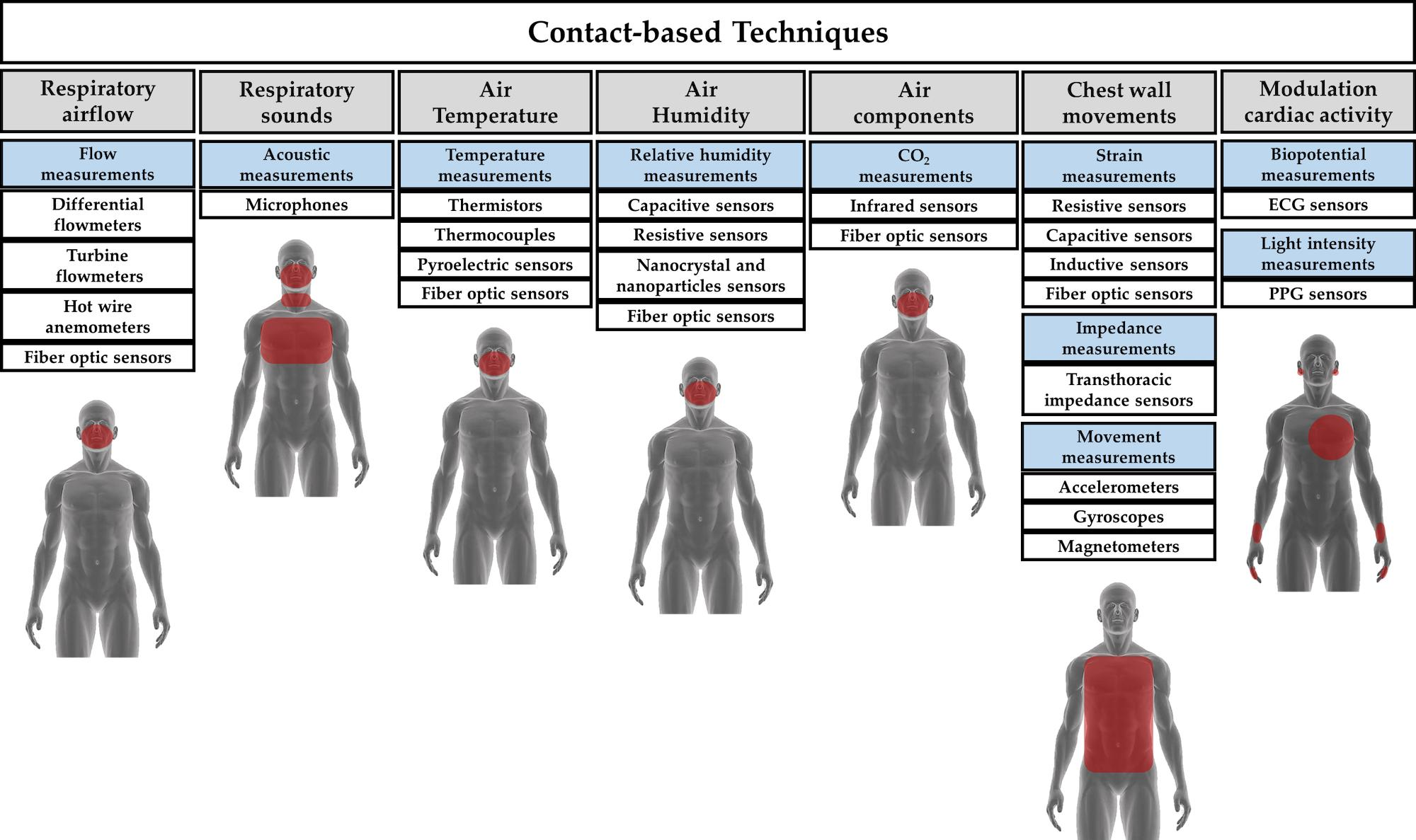
Section 8), which consists of a brief introduction of the measuring principle and a short overview of the most popular sensors that can be used to transduce the physical or chemical quantity into a signal to extract
fR. At the end of each section, a table summarizes metrological properties, sensor characteristics and possible applications, and a short summary describes the strengths and weaknesses of the different sensors. Specifically, we describe methods based on airflow (
Section 2), respiratory sounds (
Section 3), air temperature (
Section 4), air humidity (
Section 5), air components (
Section 6), respiratory-induced chest wall movements (
Section 7), and respiratory modulation of cardiac activity (
Section 8). The last section is dedicated to conclusions (
Section 9).
Here below the most popular contact-based techniques for measuring
fR and related areas of the body on which the sensors must be positioned. PPG = photoplethysmography; ECG = Electrocardiography. The following figure is from Massaroni, C., Nicolò, A., Lo Presti, D., Sacchetti, M., Silvestri, S., & Schena, E. (2019). Contact-based methods for measuring respiratory rate.
Sensors,
19(4), 908. (
https://www.mdpi.com/1424-8220/19/4/908/htm)