
Every year, thousands of people worldwide are bitten by ticks—but not all tick bites are harmless. One of the most well-known dangers is Lyme disease, a stealthy illness that can mimic other health conditions and, if left untreated, cause long-lasting complications.
1. What Is Lyme Disease?
Lyme disease is a bacterial infection caused by Borrelia burgdorferi, transmitted to humans through the bite of infected black-legged ticks (also known as deer ticks). It was first recognized in Lyme, Connecticut, in the 1970s, hence the name.
Though most common in the United States, Europe, and parts of Asia, Lyme disease has become an increasing public health concern due to rising tick populations linked to climate change and habitat expansion.
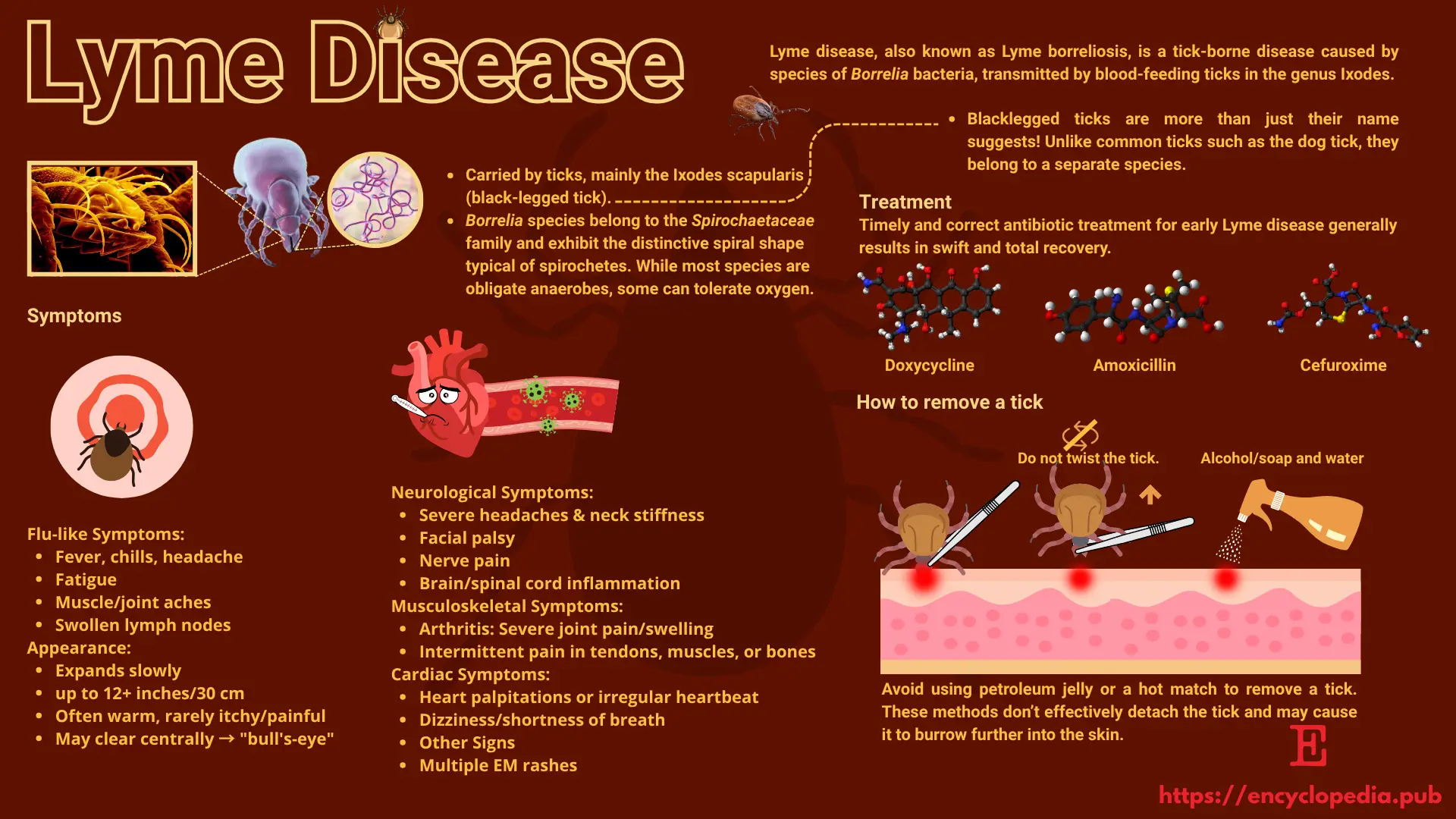
Source: Encyclopedia Scientific Infographics (https://encyclopedia.pub/image/3685)
2. How Is It Transmitted?
Ticks don’t jump or fly—they crawl onto animals or people when brushing against tall grass, leaf litter, or shrubs. An infected tick needs to attach to a person for 24–48 hours to transmit Borrelia burgdorferi into the bloodstream. Many people are unaware they've even been bitten due to the tick's small size (especially in its nymph stage).
3. Symptoms to Watch Out For
Lyme disease often progresses in stages. Early detection is key, but symptoms can vary:
- Early Localized Stage (3–30 days after bite):
-
Erythema migrans (EM) rash: Often in a "bull's-eye" pattern, but not always
-
Fever, chills
-
Fatigue
-
Muscle and joint aches
-
Swollen lymph nodes
-
- Early Disseminated Stage (days to weeks):
-
Multiple EM rashes
-
Neurological symptoms (e.g., facial palsy, meningitis-like symptoms)
-
Shooting pains or numbness
-
Heart palpitations or irregular heartbeat (Lyme carditis)
-
- Late Stage (months later):
-
Arthritis, especially in the knees
-
Cognitive issues (memory, concentration)
-
Chronic fatigue
-
Nerve pain
-
4. How Is Lyme Disease Diagnosed?
Diagnosis can be challenging, especially if the characteristic rash is absent. It typically involves:
-
Medical history & symptom review
-
Two-tiered blood testing (ELISA followed by Western blot)
-
In some cases, lumbar puncture or imaging may be used if neurological symptoms are present.
Because Lyme antibodies can take weeks to develop, early blood tests may yield false negatives.
5. Treatment and Recovery
Most Lyme disease cases can be effectively treated with a 2–4 week course of antibiotics, such as doxycycline, amoxicillin, or cefuroxime. Early treatment leads to full recovery in the majority of patients.
However, some individuals experience lingering symptoms—Post-Treatment Lyme Disease Syndrome (PTLDS)—which may include fatigue, joint pain, or brain fog. The exact cause is still under investigation.
For more information about topic, you can view the online infographic entitled "Lyme Disease".