Overcoming the traditional stigma of academic self-promotion is not an act of ego; it is an ethical imperative for researchers who want to rescue their hard work from algorithmic obscurity.
There is a deeply ingrained, romantic myth in academia: good work speaks for itself.
We are conditioned from our days as graduate students to believe that if our methodology is rigorous and our findings are profound, the global scientific community will naturally beat a path to our door. We treat the act of actively marketing our publications with a mix of suspicion and disdain, quietly labeling it as vain, unscientific, or flat-out "shameless."
But let’s look at the unforgiving reality of modern publishing. Tens of thousands of papers are published across global repositories every single month. In this hyper-saturated digital attention economy, relying on the sheer quality of your work to attract readers is a statistical gamble. Good work does not speak for itself—it sits silently on a server waiting for an algorithm to notice it.
Reclaiming the narrative around self-promotion isn't about feeding your ego; it is about protecting your intellectual investment and ensuring your findings reach the people who can actually use them.
1. The Half-Life of a Published Paper and the "Publication Cliff"
To understand why post-publication promotion is non-negotiable, we must look at the brutal lifecycle of academic attention. When a paper drops, it receives a tiny, automated bump from journal alert systems and RSS feeds. For the vast majority of studies, this 48-hour window is the absolute peak of their lifetime visibility. Without active intervention, that attention decays at an alarming rate, falling off what data scientists call the "Publication Cliff" (Figure 1).
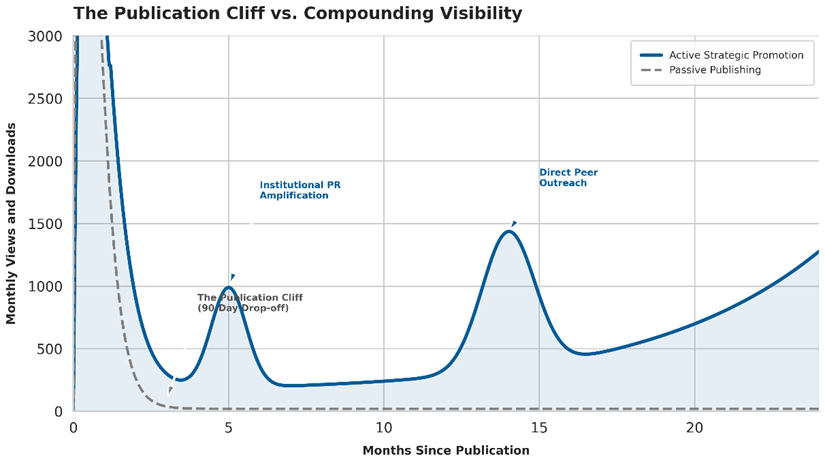
Figure 1. The publication cliff vs. compounding visibility. A longitudinal representation of research paper visibility over 24 months, illustrating the catastrophic algorithmic drop-off of passive publishing against the compounding growth of strategic promotion.
As Figure 1 illustrates, passive publishing results in a catastrophic flatline in views within the first ninety days. When you let your paper drop off the cliff, you are essentially allowing your hard-earned data to become invisible to both human peers and AI discovery engines. Active, sustained promotion bends this curve. It transforms your publication from a fleeting, one-time event into an evergreen resource that continuously captures citations over years, not weeks.
2. The Ethics of Visibility: Why Silence is a Disservice
We need to completely reframe how we view academic self-promotion. It is not "bragging." Done correctly, it is an act of scientific stewardship.
Consider who funded your research. Whether it was public taxpayer money, a charitable foundation, or an institutional grant, those resources were allocated with the expectation of societal advancement. If you hide your results behind a wall of professional modesty and leave them buried in an unpromoted PDF, you are failing to deliver on the fundamental promise of that funding.
Furthermore, think of your peers. Somewhere in the world right now, an early-career researcher or a startup founder is struggling with the exact problem you just solved. If your paper is buried under the algorithmic noise of giant publishing houses, they will waste months reinventing the wheel. Promoting your work is a direct service to your scientific community. You are removing friction and making it easier for others to build upon your progress.
3. The Low-Effort, High-Impact Promotional Playbook
You do not need to spend hours a day on social media to build a robust academic footprint. Instead, deploy a high-efficiency strategy that targets the specific digital spaces where modern scholars actually discover the literature (Figure 2).
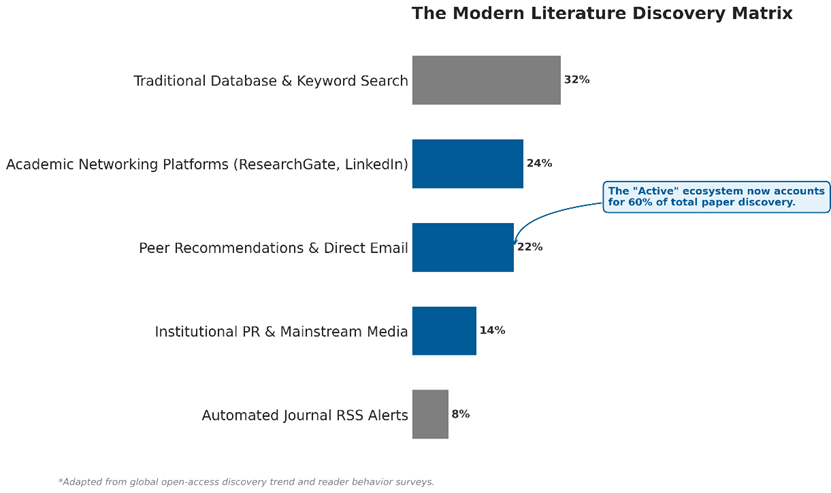
Figure 2. The modern literature discovery matrix. Data-driven matrix illustrating the primary channels through which contemporary researchers discover new publications, highlighting the shift away from raw database searches.
As shown in Figure 2, traditional keyword searching of journal databases is now only a fraction of the discovery puzzle. A massive percentage of discovery happens via peer recommendations, academic networking platforms, and algorithmic suggestions based on existing digital momentum. To capitalize on this, focus your energy on three highly targeted levers:
3.1. Leverage Your Signature Assets
Every single day, you send dozens of emails to colleagues, editors, student candidates, and funding managers. Your email signature is prime, unutilized digital real estate. Stop using it for standard boilerplate text. Update it to include a crisp, trackable link to your latest paper: "Read my latest open-access study on [Topic] in [Journal Name]." It takes thirty seconds to set up, requires zero maintenance, and guarantees daily impressions with a highly relevant, captive audience.
3.2. Activate the Institutional Megaphone
Your university or research institute has a dedicated press office or communications team, and they are constantly starving for high-quality stories. When your paper is accepted, do not just forward the DOI to your department head. Send a brief, three-bullet-point summary to your institution's media officer. Tell them exactly why a journalist, an industry leader, or a member of the public would care about your finding. Let their marketing budget, their mailing lists, and their media networks do the heavy lifting for you.
3.3. The Courteous Direct Outreach
Identify five to ten researchers globally whose work directly aligns with yours, or whom you have heavily cited in your paper. Send them a brief, highly personalized email. Do not mass-spam them. Say something genuine: "Dear Professor X, I have been following your work on [Theme], which heavily informed our latest study. We just published our findings on [Topic] and thought your lab might find our data on [Specific Dynamic] useful. The open-access link is below." This is not spam; it is peer-to-peer knowledge transfer. This is exactly how genuine international collaborations and citations are born.
4. Survival of the Visible
The days of the cloistered academic who sits in an ivory tower waiting to be discovered are officially over. In the modern ecosystem, your scientific impact is a direct, undeniable function of your digital visibility.
Stepping up to promote your own research requires a shift in mindset, a willingness to shed outdated professional modesty, and a small, disciplined investment of digital effort. You owe it to your funders, you owe it to your peers, and most importantly, you owe it to yourself to make sure your science is heard.
Stop letting your best work die in silence. Own your narrative, champion your findings, and push your data into the light where it belongs.
Biography
Dr. Akeem Adeyemi Oladipo is a Research Professor of Chemistry at Eastern Mediterranean University (Cyprus), where he heads the SMART LAB (Electro-Bio-Environmental & Energy Technologies). Recognized globally among the Top 2% of Scientists by Stanford University and Elsevier, his pioneering research sits at the critical nexus of nanotechnology, advanced materials, and AI-driven materials discovery. Refusing to let his findings languish in academic repositories, Dr. Oladipo is an active deep-tech entrepreneur and the founder of multiple commercial ventures, including TracePulse, Adsoora, and ReduOXLab. Through these startups, he actively translates complex laboratory breakthroughs—such as high-performance nanofluids and advanced environmental remediation strategies—into scalable, industry-ready technologies. A highly prolific author and editorial board member, he is deeply passionate about bridging the gap between isolated laboratory data and high-visibility, real-world sustainable solutions.