A systematic review can begin in an outpatient clinic, without a dedicated research unit, a specialist librarian, or institutional access to every bibliographic database. The methodological responsibilities, however, remain the same. Before results are known, researchers must define the question, eligibility criteria, information sources, selection process, and approach to synthesis. PROSPERO provides a public record against which the eventual review can be compared; it is not a certificate determining that the review itself is methodologically sound.
For small clinical teams, the main challenge is often a mismatch between what the protocol promises and what the available people, time, and resources can deliver. The following five pitfalls draw on practical experience in clinical evidence synthesis but are framed as broadly applicable methodological considerations. Where relevant, PROSPERO guidance, reporting guidelines, and conduct standards are distinguished from pragmatic recommendations for teams working without formal research support.
1. Registering a Review After Its Findings Have Begun to Shape the Protocol
The concern is not simply that searching has started before registration; it is whether knowledge of the emerging evidence has influenced decisions that should have been made prospectively. Eligibility criteria, outcomes, and synthesis methods can appear tailored to a set of known studies, even when the researchers did not intend to introduce bias.
A preliminary or scoping search and a formal systematic search serve different purposes. A brief preliminary search checks whether a question is feasible, identifies its principal terminology, and explores whether a similar review is already registered or published. The formal search is the prespecified, reproducible strategy designed to identify the eligible evidence across planned sources. A preliminary search does not become a scoping review merely because it explores feasibility; nor should a full screening and extraction exercise be relabelled as 'scoping' after the event.
PROSPERO's published guidance recognises the registration of reviews that are planned or underway, subject to its stage-of-review eligibility rules. It is therefore inaccurate to describe registration before the first database query as an absolute PROSPERO requirement. What matters is an accurate account of progress at submission, and that the current online eligibility instructions should be checked [1,2]. As a pragmatic, more conservative workflow, a small team can perform a short feasibility check, finalise the protocol, register it, and only then execute the formal search. If the formal search or screening has already begun, the registration should state this openly.
Figure 1 illustrates a conservative prospective workflow and the risk of allowing known study findings to shape protocol decisions.
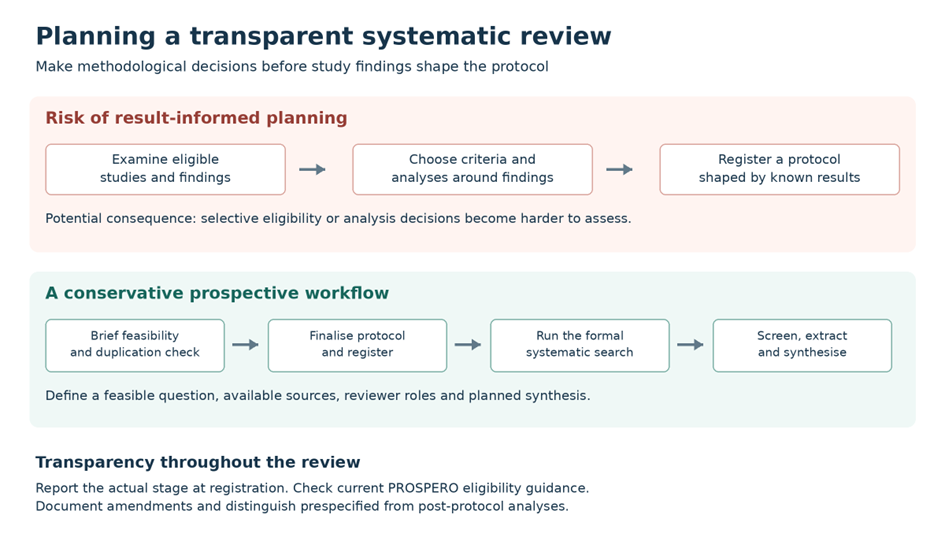
Figure 1. Protocol planning and transparency in systematic reviews. The upper pathway illustrates the risk of allowing known study findings to influence eligibility criteria and analysis plans. The lower pathway presents a conservative workflow for small clinical teams, from a brief feasibility check to protocol finalisation, registration and review conduct. This sequence is a practical recommendation, not a statement that PROSPERO universally requires registration before the first search. Authors should check current eligibility guidance, report their actual progress and document material amendments.
2. Defining a Question Broader Than the Team Can Analyse Coherently
A clinically interesting question may combine populations or outcomes that are too heterogeneous for one interpretable synthesis. For example, a prognostic review of a fibrosis score may retrieve general-population, diabetes, hepatology, and post-cardiovascular-event cohorts, with different thresholds, follow-up periods, and baseline risks. Pooling every available hazard ratio would create a numerical summary, but not necessarily a meaningful clinical answer.
The protocol should identify a population that can be justified as a single analytical group, a clear intervention or exposure, prespecified comparators when applicable, and a primary outcome that eligible studies are likely to report. Anticipated differences in design, definitions, age, follow-up, or effect measures should inform planned subgroup analyses and the decision regarding whether meta-analysis will be appropriate. When meaningful pooling is unlikely, a structured synthesis without meta-analysis should be planned rather than treated as an improvised fallback [3].
The practical test for a small team is simple: can the proposed question be answered, with the intended checks and analyses, by the named reviewers before the declared completion date? Narrowing a question is not a reduction in scientific ambition when it protects interpretability and reproducibility.
3. Describing a Screening and Extraction Process That Cannot Be Delivered
Selection and data extraction need a real workflow, not a conventional sentence copied from another review. PRISMA 2020 is a reporting guideline: items 8 and 9 ask authors to state how many people screened and extracted data, whether they worked independently, and how disagreements were handled. Those items do not themselves prescribe a universal minimum team size [3]. Cochrane's conduct standards for intervention reviews are more specific: independent assessment by at least two people is required for final inclusion decisions and for extraction of outcome data [4,5]. These are related but distinct standards.
A two-person clinical team can design a traceable process by defining each member's tasks, recording independent full-text decisions, agreeing on how discrepancies will be resolved, and retaining extraction sheets and decision logs. If there is no standing third reviewer, this fact can be stated; unresolved disagreements still need a defensible resolution procedure. Simply writing 'two reviewers independently screened' does not establish that this process has occurred.
Where fully independent duplicate extraction cannot be delivered, authors should reconsider scope, seek additional support, or explain their actual verification approach and its limitations. Checking only a sample of extracted outcomes is not equivalent to independent duplicate extraction of all outcome data and should never be presented as meeting the stricter Cochrane standard [5].
4. Listing Bibliographic Sources That the Team Cannot Access
A protocol sometimes names Embase, CENTRAL, Scopus, or Web of Science because these databases appear in exemplary search strategies, not because the review team can search them. If the published methods later describe only PubMed and reference checking, the discrepancy becomes a substantive methodological problem: the retrieved evidence may be incomplete, and the preregistered plan was not executed.
Researchers should establish database access before registration and specify exactly which sources will be searched. PubMed, Europe PMC, appropriate trial registers such as ClinicalTrials.gov, reference-list checking, and forward citation searching may improve retrieval where subscriptions are limited. They are complementary approaches, not interchangeable replacements for every unavailable database. The risk of missing studies depends on the review question and on where relevant studies are indexed; disclosure does not eliminate this risk [3,6].
A feasible protocol therefore identifies the available sources, records the search strategies and dates, explains important access limitations, and describes proportionate mitigation. If specialist support can be obtained for the search strategy alone, independent review using the PRESS framework can help identify avoidable errors before the search is run [6].
5. Treating Protocol Deviations as Defects to Conceal
An evidence synthesis may reveal that the planned analysis is unsuitable: studies may use incompatible populations, an outcome may be reported too rarely, or a prespecified subgroup may contain no eligible studies. The methodological issue is not that every plan must remain unchanged. It is whether readers can distinguish decisions made before the evidence was examined from decisions made afterwards.
PROSPERO was established to make planned methods visible and to preserve an audit trail of material changes. PRISMA 2020 also asks authors to describe and explain amendments to registered information and protocols [2,3]. A clear account should identify what changed, when, why, and whether knowledge of study findings may have contributed to the decision.
For example, if clinical heterogeneity makes a planned pooled estimate difficult to interpret, a revised primary synthesis may be warranted. The record should be amended, the methods should distinguish prespecified from post-protocol analyses, and the discussion should explain how the change affects interpretation. Where relevant, the SWiM reporting guideline can support transparent reporting of synthesis without meta-analysis; it does not retroactively make an unplanned methodological decision prespecified [7].
6. A Workable Sequence for a Small Clinical Team
Before registration, check existing PROSPERO records and the published literature, formulate a feasible question, confirm resource and database access, and agree on the screening, extraction, and synthesis methods. Register an accurate protocol that reflects the review's actual stage. During the review, retain a record of decisions, document any departure from the plan, and explain those departures in the final report. The aim is not to imitate the infrastructure of a large research unit; it is to make a realistic commitment in advance and provide a transparent account of how that commitment was fulfilled.
References
[1] Centre for Reviews and Dissemination, University of York. PROSPERO: International prospective register of systematic reviews. https://www.crd.york.ac.uk/PROSPERO/ (accessed 20 September 2026).
[2] Booth, A.; Clarke, M.; Dooley, G.; Ghersi, D.; Moher, D.; Petticrew, M.; Stewart, L. The nuts and bolts of PROSPERO: an international prospective register of systematic reviews. Syst Rev. 2012, 1, 2.
[3] Page, M.J.; McKenzie, J.E.; Bossuyt, P.M.; Boutron, I.; Hoffmann, T.C.; Mulrow, C.D.; Shamseer, L.; Tetzlaff, J.F.; et al. The PRISMA 2020 statement: an updated guideline for reporting systematic reviews. BMJ 2021, 372, n71.
[4] Cochrane. Cochrane Handbook for Systematic Reviews of Interventions. Chapter 4: Searching for and selecting studies. https://www.cochrane.org/authors/handbooks-and-manuals/handbook/current/chapter-04 (accessed 20 September 2026).
[5] Cochrane. Cochrane Handbook for Systematic Reviews of Interventions. Chapter 5: Collecting data. https://www.cochrane.org/authors/handbooks-and-manuals/handbook/current/chapter-05 (accessed 20 September 2026).
[6] McGowan, J.; Sampson, M.; Salzwedel, D.M.; Cogo, E.; Foerster, V.; Lefebvre, C. PRESS Peer Review of Electronic Search Strategies: 2015 Guideline Statement. J. Clin. Epidemiol. 2016, 75, 40–46.
[7] Campbell, M.; McKenzie, J.E.; Sowden, A.; Katikireddi, S.V.; Brennan, S.E.; Ellis, S.; Hartmann-Boyce, J.; Ryan, R.; et al. Synthesis without meta-analysis (SWiM) in systematic reviews: reporting guideline. BMJ 2020, 368, l6890.
Biography
Antonio Maria Labate, MD, is a specialist in Internal Medicine working as an outpatient diabetology and internal medicine specialist at ASST Franciacorta and ASST Mantova, in Lombardy, Italy. He trained in Internal Medicine at the University of Messina and has broad clinical experience spanning internal medicine, emergency medicine, and diabetology. His work focuses on clinical diabetology, cardiovascular and cardiometabolic risk in type 2 diabetes, real-world evidence, and the clinical use of newer glucose-lowering therapies such as GLP-1 receptor agonists and SGLT2 inhibitors. He has authored peer-reviewed articles and congress communications on the cardiovascular, renal, and metabolic effects of these agents and serves as a reviewer for several international journals.