
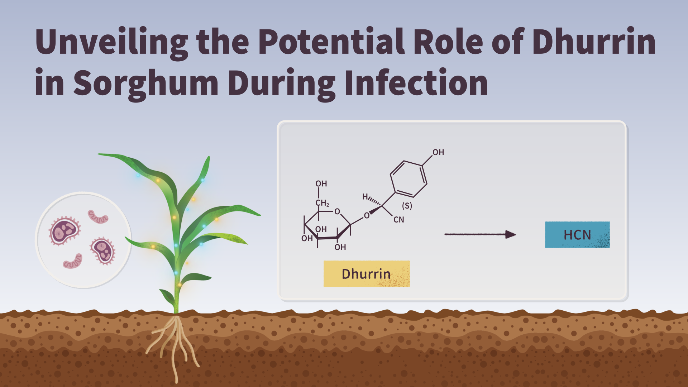
Plants have evolved multiple defense layers to cope with environmental stresses and pathogen attacks. In sorghum (Sorghum bicolor), one of the main chemical defenses is the cyanogenic glucoside dhurrin, which can release hydrogen cyanide (HCN) upon bioactivation. Because of this biochemical link, dhurrin content and hydrogen cyanide potential (HCNp) have often been treated as closely associated indicators of sorghum defense capacity.
A recent study published in MDPI Plants entitled “Unveiling the Potential Role of Dhurrin in Sorghum During Infection by the Head Smut Pathogen Sporisorium reilianum f. sp. reilianum” investigates the genomic basis of HCN variation in sorghum seedlings and explores whether dhurrin alone governs defense responses during early infection.
1. Dhurrin as a Chemical Defense in Sorghum
Dhurrin is particularly abundant in young vegetative tissues, where it functions as a rapid-response chemical defense. Upon tissue damage or stress, dhurrin undergoes hydrolysis, releasing HCN, a compound toxic to many herbivores and pathogens.
Previous studies have established dhurrin’s role in sorghum responses to abiotic and biotic stresses. Because HCN is a direct product of dhurrin bioactivation, dhurrin content and HCNp are often used interchangeably. However, whether dhurrin biosynthesis and bioactivation fully explain variation in HCNp—especially during pathogen infection—has remained unclear.
2. Head Smut Infection and Early Defense Responses
Head smut, caused by Sporisorium reilianum f. sp. reilianum, infects sorghum seedlings before visible symptoms appear. This early infection stage makes seedling defense mechanisms crucial.
Interestingly, previous studies have shown that enzymes of the phenylpropanoid pathway, such as chalcone synthase and phenylalanine ammonia lyase (PAL), do not strongly accumulate after inoculation with the pathogen. This suggests that other biochemical pathways, including cyanogenic defense, may play more relevant roles during the early stages of infection.
3. Investigating Hydrogen Cyanide Variation through GWAS
To examine the genetic basis of HCNp, the researchers conducted a genome-wide association study (GWAS) using a diverse set of sorghum accessions. Seedling HCNp was qualitatively assessed, and these phenotypes were combined with single nucleotide polymorphism (SNP) data for association analysis.
The GWAS revealed that variation in HCNp cannot be explained solely by dhurrin biosynthesis and bioactivation genes. Multiple genomic regions contribute to this trait, suggesting a complex genetic architecture for cyanogenic potential in seedlings. These findings challenge the assumption that dhurrin alone governs HCN variation during early development.
4. Gene Expression Responses to Pathogen Inoculation
The study further investigated dhurrin’s role by examining the expression of dhurrin biosynthetic genes following head smut inoculation. Reverse-transcription quantitative PCR (RT-qPCR) analyses showed that these genes were not strongly or uniformly induced by pathogen exposure.
This suggests that while dhurrin is present and potentially important for defense, its regulation may differ between resistant and susceptible lines and is unlikely to be the sole determinant of defense outcomes against head smut.
5. Implications for Sorghum Resistance
The combined results support a nuanced view of cyanogenic defense in sorghum:
-
Dhurrin contributes to seedling defense, particularly in resistant lines.
-
Other genetic and biochemical factors likely influence HCNp and pathogen resistance.
-
Solely selecting for dhurrin content may overlook other contributors to early defense, highlighting the need for a more integrated breeding strategy.
These insights are important for both sorghum breeding programs and fundamental understanding of plant-pathogen interactions, emphasizing that cyanogenic glucosides function within a broader defensive network.
6. Conclusion
This study provides valuable insights into dhurrin’s role during sorghum–head smut interactions by integrating phenotypic assessment, GWAS, and gene expression profiling. Dhurrin is an important component of defense but not the exclusive determinant of HCN variation or seedling resistance.
By uncovering the genetic diversity underlying HCNp and highlighting the complexity of early defense mechanisms, the research encourages an integrated approach to sorghum disease resistance—one that considers dhurrin as a significant, but not solitary, contributor to pathogen defense.
For more information about topic, you can view the online video entitled "Dhurrin’s Role in Sorghum Head Smut Infection Defense".