Natural antioxidants have been widely used in food preservation due to their unique properties that offer many advantages over synthetic molecules. Unlike synthetic agents, natural options derived from plants, fruits, and spices have been proven to be safe and effective in reducing lipid rancidity. These antioxidants possess a combination of beneficial compounds that act synergistically to delay oxidative processes, improving the shelf life and quality of food products. Additionally, natural antioxidants are typically recognized as safe by regulatory agencies and are favored by consumers who prefer natural food additives. By incorporating natural antioxidants, the food industry can not only improve food quality and safety, but also appeal to the growing demand for natural and organic food products.
1. Balancing Quality and Safety: The Debate Between Natural and Synthetic Antioxidants
Natural antioxidants, such as vitamins, minerals, and plant extracts, are derived from natural sources and are commonly used in food applications [
66]. On the other hand, synthetic antioxidants are chemically synthesized and generally considered more potent than natural antioxidants, but they also come with potential health concerns [
68]. Both antioxidants protect food from oxidative rancidity, which can cause off-flavors, reduce nutrient content, and increase the risk of harmful oxidation by-products [
26].
Food antioxidants can be added during all production steps, and their use is strictly controlled [
7,
11,
68]. The two main regulatory organizations for these substances are the European Food Safety Authority (EFSA) in the European Union and the Food and Drug Administration (FDA) in the United States. Other regulatory bodies are the Food and Agriculture Organization (FAO), World Health Organization (WHO), Expert Committee on Food Additives, and Codex Alimentarius [
7]. In Mexico, the agency in charge of regulating the use of additives is the Federal Commission for the Protection against Health Risks (COFEPRIS) [
69].
According to its functions, the Codex Alimentarius has classified food additives into 27 families, while EFSA has organized them into 9 “E numbers.” Within these classifications, antioxidant agents constitute one of the most important families because oxidation is one of the main causes of food degradation [
11]. Antioxidants, classified within the E300–E399 number block, are used to extend the shelf life of foods by preventing rancidity, loss of color, development of odors, and loss of texture, among other undesirable effects [
7].
Table 1 lists some antioxidants approved by the EFSA, their maximum dosage range, and reported adverse reactions.
Table 1. E number, maximum dosage range, and reported adverse reactions of some antioxidants used in the food industry.
In the particular case of antioxidant additives, there are several ways to classify them. According to their origin, they can be classified as natural, natural-identical, which correspond to compounds chemically synthesized to mimic natural ones, and synthetic, equivalent to molecules that do not exist in nature [
8]. Generally, natural antioxidants are added to meat, fish, nuts, vegetables, fruits, beverages, and canned food, while synthetic ones are added to oils, cheeses, and chips [
9]. It should be noted that there is still no consensus on this classification, so, officially, all antioxidants are still considered in a single group [
7]. Primary antioxidants and secondary or synergistic molecules represent another distinction. Primary antioxidants act by oxidizing themselves, which allows food components to remain unchanged, while synergistic antioxidants reinforce the action of the primary ones [
8,
11].
Antioxidants play a crucial role in preventing oxidative rancidity in food, thus extending its shelf life and preserving its quality. The classification of antioxidants into natural and synthetic, primary and secondary, and natural-identical and synthetic highlights the diversity and complexity of these compounds. While various international and national agencies strictly regulate their use, further research is still needed to fully understand the different modes of action of antioxidants and their effects on food quality and human health and identify the most effective and safe combinations of antioxidants for specific food applications. Additionally, it is important to consider the environmental impact of synthetic antioxidants and to explore the potential of natural and natural-identical molecules as sustainable alternatives. By addressing these gaps in knowledge, the food industry can ensure the safe and effective use of antioxidants in preserving food quality while protecting consumer health and the environment.
2. Health Problems Associated with Synthetic Antioxidants
The use of antioxidants in agri-food and food products has become common due to the economic benefits it brings by reducing losses due to rancidity. Wsowicz and collaborators [
38] mentioned that some state governments have a financial and public health interest in the widespread use of these compounds since adding antioxidants in high-fat foods could influence consumer health. This action would lower the incidence of certain diseases related to oxidative stress and the public expenditure they represent. However, synthetic antioxidants have also been shown to have adverse health effects [
68], leading to some consumers’ fear and rejection and promoting the search for natural options.
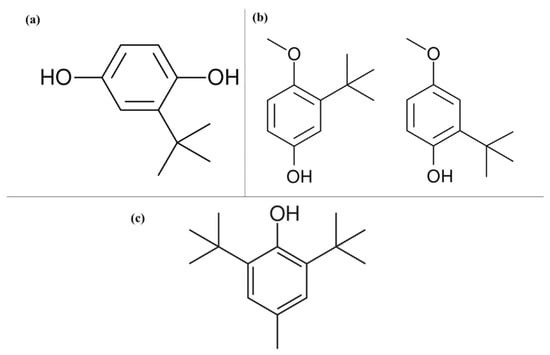
The synthetic compounds BHA and BHT (
Figure 4) have been identified to possess carcinogenic properties at high doses; furthermore, prolonged exposure to BHT can cause chronic poisoning and metabolic disorders [
9,
11]. Similarly, manifestation and exacerbation of allergic reactions such as chronic urticaria, rash, angioedema, and atopic dermatitis have been reported (
Table 1), as well as increased blood cholesterol and lipid levels. These undesired side effects have led to these compounds not being used in foods for infants and children [
11,
69,
71]. The antioxidant TBHQ has also been considered as carcinogenic and genotoxic, so its maximum permitted use limit does not exceed 200 mg/kg, while the use of antioxidants from gallates is also prohibited in foods for infants and children due to the risk of developing methemoglobinemia [
11]. Other effects caused by this group of antioxidants are allergic reactions in asthmatic people and those who cannot tolerate acetylsalicylic acid [
11]; propyl gallate can also cause apoptosis and DNA cleavage [
9].
Figure 4. Chemical structures of the molecules. (a) Tert-butyl hydroquinone (TBHQ); (b) Butyl hydroxyanisole (BHA); (c) Butylated hydroxytoluene (BHT).
Whether to use synthetic or natural additives is still a hotly debated topic. It is considered that these antioxidants are better than synthetic ones because they come from a natural source; however, this statement is not always supported by scientific data [
72]. This does not mean that the negative effects caused by synthetic antioxidants should be left aside. Hence, it is necessary to closely monitor the doses used in food and continue searching for new compounds that present less risk to human health. The potential public health benefits and financial savings of using antioxidants in high-fat foods make it an important area for future research. The challenge is finding a balance between the benefits of using antioxidants to extend the shelf life of food products and the potential health risks these compounds pose. It is also important to consider the varying conditions of use and the specific type of antioxidant when evaluating its effectiveness and safety.
This entry is adapted from the peer-reviewed paper https://doi.org/10.3390/antiox12040861