Traditionally, persimmon leaves (PL) are used as a functional tea in Asian culture to cure different ailments, and are also incorporated into various food and cosmeceutical products as a functional ingredient. PL mainly contain flavonoids, terpenoids, and polysaccharides, along with other constituents such as carotenoids, organic acids, chlorophylls, vitamin C, and minerals. The major phenolic compounds in PL are proanthocyanidins, quercetin, isoquercetin, catechin, flavonol glucosides, and kaempferol. Meanwhile, ursolic acid, rotungenic acid, barbinervic acid, and uvaol are the principal terpenoids. These compounds demonstrate a wide range of pharmacological activities, including antioxidant, anticancer, antihypertensive, antidiabetic, anti-obesity, anti-tyrosinase, antiallergic, and antiglaucoma properties. PL contain a high amount of flavonoids (e.g., astragalin, hyperin, isoquercitrin, kaempferol, and quercetin) and terpenoids along with other compounds, including chlorophylls, carotenes, kryptoxanthin, cellulose, hemicelluloses, and lignins. These compounds exhibit potential antioxidant, antihypertensive, anti-inflammatory, anticancer, antidiabetic, antiallergic, and antimicrobial effects.
1. Phenolic Compounds
Phenolic compounds are secondary metabolites containing hydroxylated aromatic rings, which play an essential role in the growth and development with a defense mechanism in the plant. In particular, they engage in plants’ defense by inhibiting herbivory, ultraviolet radiation, and pathogen attacks. In addition, they are responsible for the flavor, color, bitterness, and astringency of fruits such as persimmon [
26]. Phenolic compounds in plants primarily originate from phenylalanine, and to a lesser extent, tyrosine. For example,
p-hydroxycinnamic acid is derived from tyrosine with the assistance of tyrosine ammonia-lyase (TAL), whereas
trans cinnamic acid is derived from phenylalanine, catalyzing by phenylalanine ammonia-lyase (PAL). The major phenolics present in plants are flavonoids, phenolic acids, tannins, stilbenes, lignans, and coumarin [
26,
27,
28]. Phenolic compounds are well known as antioxidants, which demonstrate inhibitory activities against α-glucosidase and tyrosinase activities as well as LDL-cholesterol, DNA, and lipid oxidation [
29].
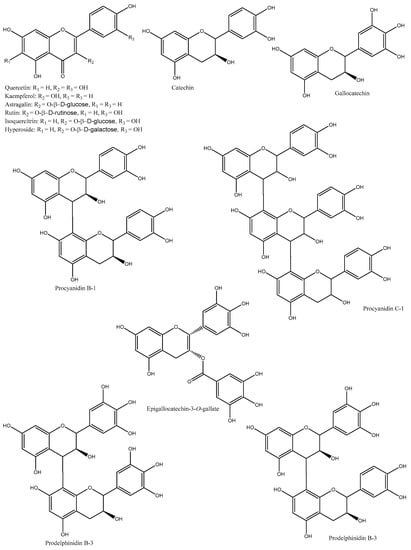
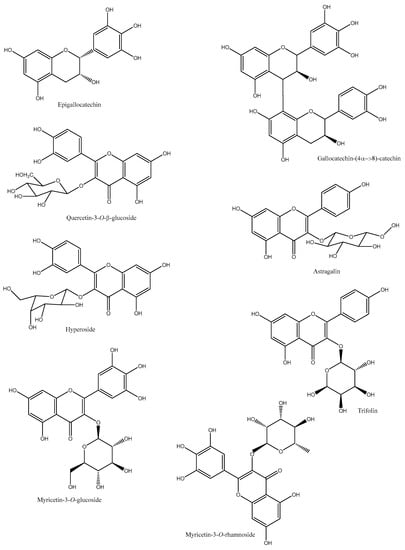
Phenolics in PL are mainly flavonoids, including flavonol (e.g., quercetin, isoquercetin, kaempferol, and myricetin) and flavonol glucoside (e.g., quercetin-3-
O-β-L-arabinopyranoside, quercetin-3-
O-β-D-glucopyranoside, quercetin-3-
O-β-D-galactopyranoside, kaempferol-3-
O-α-L-rhamnopyranoside, kaempferol-3-
O-β-D-galactopyranoside, kaempferol-3-β-D-xylopyranoside, kaempefrol-3-
O–L-arabinopyranoside, kaempferol-3-
O-(2″-
O-galloyl)-β-D-glucopyranoside, myricetin-3-
O-α-D-glucopyranoside, and quercetin-3-
O-β-D-galaetoside) [
10] (
Table 1 and
Figure 2).
Figure 2. Major phenolic compounds found in PL.
Table 1. Major phenolic compounds in persimmon leaves.
For example, Choi et al. [
32] identified four flavonoids from PL, namely isoquerercitrin, quercetin 3-
O-β-D-glucopyranoside-2″-gallate, kaempferol 3-
O-β-D-glucopyranoside-2″-gallate, and astragalin. Similarly, nine flavan-3-ols were isolated from PL, mainly catechin, gallocatechin, and pyrocyanidins [
30]. Moreover, Kawakami et al. [
33] reported that the major phenolics in PL were unique proanthocyanidin oligomers, such as catechin, epicatechin, epigallocatechin-3-
O-gallate, epigallocatechin, epicatechin-3-
O-gallate, and prodelphinidin. Likewise, Tao et al. [
38] suggested that proanthocyanidins of PL were mainly catechin with a B-type link along with a small portion of catechin gallate, gallocatechin, and an A-type link. Finally, Cho et al. [
39] stated that the 60% ethanol was the best solvent to extract phenolics, which were mainly composed of (+)-gallocatechin and prodelphinidin B-3.
Bei et al. [
40] identified four flavonoids (quercetin, kaempferol, hyperin, and astragalin) from PL using HPLC. An aqueous extract was prepared from the Korean PL, which contained quercetin 3-
O-2′galloylglucoside and kaempferol 3-
O-2′galloylglucoside [
41]. The compositions and contents of phenolics were investigated from eight varieties of PL harvested in Taiwan [
36]. The major compounds were flavonoid, condensed tannin, and phenolic acids, including kaempferol-3-
O-rhamnoside, myricetin, naringin, quercetin-3-
O-rhamnoside, quercetin-3-
O-glucoside, quercetin-3-
O-galactoside, sinapic acid, gallic acid, and
p-hydroxybenzoic acid, among others. Heras et al. [
2] dried PL using various drying techniques (hot-air-drying at 100 and 180 °C, shade-drying, and freeze-drying) and extracted phenolic compounds by aqueous extraction (70, 80, and 90 °C for 1, 3, 5, 60, and 1440 min). It was found that PL dried under air-drying at 100 °C and extracted at 90 °C for 60 min provided the optimal process for the extraction of phenolic compounds. In another study, Heras et al. [
3] identified and quantified 41 phenolic compounds from PL using liquid chromatography (LC) coupled with mass spectrometry (MS); the major compounds were simple phenolic acids, hydroxycinnamic acids, hydroxybenzoic acids, flavanols, flavanones, flavonols, flavonechalcones, tyrosols, and their conjugated derivatives. So far, this is the highest number of phenolic compounds identified from PL. Meanwhile, a new flavonoid (kaempferol-3-
O-β-D-2″-coumaroylgalactoside) along with kaempferol-3-
O-β-D-2″-feruloylglucoside were identified from the Korean PL [
16]. The overall identified chemical compounds were 14 flavonoids, 7 triterpenoids, 2 coumarins, 1 ionone, and 1 acetophenone. Furthermore, the major phenolic compounds of six selected persimmon cultivars in Japan were investigated using a reverse-phase HPLC, and their structures were confirmed by NMR [
34]. The identified compounds were isoquercitrin, hyperoside, trifolin, chrysontemin, astragalin, kaempferol-3-
O-(2″-
O-galloyl-β-D-glucopyranoside), and quercetin-3-
O-(2″-
O-galloyl-β-D-glucopyranoside).
NXQ prepared from PL is used for the management of cardio- and cerebrovascular diseases, and its composition was investigated using UPLC coupled with a tandem MS [
42]. Seven compounds, specifically kaempferol-3-
O-glucoside (astragalin), quercetin-3-
O-glucoside (isoquercitin), quercetin-3-
O-galactoside (hypericin), kaempferol, quercetin, pyromucic acid, and protocatechuic acid were identified in the NXQ. Furthermore, Wang et al. [
43] isolated a novel compound named vomifoliol 9-
O-α-arabinofuranosyl (1→6)-β-D-glucopyranoside. However, most of these studies investigated the soluble phenolics of PL though insoluble-bound phenolics (IBPs) are abundant in leaves (up to 70%); thus, attention should be paid to the extraction of IBPs from PL in order to fulfill the overall phenolic profile [
44].
2. Terpenoids
Terpenoids are a large class of diverse organic compounds, occurring naturally in plants to protect against biotic and abiotic stresses. Based on the number of isoprene units, terpenoids can be classified into monoterpenes (10 carbons), sesquiterpenes (15 carbons), diterpenes (20 carbons), sesterpenes (25 carbons), and triterpenes (30–40 carbons) [
45]. They are the major constituents of essential oils (EOs) and exhibit several pharmacological and biological activities [
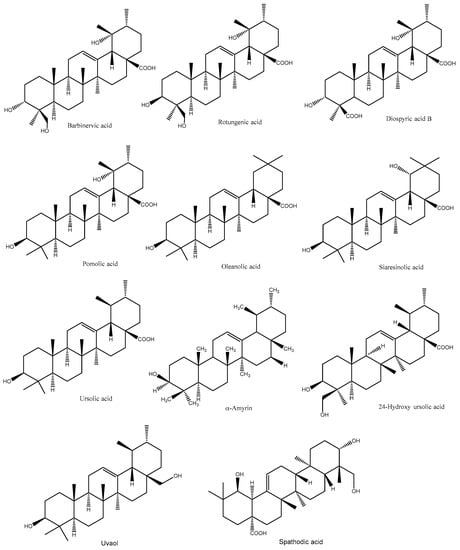
45]. The major terpenoids found in PL are mainly pentacyclic triterpenoids such as ursolic acid, 19,24-dihydroxyursolic acid, 19-hydroxyursolic acid, 24-hydroxyursolic acid, siaresinolic acid, oleanolic acid, barbinervic acid, rotungenic acid, amyrin, and uvaol, among others (
Figure 3).
Figure 3. Major triterpenoids in PL.
For instance, Fan and He [
46] developed an HPLC method to identify triterpene acids from PL, and the compounds were rotungenic acid, 24-hydroxyursolic acid, and barbinervic acid and its epimer. Similar to this study, seven triterpenoids were isolated from the Korean PL, namely barbinervic acid, diospyric acid B, pomolic acid, rotungenic acid, oleanolic acid, siaresinolic acid, and ursolic acid [
16]. Moreover, Chen et al. [
47] reported five triterpenoids such as ursolic acid, α-amyrin, uvaol, 19 α,24-dihydroxyursolic acid, and 19α-hydroxy ursolic acid in PL. Similarly, three minor novel triterpenoids and a known terpenoid (rosamultin) were identified from Chinese PL using NMR [
48]. The novel triterpenoids were kakisaponin B (28-
O-β-D-glucopyranosyl-3α,19,24-trihydoxy-18,19-secours-11,13(18)-dien-28-oic acid), kakisaponin C (28-
O-β-D-glucopyranosyl-2α,3α,19-trihydoxy-18,19-secours-11,13(18)-dien-28-oic acid), and kakidiol (C
29-triterpene with an aromatic E-ring structure). In another study, they identified another novel triterpene compound (18,19-
seco-3β-hydroxy-urs-12-en-18-one) along with five known compounds (uvaol, oleanolic acid, ursolic acid, (−)-syringaresinol, and (−)-syringaresinol-4-β-D-glucopyranoside) [
49]. In addition, two new ursane-type triterpenoids, namely 3α,19α-dihydroxyurs-12,20(30)-dien-24,28-dioic acid and 3α,19α-dihydroxyurs-12-en-24,28-dioic acid, along with 12 known ursane- and oleanane-type triterpenoids (coussaric acid, rotungenic acid, barbinervic acid, pomolic acid, ursolic acid, oleanolic acid, 24-hydroxyursolic acid, 24-hydroxy-3-
epi-oleanolic acid, 24-hydroxy-3-
epi-ursolic acid, 19,24-dihydroxyurs-12-en-3-on-28-oic acid, and spathodic acid) were identified from the Korean PL [
50].
3. Polysaccharides
Polysaccharides of PL are mainly a group of hetero-polysaccharides, and the most common polysaccharides units are glucose, galactose, arabinose, mannose, and rhamnose. For example, Park et al. [
51] suggested that polysaccharide fraction I of PL is mainly composed of galactose (29.9%), galacturonic acid (16.7%), arabinose (17.8%), rhamnose (10.4%), and trace amounts of 3-deoxy-D-manno-2-octulosonic acid (KDO)-like materials (0.9%). Fraction II was composed of 27.2% acidic sugars (glucuronic acid and galacturnonic acid), 19.6% arabinose, 19.4% rhamnose, 13.6% galactose, and 9.6% KDO-like compounds, including 2-methyxylose (3.3%), 2-methylfucose (3.0%), and KDO (3.1%). Moreover, fraction III consisted of acidic sugars (31.4%), arabinose (14.6%), rhamnose (15.9%), galactose (12.6%), and KDO-like materials (1.7%). In another study, Park et al. [
11] reported that the polysaccharides of PL mainly consisted of arabinose (20%) and galactose (17.9%) along with uronic acids (glucuronic and galacturonic acids) and unusual sugars, such as 2-
O-methylxylose, 2-
O-methylfucose, apiose, KDO, and 3-deoxy-D-lyxo-2-heptulosaric (DHA). Furthermore, a few studies have reported that the polysaccharide composition of PL was mainly neutral sugars (58.1–78.6%), uronic acids (26.2–38.3%), and KDO-like materials (2.5–4.43%); the major sugars being fucose, 2-methylfucose, 2-methylxylose, rhamnose, arabinose, galactose, glucose, mannose, xylose, apiose, galacturonic acid, and glucuronic acid [
12,
52,
53,
54].
4. Other Compounds
Other compounds such as naphthoquinones (3-bromoplumbagin, 3-methoxy-7-methyluglone, 8′-hydroxy-isodiospyrin, martinone, isodiospyrin, diospyrin, neodiospyrin, mamegakinone, and 7-methyluglone), organic acids (benzoic, succinic, salicylic, pyromucic, indoleacetic, and procatechuic acids), and coumarins (6–7-hydroxyl-7-hydroxycoumarin and scopoletin) have been reported in PL [
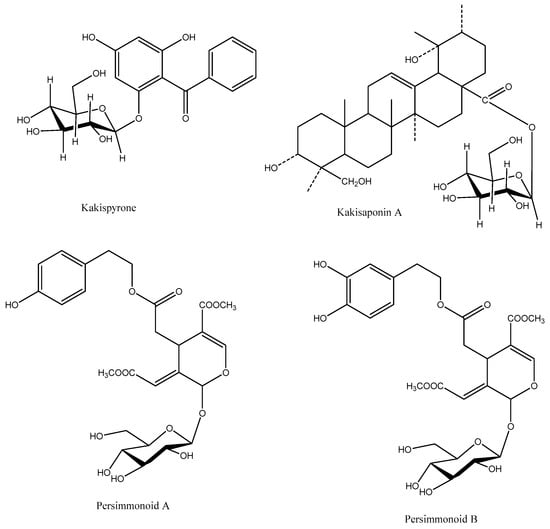
10]. Secoiridoids and lignans were identified from PL, which were mainly persimmonoid A and B, ligustroside, oleuropein, medioresinol, syringaresinol, pinoresinol, medioresinol monoglucoside, syringaresinol-β-D-glucoside, and pinoresinol-β-D-glucoside, isolariciresinol [
55]. Additionally, Chen et al. [
56] identified two new compounds, such as 4,6-dihydroxy-2-
O-β-D-glucopyranosylbenzophenone (kakispyrone) and kakisaponin A, from PL along with 11 known compounds, mainly phenolic compounds (
Figure 4).
Figure 4. Chemical structures of kakispyrone, kakisaponin A, and persimmonoid A and B.
This entry is adapted from the peer-reviewed paper https://doi.org/10.3390/plants12040937