Sauce-aroma Baijiu is a distilled Baijiu well-known in China, and features a unique sauce-aroma style formed by a complex producing process in a specific geographical environment. The production of Sauce-aroma Baijiu mainly depends on microbial interactions and metabolisms in a complex brewing process, in which raw materials, geographical environment, and brewing and storage technology are the main factors affecting the flavor formation, and research on these factors will help to improve the quality of Sauce-aroma Baijiu. Sorghum is the main brewing raw material for the production of Sauce-aroma Baijiu, the starch, protein, fat, and tannin in which provide the energy source and the material basis for microbial fermentation and metabolism. The structural and content differences of these components influence both the yield and the quality of Sauce-aroma Baijiu. The main factor contributing to different Baijiu manufacturers forming their own unique styles is the geographical environment, which makes it also a prerequisite for stabilizing the production quality of sorghum grains to ensure a stable planting area. The influence of storage on Baijiu quality not only is affected by the storage time, but is also subject to factors such as the storage container, storage environment, Baijiu quality, cost input, Baijiu warehouse management, etc.
1. Introduction
Sauce-aroma Baijiu is one of the flavor styles among Chinese traditional fermented liquor, the sensory characteristics of which are described as an elegant sauce aroma, mellow and sweet entrance, soft with obvious acidity, delicate taste and long aftertaste, with enduring and lingering aroma in an empty cup [
1,
2]. During the producing process, the flavor characteristics are jointly formed by the raw materials, the environment, brewing process, and storage [
3,
4,
5,
6].
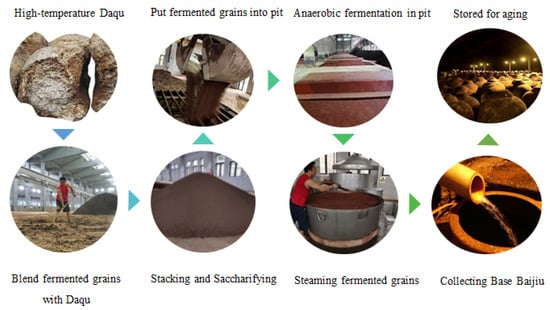
The traditional process of producing Sauce-aroma Baijiu is very complicated. The main process of producing Baijiu is as follows (
Figure 1): mix fermented grains with Daqu and water, and pile them on the floor of the fermentation workshop for 2 to 11 d, depending on the temperature of the surroundings, then transfer them to a cellar pool sealed with cellar mud for another month to allow anaerobic fermentation. Next comes distilling the fermented grains taken from the mud, then collecting the Base Baijiu, which is pungent and spicy due to its rich content of low-boiling substances. Suitable storage is needed at this stage [
7]. The producing process has several characteristics that distinguish it from that of other aroma types of Baijiu, namely, high-temperature Daqu production (60 to 65 °C), high-temperature stacking (grains mixed with Daqu and piled on the floor, after 2–11 d stacking, the temperature can reach ≥50 °C), high-temperature fermentation (40 to 45 °C), high-temperature of distilled Baijiu (the temperature of the distilled Baijiu can reach 37 to 45 °C), long production cycle (one year), and long-term storage [
2].
Figure 1. The main producing process of Sauce-aroma Baijiu.
2. Effect of Brewing Raw Materials on Sauce-Aroma Baijiu
The brewing production of Baijiu directly involves raw materials including sorghum, wheat, rice, glutinous rice, corn, and barley. Different brewing materials will lead to differences in Baijiu flavor. A well-known Chinese saying goes, “sorghum as brewing raw material can produce fragrant Baijiu; corn can produce sweet Baijiu; rice can produce clean Baijiu; glutinous rice can produce soft Baijiu; and wheat can produce rough Baijiu” [
11,
12]. The saying introduces the concept that different grain varieties have different effects on Baijiu quality.
Sorghum is the major brewing raw material for the most famous Baijiu, especially for the production of Sauce-aroma Baijiu. Different kinds of sorghum have different contents of starch, tannin, protein, and fat. Long-term production practice has demonstrated that the application of different sorghum grain qualities leads to different liquor yields and flavors. Important criteria for brewing include obtaining sorghum grain with a high starch, moderate protein, and low-fat content, and a certain content of tannin, ash, and coarse fiber [
13,
14].
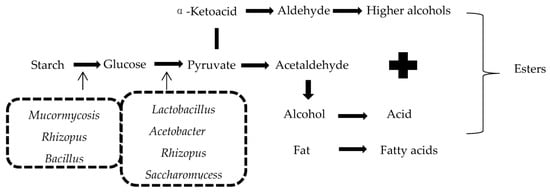
According to the proportions of amylose and amylopectin in the grain and differences caused by the structure of starch in the brewing process, sorghum can be divided into waxy sorghum and japonica sorghum. Sauce-aroma Baijiu using glutinous sorghum as the raw material is provided with a higher liquor yield and quality, and much greater quantities of flavor substances [
23]. In the fermentation process, starch is hydrolyzed to produce glucose, fructose, lactose, etc., under the action of
Rhizopus, Mucormycosis and other microorganisms, and then further generates ethanol, lactic acid, esters and other flavor substances with the action of bacteria,
Rhizopus and yeast [
24]. Besides, microorganisms can also produce various higher alcohols through the glucose anabolic pathway using sugars [
25]. The oxidation of alcohols will further generate acids [
26], and, together with fatty acids produced by fat metabolism, they constitute the acids in Sauce-aroma Baijiu, have obvious flavor effects and can prolong the taste of Sauce-aroma Baijiu in the mouth [
27]. Then, the acids react with alcohols to form esters (
Figure 2).
Figure 2. Key—transformations of glucose and the formation of esters.
Tannin is a kind of polyphenol compound, extensively existing in the seed coat and glume of sorghum grains, and plays a crucial role in Baijiu brewing. It can not only inhibit the growth of miscellaneous bacteria, but can also be degraded by tannase secreted by microorganisms to generate various intermediate metabolites, such as phenolic acids, flavonoids and other small molecular phenols in the brewing process [
28]. Then, in the process of high-temperature accumulation, carboxyl groups in phenolic acids are removed by decarboxylase-secreted microorganisms and form other volatile phenols [
21], such as catechol and phenol, which are further degraded to generate other small molecules, giving Sauce-aroma Baijiu a unique flavor, such as smoky flavor, soy sauce flavor, burnt sauce flavor and milk flavor [
29]. The balance of various phenolic substances has a significant effect on the flavor quality of Baijiu. Thus, the content of tannin, a specific component of sorghum, determines the taste and flavor of Baijiu. Generally, the tannin content of sorghum used for brewing Maotai-flavor Baijiu is between 1.4% and 1.7% [
13].
Although the fat content in sorghum grain is lower than the content of other nutrients, in the brewing process of Sauce-aroma Baijiu the fatty acids and various organic acids produced by the fat in sorghum grains can be used as a prerequisite for flavor substances, Then, these substances can be metabolized by microorganisms to produce corresponding esters or decomposed by non-enzymatic reactions to produce volatile substances, thereby enriching the flavor of Sauce-aroma Baijiu [
30]. In glutinous sorghum used for brewing, the content of fat in the grain is generally not more than 4%. A small amount of fat can reduce the off-flavor in the brewing process, while a large amount of fat will lead to the rapid and wide generation of acids such as oleic acid and linoleic acid in the liquor, and the liquor develops an off-flavor and easily becomes turbid when cold. If the sorghum contains more fat, the oxidative decomposition of fatty acids will occur in the fermentation process, and low-molecular aldehydes or ketones will be formed, thus resulting in rancidity [
14].
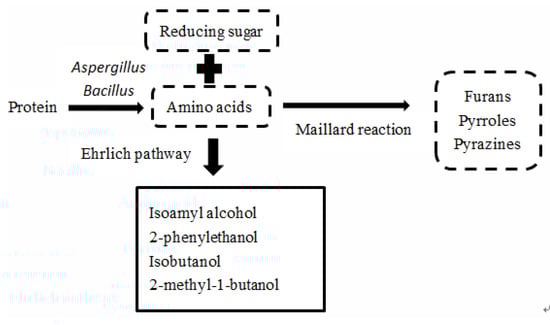
Proteins in sorghum grain also matter considerably in the production of Sauce-aroma Baijiu. In the fermentation process, proteins are metabolized to amino acids, peptides, organic acids and other substances under the action of microorganisms such as Bacillus, lactic acid bacteria, acetic acid bacteria and enzymes. The amino acids produced by
Aspergillus can promote the growth and metabolism of microorganisms and the activities of related proteases. At the same time, amino acids (aspartic acid and glutamic acid) in fermented grains react with reducing sugars. The flavor substances such as furan, pyrrole, and produced pyrazine are not only trace substances of Sauce-aroma Baijiu (
Figure 3), but are also the precursors of other flavor substances. Different types and contents of Maillard reaction products are important contributors to the unique Sauce-aroma [
32]. Besides, in the case of sufficient amino acid content, the corresponding alcohols can be generated by the catabolic pathway (Ehrlich pathway) [
25] (
Figure 3), and these alcohols are important precursors for the production of acids and esters.
Figure 3. Key—transformations of protein and the formation of sauce aroma.
3. Effect of Environment on Sauce-Aroma Baijiu
The core region of Sauce-aroma Baijiu is in the Chishui river basin, where the water is colorless, transparent, odorless, slightly sweet, and refreshing, with a moderate pH of about 7.2–7.4. The water is abundant with dissolved oxygen and contains more than 30 trace elements that not only benefit human health but are also essential for microbial growth and reproduction. The soil is heavy, red, and rich in organic matter that supplies various nutrient elements, especially nitrogen, phosphorus, and potassium, which are necessary for microbial metabolism in the pit mud. In addition, the subtropical microclimate, with an annual average temperature of 15 to 17 °C, humidity of 70 to 80%, and the suitable altitude of 300 to 600 m, is appropriate for the growth, reproduction, and metabolism of the brewing microorganisms and ensures their diversity and richness [36]. Such a micro-environment is rather suitable for the growth of Baijiu-making microbes necessary for forming the flavor of Sauce-aroma Baijiu. The process of brewing Baijiu involves an open network of microbes. For instance, Pseudomonas sp. and Bacillus oleronius are mainly from air, whereas uncultured Actinobacteria and possibly other bacteria, such as Weissella cibaria and Bacillus sonorensis, are mainly derived from soil [3]. During the natural fermentation process, the structure of the microbial community usually changes with changes in the fermentation environment including the temperature, humidity, acidity of fermented grains, and fermentation substrates [3,37]. Since ancient times, Chinese people have attached great importance to the geographical and ecological environment of Baijiu production; for example, the climate, soil, water quality, and other unique factors in the locality are generally taken into careful account. It is recorded in Qimin Yaoshu Making Divine Comedy and Liquor concerning the method of making liquor that, “A bucket of Qu consumes a five-liter bucket of water; When mulberry falls in October, it begins to freeze; making liquor with the current water can produce the spring rice wine…”. This passage reflects one of the technical measures in the process of producing traditional Huang Jiu (Chinese rice wine), which cleverly takes advantage of temperature changes and hot-water sterilization. The production of Sauce-aroma Baijiu adopts traditional brewing technology, with seasonal characteristics of “putting cereal for production on Double Ninth Festival and making Daqu on Dragon Boat Festival, both of which are traditional festivals in China” which likewise embodies or utilizes the value of environmental characteristics.
4. Effect of Production Process on Sauce-Aroma Baijiu
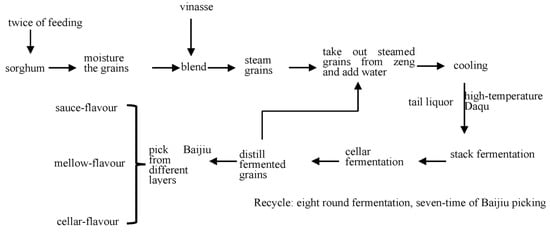
The process of producing Sauce-aroma Baijiu is the most complex among the 12 kinds of aromas Baijiu in China which include strong-aroma, light-aroma, sauce-aroma, rice-aroma, feng-aroma, te-aroma, sesame-aroma, laobaigan-aroma, fuyu-aroma, herbal-aroma, chi-aroma, and mixed-aromas. Baijiu production, from the beginning of feeding the sorghum to the end, requires following the process of “12,987”, i.e., “one production cycle per year, twice feeding, nine times cooking, eight rounds of fermentation, and seven times of Baijiu collection”. The steps are as follows (
Figure 4): (1) first feed sorghum; (2) moisten grains; (3) blend with vinasse from previous batch; (4) steam the grains; (5) take out the steamed grains from Zeng and cooling; (6) blend with high-temperature Daqu to pile on the ground and stack fermentation for 2 to 11 days; (7) place fermented grains in the cellar and ferment them for one month; (8) feed sorghum and moisten the grains again; (9) repeat Steps 4 to 7; (10) distil and pick the first round of Baijiu from different layers; and (11) repeat Steps 4 to 7 until seven rounds of Baijiu collection are completed [
40]. Metabolism, mechanisms, and materials change during the processes, as well as the materials, microorganisms, and enzymes in the system have always been a hot spot in the industry.
Figure 4. Flow chart of the brewing process of Sauce-aroma Baijiu.
4.1. Effect of Daqu on Sauce-Aroma Baijiu
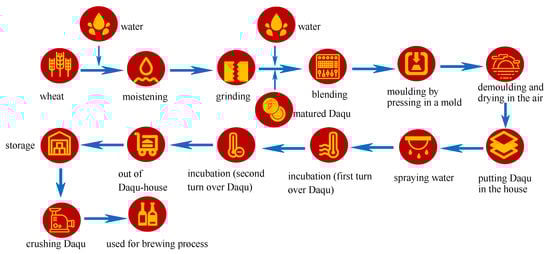
While producing Baijiu, the saccharification starter used in Baijiu production, called Daqu, takes wheat or barley and pea as the main raw materials. These materials are crushed by grinding, adding water and pressing into a brick, and are then fermented in Qu-room, thereby forming a saccharification and fermentation starter rich in multi-strains to initiate the alcoholic fermentation process [
41]. It can be divided into high-temperature, medium-temperature, and low-temperature Daqu. During the Daqu manufacturing process, bio-heat is likely to be the primary driver of the progression of Daqu microbiota. Culture temperature affects the growth and death, also the number of microorganisms, especially that of heat-sensitive and heat-resistant species, thus forming a special heat-resistant microflora composition. These microbes secrete various enzymes, such as amylase, glucoamylase, proteases, xylanase, and glucosidase, while these enzymes catalyze hydrolysis of compounds, including starch (alpha amylase and amyloglucosidase), protein (proteases), non-starchy polysaccharides (xylanase and others), glucan (β-glucosidase), and form the unique flavor of Baijiu [
42,
43]. Functional microbiota drive the fermentation process and influence the flavor of Daqu, even that of the final products, indicating the great significance of Daqu for the flavor formation. Its contribution to Baijiu production is comprised of three aspects, i.e., providing the microorganisms, providing the enzymes, and producing the aroma [
15,
44]. Microorganisms that exist in Daqu, such as
Aspergillus,
Rhizopus,
Bacillus spp.,
Lactobacillus,
Wickerhamomyces, and
Saccharomycopsis, secrete enzymes that catalyze hydrolysis-appropriate compounds, and eventually produce some flavor substances [
45,
46]. High-temperature Daqu used for producing Sauce-aroma Baijiu is entirely made from wheat, and contains a variety of microorganisms and enzymes, the culturing temperature of which reaches 60–65 °C. It should be cultivated at this high temperature for approximately 7–8 days, and then stored for 3–6 months before use (
Figure 5) [
47].
Figure 5. The process of producing high-temperature Daqu.
4.2. Effect of Brewing Process on Sauce-Aroma Baijiu
The technology of Baijiu production by solid fermentation involves double fermentation, i.e., simultaneous saccharification and fermentation. Saccharification means conversion of starches in grains into sugars, which are then fermented by microorganisms and enzymes into ethanol and other flavor compounds to complete the brewing process. The process of brewing Sauce-aroma Baijiu also involves two steps, i.e., high-temperature saccharification while being stacked on the floor and high-temperature fermentation in a cellar [
8]. The stacking process is a basic phase for flavor formation of Sauce-aroma Baijiu, when microorganisms make use of the nutritional components of the raw materials to produce organic acids, amino acids, sugars, alcohol, and other substances. During this very process, changes in moisture, acidity, oxygen, and temperature in the fermented grains affect the microbial community structure. The latter changes are conducive to the growth and reproduction of microbes, alcohol fermentation, and the generation of aromatic substances after entering the pit. After a series of biochemical reactions in the pit, alcohol and characteristic flavor components will eventually be produced [
8]. After high-temperature stacking, the contents of esters, alcohols, and acids in the fermented grains are significantly different from those not stacked, and the contents of each substance are much higher, perfectly demonstrating the importance of the high-temperature stacking fermentation in the whole Sauce-aroma Baijiu brewing process. The microbial profile in the fermentation stage differs substantially from that in the Daqu-making stage [
66]. Generally, the structural composition and functional capacity of the core microbiota determine the quality and quantity of the products.
In a high-temperature environment, microbes enriched in high-temperature Daqu propagate on fermented grains, accumulate in the ambient air to generate Sauce-aroma or its precursors, and create the conditions for cellar fermentation. During the stacking fermentation process, accompanied by a decrease in bacteria and fungi, the yeasts grow rapidly, thereby facilitating the normal fermentation in the cellar. During the stacking fermentation process, some bacilli such as
Clostridium and
Lactobacillus influence the amylase activity. The a-amylase concentration presents a typical changing pattern, with an initial increase followed by a decrease. Thus, degradation reactions are initiated by starches during the liquor fermentation process, and they themselves or their intermediates influence the taste and flavor of the liquor [
67]. Nine yeasts absent during the Daqu-producing process can be detected during the stacking fermentation stage. Four yeasts, namely,
Zygosaccharomyces bailii,
Saccharomyces cerevisiae,
Pichia membranifaciens, and
Schizosaccharomyces pombe, maintain their dominance until the cellar fermentation, among which,
S. cerevisiae and
S. pombe are the largest contributors to the production of volatile substances [
14,
68,
69]. Fungi are another microorganism that perform as a flavor producer during the stacking fermentation process. The predominant species in this stage is
Aspergillus oryzae, which is used as a saccharifying agent, with high glucoamylase and alpha-amylase activity, and produces large quantities of alcohols (phenyl ethanol, 1-octene 3-ol, 3-methyl-butanol) and esters (ethyl acetate, ethyl phenyl acetate), second only to yeast [
70].
Cellar fermentation is a key step in the generation of alcohol and flavor components, which can be divided into two stages, i.e., the ethanol generation stage and the high-level acid (lactic acid and acetic acid) generation stage. Eventually, the chemical reaction between ethanol and acetic acid forms ethyl acetate, which has the highest content among all ester compounds in Sauce-aroma Baijiu. The core functional microorganisms differ in these two stages of cellar fermentation. The production of ethanol is mainly related to
Schizosaccharomyces, while that of acid mainly involves
Saccharomyces cerevisiae activity. The transformation of functional microorganisms from
Schizosaccharomyces to
Lactobacillus is an important factor driving the change of the flavor components from alcohol (ethanol) to acid (lactic acid and acetic acid) while producing Chinese Sauce-aroma Baijiu [
3].
The Base Baijiu taken from fermented grains must continue for a further seven cycles of the Sauce-aroma Baijiu producing process. The Base Baijiu of the third, fourth, and fifth fermentation rounds is superior, and the main flora in these rounds include
Clostridium,
Lactobacillus,
Streptococcus,
Escherichia/Shigella,
Actinobacillus,
Citrobacter,
Alternaria,
Ciliophora,
Pyrenochaetopsis,
Cyphellophora,
Aspergillus,
Issatchenkia, and
Pichia, which may all matter considerably in forming flavor substances and producing ethanol during fermentation [
67]. Understanding the correlation between the main flora and liquor quality in each round should be beneficial for improving the flavor of Sauce-aroma Baijiu.
5. Effect of Storage on Sauce-Aroma Baijiu
5.1. Effect of Storage Time on Sauce-Aroma Baijiu
Generally, the pungent, spicy, and miscellaneous tastes in fresh Baijiu, mainly composed of low-boiling aldehydes and free olefinic molecules, can be reduced after storage. At that time, these low-boiling components volatilize, and various biochemical reactions proceed in the Base Baijiu, which make the Baijiu softer, sweeter, and full-bodied. Besides, the style becomes prominent, and the quality is improved [74]. However, reasonable storage time is necessary for Baijiu. To be specific, when Basic Baijiu is stored for some years, the content of aroma components will reach a balance, and the quality will tend to be stabilized. Baijiu manufacturers must consider the capital cost of storage, and formulate a reasonable storage time after taking into account the values of different qualities of Base Baijiu [75]. One of the main characteristics of the production of Sauce-aroma Baijiu is its long storage time, generally at least three years. During the storage process, the contents of various substances change continuously, and the total acid content increases, while the total ester content decreases and the two main esters, i.e., ethyl lactate and ethyl acetate, both decrease slightly. Among the aldehydes, the content of acetaldehyde decreases, while that of acetal (1,1-Diethoxyethane) increases significantly [76,77].
5.2. Effect of Storage Container on Sauce-Aroma Baijiu
There are many types of Baijiu storage containers, including pottery jars, stainless-steel tanks, and underground tanks, and different manufacturers choose different storage containers. Sauce-aroma Baijiu factories usually choose pottery jars and stainless-steel tanks for the storage of Base Baijiu. As a unique process, storage of Baijiu in pottery jars has been extensively researched. The microporous structure of pottery jars formed during the firing process can facilitate the Baijiu to undergo micro-oxygen respiration during storage, which not only is conducive to volatilizing the low-boiling substances in the Baijiu, but also promotes the redox reaction [
78,
79,
80]. Further, the metal ions contained in the pottery jars can enhance the associating ability of ethanol and water molecules, and metal oxides dissolved in the Baijiu can undergo condensation reactions with the aroma components, making the Baijiu more stable. Further, a higher content of metal ions such as iron and copper generally indicates that the metal ions are more conducive to the maturation of the Baijiu [
81,
82].
5.3. Effect of Storage Method on Sauce-Aroma Baijiu
During the production process, different manufacturers choose the most suitable storage methods according to the characteristics of different storage containers. Given that high-temperature storage in the short-term is beneficial for the speed of molecular movement in the Baijiu solution, the quality of Baijiu stored for 1 to 2 months at 55 °C is equivalent to that stored at natural temperatures for two years, and no reverse reaction will occur after their returning to room temperature [85]. Thus, open-air storage in summer can adjust the molecular structure of Baijiu and accelerate the aging. Storage in pottery jars can accelerate the change of substances more than storage in stainless-steel tanks [86], but greater weight loss occurs in the open air, thus making open-air containers more suitable for early-stage storage. After being stored for 6–12 months, the Baijiu should be transferred indoors [87]. Compared with open-air storage, indoor storage is less disturbed by external environmental conditions, where temperature and humidity are relatively constant, various reactions in the natural aging process can proceed smoothly, the style of Baijiu is more stable, and there is less weight loss [88]. A more stable indoor environment is more conducive to natural maturation.
This entry is adapted from the peer-reviewed paper https://doi.org/10.3390/foods11213534