2. Development of Cosmetic Formulations Based on Bioactive Compounds Obtained from Grapevine Wastes
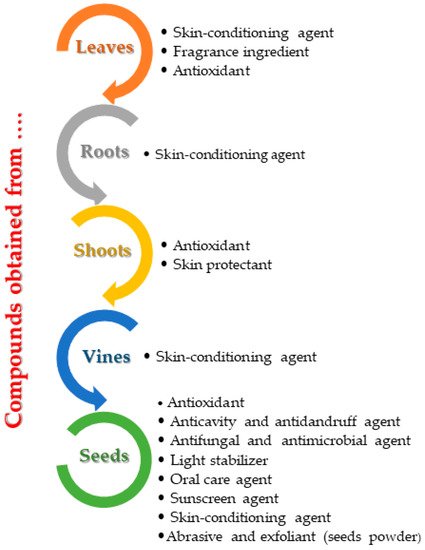
The cosmetics industry includes a wide range of products having as their main role the care, protection and improvement of skin (
Figure 4). Given their final application, they can be classified into hygienic (deodorants, soaps), decorative (hair dyes, makeup) and protective (moisturizers, lubricants or sunscreens) products [
38]. Each of them contains a basic substance, an active ingredient and a raw material or main ingredient. Classic preservatives in cosmetic formulations, mainly parabens or formaldehyde, exhibit negative effects on an organism, and were eventually replaced by natural ingredients. The process includes the extraction of biologically active principles (especially polyphenols) and their application in cosmetic formulations, as antioxidants for skin care [
39]. Various scientific studies confirm the presence of high levels of bioactive compounds in grapevine wastes (especially canes, stems, leaves, etc.), the literature data presenting over 183 phenolic compounds, 78 stilbenes, 15 hydroxycinnamic acids, 9 hydroxybenzoic acids, 17 flavan-3-ols, 14 anthocyanins, 8 flavanoavonols, 2 flavones and 5 coumarins [
40]. Many of these biocompounds can be successfully applied for the development of new cosmetic formulations [
41].
Figure 4. The main applications of bioactive compounds obtained from grapevine waste extracts in cosmetic formulations.
Polyphenols play an important role in skin functionality, having moisturizing, smoothing, calming, softening and astringent effects. In addition, they soothe irritation and reduce the redness of the skin, accelerate the natural regeneration of the epidermis, and improve the microcirculation and elasticity of the skin [
42]. They also protect the skin from harmful external factors, being used as active agents in cosmetic formulations as sun protection ingredients, having the same mechanism of action as chemical UV filters [
43]. Oxidative stress, defined by Kawamura et al. [
44] as a “disturbance of the oxidation-reduction balance in favor of oxidants”, can eventually lead to damage to biomolecules, changes in metabolism, increased DNA mutations, and an increased rate of cell mitosis [
45]. In addition, the impact of oxidative stress on human body can generate inflammatory, cardiovascular, neurodegenerative or metabolic disorders, which in turn can lead to the development of cancer [
46]. Free radicals and ROS (reactive oxygen species) are the main oxidizing agents in cellular systems, physiologically produced in various cellular biochemical reactions that occur in the organism, both in mitochondria for aerobic oxygen production, in the metabolism of fatty acids and drugs, and during the activity of the immune system [
47]. Furthermore, they are involved in the aging process and in the evolution of many other types of diseases [
48]. The aging process can be slowed down by using exogenous and endogenous antioxidants, which can readjust the level of oxidative stress in the human body [
49]. The antioxidant effect of polyphenols (including those recovered from vineyard wastes) is to eliminate free radicals O
2− and OH
−, by donating a proton from a hydroxyl group attached to the aromatic ring. Thus, they prevent high levels of ROS, reactive nitrogen species and oxidation of sensitive biomolecules, proteins or lipids [
46]. Skin aging is a continuous phenomenon, being caused by both internal factors (cellular metabolism, DNA metamorphosis, mitochondrial and genetic dysfunction) [
50,
51] and external ones (including lifestyle, diet, pollution, smoking, UV light and other environmental factors) [
52].
In addition to their antioxidant properties, polyphenols can inhibit the enzymes (tyrosinase, collagenase and elastase) responsible for the aging process of the skin [
53,
54].
Thus, gallic acid, chlorogenic acid, epicatechin, rutin, and resveratrol, which are found in vine-leaf extract, can inhibit the activity of tyrosinase with an IC
50 value of 3.84 mg/mL of tyrosinase inhibition, and thus the extracts can be used in cosmetic formulations as a natural whitening agent [
55].
In many cases, nanoformulation of resveratrol might be a reliable solution to increase its efficiency because it is unstable against temperature, pH and light and has low solubility in water [
56]. Resveratrol-based gel (0.01% weight by volume, applied once a day) may improve the severity of acne and the average surface of microcomedones without any reported side effects [
57], while resveratrol-enriched products can ameliorate facial redness [
58].
In a recent study, Leal et al. [
59] propose the use of grapevine stem extracts (Syrah variety) as raw material in cosmetic products to combat skin wrinkling and pigmentation. In addition, they exhibit anti-inflammatory activity (by inhibiting the nitrite production at non-toxic cell concentrations), anti-aging activity by suppressing the enzymes tyrosinase (53%) and elastase (98.02%), and antimicrobial effects on gram-positive bacteria, having the ability to inhibit the growth of ulcerated bacteria in wounds to the foot [
59].
Grape seed oil is known to be rich in unsaturated fatty acids and phenolic compounds [
60,
61]. Furthermore, high levels of antioxidants from grape seeds exert a protective effect on the skin by increasing cellular resistance and protecting fibroblasts from UV damage by absorbing it [
62]. Based on all these considerations, grape seeds can serve as value added to cosmetic formulations [
62]. In the composition of some sunscreens, extracts with compounds that exhibit anti-inflammatory activity to reduce UVB-induced erythema or to increase the protection factor (SPF) have been added [
63]. In vitro studies on the photostability of the formulation containing 10%
w/w grape pomace extract and 11.5%
w/w UV filters showed an SPF value of 16 and an antioxidant activity of 519.92 ± 0.00 μmol Trolox equivalents/g [
64]. Furthermore, the methodology proposed by Michailidis et al. [
65] proposes the use of grape seed extracts obtained by ultrasound-assisted extraction in dermo-cosmetic products, as anti-elastase and anti-tyrosinase factors [
65].
Grape seed extracts (GSE) have been successfully used in the formulation of emulsions and emulgels. In a detailed study, Rafique et al. [
66] demonstrated the anti-inflammatory and anti-wrinkle properties of polyphenols from grape seeds, properties that increase skin hydration and elasticity. The proposed emulsion consists of an oily phase containing propylene paraben (preservative)/paraffin oil/Abil-EM 90 (emulsifier)/distilled water/5% grape seed extract. In parallel, the emulgel was formed by mixing the oily phase with an aqueous phase (containing grape seed extract) and finally with a gel phase (created by homogenizing the Carbopol 940 with water). The authors claim that, due to its twice as well-controlled release effect, the emulgel has better anti-aging properties than the emulsion. Another type of oil-in-water emulsion was developed by Yarovaya et al. [
62]. In the aqueous phase (containing glycerin and water) xanthan gum was dispersed until a uniform gel was formed. The oily phase was formed in two stages: (i) emulsion consisting of mineral oil, cetyl alcohol and cetamacrogol 1000, over which the aqueous phase and grape seed extract were added and (ii) emulsion containing both grape seed extract and octyl methoxycinnamate. A preservative was added to the mixture of these two parts. The results showed that cells can be protected against UVA radiation if a concentration of 25 μg/mL of GSE is used (this increases the activity of dermal fibroblasts). At the same time, the octyl methoxycinnamate plays an important role in cosmetic formulation because it increases the absorption capacity of the UV filter [
62].
Grape cane extracts enriched with polyphenols may activate SIRT1 (a cell longevity protein) and have the ability to inhibit tyrosinase as effectively as pure E-resveratrol and E-ε-viniferin, having utility against dark spots or as skin-lightening agents in eco-dermocosmetic products [
67]. In a 28-day study on 60 female subjects, shoot extracts (serum/cream formulation) proved anti-aging effects through increasing radiant glow, evenness, smoothness, hydration, texture, softness effects and decreasing of wrinkles and fine lines [
68].
A topical formulation was created by Moreira et al. [
69] using subcritical water vine-cane extract with high antioxidant properties. The ingredients used for this purpose were: glycerin (7%)/Carbopol (0.5%)/triethanolamine (0.3%)/preservative (phenoxyethanol/methyl paraben/ethyl paraben/propyl paraben/butyl paraben mixture, 0.1%)/perfume (0.1%). The cosmetic formulation was achieved by dissolving the Carbopol in a mixture of extract/water: 75%/17% ratio at room temperature, while to form a homogeneous gel, triethanolamine was added under continuous stirring. Furthermore, vine cane extracts effectively inhibit the formation of biofilm on
Candida albicans and
Candida parapsilosis strains, with a minimum inhibitory concentration (MIC) value of 5 mg/L and 30 mg/L respectively [
70].
The extracts obtained from tendrils and leaves of
Vitis vinifera L. have shown antioxidant activities (in the DPPH and ferric reducing antioxidant power — FRAP assays) and anti-inflammatory capabilities by mitigating the proinflammatory response induced by the exposure to lipopolysaccharides of human gingival fibroblasts cells. The authors suggest that they may be used in oral hygiene products for periodontal disease [
71]. In another study, Singla et al. obtained a mouthwash solution based on grape seeds. From in vitro studies, the grape-based oral care formulation showed a reduction of 12.5 % in oral streptococci [
72].
In a formulated cream based on an oil/water emulsion, Carica papaya leaf,
Psidium guajava leaf and
Vitis vinifera seeds were used as natural preservatives. The obtained emulsion showed a promising antibacterial effect against the proliferation of various microorganisms, as the concentration of grape seed extract was higher [
73]. Extracts rich in stilbene, obtained from grapevine cane waste (Ohanes, Regent, Pinot noir and Tin-tilla de Rota), have showed high antioxidant activity. Thus, they can be used as a natural raw material in nutraceutical applications, but also as natural fungicides [
35]. Some representative examples regarding the application of compounds from grapevine wastes in cosmetic industry are presented in
Table 2.
Table 2. Some examples of grapevine wastes application in cosmetic formulations.
3. Applications in the Food and Beverage Industries
The food industry is one of the main industries that generates different types of waste. Worldwide, the interest in new valorization mechanisms has increased significantly in order to protect resources and the environment [
74]. Due to its phytochemical profile, abundant polyphenols and fibers, and exhibiting of high antioxidant and antimicrobial activities, grapevine waste extract (vine shoots, grape stalks and wine lees) might be efficiently used in the food sector as an oenological and functional additive, functional food or even as fillers in food packaging [
24]. Therefore, adding grape by-products (pomace) into animals’ diets has been shown to be effective in increasing the nutritional value of their meat. In the same way, they have been added to the diets of poultry, observing the ratio improvement of polyunsaturated and saturated fatty acids [
75,
76]. Furthermore, the use of grape stems and wine lees grape extracts as feed additives in broilers’ diets improves the quality of the meat [
77].
De Iseppi et al. [
78] proposed the use of wine yeast glycocompounds (a winemaking by-product) in order to improve both the sensory properties and stability of wine. Results obtained in the case of wine lees extracted by autoclave showed an enhancement of wine foaming along with the efficient recovery of tartrates from its insoluble fraction, and the yeast extracted by enzymatic and ultrasound methods stabilizes the proteins from heat-sensitive wine [
78]. Raposo et al. [
79] studied extracts from vine shoots, which contain 29% stilbenes, for their potential preservative effect on bottled wine. In the initial phase, the wines treated with shoot extracts presented qualitative superior oenological parameters and higher values of purity and color intensity; unfortunately, these characteristics are not maintained after a year [
79]. Additionally, Gutiérrez-Escobar et al. [
80] have studied the possibility of the replacement of SO
2 in wine with pure stilbene extracts from grapevine shoots. The natural extracts, abundant in E-ε-viniferin (70%) and E-resveratrol (18%) and with no aromatic compounds, exhibited high antimicrobial activity against
Brettanomyces bruxellensis and
Zygosaccharomyces bailli yeasts strains. Thus, vine shoot extract might be used as a preservative of wine as well as to increase its stilbenes content [
80].
Various scientific studies report the applicability of grape stems extracts in the food industry. Phenolic acids, flavanols and tannins from dried and milled vine stems have the ability to remove unstable proteins, being used as a replacement for bentonite (a clay used in wine to avoid protein haze formation) [
81]. The hydroalcoholic extracts of grape stems play an important role in the inhibition of food pathogens such as
Listeria monocytogenes,
Staphylococcus aureus,
Salmonella enterica subsp.
enterica serovar
Typhimurium and
Escherichia coli in the cases of lettuce and spinach [
82]. By drying, crushing and autolysis of wine yeast, proteins are successfully extracted and applied in the production of fortified cereal bars, improving their protein content [
83].
Due to their phytochemical composition, wine lees can also enhance the antioxidant and antimicrobial activity and phenolic compounds in burgers, being used as an alternative to synthetic additives [
84]. Phenolic compounds and dietary fiber from wine lees can be also used in the production of high added-value ice cream, conferring better structure, high antioxidant content and inhibitory effect towards the oxidation of human erythrocyte membranes [
85], enhancing their physical, chemical and sensory properties, along with protection against
Lactobacillus acidophilus during storage [
86].
Iuga et al. [
87] proposed the use of grape seeds and pomace as secondary flours in the production of pasta and pastry products, having the effect of improving the functional ingredients in these branches of the food industry [
87]. In the same way, the flours obtained from these types of waste offer physico-chemical characteristics within the nutritional standards, being applied in the biscuit industry [
88].
The negative effects of plastic materials on the environment have led the scientific community to develop new biodegradable materials. Thus, insoluble lignocellulosic fibers extracted from grape stalks are used as foams in food packaging, giving them improved mechanical properties, high resistance to moisture and biodegradable characteristics [
89]. Díaz-Galindo et al. [
90] created a new sustainable food packaging formula based on polylactic acid loaded with grapevine cane extract (5–15 wt%), aiming to prevent food contamination throughout transport and storage. The material showed thermal stability up to 300 °C and resistance values at traction similar to those of commercial materials; the addition of larger amounts of extract increases the breaking strength of the films. Some representative examples regarding the application of compounds from grapevine wastes in food and beverage industry are presented in
Table 3.
Table 3. Applications of grapevine wastes-derived products in food and beverage industry.
4. Potential Uses of Grapevine Waste-Derived Products in Biomedical Applications
It is well known that the long-term use of commercial synthetic drugs presents side effects on human health [
91]. Various scientific papers claim the benefits that polyphenols recovered from different plants in general, and from grapevine wastes in particular, can bring on human health, by protecting the cardiovascular system and neurons as well as anticancer activity [
92,
93,
94,
95,
96,
97]. In different parts of the grapevine, there are different nutritional components such as proteins, lipids, carbohydrates, minerals, vitamins and a wide diversity of bioactive compounds that can have antioxidant, antiviral, antiplatelet, antifungal, anti-cataract, anti-obesity, anticholinergic, and anti-inflammatory effects among others [
98].
As mentioned before, winemaking by-products consist of high levels of polyphenols and dietary fiber that fulfil various beneficial roles on human health, namely cardiovascular disease and obesity prevention, control of glucose absorption and the levels of cholesterol in blood [
99,
100]. One of the main radical generators involved in cell damage is the powerful oxidant called peroxynitrite (ONOO
−). Thus, quercetin, catechin and epicatechin extracted from grape seeds and skins lead to IC
50 values of 48.8, 55.7 and 56.7 mM [
101].
Two potential inhibitor compounds of amyloid β-protein 25−35 (Aβ) were recovered from grapevine extracts, namely ampelopsin A and piceatannol [
102]. It is known that ampelopsin A is responsible for the in vivo protection against brain cell dysfunction by blocking the aggregation of Aβ [
103]. In addition, piacetamol (a hydroxyresveratrol) has cardioprotective activity and can also decrease neuronal inflammation in microglial cells [
104]. Another compound that can prevent the aggregation of amyloid-β peptides was isolated by Chaher et al. from vine shoot extracts. Thus, the newly isolated compound, Vitisinol C, showed an EC50 value of 5 ± 3 (μmol/L), being proposed for use in the evolution of pharmaceutical therapy for Alzheimer’s disease [
105].
Nowadays, it is a generally accepted premise that moderate and regular consumption of red wine might be the key to the prevention of cardiovascular, oncological and neurodegenerative diseases, type 2 diabetes and other chronic diseases [
106]. However, winemaking by-products present a much higher total content of anthocyanins, stilbenes, and flavanols, being much more effective in antioxidant therapy than wine itself [
107].
Bioactive compounds from wine by-products exert their protective effect on disorders caused by oxidative stress or inflammatory processes [
108]. Thus, flavonoids from grape pomace can decrease the production of RONS (reactive oxygen species and nitrogen) by inhibiting the enzymes that produce them, in particular NOX4 (NADPH oxidase 4), eNOS (endothelial nitric oxide synthase), COX2 (ciclooxigenase 2) and SOD1 and 2 (superoxide dismutase 1 and 2), upregulating NF-κB (nuclear factor-kappa B) and downregulating Nrf2 (nuclear factor erythroid 2-related factor 2) pathways [
109]. Enzymatic grape pomace extracts can adapt, in vitro, the transcription of 7α-hydroxylase cholesterol and 27-hydroxylase sterol [
110], and ex vivo tests in Wistar rats show lowering levels of VLDL cholesterol and triacylglycerol [
106]. Ulcerative colitis, induced by acetic acid, showed ulceration, edema and erosions to the colon in laboratory mice. Histological examination presented an improvement in the intensity and distribution of lesions during the treatment with 0.15 and 0.1 mg of grape pomace seeds [
111].
Following the evaluation of grape stem extracts, Quero et al. [
112] reported the effects they have on cancer cells (Caco-2, MCF-7, and MDA-MB-231) and also on the intestinal barrier (differentiated Caco-2 cells), suggesting them as a promising factor in cancer treatment and in adjustment of ROS in the gastrointestinal tract. The extracts exerted a decreasing effect on the growth of cancer cells, causing death by apoptosis and an inhibitory effect on the antioxidant enzyme TrxR1, which is responsible for the growth of ROS at the cellular level. In the intestinal barrier, bioactive compounds produce an antioxidant effect providing protection to the intestine in the case of disturbances associated with oxidative stress [
112]. Similarly, grape seed extracts from the Negramaro variety were found to be able to induce apoptotic cell death in MCF-7 breast cancer cells. Researchers demonstrated that this effect of grape seed extracts is mediated by improving gap-junction-mediated cell–cell communications through reallocating connexin-43 proteins on plasma membranes and controlling cx43 mRNA expression [
113]. A preliminary test over 14 days was performed on rats, to which a pretreatment with 4 mL/kg/day grape seed oil (GSO) was applied, following the experimental induction of ischemia by a single administration of isoproterenol (ISO) 45 mg/kg after 14 days. The final results showed that GSO pretreatment has the ability to remarkably decrease the ventricular conduction, the levels of proinflammatory cytokines and the myocardial fraction of creatine kinase, thus providing a cardioprotective effect in ISO-induced myocardial ischemia [
114]. In the case of Cyclophosphamide-induced cardiotoxicity (a single dose of 200 mg/kg/b.w.), a pretreatment consisting of grape seed extracts (oral administration on rats, 150 and 300 mg/kg doses for 6 weeks) has the ability to protect the liver and heart tissue, and may also have an ameliorating effect on oxidative and apoptotic biomarkers, as well as the activity of liver and heart function enzymes [
115]. Grape seed extracts were also proven to possess the capacity to reduce two digestive enzymes, namely pancreatic lipases and α-glucosidases, thus having utility in preventing obesity [
116].
According to Doshi et al. [
117], grape seeds and stems may be a new source of insulin secretagogues, suggesting their application in the treatment of type II diabetes. In the presence of these waste extracts, clinical trials on mice showed that, in the pancreatic islets, there is a 2- to 8-fold increase in insulin secretion at a concentration of 5.5 mM and 16.5 mM glucose [
117]. One of the major risk factors for cardiovascular disease is represented by hypertension. Thus, Odai et al. [
118] conducted a scientific study in which, for 12 weeks, they administered high doses of grape seed proanthocyanidin extract (400 mg) to 6 men and 24 women, all middle-aged and prehypertensive. The final results revealed an improvement in vascular elasticity and a decrease in systolic blood pressure by 13 mmHg after 12 weeks [
118].
Two experimental pathways have been adopted by Empl et al. [
119] to investigate the possibility of using grapevine shoots extracts as agents in the prevention of human gastrointestinal cancer. In vivo research on ApcMin mice, which were subject to a high-fat diet similar to a human model of adenomatous polyposis, reported that both low and high doses of grapevine shoot extracts have the ability to reduce the number (in males) and volume (in females) of intestinal adenoma. An in vitro experiment was conducted on APC10.1 cells derived from one ApcMin mouse, showing that shoot extracts may reduce the increase in APC10.1 cells by stopping the cycle and cell sequence, as well as by lessening the number of cells [
120].
The neuroprotective effects of organic and conventional extracts from grapevine leaves have been analyzed by their ability to diminish protein and lipid damage and by adjustment of enzymatic antioxidant activity. Organic extracts have shown a protective effect on oxidative deterioration (caused by hydrogen peroxide in the brain of rats) of lipids and proteins in the hippocampus and cerebellum tissues. The conventional ones could reduce TBARS (thiobarbituric acid reactive species) levels in the cortex [
120]. The MTT test, applied to evaluate the antiproliferative activity of grape leaf extracts on melanoma A375 and SK-MEL cells, revealed that, with increasing water concentrations and methanolic leaf extracts (1.136, 2.27 and 4.54 mg/mL), a decrease in melanoma cell proliferation is observed during 72 h. Thus, the extracts exert an antiproliferative effect comparable to Cisplatinium [
121].
Meng et al. [
122] induced obesity in mice by applying a high-fat diet, containing 60% kcal from fat. They claim that the intragastric application of leaf extract (400 mg/(kg × day) inhibits the secretion of pancreatic lipase (IC
50 = 1.18 mg/mL), supports the secretion of fibroblast growth factor-15 (which stops the synthesis of bile acids and fatty acids) and can reduce food intake by suppressing orexigenic neuropeptide-Y. All these aspects can lead to a lower level of serum cholesterol and low-density lipoproteins in triglycerides, while also decreasing the amount of tissue fat. Thus, leaf extracts may be a natural source of components for preventing obesity mediated by neuropeptide-Y and bile acids [
122]. Some representative examples regarding the biomedical applications of compounds from grapevine wastes are presented in
Table 4.
Table 4. Examples of biomedical applications of compounds from grapevine wastes.