You're using an outdated browser. Please upgrade to a modern browser for the best experience.
Lime Mortar: History
Please note this is an old version of this entry, which may differ significantly from the current revision.
Subjects: Engineering, Civil
Contributor: Abirami Manoharan ,

Lime is an ancient construction material that has been utilized throughout the world in various forms, providing stable construction methods in usable conditions. Lime mortar is well known for its low carbon footprint in production and carbon absorption throughout its lifespan as a hardened material. The significant benefits of lime mortar were analyzed and reviewed for further research. Ancient lime constructions need proper maintenance for aesthetic and structural strengthening to preserve this cultural architecture of national pride. Hence, the characterization of ancient mortars is mandatory for renovation work. 

  • lime mortar/ancient mortar
  • bio-additives
  • characterization study

1. Introduction

The long lifespan of ancient structures has interested researchers to analyze and study the use of old construction materials for present environmental conditions. These ancient monuments require proper maintenance, capable of making them more stable. The United Nations Educational, Scientific and Cultural Organization (UNESCO) lists about 1154 properties throughout the world as heritage sites, out of which 52 are on the danger list because of improper maintenance and are prone to natural calamities (such as climate change). India is home to 40 of the total heritage properties listed by UNESCO, out of which 36 heritage sites have been given international assistance. However, thousands of ancient structures (temples/palaces/mosques, etc.) are present locally in every part of the country, which need immense care for the pride they represent. India is rich in culture, resources, and numerous peoples who live united and work together to preserve their traditions in all aspects. The peoples of every region traditionally conduct the construction of any structure according to their beliefs.
The initial development of construction technology throughout the world made use of lime, the most important binder material for construction, which is readily available and can quickly be processed into a usable form for more substantial and more durable buildings [1]. Lime is a natural rock formed by the sedimentation of shell, coral, algal, fecal, and other organic debris, as well as by chemical sedimentary processes, such as the precipitation of calcium carbonate from lake or ocean water. It has been the primary binding material for construction from ancient periods until today, in partial combination with cement. Historically, people made use of materials for construction, which were minimally processed and utilized; these materials satisfied the needs of people without disturbing nature [1].
Despite their merits, modern construction materials have the major demerit of producing carbon dioxide emissions [2], which is a significant greenhouse gas. From its production phase and throughout its life span, cement material emits this harmful pollutant into the environment. The carbon dioxide sequestered by cement materials is much higher than the amount they produce in the atmosphere. Carbon dioxide is the primary greenhouse gas leading to the increase in global warming. Global warming is a global problem that is melting the ice glaciers, which will increase the sea level [3,4] and submerge coastal areas. Hence, more populated areas will be submerged by water. The introduction of cement was a major breakthrough in construction due to its highly beneficial property of faster setting time and higher strength than lime (initially the most common binding material used by humans from the construction era) [5,6]. Lime as a construction material has significant quality of carbon dioxide absorption for the carbonation of lime to form a stable and durable construction material [7]. The carbonation process benefits the environment and the construction quality [6].
Tamil Nadu is rich in cultural, heritage, and historic sites, which play a vital role in the tourism sites of South India. The origin and historic sites are renowned constructions made with construction technology using naturally available environmental materials, without causing any pollution. These sites thus have a minimal carbon footprint, from production to throughout their lifespan. Lime and river sand enabled the construction of magnificent structures such as Brihadeshwarar Temple, Thanjavur; Shore Temple, Mahabalipuram; Vellore Fort; Gingee Fort, and numerous temples in Kanchipuram, Madurai, Kumbakonam, and other parts of Tamil Nadu. In this study, characterizations of sample materials taken from these ancient structures of Tamil Nadu confirmed the presence of organic materials in lime mortar. Reports of the samples collected from these ancient structures indicate the mineralogical presence of various organic substances. Characterization studies play a vital role in choosing repair materials because incompatible repair materials lead to enhanced structural deterioration. Many temples have undergone renovations with cement repair materials and utterly incompatible repair work methods for lime-based structures. To maintain the originality and the environment produced in these old temples, the preservation should retain its uniqueness. The characterization study was effectively conducted using RILEM TC 167-COM norms to determine the mineralogical composition [8,9].

2. Characterization of Ancient Mortar—Overview

The importance of characterization studies has been researched across various aspects to determine compatible repair materials and suggest ancient construction materials for the modern scenario. This research paper analyzes and overviews the experimental methods and identifies the presence of various ingredients formed by age capable of giving solid and durable constructions. Table 1 provides an overview of the research conducted in different parts of the world.
Table 1. Overview of characterization studies and experimental methods used.
Ref. No Author Location of Ancient Structure Characterization Ingredients Research Findings
[10] [1] Minoan civilization Petrographical and mineralogical
characterization,
calorimetry,
XRD, TGA, FTIR, and chemical analysis
Hydraulic lime, with crushed brick, with pozzolan The level of hydraulicity
and compatible repair material suggestion
[11] [2] Beja, Portugal Petrography, XRD, TGA, SEM-EDS,
potentiometry and combustion analysis
Calcitic air lime The compatible
repair materials and water-proofing properties and higher mechanical strength
[12] [3] Turkey Optical microscopy and XRD Lime, volcanic tuff, and ceramic waste High freeze-thaw resistance
[13] [4] Indian lime mortars SEM–EDS Hydraulic lime The polymorphic changes and the presence of portlandite, anhydrite, and gypsum were confirmed along with minor traces of ettringite and thaumasite; the chloride and sulfate phases are explained
[14] [5] Herculaneum,
Italy
XRF, petrography, and TGA Slaked lime and ground brick dust The importance of
the maintenance of structures
[15] [6] Skikda in Algeria Mechanical properties—compression and flexural strength, fresh state–flow table test, durability, Water absorption, and carbonation tests Air lime, brick dust, and glass powder Reuse of waste products with lime
[16] [7] Greece SEM, compression, and flexure Lime and marine plant fibers Fiber-reinforced lime mortar
and low carbon emissions
[17] [8] Campania–Southern Italy Optical microscopy (OM), X-ray powder diffraction (XRPD), X-ray fluorescence (XRF), electron probe microanalysis (EPMA), and Raman spectroscopy Lime Identifying various ancient mortar mix
[18] [9] Florence, Italy Archaeometry study, XRD, SEM, and XRF Hydraulic lime Prevailing calcite and hydraulic compounds
[19] [10] Karaikudi, Tamil Nadu Acid loss analysis, XRD, XRF, SEM
and FTIR
Powdered brick, animal fur (especially goat), volcanic pozzolanic material, egg white, jaggery, and fenugreek seeds Confirmation for Ingredients in the mortar sample
[20] [11] Pisa EDAX, XRF, the chemical composition of the binder, petrographical and mineralogical determinations Lime
and fine aggregates
The presence of carbonate crystalline fraction and an amorphous carbonate-free fraction
[21] [12] Roman Odeion Physio-mechanical,
Microstructural
Chemical properties
Lime, clay, pozzolan, gypsum, brick dust, and different types of aggregates The compatible repair material selection and preservation of ancient monuments
[22] [13] Villa San Marco Digital video microscopy, optical microscopy, digital image analysis, SEM-EDS analysis, and quantitative powder X-ray diffraction Lime and volcanic sand as aggregate Reference for the research of ancient structures and selection of materials
[23] [14] China Water/lime ratio,
sand/lime ratio and curing ages
Shell lime
and glutinous rice
The improved properties of structures using shell lime compared with rock lime
[24] [15] Belém do Pará, Northern Brazil XRF, SEM, DSC Shell lime The types of layered coating and resistance of the ancient mortar to various climates because of the homogenous selection and development of the binder material
[25] [16] Southern Italy Photogrammetric
survey, damage
diagnosis, petrography and FTIR
Geomaterials,
limestone, yellow tuff, grey tuff and brick
The damage categories and indices and decision making for restoration
[26] [17] Egypt Polarized optical
microscopy (POM),
scanning electron microscopy (SEM–EDS), X-ray diffraction (XRD), thermogravimetry (TG),
X-ray fluorescence (XRF), ion chromatography (IC)
and petrological techniques
Lime, soil
and airborne particles
Self-healing capacity of mortar and changes in isotopic fractions by time
[27] [18] Swedish church Mass spectrometry
principal component analysis, liquid chromatography and electrospray ionization quadrupole time-of-flight mass spectrometry
Lime, animal glue, blood, egg and milk Method of protein analysis
and the presence of protein
was identified by mass spectrometric techniques
[28] [19] China Visual inspection,
apparent density,
compressive strength
and chemical composition
Hydrated lime, sand, clay and blue bricks Characterization study to determine aggregate binder ratio and strength
[29] [20] China XRD, SEM, FTIR and TGA Lime, sticky rice, sand and clay Encouraging the use of organic additives
[30] [21] San Lorenzo Church, Milan XRD, SEM, TGAand visual observation Lime and sand The presence of
silico-aluminate
[31] [22] Corsiglia,
CastelViscardo
XRF Lime For the preservation of cultural heritage, compatible repair materials production and identification
[32] [23] Janjira Sea Fort, India XRD, SEM, FTIR, NMR and MIP Lime Formation of apatite and
the presence of phosphate-solubilizing bacteria
[33] [24] Ostia Antica Mineral–petrographic composition, XRD and FTIR Lime The presence of calcitic hydraulic materials and flying lime and dolomite aggregate with impurities of metamorphic quartz typical of a filler
[34] [25] India SEM-EDS, XRD, FTIR, TGA-DT
and acid-dissolutionanalysis
Lime The presence of organic content and formation of crystal morphology of calcite and quartz is identified
[35] [26] Pyramid,
Queretaro, Mexico
SEM, stucco elemental composition by ICP-OES, EDS, XRD, and particle size analysis Quicklime, pozzolan/organic ashes, additives, and aggregates such as sand and fibers Characterization by
experimentation
Table 1 presents brief details of various interesting studies that have experimented on the characterization of ancient lime mortar in multiple parts of the world. The significant number of experimental results given by all the researchers to develop basic knowledge on the ingredients of ancient lime mortar revealed the acid dissolution process of the hardened mortar material. The components were segregated and studied further by SEM, XRD, and FTIR tests. Each study exhibited a different composition, and all the results had one joint achievement of strength and durability. The research findings give the reactions of the formation of stable polymorphs of calcium carbonate by crystal morphology. The appearance of crystals and ettringite traces provide an understanding of the responses and construction of components that have made ancient structures time-resistant.

3. Lime with Bio-Additives

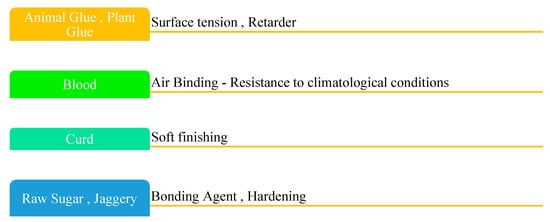
Lime is a form of sedimentary rock calcined to form lime and is minimally processed to form calcium oxide with water forms into a binding material. On environmental exposure, this matrix material absorbs carbon dioxide present in the air to form stable calcium carbonate (the carbonation process). The capability to utilize carbon dioxide makes it unique. It is a point of much-needed research to utilize it in present-day constructions. Bio-additives have been seen to improve the lime properties for more robust and durable ancient structures. Some of the predominantly used bio-additives for their associated improvements in properties are presented in Figure 1.
Figure 1. Commonly used bio-additives in ancient lime mortar [3,28,29,36,37,38,39].
The utilization of locally available materials in all the construction materials resulted in a reduced carbon footprint and more stable constructions that satisfied every area’s respective climatic conditions.

This entry is adapted from the peer-reviewed paper 10.3390/su14116481

This entry is offline, you can click here to edit this entry!
Academic Video Service