Your browser does not fully support modern features. Please upgrade for a smoother experience.

Please note this is an old version of this entry, which may differ significantly from the current revision.
Subjects:
Biochemistry & Molecular Biology
The development of low- or non-invasive screening tests for cancer is crucial for early detection. Saliva is an ideal biofluid containing informative components for monitoring oral and systemic diseases. Metabolomics has frequently been used to identify and quantify numerous metabolites in saliva samples, serving as novel biomarkers associated with various conditions, including cancers.
- oral cancer
- metabolomics
- saliva
1. Introduction
Oral cancer (OC) is a blanket term used to describe any cancer occurring in the oral cavity. In 2018, more than 350,000 new cases of OC and 170,000 deaths were recorded worldwide [1]. Tobacco usage, alcohol consumption, and human papillomavirus infection are the major risk factors for OC [2,3,4]. A recent study compared the incidence of OC in the 10 most populous countries over the past 30 years and reported declining trends in the annual age-standardized incidence rate of OC in Bangladesh, Brazil, Mexico, and the United States; however, increasing trends were observed in China, Indonesia, Pakistan, India, and Japan [5]. The 5-year overall survival rate of OC is approximately 50% [6]. To improve the prognosis and quality of life of patients, early detection of OC is essential [7].
The underlying epigenetic mechanisms and major risk factors of OC vary across countries. India accounts for one-third of the global OC cases, with 77,000 new OC cases and 52,000 related deaths annually [8]. Tobacco consumption is the main etiological factor. Most OC cases are diagnosed at advanced stages owing to delays in reporting to healthcare professionals [9]. Approximately 60–80% of the patients with OC diagnosed at late-stage Early detection can improve treatment efficacy and prognosis. Although various methods are available for screening, visual examination is the most commonly used owing to its low cost [10]. However, diagnosing lesions in the initial stage and differentiating them from inflammatory conditions remain challenging.
Despite the declining trend of tobacco use in Japan, the incidence of OC has increased [11]. Similar to the global trend, many patients are diagnosed with late-stage OC. In Japan, nationwide screening of five cancers (gastric, colon, and lung cancers for both sexes and breast and cervical cancers for women) is conducted annually or every other year. Insufficient screening is among the reasons for the increasing trend of OC. Therefore, the development of a new cost-effective screening system for OC is necessary.
Saliva is a mixture of biofluids and plays vital roles in oral homeostasis. Other functions of saliva include lubrication, digestion, buffering, taste, tooth protection, and immune defense by protecting against bacteria, viruses, and fungi. Saliva consists of various cellular and molecular components, such as transudate of the oral mucosa, desquamated oral epithelial cells, blood cells, oral bacteria, proteins, metabolites, and inorganic ions (Figure 1). Furthermore, it is mainly secreted from three major salivary glands (parotid, submandibular, and sublingual glands) and other minor glands. It also contains various components which originate from other sources, such as gingival crevicular fluid. Overall, these components make saliva an ideal biofluid for detecting various diseases.
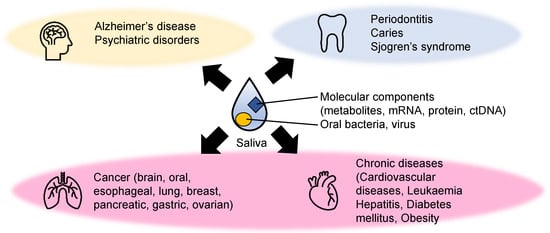
Figure 1. Examples of diseases detected using metabolite biomarkers. The biomarkers of mental illnesses (yellow), dental diseases (light blue), and various systematic diseases (light pink) related to metabolic abnormalities have been explored.
There are several advantages of using saliva for cancer detection. First, a positive correlation has been reported between salivary and plasma metabolite levels, such as those of glucose, pyruvate, and lactate [12,13], indicating that salivary metabolites provide biological information. Second, saliva is the most readily available biofluid, and its collection requires minimal training [14]. Third, analysis of saliva samples is convenient owing to the noninfectious collection process, easy transportation, and disposable nature [15]. Fourth, the saliva metabolite profile of each individual is affected by diet compared to that of urine collected from identical individuals [16]. Therefore, several cancer biomarkers have been identified using salivary omics technologies.
This entry is adapted from the peer-reviewed paper 10.3390/metabo12050436
This entry is offline, you can click here to edit this entry!