
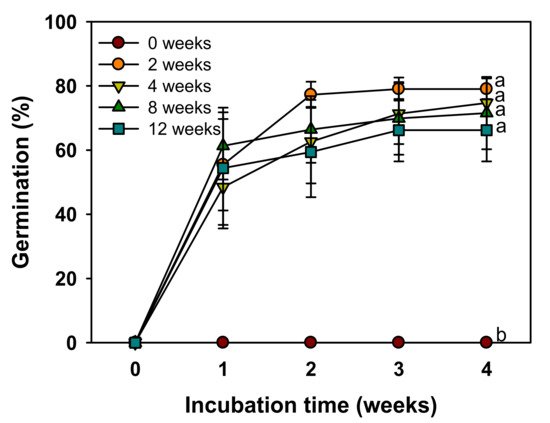
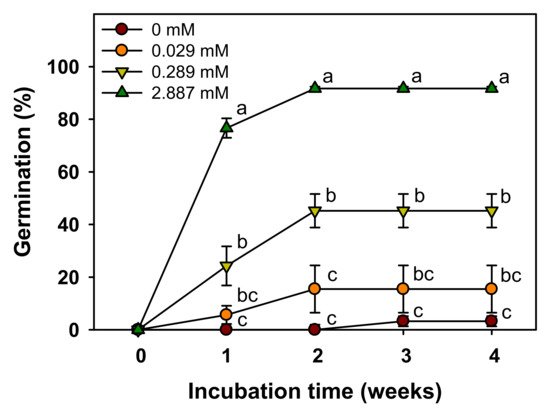
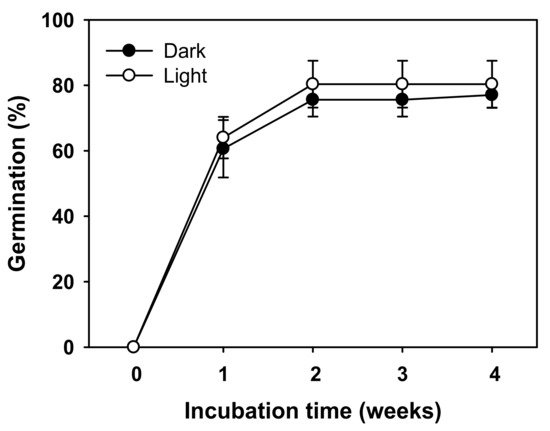
Veronicastrum sibiricum is a perennial species distributed in Korea, Japan, Manchuria, China, and Siberia. This study aimed to determine the requirements for germination and dormancy break of V. sibiricum seeds and to classify the kind of seed dormancy. Additionally, its class of dormancy was compared with other Veronicastrum and Veronica species. V. sibiricum seeds were permeable to water and had a mature embryo during seed dispersal. In field conditions, germination was prevented by physiological dormancy, which was, however, relieved by March of the next year, allowing the start of germination when suitable environmental conditions occurred. In laboratory experiments, the seeds treated with 0, 2, 4, 8, and 12 weeks of cold stratification (4 °C) germinated to 0, 79, 75, 72, and 66%, respectively. After the GA3 treatment (2.887 mM), ≥90% of the seeds germinated during the four incubation weeks at 20/10 °C. Thus, 2.887 mM GA3 and at least two weeks at 4 °C were effective in breaking physiological dormancy and initiating germination. Therefore, the V. sibiricum seeds showed non-deep physiological dormancy (PD).
- cold stratification
- physiological dormancy
- seed dormancy
- seed germination
- trait stasis
- Veronica
- Veronicastrum
1. Introduction
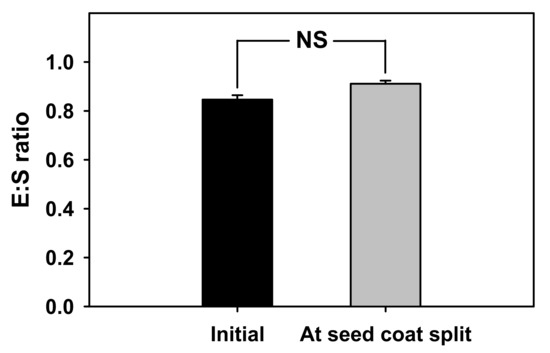
2. Internal and External Seed Morphology
| Scientific Name | Collection | Seed Length (mm) |
Seed Width (mm) | 100 Seeds Weight (mg) | Collection Date |
|---|---|---|---|---|---|
| Veronicastrum sibiricum | Collections of live specimens from genetic resources plot, Andong National University, Korea | 0.75 ± 0.010 z | 0.05 ± 0.010 z | 7.74 ± 0.200 y | 16 October 2019 |
| -x | - | - | 14 September 2020 |
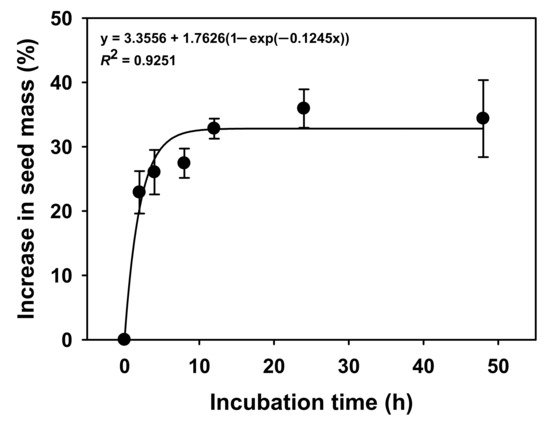
3. Water Absorption Rate
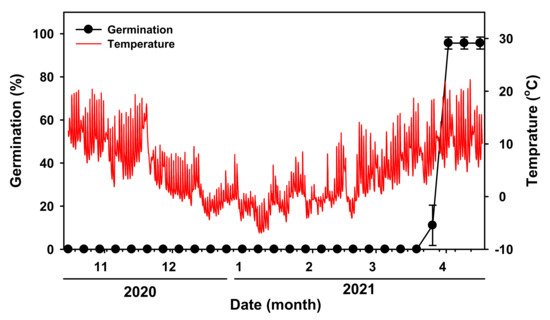
4. Phenology of Germination
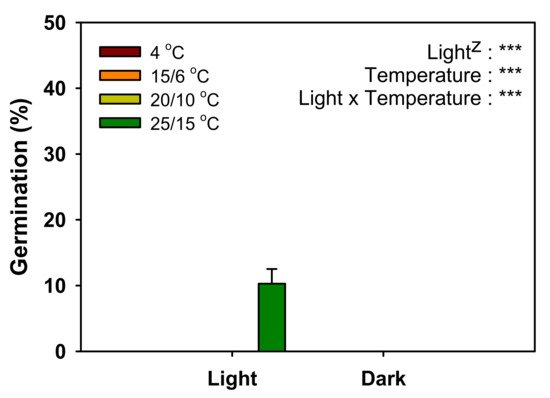
5. Effect of Light and Temperature on Germination
6. Effect of Cold Stratification
7. Effect of GA3 Treatment
8. Effect of Light on Germination after Cold Stratification
This entry is adapted from the peer-reviewed paper 10.3390/plants11020160
References
- Nonogaki, H. Seed dormancy and germination—Emerging mechanisms and new hypotheses. Curr. Biol. 2014, 27, 853–909.
- Rajjou, L.; Duval, M.; Gallardo, K.; Catusse, J.; Bally, J.; Job, C.; Job, D. Seed germination and vigor. Annu. Rev. Plant. Biol. 2012, 63, 507–533.
- Korea Biodiversity Information System (KBIS) (Naengcho). Korea Biodiversity Information System, an Illustrated Plant. Book. Available online: http://www.nature.go.kr/kbi/plant/pilbk/selectPlantPilbkDtl.do (accessed on 1 November 2021).
- Chung, J.M.; Cho, S.H.; Kim, Y.S.; Kong, K.S.; Kim, H.J.; Lee, C.H.; Lee, H.J. Ethnobotany in Korea: The Traditional Knowledge and Use of Indigenous Plans; Korea National Arboretum: Pocheon, Korea, 2017.
- Ellmouni, F.Y.; Karam, M.A.; Alil, R.M.; Albach, D.C. Systematic treatment of Veronica L. Section beccabunga (Hill) Dumort (Plantaginaceae). Taeckholmia 2018, 38, 168–183.
- Flora of Korea Editorial Committee (FKEC). The Genera of Vascular Plants of Korea; Academy Publishing Co.: Seoul, Korea, 2018.
- Muñoz-Centeno, L.M.; Albach, D.C.; Sánchez-Agudo, J.A.; Martínez-Ortega, M.M. Systematic significance of seed morphology in Veronica (Plantaginaceae): A phylogenetic perspective. Ann. Bot 2006, 98, 335–350.
- Marinez-Ortega, M.M.; Sanches, J.S.; Rico, E. Palynological study of Veronica Sect. Veronica and Sect. Veronicastrum (Scrophulariaceae) and its taxonomic significance. Grana 2000, 39, 21–31.
- Zhou, B.; Meng, X. Pharmacological study on Veronicastrum sibiricum (L.) Pennell. Zhongguo Zhong Yao Za Zhi 1992, 17, 493–496.
- Kostenko, S.; Khan, M.T.; Sylte, I.; Moens, U. The diterpenoid alkaloid noroxoaconitine is a Mapkap kinase 5 (MK5/PRAK) inhibitor. Cell Mol. Life Sci. 2011, 68, 289–301.
- Gao, W.; Zhang, R.; Jia, W.; Zhang, J.; Takaishi, Y.; Duan, H. Immunosuppressive diterpenes from Veronicastrum sibiricum. Chem. Parm. Bull. 2004, 52, 136–137.
- Lee, S.Y.; Yu, S.J.; Chi, H.J. Chemical components of the root of Veronicastrum sibiricum Pennell. Kor. J. Pharmacogn. 1987, 18, 168–176.
- Baskin, C.C.; Baskin, J.M. Seeds: Ecology, Biogeography, Evolution of Dormancy and Germination; Academic Press: San Diego, CA, USA, 2014.
- Finch-Savage, W.E.; Leubner-Metzger, G. Seed dormancy and the control of germination. New Phytol. 2006, 171, 501–523.
- Baskin, C.C.; Baskin, J.M. Germinating seeds of wildflowers: An ecological perspective. HortTechnology 2004, 14, 467–473.
- Hepp, J.; Gomez, M.; Leon-Lobos, P.; Montenegro, G.; Vilalobos, L.; Contreras, S. Characterisation of seed dormancy of 12 Chilean species of Nolana (Solanaceae) from the coastal Atacama Desert. Seed Sci. Res. 2021, 31, 20–29.
- Martin, A.C. The comparative internal morphology of seeds. Am. Midl. Nat. 1946, 36, 513–660.
- Choi, K.S. Phylogeny and Biogeography of the Veronica L. Subgenus Pseudolysimachium (W.D.J. Koch) Buchenau. Ph.D. Thesis, Yeungnam University, Gyeongsan, Korea, 2016; pp. 1–179.
- Marinez-Ortega, M.M.; Rico, E. Seed morphology and its systematic significance in some Veronica species (Scrophulariaceae) mainly from the Western Mediterranean. Plant. Syst. Evol. 2001, 228, 15–32.
- Guerin, J.; Thorpe, M.; Duval, D.; Jusaitis, M.; Ainsley, P. Germination of Veronica parnkalliana seeds in response to seasonal and fire cues. In Proceedings of the 5th Global Botanic Gardens Congress, Dunedin, New Zealand, 20–25 October 2013; pp. 1–6.
- Song, S.; Shin, U.; Oh, H.; Kim, S.; Lee, S.Y. Seed germination responses and interspecific variations to different incubation temperatures in eight Veronica species native to Korea. Hortic. Sci. Technol. 2019, 37, 20–31.
- Adams, C.A.; Baskin, J.M.; Baskin, C.C. Traits stasis versus adaptation in disjunct relict species: Evolutionary changes in seed dormancy-breaking and germination requirements in a subclade of Aristolochia subgenus Siphisia (Piperales). Seed Sci. Res. 2005, 15, 161–173.
- Vandelook, F.; Lenaerts, J.; Van Assche, J.A. The role of temperature in post-dispersal embryo growth and dormancy break in seeds of Aconitum lycoctonum L. Flora 2009, 204, 536–542.