Human skin and coastal vegetation present a striking contrast at the shoreline. Acute exposure of inadequately protected human skin to solar UV radiation can initiate erythema, oxidative stress, DNA photolesions, inflammatory signaling, and, after repeated exposure, extracellular matrix degradation and photoaging. UVB is particularly effective at generating cyclobutane pyrimidine dimers and 6–4 photoproducts, while solar-induced redox and inflammatory signaling extends the biological consequences beyond direct DNA absorption. Keratinocyte-derived signaling can also promote MAPK/AP-1-dependent matrix metalloproteinase expression in dermal fibroblasts, providing a mechanistic bridge between epidermal irradiation and dermal photoaging [
1,
2,
3].
By contrast, a beach creeper, mangrove leaf, dune shrub, or salt-marsh halophyte repeatedly exposes its photosynthetically active tissues to sunlight while simultaneously coping with salt, heat, drying, wind, and nutrient constraints [
4,
5,
6,
7,
8,
9]. This should not be interpreted to mean that coastal plants “do not suffer UV damage”; they do [
10,
11]. Rather, successful species persist because damage is prevented, buffered, tolerated, or repaired sufficiently to preserve tissue function [
10,
11,
12]. The resulting phenotype is therefore better understood as integrated photoprotection than as a simple sunscreen layer [
13,
14]. We define the littoral plant photoprotectome as the integrated ensemble of structural, optical, chemical, redox-regulatory, stress-responsive, and reparative characteristics that enables coastal vascular plants to preserve tissue function under chronic solar irradiation and interacting littoral stressors, and that may provide molecules or biological design principles for human photoprotection [
10,
15,
16].
Within this broader system, the littoral surface shieldome may be considered the subset located at or near the plant–environment interface: epicuticular and intracuticular waxes, cutin-associated phenolics, outer epidermal metabolites, trichomes, surface microstructures, and related optical features. A second useful concept is the cuticle-metabolome continuum, emphasizing that function depends not only on chemical identity but also on
where a molecule is located, the molecular matrix surrounding it, and whether multiple chromophores, antioxidants, and lipids act cooperatively [
13,
14].
This distinction is supported by direct plant photophysics. González Moreno and colleagues showed that isolated cuticles strongly attenuated UVB, with UVB transmittance varying from approximately 0.3% in some phenolic-rich cuticles to approximately 40–48% in thin cuticles with much less UV-absorbing material. UV reflectance was comparatively small; absorption by cuticular phenolics accounted for much of the attenuation.
p-Coumaric, ferulic, caffeic, and
p-hydroxybenzoic acids have been reported in plant cuticles, and
p-coumaric acid was found across the studied species. Ultrafast spectroscopy supported non-radiative deactivation of excited cuticular hydroxycinnamates, providing a plausible mechanism by which energy can be absorbed without persistent photochemical excitation [
13,
17,
18]. Cuticles isolated from a range of species (including
Capsicum annuum,
Hedera helix,
Iris germanica,
Beta vulgaris and
Brassica oleracea) were characterized by UV–visible transmittance, reflectance and absorbance measurements, and the photophysics of hydroxycinnamic acids (with
p-coumaric acid as the model chromophore) was examined by ultrafast transient absorption spectroscopy combined with quantum-chemical calculations [
13]. UVB transmittance ranged from about 0.3% in phenolic-rich cuticles to about 40–48% in thin cuticles. The species studied were not specialists of littoral habitats. The work therefore supports the principle of cuticular UV screening and non-radiative energy dissipation, but it does not demonstrate the efficacy of any littoral extract or of any ingredient in human skin, and extrapolation to littoral plants and to human photoprotection remains a hypothesis.
The ecological case is equally compelling. Lovelock, Clough, and Woodrow demonstrated that UV-absorbing phenolic compounds were concentrated in the epidermis of tropical mangrove leaves and, together with leaf succulence, could act as selective filters against high-energy wavelengths. Later three-dimensional canopy mapping in
Avicennia germinans showed that exterior leaves experiencing greater irradiance contained more UV-absorbing compounds than interior leaves, indicating spatial allocation of chemical screening according to exposure [
15,
19,
20].
Whether habitat-specific stress produces reproducible chemical or structural phenotypes, and whether those phenotypes can be exploited systematically, is not yet established and is therefore treated here as a testable hypothesis rather than an assumption. First, exposed
Avicennia germinans leaves contained more UV-absorbing compounds than interior leaves [
20], and a meta-analysis of 70 plant traits found that light intensity shifts molecular, anatomical and physiological traits in a consistent direction across species [
21]. Second, salinity and UV-B can remodel specialized metabolism in halophytes under controlled conditions, as reported for antioxidant enzymes and flavonoids in
Sesuvium portulacastrum [
22,
23,
24] and for UVB-induced changes in carotenoid accumulation in
Salicornia europaea [
25]. Third, the same species can vary markedly with irrigation salinity, season and collection site, as shown for
Limonium algarvense [
26,
27], and tissue-resolved data linking localization to a measured photoprotective function are largely missing. Systematic bioprospecting therefore requires that ecotype, exposure, salinity, season and plant organ be recorded as part of ingredient identity, that sampling be replicated across sites and seasons, and that localization be tested against optical and biological endpoints.
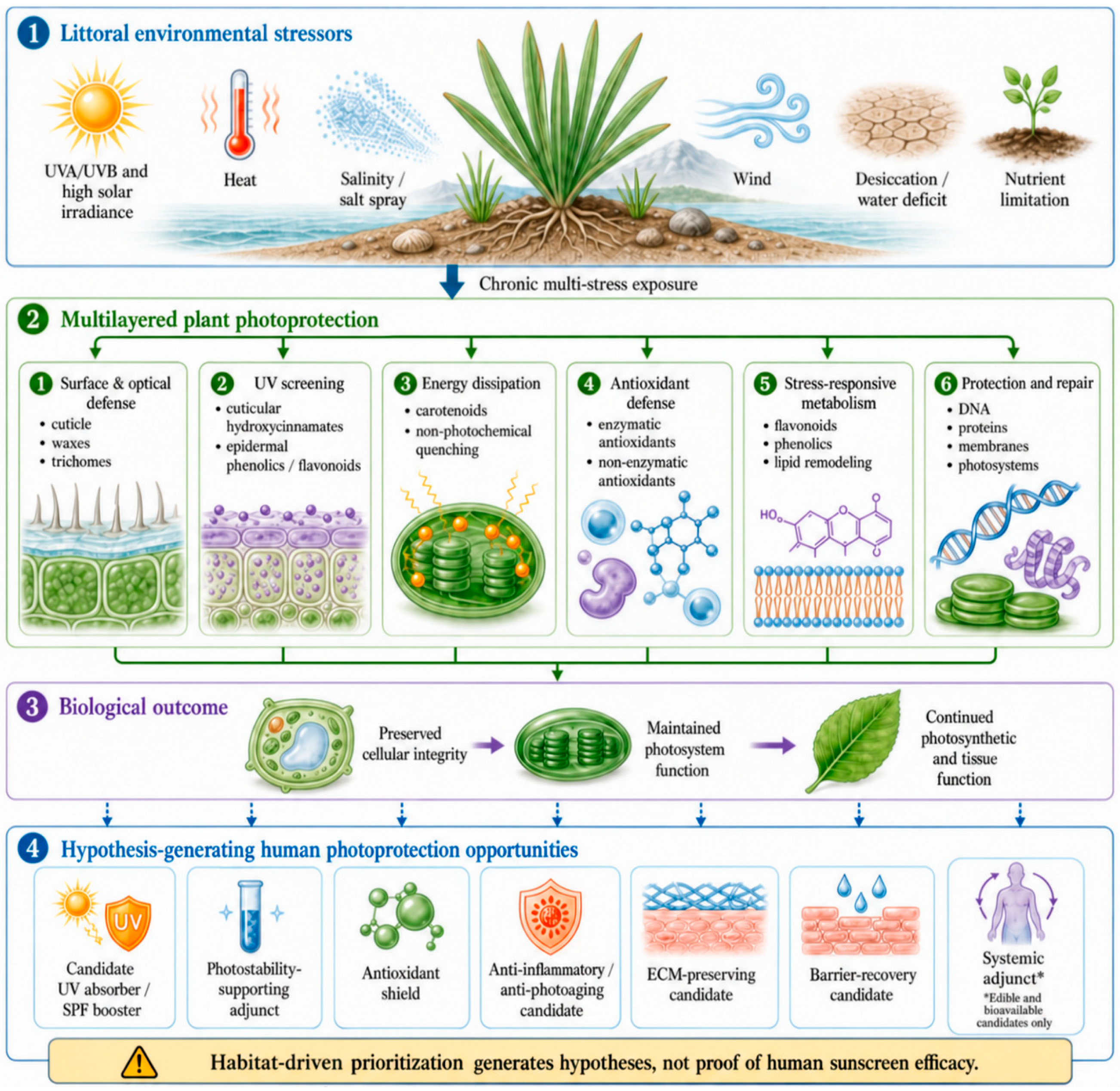
So, the chronic co-exposure to solar radiation, salinity, salt spray, heat, wind, and water limitation selects or acclimates coastal plants toward coupled surface and metabolic defense phenotypes. These phenotypes constitute a rational, ecology-informed discovery space for UV-attenuating molecules, photostabilizers, biological photoprotective boosters, barrier-supporting ingredients, anti-photoaging actives, and edible and systemically bioavailable adjunctive nutricosmetic photoprotectants. The relationship between environmental selection, plant defense architecture, and translational opportunity is summarized in Figure 1.
Figure 1. The littoral exposome and the multilayered littoral plant photoprotectome. Coastal vascular plants experience chronic co-exposure to solar UVA/UVB and high irradiance, heat, salinity and salt spray, wind, desiccation, and nutrient limitation. These interacting stressors are associated with a multilayered photoprotective architecture comprising surface and optical defenses, cuticular and epidermal UV-screening metabolites, carotenoid-dependent and non-photochemical energy dissipation, enzymatic and non-enzymatic antioxidant defenses, stress-responsive secondary metabolism, and protection or repair of DNA, proteins, membranes, and photosystems. Together, these mechanisms help preserve cellular integrity, photosystem performance, and photosynthetic and tissue function. Dashed arrows indicate hypothesis-generating translational opportunities for candidate UV absorbers/SPF boosters, photostability-supporting adjuncts, antioxidant and anti-inflammatory/anti-photoaging agents, ECM-preserving and barrier-recovery candidates, and systemic adjuncts where edible and bioavailable. These ecological adaptations provide a rationale for habitat-guided bioprospecting but do not constitute evidence of human sunscreen efficacy.