Your browser does not fully support modern features. Please upgrade for a smoother experience.
Digitalization and SME Internationalization in the Digital Era: Technologies, Capabilities and Barriers: History
Please note this is an old version of this entry, which may differ significantly from the current revision.
Contributor: , , Raúl E. Zavala Sánchez , , Adolfo A. Jurado Rosas , Marina Fernández Miranda , , , Leonardo P. Dominguez Zeta

This is a systematic review of the literature on how digital technologies shape and influence the internationalization of SMEs through capability development and barrier mitigation. Following the Preferred Reporting Items for Systematic Reviews and Meta-Analyses (PRISMA) 2020 guidelines, a search was conducted on 13 July 2025, in the Scopus and Web of Science databases. The inclusion criteria prioritized peer-reviewed journal articles published between 2020 and 2025. The rigorous selection process resulted in a final sample of 61 studies from an initial group of 1120 records. A descriptive bibliometric analysis and qualitative thematic synthesis were used to classify the evidence according to technologies, internationalization functions, barriers, and contextual characteristics. The results show that the literature primarily focuses on digital transformation and innovation (27.9%), managerial and strategic capabilities (26.2%), and the institutional environment (21.3%). The findings further show that digital technologies play distinct roles: while e-commerce and cross-cutting information and communication technology (ICT) capabilities primarily facilitate market access and adaptation, more advanced technologies such as blockchain, Industry 4.0, and the IoT are directly linked to coordination and international performance. The review also shows that the digital internationalization of SMEs is constrained by multilevel barriers that operate simultaneously, with organizational and strategic limitations, regulatory compliance requirements, and financing costs being the most prominent. In conclusion, the value of digitalization lies in its organizational integration rather than in the mere adoption of technology. Future research with longitudinal designs is needed to examine how these digital resources are transformed into effective capabilities under different internal and environmental conditions.

  • digital transformation
  • SME internationalization
  • multilevel barriers
  • dynamic capabilities
  • systematic literature review
The internationalization of small and medium-sized enterprises (SMEs) is currently taking place in an environment characterized by the growing digitalization of information systems. Although traditional models, such as the Uppsala model and the network perspective, remain relevant, they are insufficient on their own to explain how SMEs enter, adapt to, and compete in increasingly digitalized international markets [1]. This situation is particularly complex in developing economies, where a scarcity of financial resources and limited managerial capabilities make it difficult for SMEs to identify opportunities and adapt to international demands [2][3]. Added to this are weak strategic networks and low technology adoption, factors that further restrict their ability to sustain international expansion [4][5].
In this context, digitalization is redefining traditional mechanisms of internationalization by enabling even SMEs with limited resources to access information on foreign markets, coordinate operations remotely, and build relationships with international customers and partners without the need for a gradual physical presence. Technologies such as artificial intelligence (AI), the Internet of Things (IoT), digital platforms, e-commerce, and blockchain can reduce operational barriers and strengthen the capabilities required to participate in international markets [6]. However, Huseynova [2] notes that these benefits are not automatic, as realizing them depends on factors such as technological infrastructure, the availability of specialized personnel, financing, and organizational adaptability.
Despite these advances, the literature remains fragmented: some studies treat technologies as internal resources that improve processes and efficiency, while others prioritize managerial capabilities, networks, institutional conditions, or export performance.
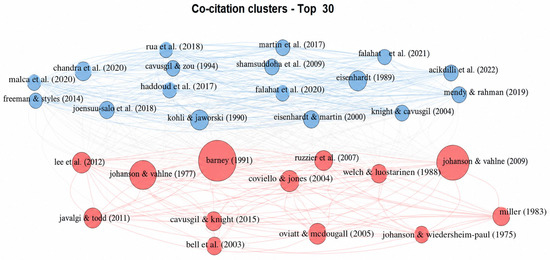
This conceptual fragmentation is reflected in the co-citation network shown in Figure 1.
Figure 1. Co-citation network of the top 30 references. Analysis generated using the Bibliometrix software package (version 4.1, K-Synth Srl, Naples, Italy) based on the final sample of 61 articles [7][8][9][10]. The red and blue clusters group the studies according to their citation co-occurrence; the minimum threshold was set at 2 co-citations.
The structure of the network reveals two main theoretical frameworks. The first brings together perspectives related to resources, capabilities, and business expansion, such as the resource-based view [7] and models of internationalization [8][9]. The second incorporates approaches related to adaptation to the environment and organizational behavior, including market orientation [10] and resilience. Taken together, these perspectives tend to treat digitalization as an additional resource or capability within already established frameworks, rather than examining it as a phenomenon that transforms the very conditions of internationalization.
While previous reviews and research have contributed to the field, they address the intersection between digitalization and internationalization from partial perspectives. Foundational studies have mapped the historical pathways of SME expansion [1], without focusing on the cross-cutting impact of technological transformation. More recent reviews focus on specific niches: e-commerce and dynamic managerial capabilities [11], the adoption of emerging tools, or resource management in emerging economies [12]. This body of literature often examines technologies in isolation, without explaining how they interact with one another, leaving a gap: the lack of an integrative framework that consolidates which technologies are involved and how they reconfigure operational processes in the face of existing barriers.
Consequently, this review seeks to understand how digitalization is incorporated into the study of SME internationalization, which technologies and digital capabilities are related to this process, how they contribute to international access, adaptation, coordination, and performance, and what barriers limit such contributions. Based on this, the following research questions are posed: (RQ1) How have scientific output, methodological approaches, and the main thematic areas regarding the digitalization and internationalization of SMEs evolved between 2020 and 2025? (RQ2) What digital technologies support the internationalization of SMEs, and how do they facilitate access, adaptation, coordination, and performance in international markets? and (RQ3) What barriers limit the contribution of digitalization to the internationalization of SMEs?
The aim is to provide a framework that guides both future empirical research and the design of business strategies and public policies aimed at strengthening the international competitiveness of SMEs.

This entry is adapted from the peer-reviewed paper https://doi.org/10.3390/encyclopedia6110237

References

  1. Dabić, M.; Maley, J.; Dana, L.P.; Novak, I.; Pellegrini, M.M.; Caputo, A. Pathways of SME internationalization: A bibliometric and systematic review. Small Bus. Econ. 2020, 55, 705–725.
  2. Huseynova, L. Challenges and opportunities in the development of micro, small, and medium-sized enterprises (MSMEs) in Central and West Asia. Probl. Perspect. Manag. 2024, 22, 527–538.
  3. Heriqbaldi, U.; Esquivias, M.A.; Lau, W.Y.; Cesilia, A.F. Export promotion programs and firm performance: Linking knowledge, commitment, and market strategy to enhance competitiveness. J. Open Innov. Technol. Mark. Complex. 2025, 11, 100479.
  4. Morini, C.; Polis, M.C.B.; da Silva, D.; Junior, E.I. Export Barriers for SMEs from Emerging Market: A Model of Analysis for Non-Tech Companies. BAR-Braz. Adm. Rev. 2021, 18, e200121.
  5. Vasani, S.; Abdulkareem, A.M. MSME market presence and competitiveness in a global economy. Cogent Econ. Financ. 2024, 12, 2416992.
  6. Mohammad, R.I.; Faraji, M.R.; Rashid, M.; Bhuyan, M.K.; Hossain, R.; Ghose, P. Digital Transformation in SMEs Emerging Technological Tools and Technologies for Enhancing the SME’s Strategies and Outcomes. J. Ecohumanism 2024, 3, 211–224.
  7. Barney, J. Firm resources and sustained competitive advantage. J. Manag. 1991, 17, 99–120.
  8. Johanson, J.; Vahlne, J.E. The Uppsala internationalization process model revisited: From liability of foreignness to liability of outsidership. J. Int. Bus. Stud. 2009, 40, 1411–1431.
  9. Knight, G.A.; Cavusgil, S.T. Innovation, organizational capabilities, and the born-global firm. J. Int. Bus. Stud. 2004, 35, 124–141, Correction in J. Int. Bus. Stud. 2004, 35, 334.
  10. Kohli, A.K.; Jaworski, B.J. Market Orientation: The Construct, Research Propositions, and Managerial Implications. J. Mark. 1990, 54, 1.
  11. Yao, G.; Dato’mansor, Z.; Ghazali, H.B.; Yan, Z. A comprehensive mixed-methods study on cross-border e-commerce SMEs, digital transformation and dynamic managerial capabilities. Environ. Soc. Psychol. 2024, 9, 2255.
  12. Winckler, N.C.; Zen, A.C.; Prevot, F. Firm resources for internationalization of SMEs from emerging countries: A multimethod study. Rev. Adm. Mackenzie 2022, 23, eRAMR220165.
More
This entry is offline, you can click here to edit this entry!
Write an Entry