
Violent crime varies across countries and cannot be adequately understood through homicide rates alone. This entry examines multidimensional configurations of violent crime based on a comparative study of 23 countries between 2017 and 2023, using 161 country-year observations. Principal Component Analysis identified two dimensions explaining 77.75% of the total variance, revealing differences in national positions associated with socioeconomic, demographic, and crime-related indicators. The analysis also examines changes in countries' relative positions and associations with organized crime indicators, without attributing causal relationships to the observed statistical patterns. Violent crime exhibits different patterns across countries, and these differences cannot be understood solely through homicide rates. This entry summarizes the findings of an international study that examined the relative positions of 23 countries between 2017 and 2023, jointly considering crime-related, socioeconomic, demographic, and penal response indicators. The research used 161 country-year observations and applied Principal Component Analysis (PCA) to identify multidimensional configurations and changes in countries' relative positions. Two principal components were identified, jointly explaining 77.75% of the total variance. The first differentiated countries mainly through the relationships among human development, income, adolescent fertility, and homicide rates. The second reflected a configuration associated with urbanization, incarceration, and homicide rates. A complementary analysis identified associations between organized crime indicators and certain positions along the first dimension. The findings demonstrate that countries with similar homicide rates may exhibit different configurations, although these statistical associations do not constitute causal explanations of violence.
- Violent Crime
- Homicide.
- Relational Space
- Principal Component Analysis
1. Introduction
International comparisons of violent crime frequently use homicide rates as an indicator of the magnitude of lethal violence. Although this measure makes it possible to examine differences across countries and periods, it does not, by itself, account for the social, economic, demographic, and institutional conditions associated with the contexts in which homicides occur.
Countries with similar homicide rates may differ in terms of income, human development, urbanization, incarceration, and demographic characteristics. Likewise, countries sharing certain socioeconomic conditions may exhibit different levels of violence.
This heterogeneity raises an analytical question: how can differences between countries be understood when indicators of violence and other national characteristics are considered jointly?
One possible approach involves constructing multidimensional statistical spaces to examine countries' relative positions, the configurations associated with those positions, and changes over time [1].
2. Violent Crime and the Relational Perspective
Relational analysis shifts attention from characteristics considered in isolation to the relationships among observed properties.
This perspective makes it possible to distinguish four concepts:
- Magnitude: the observed intensity of a particular characteristic, such as the homicide rate.
- Position: a country's relative location within the multidimensional space constructed from the selected indicators.
- Configuration: the combination of properties associated with the position occupied.
- Change: a shift in relative position over the period under analysis.
Distinguishing these elements makes it possible to examine situations in which countries exhibit similar levels of violence but occupy different positions because of the other characteristics considered.
This approach engages with Pierre Bourdieu's relational sociology and contributions from sociological criminology, particularly Social Disorganization Theory and studies of collective efficacy.
However, these theoretical traditions operate at different levels of analysis. Mechanisms of community organization and informal social control investigated in neighborhoods and communities cannot automatically be transferred to the national level.
Similarly, a statistical space constructed through PCA does not fully correspond to Bourdieu's concept of social space. Its positions represent relationships among selected indicators rather than directly demonstrating social interactions between countries.
3. Data and Methodological Procedures
The original study examined 23 countries over seven years, from 2017 to 2023, totaling 161 country-year observations.
Six active variables were used:
- Intentional homicide rate per 100,000 inhabitants.
- Incarceration rate per 100,000 inhabitants.
- Gross national income per capita, adjusted for purchasing power parity.
- Percentage of the population living in urban areas.
- Inequality-adjusted Human Development Index (IHDI).
- Adolescent fertility rate.
Employment was included as a supplementary variable, meaning that it was used to assist interpretation without contributing to the construction of the principal components.
Data were obtained from international sources, including the United Nations Office on Drugs and Crime (UNODC), the World Bank, the United Nations Development Programme (UNDP), and international prison statistics databases.
The variables were standardized and subjected to PCA, a statistical technique used to summarize relationships among correlated indicators and represent observations in a lower-dimensional space.
The suitability of the data matrix was assessed using the Kaiser–Meyer–Olkin (KMO) measure, which reached 0.738 in the final specification, and Bartlett's test of sphericity, which was statistically significant.
The analysis is exploratory and descriptive. No causal effects were estimated, and no panel regression models were employed.
4. Multidimensional Configurations of Violent Crime
4.1. Relationships Among Indicators
The correlation analysis identified different associations among the indicators considered. The homicide rate was positively correlated with adolescent fertility (r = 0.642) and negatively correlated with inequality-adjusted human development (r = −0.500) and income (r = −0.436).
In contrast, the correlation between homicide and urbanization was weak (r = 0.106), as was the association between homicide and incarceration (r = 0.252).
These findings indicate that the properties analyzed do not vary according to a single pattern. Some exhibit relatively strong associations, while others help differentiate national configurations.
The observed correlations do not demonstrate that adolescent fertility, income, or human development determine homicide levels. They express statistical relationships identified within the specific set of countries and years investigated.
4.2. First Dimension: Human Development, Income, Adolescent Fertility, and Homicide
PCA identified a first dimension, designated Principal Component 1 (PC1), accounting for 52.22% of the total variance. This dimension showed positive associations with inequality-adjusted human development (0.932) and income (0.922), in contrast to negative associations with adolescent fertility (−0.840) and homicide rates (−0.659).
Consequently, observations located at the positive pole tended to exhibit comparatively higher levels of income and human development, accompanied by lower adolescent fertility and homicide rates. At the negative pole, configurations were more strongly associated with higher adolescent fertility and homicide rates and lower levels of income and human development.
Between 2017 and 2023, Japan, South Korea, Estonia, Lithuania, Latvia, Montenegro, Uruguay, and the Bahamas remained at the positive pole of this dimension.
Honduras, Mexico, El Salvador, Colombia, Guatemala, Brazil, Ecuador, Paraguay, South Africa, Pakistan, and India remained at the negative pole.
However, remaining at the same pole does not mean that these countries possess identical characteristics. Their individual coordinates and positions along the second dimension also differ.
4.3. Second Dimension: Urbanization, Incarceration, and Homicide
The second principal component (PC2) explained 25.53% of the total variance. Its structure was primarily characterized by associations with urbanization (−0.777), incarceration (−0.716), and homicide rates (−0.513). Together, these three indicators accounted for approximately 90.07% of the contributions to the construction of the second dimension.
Figure 1 illustrates the distribution of active and supplementary variables across the first two principal components, highlighting the different associations involving homicide, socioeconomic conditions, urbanization, and incarceration.
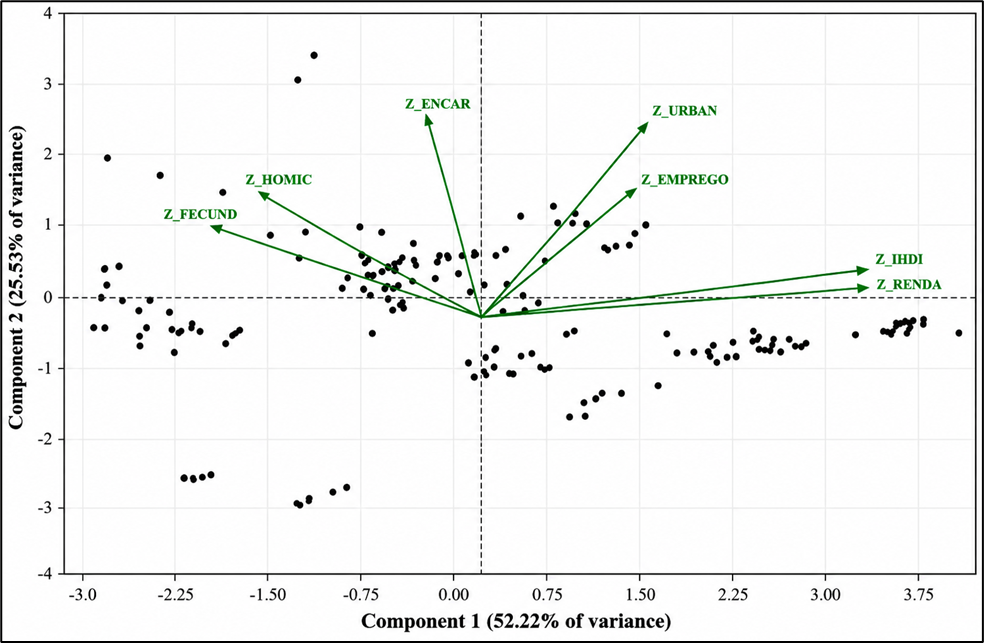
Figure 1. Representation of active and supplementary variables in the first two principal components. Source: Carneiro (2026).
The identification of this configuration demonstrates that lethal violence is associated with different patterns. While the first dimension emphasizes relationships with socioeconomic and demographic characteristics, the second differentiates countries primarily through the combination of urbanization, incarceration, and homicide rates.
However, the presence of urbanization in this dimension does not imply that urban growth necessarily produces violence. Similarly, incarceration rates are not direct measures of state capacity or the effectiveness of criminal justice institutions.
The interpretation of these indicators depends on penal policies, institutional practices, and countries' historical characteristics.
4.4. Changes in Countries' Relative Positions
The longitudinal structure of the data made it possible to examine shifts in relative positions between 2017 and 2023.
Figure 2 presents the distribution of the 161 country-year observations in the factorial plane, illustrating differences in national configurations and changes in relative positions throughout the period analyzed.
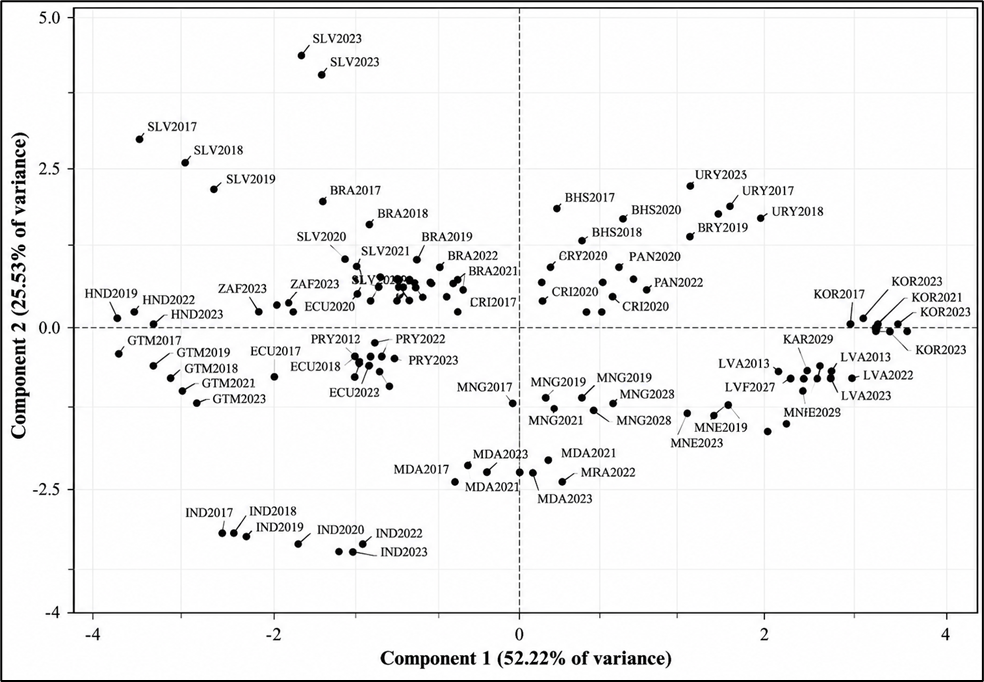
Figure 2. Positions of country-year observations in the Principal Component Analysis factorial plane, 2017–2023. Source: Carneiro (2026).
Along the first dimension, Costa Rica and Mongolia moved from the negative to the positive pole in 2018. Moldova exhibited a similar shift in 2021, while Panama crossed the component's origin in 2022.
Along the second dimension, Ecuador, Paraguay, and South Korea exhibited changes of pole. Ecuador moved from the positive to the negative pole in 2022, followed by Paraguay in 2023. South Korea also crossed the origin in 2023, although its coordinates were close to zero, which calls for caution when interpreting this shift.
These changes demonstrate that countries' relative positions did not necessarily remain constant throughout the period. However, a shift within the multidimensional space does not automatically correspond to a proportional change in homicide rates. Because the coordinates result from the combination of six indicators, changes in different properties may alter relative positions.
Likewise, movement between poles should not be interpreted as a transition between fixed categories of countries.
5. Organized Crime and National Configurations
A complementary analysis examined the association between countries' average positions over the 2017–2023 period and two indicators from the Global Organized Crime Index 2025: mafia-style groups and criminal networks.
The results identified negative correlations between the first PCA dimension and the indicators for mafia-style groups (r = −0.506; p = 0.014) and criminal networks (r = −0.668; p < 0.001).
This indicates that, among the countries analyzed, higher scores on these indicators tended to be associated with configurations located at the negative pole of the first dimension. Along the second dimension, associations with mafia-style groups and criminal networks were not statistically significant.
The two criminal actor indicators were strongly positively correlated with each other (r = 0.860; p < 0.001), although they represent conceptually distinct categories.
These findings extend the characterization of national configurations by incorporating information on the presence and influence of organized crime actors. However, because the organized crime indicators refer to 2025, whereas the main PCA uses data from 2017 to 2023, it is not possible to establish temporal precedence or causal relationships between these measures.
6. Limitations and Analytical Implications
The findings should be interpreted in light of the study's characteristics and limitations. The selection of the 23 countries was based on the availability of complete information for the period and variables considered. Therefore, the results cannot automatically be generalized to all countries.
Furthermore, aggregated national indicators may conceal internal territorial and social differences. Countries are heterogeneous units in which violence may be distributed differently across regions, cities, and social groups. PCA identifies patterns of covariation and relative positions, but it does not demonstrate the social mechanisms responsible for the production or reproduction of violent crime.
The analysis also uses homicide as its only direct measure of violence. For this reason, its findings primarily concern configurations associated with lethal violence rather than empirically encompassing all manifestations of violent crime. Finally, the proposed Relational Space of Violent Crime remains under theoretical development. The international application presented here constitutes a partial empirical approximation, without directly measuring processes of socialization, criminal learning, collective efficacy, institutional action, or individual trajectories.
7. Conclusions
The multidimensional analysis demonstrates that international comparisons of lethal violence should not be restricted to the magnitude of homicide rates. The two components identified, accounting for 77.75% of the total variance, express different configurations involving socioeconomic, demographic, territorial, crime-related, and penal response indicators.
The shifts observed between 2017 and 2023 indicate that countries' relative positions may change even when they remain associated with the same pole of a statistical dimension. The complementary analysis of organized crime also identified associations between certain criminal actors and national configurations, although without establishing causal relationships.
The main contribution lies in distinguishing magnitude, position, configuration, and change. This distinction makes it possible to formulate new questions concerning the heterogeneity of national contexts and the limitations of comparisons based exclusively on isolated indicators. Understanding the processes that produce these configurations requires further research capable of integrating different territorial scales, social mechanisms, criminal dynamics, and institutional conditions.
This entry is adapted from: https://doi.org/10.56238/bocav25n83-028
References
- Leonardo de Andrade Carneiro. AN ANALYSIS OF VIOLENT CRIME FROM AN INTERNATIONAL PERSPECTIVE: POSITIONS, CONFIGURATIONS, AND SHIFTS. Bol. de Conjunt. (BOCA) 2026, 25, 1. [CrossRef]