
Plant growth and development are regulated by the combined effects of environmental signals and internal hormones. Light is particularly important during seedling development because it regulates the transition from growth in darkness to growth in illuminated conditions, a process known as photomorphogenesis. Cytokinins, a class of plant hormones, also influence seedling development by regulating cell division, growth, differentiation, and responses to environmental stimuli. Although light and cytokinin signaling pathways are known to interact, the molecular mechanisms coordinating their effects on seedling growth remain incompletely understood.
In the research article MYB4 and HY5 integrate light and cytokinin signaling pathways during Arabidopsis seedling development, Pal, Basu, and Chattopadhyay investigated the functional relationship between two transcription factors, MYB4 and ELONGATED HYPOCOTYL5 (HY5), in the model plant Arabidopsis thaliana. The study examined how these proteins interact to regulate photomorphogenesis and how their relationship changes in response to different light conditions and cytokinin treatments. The findings identify a regulatory connection between MYB4 and HY5 and show that their combined effects depend on environmental and hormonal conditions. In particular, the study demonstrates that MYB4 interacts physically with HY5 and modulates HY5-mediated activation of the MYB4 promoter, providing a potential feedback mechanism for coordinating light and cytokinin responses during seedling development.
The study was published on 19 September 2025 in Frontiers in Plant Physiology, in the section Plant Morphogenesis and Evolution. It contributes to understanding how plants integrate external light signals with endogenous hormonal regulation at the molecular level.
- MYB4
- HY5
- Arabidopsis thaliana
- photomorphogenesis
- cytokinin signaling
- plant hormone interactions
- gene expression
- ABCG14
- ARR4
- CHS.
Light Signaling and Photomorphogenesis
Light functions both as an energy source for photosynthesis and as an environmental signal that controls plant development. Plants perceive differences in light wavelength, intensity, duration, and direction through specialized photoreceptors. These include phytochromes, cryptochromes, phototropins, and UV-B photoreceptors. Activation of these receptors initiates signaling pathways that change gene expression and influence processes such as seed germination, seedling establishment, leaf development, shade avoidance, and flowering.
HY5 is a basic leucine zipper (bZIP) transcription factor that plays a central role in the regulation of light-dependent development. It promotes photomorphogenesis by regulating the expression of genes involved in light responses, chlorophyll accumulation, pigment biosynthesis, and growth. HY5 also participates in the integration of light and hormone signaling, allowing plants to coordinate developmental responses with their physiological state. Seedlings lacking functional HY5 commonly exhibit elongated hypocotyls under illuminated conditions, demonstrating the importance of this transcription factor in restricting excessive stem-like elongation during light-mediated development [1].
The hypocotyl is the embryonic stem region below the cotyledons and above the root. Its elongation is a widely used indicator of photomorphogenic responses. In darkness, Arabidopsis seedlings typically develop elongated hypocotyls as part of their etiolation response. Exposure to light generally restricts hypocotyl elongation and promotes the development of photosynthetic structures.
MYB4 belongs to the R2R3-MYB family of plant transcription factors. It has previously been associated with phenylpropanoid metabolism, flavonoid biosynthesis, and responses to ultraviolet radiation. MYB4 can function as a transcriptional repressor of particular genes involved in secondary metabolism. Earlier research also established relationships between MYB4, HY5, and the calmodulin-binding transcriptional regulator CAM7 in light-dependent development. However, the functional consequences of a direct physical interaction between MYB4 and HY5, particularly during the integration of cytokinin and light signals, required further investigation [1].
3. Study Objectives and Experimental Approach
The central objective was to determine how MYB4 and HY5 interact at the molecular and genetic levels and how this interaction affects seedling development under varying light conditions and cytokinin availability.
The researchers investigated four main questions:
-
Whether MYB4 physically interacts with HY5 and which region of MYB4 contributes to this interaction.
-
How MYB4 and HY5 jointly regulate hypocotyl elongation and other light-dependent developmental responses.
-
Whether cytokinin alters MYB4 expression and changes the functional relationship between MYB4 and HY5.
-
How these transcription factors affect the expression of selected genes associated with cytokinin signaling, pigment production, and light responses.
The experiments used wild-type Arabidopsis seedlings, MYB4-deficient (myb4) mutants, HY5-deficient (hy5) mutants, and myb4 hy5 double mutants. Comparing these genotypes helped the researchers distinguish the individual effects of each transcription factor from their combined effects.
Seedlings were grown under darkness and different light regimes, including white, blue, red, and far-red light. The experiments also examined different intensities of white light and treatments with trans-zeatin, a naturally occurring cytokinin. Cytokinin concentrations included 1, 2, and 4 micromolar in the hypocotyl experiments, with selected molecular analyses using 2 and 4 micromolar treatments.
The experimental methods combined measurements of seedling morphology with molecular and biochemical analyses. Hypocotyl lengths were measured to quantify growth responses. Quantitative polymerase chain reaction (qPCR) was used to measure transcript abundance. Protein interaction assays, including in vitro pull-down, yeast two-hybrid, and co-immunoprecipitation assays, were used to examine interactions between MYB4 and HY5. Electrophoretic mobility shift assays (EMSAs) and transient expression experiments in Arabidopsis protoplasts investigated the regulation of the MYB4 promoter. Pigment measurements and the analysis of selected light-responsive genes provided additional information about the physiological consequences of these interactions [1].
4. Physical Interaction Between MYB4 and HY5
One of the principal findings was that MYB4 physically interacts with HY5. This relationship was supported by multiple experimental approaches, including in vitro binding assays, yeast two-hybrid experiments, and co-immunoprecipitation analysis. The agreement between these methods provides evidence that the two proteins can associate under the experimental conditions examined.
Domain-specific experiments further indicated that HY5 interacts with the C-terminal region of MYB4, which is associated with its transcriptional activation function. The findings suggest that MYB4 is not simply another component acting independently in the light-signaling network. Instead, it can interact directly with HY5 and potentially influence HY5-dependent transcriptional regulation.
The researchers examined this interaction in relation to the MYB4 promoter. Previous work had established that HY5 binds to a specific E-box-containing region of this promoter and promotes MYB4 expression. The new experiments investigated whether MYB4 could modify this regulatory relationship through its interaction with HY5.
In EMSA experiments, HY5 bound to the wild-type MYB4 promoter fragment, whereas mutation of the relevant promoter sequence disrupted the observed binding. The addition of MYB4 reduced the binding of HY5 to the wild-type promoter fragment, with stronger reductions observed at higher MYB4 concentrations. MYB4 alone did not form the corresponding DNA–protein complex in these experiments.
Transient expression assays provided further support for this interpretation. HY5 increased MYB4 promoter activity by approximately 2.2-fold, whereas MYB4 alone did not substantially alter promoter activity. When MYB4 and HY5 were introduced together, MYB4 reduced the increase in promoter activity mediated by HY5.
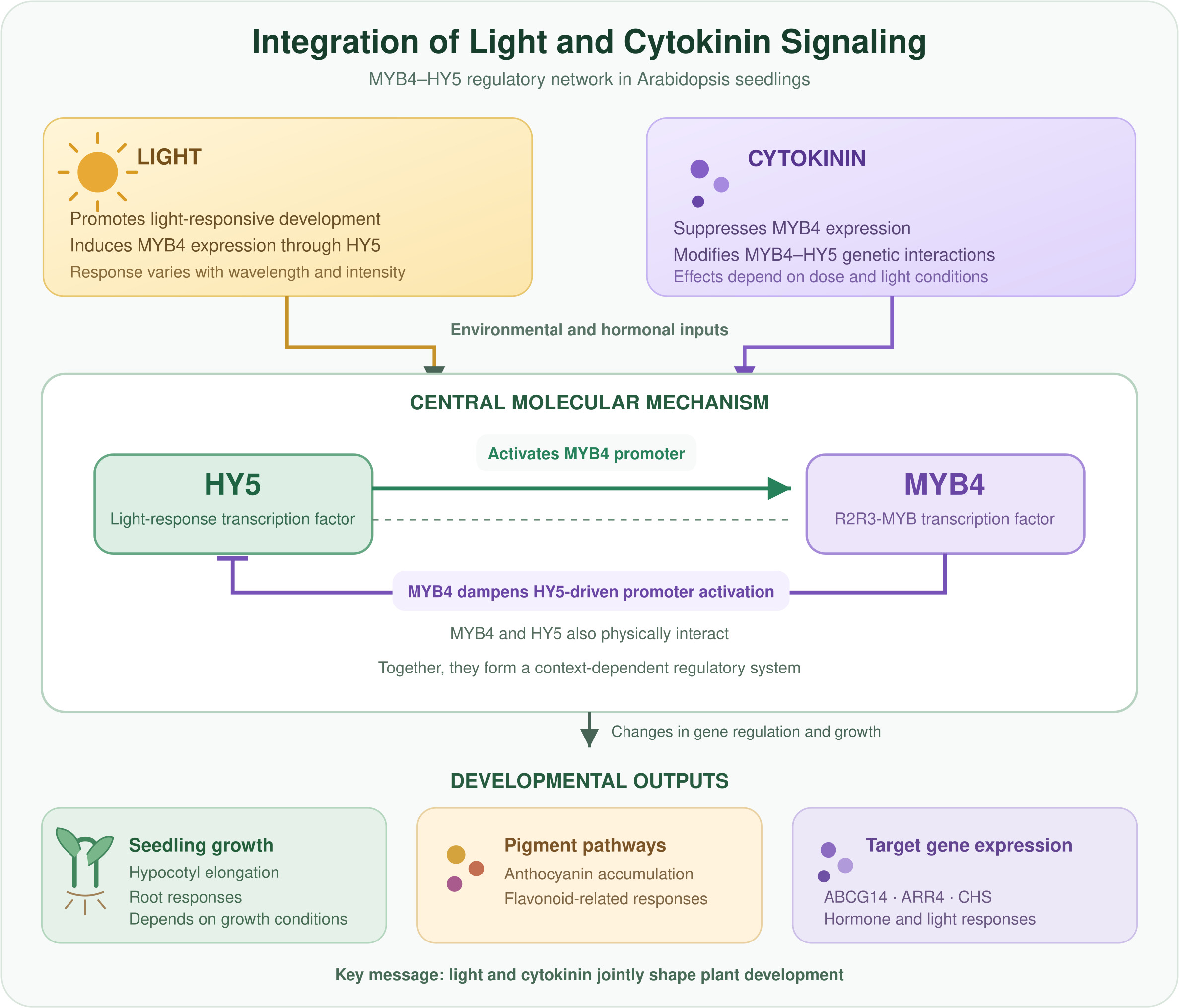
Together, these findings support a feedback model in which HY5 promotes MYB4 expression, while the resulting MYB4 protein interacts with HY5 and attenuates its promoter-activating activity. This mechanism could help regulate the intensity of the light response and prevent uncontrolled or excessive transcriptional activation of MYB4 [1].
5. MYB4 and HY5 in Light-Dependent Seedling Development
The researchers next investigated how MYB4 and HY5 contribute to photomorphogenesis. MYB4 transcript abundance increased following transitions from darkness to illumination, although the response varied according to the wavelength and duration of light exposure. Induction was observed under white, blue, red, and far-red light, indicating that MYB4 expression is responsive to multiple light conditions.
Genetic comparisons showed that MYB4 and HY5 both contribute to the regulation of hypocotyl elongation. In several light conditions, the myb4 hy5 double mutant exhibited more pronounced hypocotyl elongation than the hy5 mutant. This finding indicates that the contribution of MYB4 to hypocotyl regulation is not entirely dependent on HY5 and that the two transcription factors can have additive effects.
The relationship was wavelength-dependent. Additive effects were observed under white, blue, and far-red light, whereas the same pattern was not observed under red light. These results indicate that the regulatory relationship between MYB4 and HY5 is influenced by the light environment rather than being uniform across all conditions.
The researchers also measured the expression of the light-responsive genes RBCS-1A and CAB1. Their expression patterns in myb4 mutants were broadly similar to those of wild-type seedlings, whereas the expression profiles in the double mutant resembled those observed in hy5 seedlings. This result is consistent with an important role for HY5 in regulating these genes and suggests that the contribution of MYB4 depends on the specific biological process being examined.
Measurements of chlorophyll and other physiological characteristics further illustrated that the two transcription factors do not regulate every aspect of photomorphogenesis in the same manner. HY5 influenced chlorophyll accumulation largely independently of MYB4, while the two proteins displayed opposing effects on anthocyanin accumulation. These observations support the conclusion that MYB4 and HY5 can act independently, additively, or antagonistically, depending on the developmental trait and environmental conditions [1].
6. Cytokinin Modifies the Relationship Between MYB4 and HY5
A major contribution of this study is its demonstration that cytokinin changes the relationship between MYB4 and HY5 during seedling development.
Cytokinins are plant hormones involved in cell division, growth, differentiation, and responses to environmental signals. Previous studies have shown that cytokinin treatment can influence seedling development and interact with light signaling. However, the molecular relationship between cytokinin responses and the MYB4–HY5 regulatory system was not fully established.
The study found that cytokinin treatment suppresses MYB4 expression, in contrast to the induction associated with light exposure. This opposing regulation suggests that MYB4 is positioned at an intersection between environmental and hormonal signaling.
The researchers also compared seedling growth under different concentrations of trans-zeatin and different intensities of white light. Under control conditions, MYB4 and HY5 generally showed additive effects on hypocotyl elongation. Following cytokinin treatment, their genetic interaction changed, and conditions were observed under which the two proteins displayed a synergistic relationship.
Importantly, these effects depended on both light intensity and cytokinin concentration. Under higher white-light intensity, lower cytokinin concentrations were sufficient to alter the relationship between MYB4 and HY5. Under lower light intensity, a stronger cytokinin treatment was generally needed to observe the corresponding changes.
Cytokinin also suppressed the elongated hypocotyl phenotype of myb4 seedlings under the tested conditions. This result suggests that cytokinin can modify growth outcomes even when MYB4 function is disrupted. The authors proposed that the interaction may involve changes in the regulatory balance between light-dependent growth inhibition and hormone-mediated developmental responses.
By showing that the MYB4–HY5 relationship changes with the environment and hormonal context, the study provides evidence that transcriptional regulation in plants is dynamic rather than fixed. The same regulatory components can produce different developmental outcomes depending on the surrounding conditions [1].
7. Regulation of Cytokinin-Responsive Genes
The researchers investigated three genes to better understand the molecular connection between MYB4, HY5, and cytokinin responses: ABCG14, ARR4, and CHS.
|
Gene |
Established biological role |
Main relevance to the study |
|---|---|---|
|
ABCG14 |
Encodes a transporter important for cytokinin movement from roots to shoots. |
Its expression differed among mutant genotypes and treatment conditions, linking MYB4–HY5 regulation to cytokinin transport-related processes. |
|
ARR4 |
Encodes an A-type response regulator involved in cytokinin signaling and interactions with light signaling. |
Its expression patterns indicated that MYB4 and HY5 can affect cytokinin-responsive transcription in a condition-dependent manner. |
|
CHS |
Encodes chalcone synthase, an enzyme involved in flavonoid and anthocyanin biosynthesis. |
Its expression revealed that the relationship between MYB4 and HY5 changes with cytokinin treatment. |
7.1 ABCG14 expression
ABCG14 is important for the transport of cytokinins from roots to shoots. The analysis showed that its expression was influenced by HY5 function and that the consequences of disrupting MYB4 depended on the genotype and treatment conditions. Under untreated conditions, hy5 seedlings showed approximately 2.2-fold higher ABCG14 expression than wild-type seedlings, and introducing the myb4 mutation suppressed this increase.
Under cytokinin treatment at low light intensity, the expression pattern of the double mutant became similar to that of the hy5 mutant. This observation suggested that HY5 could function downstream of MYB4 in the regulation of ABCG14 under that specific condition. The results therefore indicate that the relationship between the two regulators can change according to hormonal treatment and light intensity.
7.2 ARR4 expression
The expression of ARR4 was also affected by the two transcription factors. Under control conditions, ARR4 expression was higher in myb4 seedlings and lower in hy5 seedlings than in wild-type seedlings. In the double mutant, expression resembled that of the hy5 mutant, suggesting that HY5 is important for the observed regulatory effect.
Under cytokinin treatment at low light intensity, however, the double mutant displayed an expression pattern similar to that of the myb4 mutant. This shift indicated that the apparent functional relationship between MYB4 and HY5 depended on the treatment conditions. At high light intensity, the tested cytokinin treatments did not produce the same clear differences in ARR4 expression among the genotypes.
7.3 CHS expression
The CHS gene provides a connection between hormone signaling and pigment biosynthesis. CHS catalyses an important step in flavonoid production, including the pathway leading to anthocyanin accumulation.
The study found that MYB4 and HY5 had context-dependent effects on CHS expression. Under cytokinin treatment, CHS expression was reduced approximately two- to threefold in myb4 seedlings relative to the comparison conditions. Meanwhile, the expression pattern in hy5 seedlings was similar to that in the double mutant.
These observations suggest that MYB4 can influence CHS expression differently depending on cytokinin availability and HY5 function. The results also reinforce the broader conclusion that the activity of plant transcription factors cannot always be interpreted independently of environmental and hormonal context [1].
8. Effects on Root Growth and Other Developmental Responses
The study also examined whether MYB4 and HY5 influence primary root growth under cytokinin treatment. In contrast to the findings for hypocotyl elongation, the inhibition of primary root length did not differ significantly between wild-type and myb4 seedlings across the tested conditions.
The hy5 mutant showed reduced sensitivity to cytokinin-mediated inhibition of root growth under the tested white-light conditions. The double mutant displayed a similar pattern to the hy5 mutant, suggesting that HY5 plays an important role in this root-growth response independently of MYB4.
This distinction is important because it demonstrates that the MYB4–HY5 interaction does not have identical consequences in all plant organs. Although the two transcription factors participate in regulating hypocotyl elongation and the expression of cytokinin-responsive genes, their relative contributions to root growth differ.
The findings therefore support a model in which individual regulatory components participate in several overlapping signaling networks, with their relative importance varying among tissues, developmental processes, and environmental conditions [1].
9. Proposed Regulatory Model
Based on the combined biochemical, genetic, and molecular evidence, the authors proposed a model in which light and cytokinin regulate seedling development partly through the interaction between HY5 and MYB4.
Light promotes HY5-dependent transcriptional responses and induces MYB4 expression. HY5 binds to a specific E-box-containing region of the MYB4 promoter, promoting MYB4 transcription. MYB4 then physically interacts with HY5, reducing HY5 binding to the MYB4 promoter and attenuating its capacity to activate MYB4 expression.
This feedback relationship offers a mechanism through which the plant can moderate the strength of a light-responsive transcriptional pathway.
Cytokinin modifies this regulatory system by suppressing MYB4 expression and changing the functional relationship between MYB4 and HY5. The extent of this change depends on light intensity and cytokinin concentration. MYB4 and HY5 also influence the expression of genes associated with cytokinin transport, cytokinin responses, and pigment production, thereby extending their regulatory effects beyond the MYB4 promoter itself.
The proposed model highlights the importance of maintaining a balance between transcriptional activation and repression. It also suggests that the regulation of seedling morphology depends on the relative activities of interacting transcription factors rather than on a single linear signaling pathway [1].
10. Significance, Limitations, and Future Directions
The principal significance of this research is the identification of a molecular connection between MYB4 and HY5 that helps explain how light and cytokinin signaling converge during Arabidopsis seedling development. By combining protein interaction assays, genetic analyses, gene-expression measurements, and growth experiments, the study connects a physical interaction between transcription factors with observable changes in plant development.
The findings advance understanding of feedback regulation in plant signaling. They demonstrate that MYB4 not only participates in light-dependent growth regulation but can also modify HY5-mediated transcriptional activation. Furthermore, they show that cytokinin can change the functional relationship between the two proteins, providing a potential molecular basis for the integration of external and internal signals.
Nevertheless, the findings should be interpreted within the scope of the experimental system. The research primarily examined Arabidopsis seedlings grown under controlled light conditions and exposed to exogenous cytokinin. Gene-expression differences do not, by themselves, establish direct regulation of every identified target gene. Similarly, the observed genetic relationships may vary according to the developmental stage, tissue, environmental conditions, and hormone concentrations.
Further experiments could investigate how MYB4–HY5 interactions change over time, whether the proposed regulatory relationships operate similarly in mature plants, and how the pathway responds to natural fluctuations in light and hormone availability. Additional work could also test whether comparable mechanisms occur in crop species and whether modifying these regulatory interactions influences seedling establishment or growth under variable environmental conditions.
Such future studies would be necessary before drawing conclusions about agricultural applications. The present study establishes a molecular framework for further investigation rather than demonstrating a direct practical benefit for crop improvement.
Overall, Pal and colleagues identify MYB4 as an interacting regulator of HY5 and provide evidence that their relationship contributes to the integration of light and cytokinin signals. Their findings emphasize that seedling development is controlled by interconnected regulatory networks in which transcription-factor interactions, feedback mechanisms, and environmental conditions jointly determine developmental outcomes [1].
References
[1] Pal, A., Basu, R., and Chattopadhyay, S. (2025). MYB4 and HY5 integrate light and cytokinin signaling pathways during Arabidopsis seedling development. Frontiers in Plant Physiology, 3, 1657264. Published 19 September 2025. https://doi.org/10.3389/fphgy.2025.1657264
This entry is adapted from: https://doi.org/https://doi.org/10.3389/fphgy.2025.1657264