
The Fibrosis-4 index (FIB-4) is a non-invasive score calculated from age, aminotransferases, and platelet count, widely used for liver fibrosis assessment. This entry examines its association with all-cause mortality in metabolic dysfunction-associated steatotic liver disease (MASLD) and cardiometabolic populations. It discusses the available longitudinal evidence, clinical interpretation, and limitations, highlighting FIB-4 as a contextual prognostic signal that may prompt further liver and cardiometabolic assessment.
- Keywords: FIB-4
- MASLD
- NAFLD
- all-cause mortality
- cardiometabolic risk
- non-invasive assessment
Definition
The Fibrosis-4 index (FIB-4) is a non-invasive score calculated from age, aspartate aminotransferase (AST), alanine aminotransferase (ALT), and platelet count. It is used for first-line liver fibrosis assessment in metabolic dysfunction-associated steatotic liver disease (MASLD). Longitudinal studies also associate elevated FIB-4 with all-cause mortality in liver and cardiometabolic populations. These associations support its use as a prompt for further assessment, but do not establish it as a causal biomarker or a standalone cardiovascular risk score [1–3].
1 Scope and clinical context
MASLD occurs in a clinical setting that frequently includes type 2 diabetes, obesity, hypertension, dyslipidaemia, kidney disease, and cardiovascular disease. A fibrosis assessment therefore often takes place in patients whose long-term prognosis depends on several organs and competing causes of death. Older studies generally use the term non-alcoholic fatty liver disease (NAFLD); their populations should not automatically be considered identical to cohorts defined using newer MASLD criteria [1,2].
FIB-4 is attractive in this setting because its inputs are routinely available. Its established clinical role is to help identify patients requiring additional liver assessment. Its broader prognostic role concerns whether an elevated value also identifies patients with greater overall vulnerability. These are related questions, but they require different evidence: diagnostic performance cannot be inferred from mortality hazard ratios, and a mortality association does not establish an individual absolute-risk prediction [1].
2 Calculation and liver assessment
FIB-4 = age × AST / (platelet count × √ALT). Age is expressed in years, AST and ALT in U/L, and platelet count in 10⁹/L [2].
Guidelines place FIB-4 within sequential assessment rather than treating it as a definitive diagnosis. Common thresholds are summarised in Table 1. Patients with indeterminate or elevated results may require elastography or another validated second-line test, depending on clinical context and local resources [2,3].
Table 1 Common FIB-4 thresholds in liver fibrosis pathways [2,3]
|
Result or context |
Interpretation |
|
Below 1.3 |
Usually lower probability of advanced fibrosis in the standard adult pathway. |
|
1.3 to 2.67 |
Indeterminate range requiring contextual assessment and often a second-line test. |
|
Above 2.67 |
Higher probability of advanced fibrosis warranting further evaluation. |
|
Age above 65 years |
A lower triage threshold of 2.0 is used instead of 1.3. |
|
Age below 35 years |
Accuracy is limited; consider further assessment when clinical suspicion is high. |
These are liver-triage thresholds, not universal mortality cut-offs. A low value does not exclude every case of advanced fibrosis. Acute illness can distort the score, and AASLD guidance advises against its use in acutely ill patients [2,3].
3 Evidence on all cause mortality
A systematic review by Labate and colleagues examined longitudinal studies of FIB-4 and related non-invasive liver tests in MASLD/NAFLD and cardiometabolic populations. The final evidence map comprised 34 records spanning mortality, cardiovascular outcomes, liver outcomes, and comparisons between non-invasive tests. The number of mapped records should not be interpreted as the number contributing to a single mortality estimate [1].
The primary synthesis used structured synthesis without meta-analysis (SWiM), restricted to MASLD and organised according to exposure definition and handling of age. This choice reflected differences in populations, FIB-4 thresholds, adjustment strategies, and outcome definitions. Across the mortality cohorts described in the review, elevated FIB-4 was associated with higher all-cause mortality. The defensible overarching finding was the consistent direction of association, rather than one common effect size applicable to all settings [1].
A supportive random-effects analysis combined four MASLD studies using a high FIB-4 threshold of at least 2.67: Feng, Chung, Barbosa, and Ciardullo. The reference estimate was a hazard ratio of 2.21, with a Hartung–Knapp 95% confidence interval of 1.80–2.72 and a 95% prediction interval of 1.08–4.52. Residual heterogeneity remained substantial (I² = 70.8%). This result was exploratory and was not the primary summary estimate [1,4–7].
The prediction interval suggests an adverse association across comparable cohorts, but its breadth and the small number of studies limit precision. The hazard ratio describes relative event rates during follow-up; it is not a patient-specific probability of death and should not be translated into a universal statement that every elevated FIB-4 doubles mortality risk [1].
Other MASLD studies reinforce the distinction between association and prediction. Wu and colleagues evaluated non-invasive fibrosis scores against mortality in MASLD, while the individual participant data meta-analysis by Mozes and colleagues examined non-invasive tests and histology for prediction of clinical outcomes in NAFLD. These complementary designs help place FIB-4 within a wider prognostic evidence base, without implying that diagnostic thresholds are interchangeable with mortality thresholds [8,9].
4 Evidence beyond liver specific populations
The prognostic literature includes people with obesity or type 2 diabetes, heart failure, and chronic kidney disease. Anstee and colleagues evaluated subsequent liver and cardiovascular events and all-cause mortality in individuals with obesity and/or type 2 diabetes. Boeckmans and colleagues assessed FIB-4 in a prospective heart failure cohort with and without MASLD. Zhu and colleagues investigated all-cause and cardiovascular mortality in chronic kidney disease [10–12].
These studies broaden the clinical relevance of FIB-4, but do not make the underlying populations interchangeable. In heart failure, congestion and haemodynamic disturbances can affect liver tests. Kidney disease, multimorbidity, and changes in platelet count may also influence the relationship between the score and outcomes. A high score can therefore reflect several overlapping processes, rather than a direct measurement of histological fibrosis alone [1,11,12].
Cardiovascular findings are also context-dependent. The exploratory AMPLITUDE-O analysis did not show a clearly different major adverse cardiovascular event signal across baseline FIB-4 categories in a very high-risk type 2 diabetes population. Evidence of association with all-cause mortality should consequently not be presented as uniformly demonstrated incremental cardiovascular prediction [1,13].
In myocardial infarction cohorts, non-invasive liver fibrosis scores have been evaluated as prognostic markers. Georgiopoulos and colleagues specifically studied their incremental value in cardiovascular risk stratification. Such analyses are relevant to the proposed cardiometabolic role of FIB-4, but their findings remain dependent on the comparator model, patient selection, and exposure definition [14,15].
Population-based evidence also extends beyond cohorts selected for liver disease. Seo and colleagues studied long-term all-cause, cardiovascular, and liver-related mortality in Korean adults, and Guan and colleagues examined mortality and cardiovascular risk among individuals with diabetes in NHANES. Continuous or per-standard-deviation FIB-4 associations must be distinguished from high-versus-low category comparisons when these studies are interpreted together [16,17].
5 Interpretation and limitations
Age is part of the FIB-4 formula and is itself a strong determinant of mortality. This creates a central interpretative problem: part of the prognostic signal may arise from age rather than fibrosis. Covariate adjustment, age-stratified analyses, and alternative exposure definitions can address this concern, but cannot guarantee that residual confounding has been removed [1].
An association that remains statistically significant after adjustment does not establish incremental clinical usefulness. A risk marker intended to improve an existing prediction model needs assessment of discrimination, calibration, and clinical decision benefit. Similarly, the observed association does not show that reducing FIB-4 will reduce mortality, or that treatment should be selected according to FIB-4 alone [1].
The systematic review identified generally moderate risk of bias among studies contributing mortality estimates, with concerns involving selected populations, database-derived diagnoses, residual confounding, and differences in adjustment. Abstract-only records were retained for context rather than primary quantitative synthesis. Variations in thresholds and follow-up further restrict the transfer of one study’s estimate to another clinical population [1].
Repeated measurement adds another dimension. Chung and colleagues investigated time-varying non-invasive scores, Zhou and colleagues studied longitudinal fibrosis markers and outcomes, and Yeo and colleagues assessed dynamic FIB-4 changes in relation to hepatocellular carcinoma. These outcomes and exposure definitions address different questions; a longitudinal association with liver events should not be substituted for evidence of improved all-cause mortality prediction [5,18,19].
Comparative work by Chen and colleagues assessed blood-based liver fibrosis scores across a health system, a MASLD registry, and NHANES. Differences in the clinical spectrum and prevalence of disease affect test performance, reinforcing the need to evaluate a score in the population and decision pathway in which it will be used [20].
6 Practical implications and research priorities
An elevated FIB-4 can be interpreted as a low-cost prognostic risk enhancer: a signal to review the patient’s liver and broader cardiometabolic status. This framing supports further assessment without assigning the score a validated standalone cardiovascular role. Conventional assessment of diabetes, blood pressure, lipids, kidney function, smoking, and established cardiovascular disease remains necessary [1].
Research should establish whether FIB-4 adds useful prediction beyond age and conventional risk factors, which thresholds perform best in different populations, and whether repeated measurements improve decisions. Changes in the score require particular care because its components may change independently of fibrosis. External validation and studies of the clinical consequences of FIB-4-guided pathways would help distinguish prognostic association from actionable benefit [1].
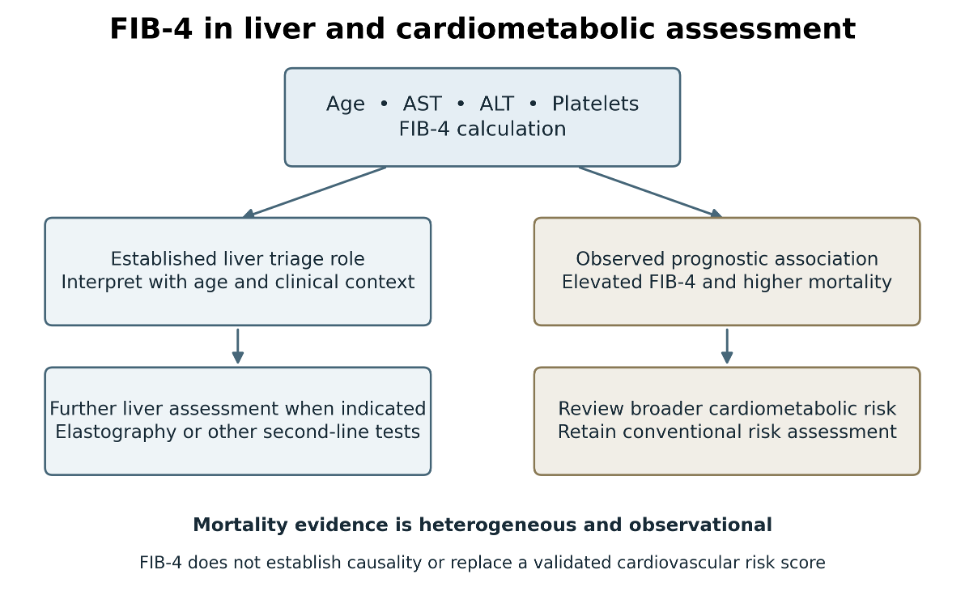
Figure 1 summarises the established liver-triage role and the broader observational prognostic signal. The two pathways can inform the same clinical assessment, but the evidence supporting each should remain explicit [1–3].
 [1]
[1]
Figure 1. FIB-4 in liver and cardiometabolic assessment. Original conceptual illustration based on the supplied systematic review and clinical guidance [1–3]. The figure summarises roles and evidence; it is not a validated clinical decision algorithm. AST, aspartate aminotransferase; ALT, alanine aminotransferase.
Conclusion
FIB-4 connects routine liver assessment with a wider literature on mortality risk. Elevated values are consistently associated with worse prognosis in the reviewed MASLD and cardiometabolic cohorts, but heterogeneous populations and exposure definitions preclude a universal mortality estimate. Its most defensible use is as a triage tool and contextual prognostic signal that prompts further evaluation [1].
[1][2][3][4][5][6][7][8][9][10][11][12][13][14][15][16][17][18][19][20]
This entry is adapted from: https://doi.org/doi:10.1016/j.numecd.2026.105008
References
- Labate AM, Villari P, Cimino E, Giacomelli L, Ettori S, Oladeji OA, Agosti B. Fibrosis-4 index and all-cause mortality in MASLD/NAFLD and cardiometabolic populations: A systematic review with structured synthesis without meta-analysis (SWiM). Nutrition, Metabolism and Cardiovascular Diseases. 2026;105008. doi:10.1016/j.numecd.2026.105008.
- European Association for the Study of the Liver, European Association for the Study of Diabetes, European Association for the Study of Obesity. EASL–EASD–EASO Clinical Practice Guidelines on the management of metabolic dysfunction-associated steatotic liver disease (MASLD). Journal of Hepatology. 2024;81(3):492–542. doi:10.1016/j.jhep.2024.04.031.
- Rinella ME, Neuschwander-Tetri BA, Siddiqui MS, et al. AASLD Practice Guidance on the clinical assessment and management of nonalcoholic fatty liver disease. Hepatology. 2023;77(5):1797–1835. doi:10.1097/HEP.0000000000000323.
- Feng Q, Izzi-Engbeaya CN, Manousou P, Woodward M. Fibrosis status, extrahepatic multimorbidity and all-cause mortality in 53,093 women and 74,377 men with metabolic dysfunction associated steatotic liver disease (MASLD) in UK Biobank. BMC Gastroenterology. 2025;25:546. doi:10.1186/s12876-025-04079-4.
- Chung SW, Park MK, Zhang X, et al. The predictive value of time-varying noninvasive scores on long-term prognosis of NAFLD in South Korea. Canadian Journal of Gastroenterology and Hepatology. 2024;2024:5667986. doi:10.1155/2024/5667986.
- Barbosa JV, Milligan S, Frick A, et al. Fibrosis-4 index as an independent predictor of mortality and liver-related outcomes in NAFLD. Hepatology Communications. 2022;6:765–779. doi:10.1002/hep4.1841.
- Ciardullo S, Cannistraci R, Muraca E, Zerbini F, Perseghin G. Liver fibrosis, NT-ProBNP and mortality in patients with MASLD: a population-based cohort study. Nutrition, Metabolism and Cardiovascular Diseases. 2024;34:963–971. doi:10.1016/j.numecd.2023.11.011.
- Mozes FE, Lee JA, Vali Y, et al. Performance of non-invasive tests and histology for the prediction of clinical outcomes in patients with non-alcoholic fatty liver disease: an individual participant data meta-analysis. Lancet Gastroenterology and Hepatology. 2023;8(8):704–713. doi:10.1016/S2468-1253(23)00141-3.
- Wu L, Cai S, Lin Z, et al. Prognostic value of non-invasive fibrosis assessment scores in predicting mortality among individuals with metabolic dysfunction-associated steatotic liver disease. BMC Public Health. 2026;26:617. doi:10.1186/s12889-026-26316-5.
- ] Anstee QM, Berentzen TL, Nitze LM, et al. Prognostic utility of Fibrosis-4 index for risk of subsequent liver and cardiovascular events, and all-cause mortality in individuals with obesity and/or type 2 diabetes: a longitudinal cohort study. Lancet Regional Health Europe. 2024;36:100780. doi:10.1016/j.lanepe.2023.100780
- Boeckmans J, et al. Clinical utility of the Fibrosis-4 index for predicting mortality in patients with heart failure with or without metabolic dysfunction-associated steatotic liver disease: a prospective cohort study. Lancet Regional Health Europe. 2025;48:101153. doi:10.1016/j.lanepe.2024.101153.
- Zhu ZY, Ren KJ, Duan XW, et al. Fibrosis-4 index as a predictor of all-cause and cardiovascular mortality in patients with chronic kidney disease. PLoS One. 2025;20(8):e0329315. doi:10.1371/journal.pone.0329315.
- Del Prato S, Li Z, Ramasundarahettige C, et al. Impact of baseline FIB-4 score on efpeglenatide benefits on cardiovascular outcomes in people with type 2 diabetes: a participant-level exploratory analysis of the AMPLITUDE-O trial. Cardiovascular Diabetology. 2024;23:352. doi:10.1186/s12933-024-02432-7.
- ] Wong E, Chen Y, Kong G, et al. Non-invasive scoring systems of liver fibrosis predict prognosis in the cohort with myocardial infarction. Scientific Reports. 2025;15:26499. doi:10.1038/s41598-025-12583-6.
- Georgiopoulos G, Athanasopoulos S, Mavraganis G, et al. Incremental value of blood-based markers of liver fibrosis in cardiovascular risk stratification. Journal of Clinical Endocrinology and Metabolism. 2025;110(4):1115–1127. doi:10.1210/clinem/dgae619.
- Guan L, Li L, Zou Y, Zhong J, Qiu L. Association between FIB-4, all-cause mortality, cardiovascular mortality, and cardiovascular disease risk among diabetic individuals: NHANES 1999–2008. Frontiers in Cardiovascular Medicine. 2023;10:1172178. doi:10.3389/fcvm.2023.1172178.
- Seo YG, Polyzos SA, Park KH, Mantzoros CS. Fibrosis-4 index predicts long-term all-cause, cardiovascular and liver-related mortality in the adult Korean population. Clinical Gastroenterology and Hepatology. 2023;21:3322–3335. doi:10.1016/j.cgh.2023.04.026.
- Zhou XD, Li YT, Kim SU, et al. Longitudinal changes in fibrosis markers: monitoring stiffness/fibrosis progression and prognostic outcomes in MASLD. Clinical Gastroenterology and Hepatology. 2026;24(2):394–406. doi:10.1016/j.cgh.2025.07.011.
- Yeo YH, Ho HJ, Huang TW, et al. Dynamic FIB-4 score changes and HCC risk in patients with MASLD and elevated liver enzymes: a nationwide cohort study. Liver Cancer. 2026. doi:10.1159/000550360
- Chen R, Petrazzini BO, Nadkarni G, Rocheleau G, Bansal MB, Do R. Comparison of blood-based liver fibrosis scores in the Mount Sinai health system, MASLD registry, and NHANES 2017–2020 study. Hepatology Communications. 2024;8(9):e0515. doi:10.1097/HC9.0000000000000515.