Emotions are relatively brief, object-directed affective episodes that arise when a person appraises an event, place, object, or memory as relevant to their concerns, and that unfold across several coordinated components: cognitive appraisal, physiological change, motivational and action tendencies, motor expression, and subjective feeling. Emotion is distinguished from the broader, longer-lasting and often objectless state of mood, from core affect (the elementary, always-present feeling of pleasantness and activation), and from feeling (the conscious, subjective component of an emotional episode). In relation to cultural heritage, “emotions and emotion-related values” denote (i) the affective responses that people have to heritage places, objects, and practices, and (ii) the dimensions of heritage significance—variously termed social, communal, spiritual, and associative value—that are constituted through, and cannot be assessed independently of, those affective bonds. On this view, heritage is not an inert set of material remains whose value is intrinsic and expert-determined; it is an active, meaning-making and emotionally charged cultural process through which individuals and communities relate to the past in the present.
How can the psychological mechanisms of emotional attachment and the political insights of critical heritage studies be brought into a single frame to fully understand heritage value? The proposition that people care about the past because they feel something about it is at once intuitive and, until recently, curiously marginal in heritage scholarship. For much of the twentieth century, heritage theory and practice were dominated by a materialist and expert-led paradigm—what Smith
[1] termed the “Authorized Heritage Discourse”—in which value was treated as an inherent property of fabric, to be identified and protected by specialists. Emotion, in this framing, was an unruly, subjective residue: real enough, but methodologically inconvenient and politically suspect. Smith and Campbell
[2] accordingly described affect and emotion as “the elephant in the room” of heritage studies—omnipresent yet unaddressed.
Two developments have since brought emotion to the centre of the field. First, the affective and emotional “turn” across the humanities and social sciences supplied heritage scholars with theoretical vocabulary and empirical methods for taking feeling seriously
[2][3][4][5]. Second, and more consequentially for practice, the international heritage-value framework itself came to acknowledge that significance is relational: places and objects matter “because of the meanings and uses that people attach to them and the values they represent”
[6]. The Council of Europe’s Faro Convention
[6], the Burra Charter
[7], the Nara Document
[8], and national policy such as English Heritage’s Conservation Principles
[9] each, in different registers, recognise an emotional or community-defined dimension of heritage significance. Emotion is therefore no longer only a psychological curiosity but a category with doctrinal and governance consequences.
The stakes of this shift are practical as well as theoretical. If heritage significance is partly constituted by how people feel about places, then conservation decisions, interpretation strategies, management plans, and community-engagement processes are all, in part, interventions in an affective field. Recognising this reframes long-standing tensions in heritage practice—between expert and lay valuation, between fabric-based and meaning-based conservation, and between the universalising language of “outstanding universal value” and the locally grounded attachments of resident communities. It also connects heritage to adjacent policy agendas in public health, social cohesion, and climate adaptation, where the emotional and identity-sustaining functions of place are increasingly acknowledged as assets to be protected rather than externalities to be ignored.
This entry synthesises peer-reviewed research and authoritative charters across four connected domains. It begins with the contemporary scientific definition of emotion (
Section 2), because heritage debates about “emotional value” are frequently muddied by loose usage of emotion, affect, mood, and feeling. It then examines emotional attachment to place as the principal mechanism by which heritage acquires social and communal value (
Section 3); the role of affect and specific emotions—especially awe and nostalgia—in the visitor experience and in wellbeing (
Section 4); and the distinctive emotional dynamics of difficult, dissonant, and “dark” heritage associated with trauma, death, and contested pasts (
Section 5).
Section 6 draws these threads into the doctrine of emotion-related heritage values, and
Section 7 identifies prospects and open problems. Throughout, the entry maintains a deliberate distinction between emotion as an individual, episodic psychological state and affect as it is theorised in critical heritage studies—a socially and politically distributed force that circulates between bodies, objects, and institutions—because conflating the two is a recurrent source of confusion in the literature.
The review draws deliberately on two studies that have developed largely in parallel and only recently begun to converge. The first is affective science and environmental psychology, which supply rigorous definitions of emotion and a substantial body of quantitative evidence on place attachment, awe, nostalgia, and wellbeing. The second is critical heritage studies and the interdisciplinary scholarship on memory, museums, and difficult pasts, which foreground the social, political, and embodied dimensions of feeling. As this entry will argue, these two bodies of work are complementary rather than competing: the psychological literature explains the mechanisms by which individuals form and act on emotional bonds to places, while the critical literature explains how those bonds are shaped, mobilised, and contested within relations of power and identity.
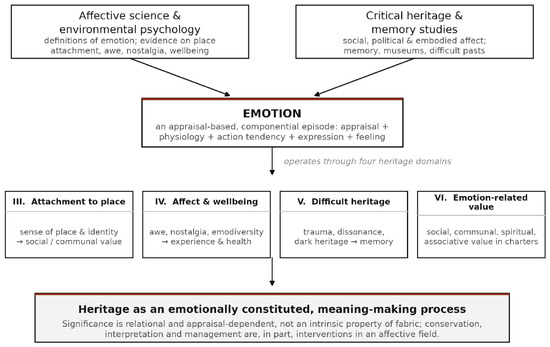
To visualize how these two distinct yet complementary bodies of research converge,
Figure 1 presents an integrative framework. This framework maps the inputs from affective science and critical heritage studies onto a core scientific definition of emotion, demonstrating how this shared understanding flows into four critical domains of heritage practice—place attachment, wellbeing, difficult heritage, and doctrinal value—ultimately redefining heritage as a dynamic, emotionally constituted meaning-making process. Further details regarding the methodological approach are provided in the
Supplementary Materials.
Figure 1. An integrative framework linking two research studies to a shared definition of emotion and, through it, to the doctrine of heritage value. Roman numerals correspond to
Section 3,
Section 4,
Section 5 and
Section 6 of the entry. Source: Authors’ own work.
This entry is adapted from the peer-reviewed paper https://doi.org/10.3390/encyclopedia6100207