Your browser does not fully support modern features. Please upgrade for a smoother experience.
Deepfakes and Synthetic Media: Generation, Detection, and Governance: History
Please note this is an old version of this entry, which may differ significantly from the current revision.

Deepfakes, synthetic audiovisual content produced by deep generative models, have escalated into a critical threat across civilian and military domains, enabling identity fraud, disinformation campaigns, and evidence fabrication. In high-stakes environments, ranging from journalism and finance to healthcare and legal contexts, the consequences extend to severe misinformation, market manipulation, identity fraud, and the erosion of institutional trust. This entry explores how modern visual intelligence and computer-vision techniques are used to detect deepfakes. It outlines key deepfake generation models, such as GANs, autoencoders, neural rendering, and diffusion systems, while also explaining how adversarial methods enhance realism and challenge existing detectors. The overview highlights visual artifacts, digital patterns, and physiological cues commonly leveraged in detection and reviews major CNN, transformer, and frequency-based approaches. It also summarizes evaluation practices and the difficulty of achieving strong generalization. Finally, it identifies emerging directions, including modern intelligence techniques for civilian and military content verification. This survey covers generation architectures (GANs, latent diffusion, neural rendering, video synthesis), the spatial, temporal, frequency-domain, and physiological artifacts they produce, and the detector families that exploit them. We examine evaluation benchmarks and protocols, highlighting cross-generator generalization as the field’s central open challenge. Beyond detection, we discuss cryptographic provenance standards, watermarking, and regulatory frameworks (EU AI Act, DSA, GDPR). We conclude that effective deepfake governance requires defense in depth integrating forensic detection, verifiable provenance, and institutional accountability.

  • deepfake detection
  • synthetic media
  • generative adversarial networks
  • diffusion models
  • multimedia forensics
  • content provenance
  • face reenactment
  • military deepfake threats
  • military content verification
  • AI governance
The term deepfake commonly refers to synthetic or heavily manipulated media, most notably images, videos, and speech, whose realism is enabled by modern machine learning, particularly deep generative models. In practice, the boundary between “deepfakes” and other manipulated media is increasingly blurred: contemporary pipelines combine generative components (e.g., diffusion or Generative Adversarial Network (GAN)-based synthesis), classical editing (compositing, retouching), and most notably, post-processing optimized for distribution environments (compression, resizing, platform-specific transcoding).
A handful of practical illustrative examples may be used to clarify the above. Specifically, everyday edits can change the look of a media, without changing what it depicts. This can be done, for example, via color grading, cropping, sharpening, compression, contrast, and other edits. Furthermore, as one travels further down the scale, there exists a wide range of manipulations, including object removal, face retouching, background replacement, or AI-assisted inpainting, which alter aspects of a photo or video, while usually keeping the event recognizable. For instance, a news picture might show a digitally slimmed crowd or erased banner, which alters the impression of an occurrence without creating the presence or words of a person. Similarly, at the end of the spectrum, techniques like face swapping, lip-sync manipulation, voice cloning, or even complete text-to-video generation can falsely assign fabricated words, deeds, or experiences to someone. As such, the ability to define what deepfake is depends on whether media elements are not—yet—a simple visual enhancement, but an alteration of who someone appears to be. Lastly, the modification may also involve what the media may be used to prove or what they seem to have believed or done; thus, the variations and possibilities are limitless.
This issue is important because it can affect both everyday civilian communication and military or security-related applications. As a result, an operational definition for researchers and practitioners is functional. A deepfake refers to media whose perceptual plausibility is sufficiently high to create a credible false impression about who did what, when, or where, and whose creation is materially facilitated by AI-based generative or reenactment methods [1][2][3]. This is of great importance, across diverse sectors; in journalism, it can skew public perception, in finance and healthcare it can lead to devastating fraud or medical misinformation, and in legal contexts, it threatens the integrity of audiovisual evidence. For example, many deepfake systems learn latent representations of identity, pose, expression, voice, or scene structure, and then recombine them to produce new audiovisual output. As a result, this enables systems to create the illusion that a target person is speaking, moving, or acting in a way that did not occur.
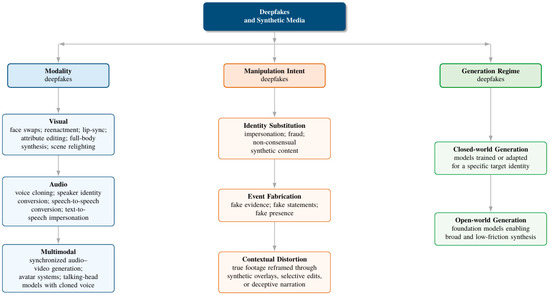
In Figure 1, we illustrate this functional taxonomy and how it separates deepfakes into three complementary dimensions: modality, manipulation intent, and generation regime. As such, based on the functional definition, one can classify deepfakes into the following broad categories based on their usage, properties, and functionality [4]:
Figure 1. Functional taxonomy of deepfakes and synthetic media according to modality, manipulation intent, and generation regime.
1.
Modality deepfakes
  • Visual: face swaps, reenactment, lip-sync, attribute editing (age, expression), full-body synthesis, scene relighting.
  • Audio: voice cloning, speaker identity conversion, speech-to-speech conversion, text-to-speech impersonation.
  • Multimodal: synchronized audio–video generation, avatar systems, “talking head” models with cloned voice.
2.
Manipulation intent deepfakes
  • Identity substitution (impersonation, fraud, non-consensual synthetic content).
  • Event fabrication (false evidence, fake statements, fake presence).
  • Contextual distortion (true footage reframed via synthetic overlays, selective edits, or deceptive narration).
3.
Generation regime deepfakes
  • Closed-world generation (trained on a specific target identity).
  • Open-world generation (foundation models enabling broad, low-friction synthesis).
The above taxonomy, even though generic and abstract, showcases real value as it suggests that detection and governance depend on which deepfake type is targeted. This distinction is also relevant for military risk assessment, where impersonation, event fabrication, and contextual distortion may produce different operational consequences. Lastly, it is noted that many failures of detection methods in real-world deployments stem from treating “deepfake detection” as a single, uniform classification problem.

Why Are Deepfakes Important?

Deepfakes are more than a computer-vision issue; they are a socio-technical risk shaped by actors, incentives, and distribution channels. Analytically, in a typical threat model, an adversary has either access to a target’s public media (photos, interviews, livestreams, military briefings, or open-source operational footage), commodity tools to generate or edit content, or platforms to distribute at scale [5][6][7]. This means that the harm is amplified by platform dynamics (virality, recommender systems) and by asymmetric verification costs (it is cheaper to generate than to thoroughly authenticate) [8][9].
A practical implication is that risk management should be framed at the system level, covering creation, publishing, detection, and incident response, rather than relying on “a model that flags deepfakes” as a standalone solution. This is especially important for military and security organizations, where false positives and false negatives may influence operational decisions. Moreover, it aligns with governance-oriented frameworks that treat AI risk across the full lifecycle and operational context [10].
As such, deepfakes combine high realism with personalization [11]: they can be tailored to a specific individual and context, which increases plausibility and emotional impact. For example, personalization can be used to imitate corporate executives authorizing fraudulent financial transfers, healthcare professionals giving false medical advice, or public figures in critical news broadcasts. As such, even when a given deepfake is debunked, the broader informational ecosystem can still be damaged via two mechanisms:
  • Evidentiary erosion: Over time, authentic recordings become easier to dismiss as fake (e.g., someone might state: “this is not genuine, it could be AI”).
  • The liar’s dividend: Public figures can strategically exploit uncertainty about synthetic media to evade accountability, deny authentic evidence, or muddy public understanding [12][13].
Therefore, the deepfake problem is not only “fake media exists” [1], but “the credibility of media as evidence is destabilized”. This is important both in terms of journalism and informed civil decisions as well as in regard to military communication, where it can weaken the trust in genuine battlefield footage, official announcements, or intelligence material.

Why Is Detection Necessary but Not Always Sufficient?

State-of-the-art detection has progressed rapidly, but deepfake defense is an arms race: generation improves, artifacts shift, and distribution transforms signals (compression, re-encoding) [14][15]. Specifically, deepfake detection attempts to figure out if the statistical patterns of an image, video, or audio signal are more compatible with natural capture or synthetic generation. As modern generators limit obvious visual artifacts, a robust detection framework must combine spatial, temporal, frequency-domain, physiological, and provenance-based evidence. Deep convolutional neural networks have consistently outperformed classical feature-based approaches for visual recognition tasks [16][17], motivating their central role in forensic detection. For military users, this defense-in-depth model should also include forensic review, provenance checks, and command-level verification procedures. As such, for this reason, current best practice is defense in depth, combining [18]:
  • Forensic detection (model-based classifiers, artifact analysis, physiological/temporal cues) [1][2][3][19].
  • Provenance and authenticity mechanisms (cryptographic manifests, signed metadata, content credentials, watermark recovery workflows), which aim to answer common questions such as: “where did this come from?” rather than the usual generic: “does it look fake?” [20][21].
  • Policy and compliance controls, including transparency duties for certain AI outputs and platform obligations for risk mitigation and accountability. In the European Union context, deepfakes intersect directly with:
    • The AI Act (risk-based obligations; transparency requirements for certain synthetic or manipulated content contexts) [22];
    • The Digital Services Act (systemic risk management and transparency duties for platforms) [23];
    • General Data Protection Regulation (GDPR) (identity, biometric data, lawful basis, data subject rights) [24][25].
These instruments do not replace technical measures, but they shape operational requirements, documentation, and response procedures.

Human Factors and Cognitive Vulnerabilities

Most of the deepfake impact beyond technical generation and algorithmic detection has deep social roots within human realms [7][11]. Specifically, over the years, it has been ingrained in our evolution to trust audiovisual evidence [13]. More specifically, to see and to hear traditionally ultimately meant to believe. As such, the evasion of analytical scrutiny by high-fidelity synthetic media takes place when emotional responses which outsmart cognitive defenses deployed by humans become activated [11][15]. This is important if we consider that confirmation bias has a marked impact on user perception [15]. Users, for example, are more likely to willingly accept, believe, and share misinformation that corresponds with their preexisting views, political affiliation, or emotional response to an issue [15].
As such, it is important to notice that a cognitive bias exists, causing one to misperceive events objectively [13][15]. This can be interpreted by highly personalized or emotionally manipulative deepfakes which influence public perception and trust, even when they do not exhibit visual artifacts. Therefore, we must deploy systemic strategies aiming at reducing cognitive vulnerabilities through advanced media literacy, even as robust technical detection invention is important [9][20].

This entry is adapted from the peer-reviewed paper 10.3390/encyclopedia6080165

References

  1. Verdoliva, L. Media Forensics and DeepFakes: An Overview. IEEE J. Sel. Top. Signal Process. 2020, 14, 910–932.
  2. Akhtar, Z. Deepfakes generation and detection: A short survey. J. Imaging 2023, 9, 18.
  3. Tolosana, R.; Vera-Rodriguez, R.; Fierrez, J.; Morales, A.; Ortega-Garcia, J. Deepfakes and Beyond: A Survey of Face Manipulation and Fake Detection. Inf. Fusion 2020, 64, 131–148.
  4. Maxmudjanov, S.; Naimov, A. Deepfake Content Types And Their Generation Methods. Пoтoмки Aль-Φapгaни 2026, 1, 26–31.
  5. Rainie, L.; Anderson, J.; Vogels, E.A. Experts doubt ethical AI design will be broadly adopted as the norm within the next decade. Pew Res. Cent. 2021, 16, 121–154.
  6. Mahr, D. Sexualized deepfakes as a socio-technical continuation of gendered power. AI Soc. 2026, 1–13.
  7. Twomey, J. Socially (de) Constructing Deepfakes: Understanding Socio-Technical Interests and Concerns in Deepfake Media. Ph.D. Thesis, University College Cork, Cork, Ireland, 2025. Available online: https://hdl.handle.net/10468/18856 (accessed on 1 June 2026).
  8. Perriello, L.E. Blurred realities: Legal strategies for the deepfake era. Maastricht J. Eur. Comp. Law 2026, 1023263X261433380.
  9. Zhang, B. Governing deepfake realities: The truth immunity framework for telecommunications policy. Telecommun. Policy 2026, 50, 103168.
  10. NIST. Artificial Intelligence Risk Management Framework (AI RMF 1.0); NIST AI 100-1; National Institute of Standards and Technology: Gaithersburg, MD, USA, 2023.
  11. Soto-Sanfiel, M.T.; Wu, Q. How audiences make sense of deepfake resurrections: A multilevel analysis of realism, ethics, and cultural meaning. Comput. Hum. Behav. 2025, 174, 108822.
  12. Putra, A.B. The Legal Standing of Deepfake Digital Evidence in Criminal Proceedings: Challenges of Evidentiary Integrity in the AI Era. Fox Justi J. Ilmu Huk. 2026, 16, 283–290.
  13. Cheng, E.K. Deepfakes, Photographs, and Trust in Evidence. Va. Law Rev. Online 2025.
  14. Peebles, W.; Xie, S. Scalable Diffusion Models with Transformers. In Proceedings of the 2023 IEEE/CVF International Conference on Computer Vision (ICCV), Paris, France, 1–6 October 2023; pp. 4172–4182.
  15. Barari, S.; Lucas, C.; Munger, K. Political deepfakes are as credible as other fake media and (sometimes) real media. J. Polit. 2025, 87, 510–526.
  16. Soundarya, B.C.; Gururaj, H.L. Deepfake detection: Critical review of state-of-the-art approaches and future perspectives. Discov. Appl. Sci. 2026, 8, 201.
  17. Sharma, S.; Selwal, A. Potential of artificial intelligence in deepfake media: From generation to detection mechanisms, state-of-the-art, and challenges. Comput. Sci. Rev. 2026, 60, 100866.
  18. Erokhin, D.; Komendantova, N. A Review of Tools and Technologies to Combat Deepfakes. Information 2026, 17, 347.
  19. Dhanapal, R.; Ps, A. Defending Against Adaptive Deepfake Generation and Detection Evasion Attacks. In Proceedings of the 2026 9th International Conference on Inventive Computation Technologies (ICICT), Kirtipur, Nepal, 15–17 April 2026; pp. 1619–1624.
  20. Modi, K. The Deepfake Conundrum: Assessing Generative AI’s Threat to Digital Reality and Proposing a Multi-Layered Defense Framework. Int. J. Comput. Trends Technol. 2025, 73, 97–103.
  21. Coalition for Content Provenance and Authenticity (C2PA). Content Credentials: C2PA Technical Specification, Version 2.2; C2PA, 2025. Available online: https://spec.c2pa.org/specifications/specifications/2.2/specs/_attachments/C2PA_Specification.pdf (accessed on 1 June 2026).
  22. European Parliament; Council of the European Union. Regulation (EU) 2024/1689 (Artificial Intelligence Act). The Official Journal of the European Union: Luxembourg, 2024. Available online: https://eur-lex.europa.eu/eli/reg/2024/1689/oj/eng (accessed on 1 June 2026).
  23. European Parliament; Council of the European Union. Regulation (EU) 2022/2065 (Digital Services Act). The Official Journal of the European Union: Luxembourg, 2022; Volume L 277, pp. 1–102. Available online: https://eur-lex.europa.eu/eli/reg/2022/2065/oj/eng (accessed on 1 June 2026).
  24. Wulf, A.J.; Seizov, O. “Please understand we cannot provide further information”: Evaluating content and transparency of GDPR-mandated AI disclosures. AI Soc. 2024, 39, 235–256.
  25. Romero Moreno, F. Generative AI and deepfakes: A human rights approach to tackling harmful content. Int. Rev. Law Comput. Technol. 2024, 38, 297–326.
More
This entry is offline, you can click here to edit this entry!
Academic Video Service