
Electro-driven membrane separations utilize external electric fields to selectively transport ionic species across charged barriers, serving as foundational technologies for desalination, resource recovery, and wastewater valorization. The performance of these systems is intrinsically governed by the complex interplay of electrochemical transport physics, thermodynamics, and membrane-solute interactions. Optimizing ion migration requires balancing concentration polarization, ohmic resistance, and irreversible energy dissipation. Furthermore, the accumulation of organic, inorganic, and biological foulants dynamically alters interfacial transport kinetics, severely limiting long-term energetic efficiency. Understanding the coupled dynamics of mass transfer, energy consumption, and fouling mechanisms is critical for the rational design and commercial scalability of next-generation electrochemical separation technologies.
- Electro-Driven Membranes
- Electrodialysis
- Ion-Exchange Membranes
- Concentration Polarization
- Specific Energy Consumption
- Membrane Fouling
- Limiting Current Density
- Donnan Exclusion
- Electrochemical Transport
- Inorganic Scaling.
1. Introduction
Electro-driven membrane separations constitute a class of electrochemical technologies that employ an externally applied electric field as the primary thermodynamic driving force for the selective transport of ions through charged matrices. Unlike pressure-driven membrane processes (e.g., Reverse Osmosis), where hydraulic pressure governs bulk fluid mass transport, electro-driven systems rely on electrochemical potential gradients. This fundamental distinction enables high permselectivity, highly concentrated brine generation, and the simultaneous separation and recovery of valuable ionic compounds from complex aqueous streams.[1][2] Representative architectures include conventional electrodialysis (ED), bipolar membrane electrodialysis (BMED), membrane capacitive deionization (MCDI), and reverse electrodialysis (RED).[3]
The efficacy of electro-driven membrane systems is dictated by a triad of interconnected domains: transport physics, energetics, and membrane fouling. Transport physics governs the spatiotemporal movement of ionic species under dual concentration and electrical gradients. Energetics dictates the thermodynamic conversion of electrical power into useful separation work, accounting for systemic, irreversible dissipations. Fouling fundamentally alters the physicochemical properties of the membrane via the deposition of organic, inorganic, and biological matrices, escalating mass-transfer resistance. Because these three phenomena are universally coupled—whereby mass transfer alters polarization, polarization increases electrical resistance, and energy dissipation accelerates foulant deposition—understanding their precise interdependence is a prerequisite for optimizing modern electrochemical water mining and biorefinery separations.[4]
2. Electrochemical Transport Physics
Electrochemical transport describes the flux of charged species within bulk electrolyte solutions and across electrically charged boundary layers. Unlike neutrally permeable networks, electro-driven membranes necessitate rigorous electrochemical thermodynamic modeling to quantify performance.[5]
2.1. Electrochemical Potential
The thermodynamic driver for ionic transport is the electrochemical potential, which unifies the chemical potential of a species with its electrostatic energy:
where μi0 is the standard chemical potential, R is the universal gas constant, T is absolute temperature, ai is ionic activity, zi is ionic valence, F is Faraday's constant, and Φ is the localized electrical potential.[1][2] Electro-driven processes operate by inducing severe electrochemical potential gradients, thereby forcing directional ionic migration against natural concentration gradients.
2.2. Ion Transport Mechanisms and the Nernst–Planck Equation
Ion flux within these systems is governed by three simultaneous mechanisms: diffusion, electromigration, and convection. The combined contribution is rigorously described by the extended Nernst–Planck equation:
where Ji is the total ionic flux, Di denotes the diffusion coefficient, ci is the local ionic concentration, ui is ionic mobility, and v represents the bulk solution velocity.[3] The electromigration term (driven by ∇Φ) is the primary vector for separation, whereas the diffusion term (∇ci) typically acts as a resistive counter-force (back-diffusion) as the concentration gradient steepens.
2.3. Ion-Exchange Membrane Selectivity and Donnan Exclusion
Ion-exchange membranes (IEMs) possess fixed, covalently bound functional groups—such as sulfonic acid (-SO3-) in cation-exchange membranes (CEMs) or quaternary ammonium (-N(CH3)3+) in anion-exchange membranes (AEMs). Permselectivity originates from Donnan exclusion, whereby ions possessing the same charge as the fixed functional groups (co-ions) are electrostatically repelled.[5] The transport number (ti = Ii /I) defines the fraction of the total electrical current carried by the target ion. In idealized scenarios, ti ≈1 for counter-ions. However, high external salinities compress the electrical double layer (EDL) via charge screening, significantly weakening Donnan exclusion and inducing parasitic co-ion leakage.[6]
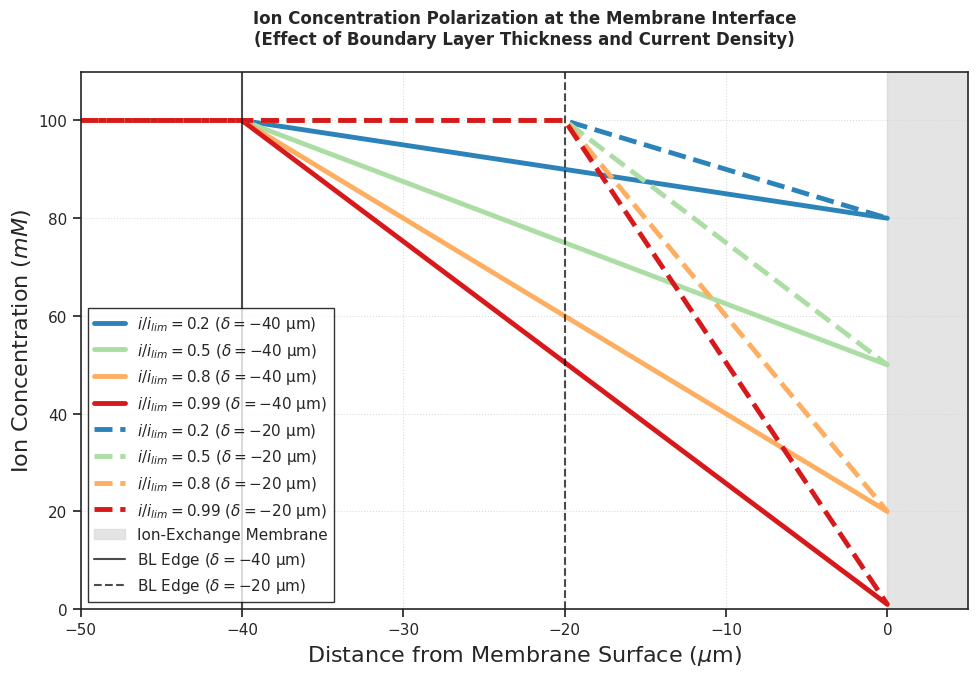
Figure 1. Ion Concentration Polarization at the membrane-solution interface. As the ratio of applied current to limiting current (i/ilim) increases, the boundary layer experiences severe ion depletion. At i/ilim ≈ 1, the surface concentration reaches zero, initiating over-limiting phenomena such as water dissociation.
2.4. Concentration Polarization and Over-Limiting Phenomena
As target ions rapidly migrate through the highly conductive membrane, they are depleted from the adjacent boundary layer on the diluate side faster than bulk diffusion can replenish them. This generates concentration polarization (CP) (Figure 1). The maximum transport rate is dictated by the limiting current density (ilim):
where cb is the bulk concentration and δ is the Nernst diffusion layer thickness.[4] Exceeding ilim drives the system into the over-limiting regime, triggering severe parasitic phenomena including electroconvection and localized water dissociation (H2O → H+ + OH-). The resulting localized pH shifts critically compromise membrane stability and trigger catastrophic inorganic scaling.[7]
3. Energetics of Electro-Driven Membrane Systems
The economic viability of electro-driven separations is strictly governed by their specific energy consumption (SEC). The total applied voltage (Vcell) is the sum of reversible thermodynamic work and multiple irreversible overpotentials:
where Vrev is the reversible Nernstian potential, Vohm represents ohmic losses across the membrane and electrolyte, Vconc denotes concentration polarization overpotentials, and Velec corresponds to electrode kinetic barriers.[8]
Because ohmic resistance (Vohm = IR) scales with electrolyte dilution, the energetic penalty of treating ultra-pure streams (e.g., in electrodeionization) is immense. Consequently, the SEC—defined as the total energy expended per volume of treated water or mass of recovered ion (SEC = IVt/Vp)—requires a delicate operational trade-off. Elevating the current density improves temporal productivity but exponentially increases non-linear Joule heating (I2R) and CP losses.[6]
4. Fouling in Electro-Driven Membrane Systems
Fouling constitutes the greatest barrier to the commercial longevity of electromembrane processes. Unlike pressure-driven systems, electromembrane fouling is driven by localized electrostatic interactions, electrophoretic deposition, and electro-chemically induced pH shifts at the solid-liquid interface.[9]
-
Organic Fouling: Driven by the adsorption of natural organic matter (NOM), humic acids, and amphiphilic proteins. The accumulation forms a highly resistive dielectric layer that neutralizes the membrane's fixed charge density, collapsing Donnan exclusion.
-
Inorganic Scaling: Strongly correlated with over-limiting currents. Water dissociation produces highly alkaline microenvironments (OH- accumulation) at the AEM interface, instantly triggering the supersaturation and crystallization of sparingly soluble salts like CaCO3 and Mg(OH)2.[7]
-
Biofouling: The electrophoretic migration of charged bacteria toward the membrane surface initiates colonization. Microbes excrete extracellular polymeric substances (EPS), creating an impenetrable biofilm that acts as an immense ohmic resistor.[10]
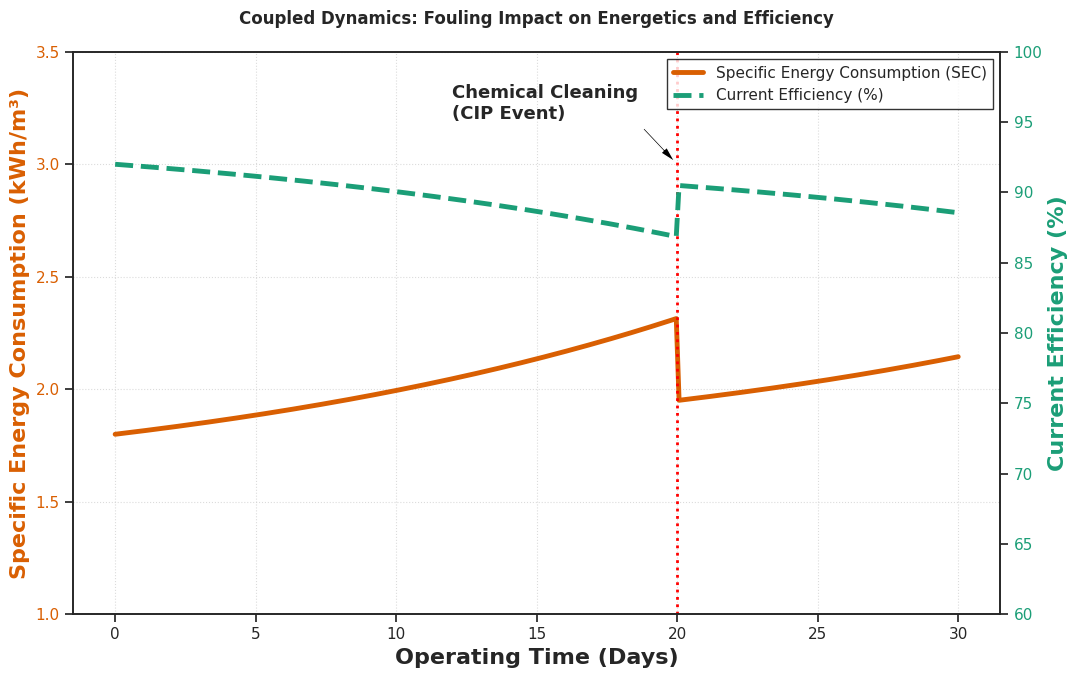
Figure 2. The coupled dynamics of fouling, Specific Energy Consumption (SEC), and Current Efficiency over time. As foulants accumulate, ohmic resistance rises exponentially, elevating SEC and suppressing current efficiency until chemical mitigation (Clean-In-Place) restores partial function.
5. Interrelationship Between Transport Physics, Energetics, and Fouling
Transport physics, energetics, and fouling do not operate in isolation; they form a tightly coupled, positive-feedback loop of systemic degradation (Figure 2).[11][2] As the operational current density increases to enhance mass transport, concentration polarization deepens. This severe boundary layer depletion exponentially increases electrical resistance, driving up the specific energy consumption. Simultaneously, the elevated localized voltage drop triggers water splitting. The resulting localized pH spikes serve as the exact thermodynamic trigger for inorganic scaling and organic coagulation.[9][12]
Once fouling occurs, the foulant layer acts as an additional physical and electrical barrier. This further intensifies concentration polarization, drastically reducing the system's current efficiency. Therefore, the rational design of next-generation electro-driven separations relies on holistic optimization: engineering advanced membrane topographies and utilizing pulsed reverse electrodialysis (PR-ED) to simultaneously suppress boundary layer depletion, mitigate foulant adherence, and minimize the irreversible dissipation of electrical energy.[10][11]
This entry is adapted from: https://www.mdpi.com/2073-4441/18/14/1746
References
- Strathmann, H.; Electrodialysis, a mature technology with a multitude of new applications.. Desalination 2010, 264, 268-288, .
- Oladipo, A.A.; Electro-Driven Membrane Separations for Sustainable Bio-Based Chemical Recovery: Energetics, Selectivity Engineering, Scale-Up Challenges, and Industrial Translation. Water 2026, 18, 1746, .
- Campione, A.; Gurreri, L.; Ciofalo, M.; Micale, G.; Tamburini, A.; Cipollina, A.; Electrodialysis for water desalination: A critical assessment of recent developments on process fundamentals, models and applications.. Desalination 2018, 434, 121-160, .
- Nikonenko, V. V.; Kovalenko, A. V.; Urtenov, M. K.; Pismenskaya, N. D.; Han, J.; Pourcelly, G.; Pourcelly, G.; Desalination at overlimiting currents: State-of-the-art and perspectives.. Desalination 2014, 342, 85-106, .
- Biesheuvel, P. M.; van der Wal, A.; Membrane capacitive deionization.. J. Membr. Sci. 2010, 346, 256-262, .
- McGovern, R. K.; Zubair, S. M.; Lienhard V, J. H.; The benefits of hybridizing electrodialysis with reverse osmosis.. Appl. Energy 2014, 136, 1064-1081, .
- Mikhaylin, S.; Bazinet, L.; Fouling on ion-exchange membranes: classification, characterization and strategies of prevention and control.. Adv. Colloid Interface Sci. 2016, 229, 34-56, .
- Post, J. W.; Hamelers, H. V. M.; Biesheuvel, P. M.; Energy recovery from controlled mixing salt and fresh water with a reverse electrodialysis system. . Environ. Sci. Technol. 2008, 42, 5785-5790, .
- Vermaas, P. M.; Saakes, M.; Oosterhaan, J. M.; Hamelers, H. V. M.; Biesheuvel, P. M; Fouling in reverse electrodialysis under natural conditions. . Water Res. 2013, 47, 1289-1298, .
- Buzzi, A.; Campione, A.; Ciofalo, M.; Cipollina, A.; Micale, G.; Tamburini, A.; A review of biofouling in electrodialysis and reverse electrodialysis.. NPJ Clean Water 2022, 5, 1-15, .
- Al-Amshawee, S.; Yunus, M. Y. B. M.; Azoddein, A. A. M.; Hassell, D. G.; Dakhil, I. H.; Hasan, H. A.; Electrodialysis desalination for water and wastewater: A review.. Chem. Eng. J. 2020, 380, 122231, .
- Oladipo, A.A.; Ahmad, M.; Energy-efficient ion recovery from water using electro-driven membranes: a comprehensive critical review. Water 2025, 17, 2456, .