
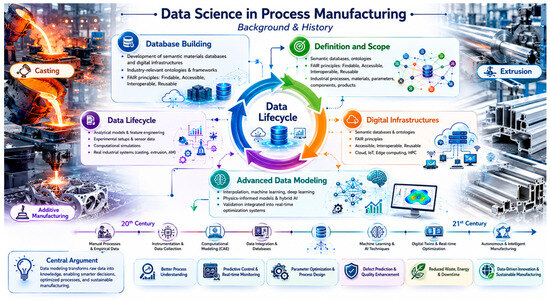
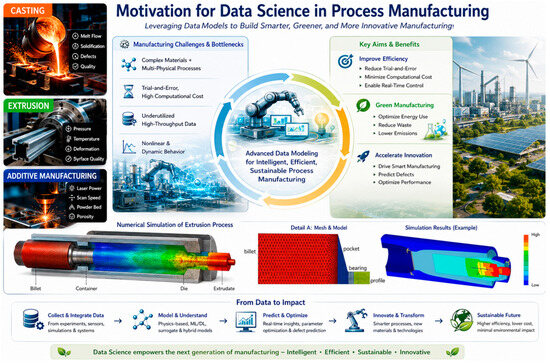
Data science methodologies are playing an increasingly important role in advancing manufacturing systems, enabling improvements in efficiency, energy usage, cost reduction, product quality, and predictive maintenance capabilities. This raises a fundamental question: to what extent can data models reshape manufacturing processes, and what limitations prevent their full-scale adoption? Recent developments show a growing integration of data models within digital twin and digital shadow architectures, facilitating real-time monitoring and decision-making. Nonetheless, the complexity of industrial processes and the scarcity of high-quality, well-structured datasets pose significant challenges, particularly in terms of model robustness, interpretability, and scalability. Importantly, the effectiveness of such models depends more on data quality and representativeness than on data quantity alone. This review presents a structured analysis of data modeling techniques for manufacturing applications, with emphasis on data generation, sampling, preprocessing, and modeling approaches across diverse operational regimes, including steady, transient, and generative processes.
- data science
- machine learning
- manufacturing processes
- digitalization
- digital twin
This entry is adapted from the peer-reviewed paper https://doi.org/10.3390/encyclopedia6070148
References
- Montgomery, D.C. The use of statistical process control and design of experiments in product and process improvement. IIE Trans. 1992, 24, 4–17.
- Haridy, S.; Gouda, S.A.; Wu, Z. An integrated framework of statistical process control and design of experiments for optimizing wire electrochemical turning process. Int. J. Adv. Manuf. Technol. 2011, 53, 191–207.
- Dogan, O.; Hiziroglu, O.A. Empowering Manufacturing Environments with Process Mining-Based Statistical Process Control. Machines 2024, 12, 411.
- Lamidi, S.; Olalere, R.; Yekinni, A.; Adesina, K. Design of Experiments (DOE): Applications and Benefits in Quality Control and Assurance. Ind. Eng. Manag. 2024.
- Patel, K. Process Optimization of Multilayer PCB Fabrication Using Statistical DOE. J. Inf. Syst. Eng. Manag. 2024, 9, 2048–2069.
- Dar, A.A.; Yadav, P.; N, A.; Wangmo, T. Optimizing Processes and Products: The Role of DOE. Insight-Stat. 2024, 7, 644.
- Shina, S.G. Industrial Design of Experiments: A Case Study Approach for Design and Process Optimization; Springer: Berlin/Heidelberg, Germany, 2022.
- Mohammed, M.A. Statistical Process Control; Cambridge University Press: Cambridge, UK, 2024.
- Anonyuo, S.; Kwakye, J.M.; Ozowe, W. A Review of Quality Control and Process Optimization in High-Volume Semiconductor Manufacturing. World J. Eng. Technol. Res. 2024, 3, 22–27.
- Huynh, H.H.; Min, C.-H. Rotating Machinery Fault Detection Using Support Vector Machine via Feature Ranking. Algorithms 2024, 17, 441.
- Wan, M.; Xiao, Y.; Zhang, J. Research on fault diagnosis of rolling bearing based on improved convolutional neural network with sparrow search algorithm. Rev. Sci. Instrum. 2024, 95, 045111.
- Varun, S.; Jigyasu, R.; Singh, S. Efficient Rolling Bearing Fault Diagnosis with a CNN-SVM System Enabled by Automatic Cut-off Conditions for Small Sample Data. J. Vib. Eng. Technol. 2025, 14, 17.
- Li, S.; Gong, Z.; Wang, S.; Meng, W.; Jiang, W. Fault Diagnosis Method for Rolling Bearings Based on a Digital Twin and WSET-CNN Feature Extraction with IPOA-LSSVM. Processes 2025, 13, 2779.
- Patel, R.A.; Desai, J.P.; Bhavsar, R.C.; Joshi, S.M. Parallel support vector machine classification framework for diagnosis of transformer faults. Electr. Eng. 2026, 108, 74.
- Yin, Z.; Xiao, C. Integration of wavelet packet transform, residual convolution neural network, and support vector machine for series arc fault detection. AIP Adv. 2024, 14, 065205.
- Ciaburro, G. Machine fault detection methods based on machine learning algorithms: A review. Math. Biosci. Eng. 2022, 19, 11453–11490.
- Chen, J.; Liu, X.; Lu, W. Multiple fault recognition for chemical processes based on TSK-type neural networks with nonlinear consequences. Granul. Comput. 2024, 9, 2.
- Kazemi, P.; Masoumian, A.; Martin, P. Fault Detection and Isolation for Time-Varying Processes Using Neural-Based Principal Component Analysis. Processes 2024, 12, 1218.
- Tsiu, S.V.; Ngobeni, M.; Mathabela, L.; Thango, B. Applications and Competitive Advantages of Data Mining and Business Intelligence in SMEs Performance: A Systematic Review. Businesses 2025, 5, 22.
- Shaaban, A.G.; Khafagy, M.H.; Elmasry, M.A.; El-Beih, H.; Ibrahim, M.H. Knowledge discovery in manufacturing datasets using data mining techniques to improve business performance. Indones. J. Electr. Eng. Comput. Sci. 2022, 26, 1736–1746.
- Sharma, S.; Osei-Bryson, K.-M. Framework for formal implementation of the business understanding phase of data mining projects. Expert Syst. Appl. 2009, 36, 4114–4124.
- Schuh, G.; Reinhart, G.; Prote, J.-P.; Sauermann, F.; Horsthofer, J.; Oppolzer, F.; Knoll, D. Data Mining Definitions and Applications for the Management of Production Complexity. Procedia CIRP 2019, 81, 874–879.
- Papadopoulos, T.; Sivarajah, U.; Spanaki, K.; Despoudi, S.; Gunasekaran, A. Editorial: Artificial Intelligence (AI) and data sharing in manufacturing, production and operations management research. Int. J. Prod. Res. 2022, 60, 4361–4364.
- Choudhary, A.K.; Harding, J.A.; Tiwari, M.K. Data mining in manufacturing: A review based on the kind of knowledge. J. Intell. Manuf. 2009, 20, 501–521.
- Saad, H. The Application of Data Mining in the Production Processes. Ind. Eng. 2018, 2, 26–33.
- Dunzer, S.; Zilker, S.; Weinzierl, S.; Tang, W.; Dieckmann, F.; Stenglein, S.; Rist, J.; Matzner, M. A technology-specific process mining maturity grid for manufacturing and logistics. Int. J. Prod. Res. 2025, 63, 4431–4457.
- Krajčovič, M.; Bastiuchenko, V.; Furmannová, B.; Botka, M.; Komačka, D. New Approach to the Analysis of Manufacturing Processes with the Support of Data Science. Processes 2024, 12, 449.
- Yin, Y.; Chu, F.; Dolgui, A.; Cheng, T.C.E.; Zhou, M.C. Big data analytics in production and distribution management. Int. J. Prod. Res. 2022, 60, 6682–6690.
- Batwara, A.; Kayande, R.A.; Kediya, S. Critical Drivers of AI Integration in Industrial Processes for Enhancing Smart Sustainable Manufacturing: Decision-Making Framework. Process Integr. Optim. Sustain. 2025, 9, 955–977.
- Zhou, S.; Bacanin, N. Artificial intelligence in advanced manufacturing. Int. J. Comp. Integ. Manuf. 2024, 37, 383–384.
- Wang, C.-C.; Chien, C.-H. Machine Learning for Industrial Optimization and Predictive Control: A Patent-Based Perspective with a Focus on Taiwan’s High-Tech Manufacturing. Processes 2025, 13, 2256.
- Okuyelu, O.; Adaji, O. AI-Driven Real-Time Quality Monitoring and Process Optimization for Enhanced Manufacturing Performance. J. Adv. Math. Comput. Sci. 2024, 39, 81–89.
- Islam, M.T.; Sepanloo, K.; Woo, S.; Woo, S.H.; Son, Y.-J. A Review of the Industry 4.0 to 5.0 Transition: Exploring the Intersection, Challenges, and Opportunities of Technology and Human–Machine Collaboration. Machines 2025, 13, 267.
- Colombathanthri, A.; Jomaa, W.; Chinniah, Y.A. Human-centered cyber-physical systems in manufacturing industry: A systematic search and review. Int. J. Adv. Manuf. Technol. 2025, 136, 2107–2141.
- Lou, S.; Hu, Z.; Zhang, Y.; Feng, Y.; Zhou, M.; Lv, C. Human-Cyber-Physical System for Industry 5.0: A Review From a Human-Centric Perspective. IEEE Trans. Autom. Sci. Eng. 2025, 22, 494–511.
- Oks, S.J.; Jalowski, M.; Lechner, M.; Mirschberger, S.; Merklein, M.; Vogel-Heuser, B.; Möslein, K.M. Cyber-Physical Systems in the Context of Industry 4.0: A Review, Categorization and Outlook. Inf. Syst. Front. 2024, 26, 1731–1772.
- Van-Lopik, K.; Hayward, S.; Grant, R.; McGirr, L.; Goodall, P.; Jin, Y.; Price, M.; West, A.A.; Conway, P.P. A review of design frameworks for human-cyber-physical systems moving from industry 4 to 5. IET Cyber-Phys. Syst. Theory Appl. 2023, 9, 169–183.
- Sharma, R.; Gupta, H. Leveraging cognitive digital twins in industry 5.0 for achieving sustainable development goal 9: An exploration of inclusive and sustainable industrialization strategies. J. Clean. Prod. 2024, 448, 141364.
- Langen, T. A Literature Review of Conceptual Modeling for Human Systems Integration in Manned-Unmanned Systems. Syst. Eng. 2025, 29, 368–383.
- Kang, H.S.; Lee, J.Y.; Choi, S.; Kim, H.; Park, J.H.; Son, J.Y.; Kim, B.H.; Noh, S.D. Smart manufacturing: Past research, present findings, and future directions. Int. J. Precis. Eng. Manuf. Green Technol. 2016, 3, 111–128.
- Krugh, M.; Mears, L. A complementary cyber-human systems framework for industry 4.0 cyber-physical systems. Manuf. Lett. 2018, 15, 89–92.
- Van-Lopik, K. Considerations for the Design of Next-Generation Interfaces to Support Human Workers in Industry 4.0. Doctoral Thesis, Loughborough University, Leicestershire, UK, 2019.
- Nakagawa, E.Y.; Antonino, P.O.; Schnicke, F.; Capilla, R.; Kuhn, T.; Liggesmeyer, P. Industry 4.0 reference architectures: State of the art and future trends. Comput. Ind. Eng. 2021, 156, 107241.
- Sharpe, R.; van Lopik, K.; Neal, A.; Goodall, P.; Conway, P.P.; West, A.A. An industrial evaluation of an Industry 4.0 reference architecture demonstrating the need for the inclusion of security and human components. Comput. Ind. 2019, 108, 37–44.
- Nguyen, H.; Ganix, N.; Ion, L. Human—Centred design in industry 4. 0: Case study review and opportunities for future research. J. Intell. Manuf. 2022, 33, 35–76.
- Moghaddam, M.; Cadavid, M.N.; Kenley, C.R.; Deshmukh, A.V. Reference architectures for smart manufacturing: A critical review. J. Manuf. Syst. 2018, 49, 215–225.
- Zong, Z.; Guan, Y. AI-Driven Intelligent Data Analytics and Predictive Analysis in Industry 4.0: Transforming Knowledge, Innovation, and Efficiency. J. Knowl. Econ. 2025, 16, 864–903.
- Çınar, Z.M.; Abdussalam Nuhu, A.; Zeeshan, Q.; Korhan, O.; Asmael, M.; Safaei, B. Machine Learning in Predictive Maintenance towards Sustainable Smart Manufacturing in Industry 4.0. Sustainability 2020, 12, 8211.
- Salierno, G.; Leonardi, L.; Cabri, G. Generative AI and Large Language Models in Industry 5.0: Shaping Smarter Sustainable Cities. Encyclopedia 2025, 5, 30.
- Horr, A.M. Notes on New Physical & Hybrid Modelling Trends for Material Process Simulations. J. Phy. Conf. Ser. 2020, 1603, 012008.
- Horr, A.; Blacher, D.; Vázquez, G. On Performance of Data Models and Machine Learning Routines for Simulations of Casting Processes. BHM Berg-Und Hüttenmänn. Monatshefte 2025, 170, 28–36.
- Horr, A.M. Real-Time Modeling for Design and Control of Material Additive Manufacturing Processes. Metals 2024, 14, 1273.
- Wang, J.; Li, Y.; Gao, R.X.; Zhang, F. Hybrid physics-based and data-driven models for smart manufacturing: Modelling, simulation, and explainability. J. Manuf. Syst. 2022, 63, 381–391.
- Bishnu, S.K.; Alnouri, S.Y.; Al-Mohannadi, D.M. Computational applications using data driven modeling in process Systems: A review. Digit. Chem. Eng. 2023, 8, 100111.
- Wilking, F.; Horber, D.; Goetz, S.; Wartzack, S. Utilization of system models in model-based systems engineering: Definition, classes and research directions based on a systematic literature review. Des. Sci. 2024, 10, e6.
- Bordas, A.; Le Masson, P.; Weil, B. Model design in data science: Engineering design to uncover design processes and anomalies. Res. Eng. Des. 2025, 36, 1.
- Vlah, D.; Kastrin, A.; Povh, J.; Vukašinović, N. Data-driven engineering design: A systematic review using scientometric approach. Adv. Eng. Inform. 2022, 54, 101774.
- Bakator, M.; Cockalo, D.; Nikolic, M. The Role of Industry 5.0 in Advancing AI-Driven Predictive Analytics in Business Operations. In Proceedings of the 5th International Science Conference Economic and Business Trends Shaping the Future, Skopje, North Macedonia, 14–15 December 2024; Available online: http://hdl.handle.net/20.500.12188/31965 (accessed on 22 April 2026).
- Gabsi, A.E.H. Integrating artificial intelligence in industry 4.0: Insights, challenges, and future prospects—A literature review. Ann. Oper. Res. 2024, 341, 1–28.
- Osho, G.O.; Omisola, J.O.; Shiyanbola, J.O. A Conceptual Framework for AI-Driven Predictive Optimization in Industrial Engineering: Leveraging Machine Learning for Smart Manufacturing Decisions. Int. J. Adv. Multidiscip. Res. Stud. 2024, 4, 1516–1532.
- Shabur, M.; Shahriar, A.; Ara, M.A. From automation to collaboration: Exploring the impact of industry 5.0 on sustainable manufacturing. Discov. Sustain. 2025, 6, 341.
- Horr, A.M.; Hartmann, M.; Haunreiter, F. Innovative Data Models: Transforming Material Process Design and Optimization. Metals 2025, 15, 873.
- Horr, A.M. Real-time Modelling and ML Data Training for Digital Twinning of Additive Manufacturing Processes. BHM Berg-Hüttenmänn. Monatshefte 2024, 169, 48–56.
- Rejeb, A.; Rejeb, K.; Zrelli, I.; Kayikci, Y.; Hassoun, A. The research landscape of industry 5.0: A scientific mapping based on bibliometric and topic modeling techniques. Flex. Serv. Manuf. J. 2024, 37, 1203–1250.
- Montgomery, D.C. Introduction to Statistical Quality Control; Wiley: Hoboken, NJ, USA, 2020; ISBN 978-1-119-72309-7.
- Box, G.E.P.; Draper, N.R. Empirical Model-Building and Response Surfaces; Wiley: Hoboken, NJ, USA, 1987; ISBN 0471810339/9780471810339.
- Kourti, T.; MacGregor, J.F. Process analysis, monitoring and diagnosis, using multivariate projection methods. Chemom. Intell. Lab. Syst. 1995, 28, 3–21.
- Qin, S.J. Statistical process monitoring: Basics and beyond. J. Chemom. 2003, 17, 8–9.
- Widrow, B.; Lehr, M.A. 30 Years of Adaptive Neural Networks; Proceedings of the IEEE; Stanford University Press: Redwood City, CA, USA, 1990; Volume 78, pp. 1415–1442.
- Chen, H.; Chiang, R.H.L.; Storey, V.C. Business Intelligence and Analytics: From Big Data to Big Impact. MIS Q. 2012, 36, 1165–1188.
- Lee, J.; Bagheri, B.; Kao, H.A. A Cyber-Physical Systems architecture for Industry 4.0-based manufacturing systems. Manuf. Lett. 2015, 3, 18–23.
- Tao, F.; Zhang, H.; Liu, A.; Nee, A.Y.C. Digital Twin in Industry: State-of-the-Art. IEEE Trans. Ind. Inform. 2019, 15, 2405–2415.
- Kumar, V.R.S.; Khamis, A.; Fiorini, S.; Carbonera, J.L.; Alarcos, A.O.; Habib, M.; Goncalves, P.; Li, H.; Olszewska, J.I. Ontologies for Industry 4.0. Knowl. Eng. Rev. 2019, 34, e17.
- Nagy, L.; Abonyi, J.; Ruppert, T. Knowledge Graph-Based Framework to Support Human-Centered Collaborative Manufacturing in Industry 5.0. Appl. Sci. 2024, 14, 3398.
- Ochoa, W.; Cuenca, J.; Larrinaga, F.; Pérez, A. I40GO: A global ontology for industry 4.0. Expert Syst. Appl. 2025, 294, 128792.
- Abonyi, J.; Nagy, L.; Ruppert, T. Ontology-Based Development of Industry 4.0 and 5.0 Solutions for Smart Manufacturing and Production, 1st ed.; Springer: Berlin/Heidelberg, Germany, 2024.
- Fani, V.; Bucci, I.; Rossi, M.; Bandinelli, R. Lean and industry 4.0 principles toward industry 5.0: A conceptual framework and empirical insights from fashion industry. J. Manuf. Technol. Manag. 2024, 35, 9.
- Horr, A.M.; Kronsteiner, J. On Numerical Simulation of Casting in New Foundries: Dynamic Process Simulations. Metals 2020, 10, 886.
- Du, Q.; Ellingsen, K.; M’hAmdi, M.; Marthinsen, A.; Tveito, K.O. The Integration of Neural Network and High Throughput Multi-Scale Simulation for Establishing a Digital Twin for Aluminium Billet DC-Casting. Mater. Trans. 2023, 64, 2.