Multicultural education has remained one of the most influential and enduring frameworks for rethinking teacher preparation in culturally, linguistically, racially, and socially diverse societies. Initially advanced through scholarship on equity, representation, prejudice reduction, and curriculum reform, the field has expanded over several decades to include questions of power, identity, belonging, language, citizenship, decolonization, and the public purposes of schooling [
1,
2,
3]. This expansion reflects a broader shift from viewing diversity as a demographic characteristic to understanding it as deeply intertwined with systems of power, knowledge production, and social inequality.
In contemporary teacher preparation, multicultural education is increasingly understood not only as a matter of inclusion but also as a means of preparing teachers to respond to structural inequality, cultural complexity, contested knowledge, and the challenges facing democratic societies. Recent scholarship further emphasizes that culturally responsive teaching, intercultural competence, democratic citizenship, and inclusive pedagogies are central to preparing teachers capable of working effectively in increasingly pluralistic classrooms and globally interconnected educational environments [
4,
5,
6,
7,
8]. Despite these advances, a growing body of research indicates that multicultural education continues to be implemented in limited and additive ways, often confined to isolated coursework rather than integrated throughout teacher education programs [
9,
10]. This gap between the conceptual aspirations of multicultural education and its programmatic implementation remains one of the field’s most significant challenges.
Although multicultural education has maintained a longstanding presence within teacher education, its interpretation and implementation remain uneven across institutions. In some programs, it is treated as a stand-alone course or diversity requirement that is disconnected from methods courses, assessment, and clinical experiences. In others, it serves as a program-wide orientation that shapes how future teachers interpret curriculum, engage with communities, design instruction, and understand their ethical and professional responsibilities. These differences reflect not only variations in program design but also broader institutional, historical, and political contexts, including standardized accountability systems, Eurocentric curricular traditions, and resistance to equity-oriented reforms [
11,
12].
At the same time, recent scholarship demonstrates that teacher education is being reshaped by increasing cultural diversity, migration, democratic challenges, decolonizing movements, and calls for equity-oriented educational reform. These developments have expanded the conceptual landscape of multicultural education beyond traditional concerns with representation and inclusion to encompass culturally responsive pedagogy, democratic participation, intercultural learning, anti-racist education, and epistemic justice [
4,
5,
6,
7,
8]. However, these rapidly evolving perspectives have largely developed in parallel rather than through an integrated conceptual framework capable of informing coherent teacher preparation.
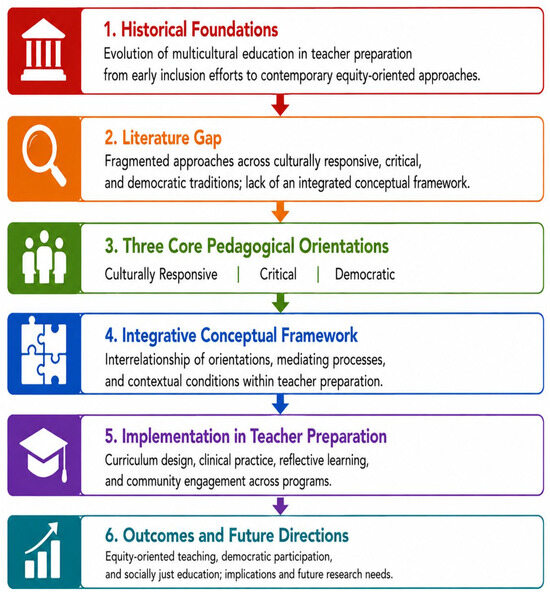
This fragmentation reveals an important gap in the literature. Existing reviews and conceptual discussions frequently examine culturally responsive pedagogy, critical pedagogy, democratic education, intercultural education, or decolonizing approaches independently. While these studies have made important theoretical contributions, relatively few have synthesized these complementary traditions into a single conceptual framework that explains how they collectively contribute to preparing teachers for culturally, linguistically, socially, and politically diverse educational settings. Consequently, teacher educators continue to lack a comprehensive framework that connects these perspectives while demonstrating how they can be enacted across curriculum, clinical practice, assessment, and professional learning. Figure 1 provides an overview of the review and illustrates the organization of the conceptual framework.
Figure 1. Overview of the Review.
The need for such a synthesis has become increasingly urgent. Recent studies published between 2023 and 2026 consistently argue that teacher preparation programs must move beyond additive models of diversity toward integrated approaches that cultivate culturally responsive practice, democratic engagement, critical inquiry, and intercultural competence simultaneously. Yet the literature remains dispersed across multiple theoretical traditions, limiting its accessibility and practical application for teacher educators and program designers [
4,
5,
6,
7,
8].
The present review examines multicultural education in teacher preparation through three interrelated traditions that have become particularly influential in contemporary scholarship and practice: culturally responsive, critical, and democratic approaches. Rather than viewing these traditions as separate or competing perspectives, this review conceptualizes them as overlapping yet analytically distinct orientations that collectively shape what teacher candidates should know, value, and be able to do in diverse educational settings.
Culturally responsive approaches emphasize relational pedagogy, cultural competence, and the affirmation of learners’ identities and community knowledge [
13,
14]. Critical approaches foreground issues of power, ideology, the hidden curriculum, and the need to interrogate dominant and deficit-oriented assumptions embedded within schooling. Democratic approaches connect multicultural education to civic dialogue, pluralism, participation, and justice-oriented teaching in diverse societies. Although each of these traditions has been widely studied, they are frequently examined independently, limiting opportunities for conceptual integration and comprehensive program design. This review addresses that limitation by examining their intersections, complementarities, and productive tensions.
Rather than presenting new empirical findings, this article synthesizes existing scholarship to provide a concise yet analytically grounded overview of multicultural education in teacher preparation. Particular attention is given to the historical development of the field, its conceptual foundations, major pedagogical approaches, global and comparative perspectives, and persistent implementation challenges. Methodologically, the review adopts an integrative approach that enables the inclusion of theoretical, empirical, and review-based scholarship to produce a comprehensive synthesis of current knowledge [
15]. The review also incorporates illustrative examples from recent teacher education research—including studies of intercultural competence, culturally responsive teaching, Indigenous education, democratic citizenship education, and culturally responsive teacher leadership—to demonstrate how multicultural education continues to evolve in response to changing social, political, and educational contexts.
The central argument advanced in this review is that multicultural education is most meaningful when it is positioned as a foundational and integrative orientation across teacher preparation rather than as an additive or symbolic component of teacher education. This argument is supported by evidence demonstrating that fragmented or superficial approaches are insufficient for preparing teachers to navigate the complexities of contemporary classrooms, particularly those characterized by diversity, inequality, and political contestation. To advance this argument, the review introduces a conceptual framework organized around culturally responsive, critical, and democratic approaches and examines the processes through which these orientations become pedagogically meaningful [
16].
This article contributes to the literature in three important ways. First, it synthesizes foundational and contemporary scholarship published across multiple traditions into a single integrative conceptual framework. Second, it demonstrates how culturally responsive, critical, and democratic pedagogies function as complementary rather than competing orientations within teacher preparation. Third, it extends recent scholarship by offering an analytically coherent model that can guide curriculum design, teacher preparation, and future research in multicultural education. In doing so, the review responds directly to recent calls for more integrated, equity-oriented, and contextually responsive approaches to teacher education.
To address this gap in the literature, this review argues that multicultural teacher preparation requires an explicitly integrative framework that connects culturally responsive, critical, and democratic pedagogies rather than treating them as separate or competing traditions. Although each approach has been examined extensively in its own right, the literature continues to reveal fragmentation in how teacher education programs conceptualize equity, power, culture, and civic engagement. Accordingly, this review advances a conceptual synthesis that bridges these traditions while incorporating recent developments in intercultural, democratic, and decolonizing education. Culturally responsive pedagogy addresses the disconnect between students’ cultural identities and classroom practices; critical pedagogy examines structural inequities, power relations, and dominant systems of knowledge; and democratic pedagogy emphasizes dialogue, participation, ethical responsibility, and civic agency within pluralistic societies. Together, these complementary perspectives provide a more comprehensive framework for preparing teachers to work effectively in increasingly diverse, unequal, and politically contested educational contexts.
1.1. Conceptual and Theoretical Framework
The conceptual framework guiding this review is organized into three interconnected components: (1) foundational theoretical perspectives, (2) contemporary extensions, and (3) analytical implications. Drawing on these perspectives, this review advances an integrative conceptual framework that synthesizes culturally responsive, critical, and democratic approaches to multicultural teacher preparation. Rather than presenting these orientations as discrete or sequential, the framework conceptualizes them as mutually reinforcing dimensions that collectively shape how teacher candidates understand identity, power, culture, knowledge, equity, and democratic participation. This integrative perspective responds directly to a persistent gap in the literature, where these traditions have frequently been examined independently despite addressing complementary dimensions of teacher preparation.
The growing body of literature further supports the need for conceptual integration. Studies published during the past several years increasingly emphasize culturally responsive pedagogy, democratic citizenship, intercultural competence, inclusive leadership, and decolonizing teacher education as interconnected rather than isolated educational priorities [
4,
5,
6,
7,
8]. However, these perspectives are often discussed within separate scholarly conversations, limiting opportunities to develop coherent models capable of guiding teacher education program design. This review addresses that limitation by bringing these complementary traditions together within a single analytical framework.
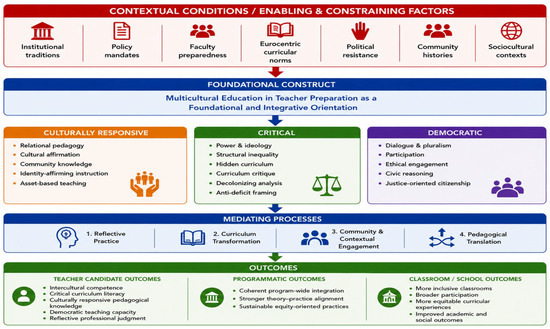
The framework further illustrates how these orientations are enacted through reflective practice, curriculum transformation, community and contextual engagement, pedagogical translation, and critical professional reflection. These mediating processes operate within broader institutional, cultural, and policy contexts that either enable or constrain the implementation of multicultural education. Consequently, the framework provides both a conceptual and practical lens for examining multicultural teacher preparation across diverse educational settings.
Unlike previous conceptualizations that primarily emphasize one pedagogical tradition, the proposed framework demonstrates that culturally responsive, critical, and democratic pedagogies are complementary because each addresses a distinct dimension of teacher preparation. Culturally responsive pedagogy focuses on culturally meaningful teaching and learning; critical pedagogy foregrounds power, inequality, and social transformation; and democratic education emphasizes participation, dialogue, and civic responsibility. Together, these orientations provide a more comprehensive understanding of teacher preparation than any single perspective alone.
Figure 2 represents an integrative conceptual framework illustrating the relationships among culturally responsive, critical, and democratic approaches within multicultural teacher preparation.
Figure 2. Integrative Conceptual Framework for Multicultural Education in Teacher Preparation.
1.1.1. Foundational Theoretical Perspectives
Three major theoretical traditions underpin multicultural teacher preparation, each contributing distinct yet complementary insights into teaching and learning within culturally diverse educational contexts.
Culturally Responsive Pedagogy
Culturally responsive pedagogy emphasizes recognizing and valuing students’ cultural backgrounds as assets that enrich teaching and learning. It promotes the development of cultural competence, meaningful relationships, and instructional practices that build upon students’ lived experiences [
2,
13]. Within teacher preparation, this perspective encourages future teachers to critically examine their own cultural identities, assumptions, and biases while developing instructional approaches that affirm linguistic, cultural, and community knowledge.
Latest scholarship extends culturally responsive pedagogy by emphasizing culturally sustaining, inclusive, and context-responsive approaches that prepare teachers to support increasingly multilingual, multicultural, and globally connected classrooms [
4,
5]. These developments reinforce the importance of moving beyond superficial cultural recognition toward pedagogical practices that sustain students’ identities while promoting educational equity.
Critical Pedagogy
Critical pedagogy focuses on examining power, ideology, inequality, and knowledge production within educational systems [
14,
15,
16,
17]. Drawing on Freire’s work, it encourages teachers to question dominant knowledge systems while recognizing how educational practices can either reproduce or challenge systemic inequities. Within teacher preparation, this perspective cultivates sociopolitical consciousness and prepares future educators to address issues of justice, equity, and oppression through reflective and transformative practice.
Contemporary scholarship further demonstrate that critical pedagogy continues to inform anti-racist education, decolonizing pedagogies, and equity-oriented curriculum reform. These perspectives broaden critical pedagogy by emphasizing epistemic justice, representation, and the inclusion of historically marginalized knowledge systems within teacher education [
6,
7].
Democratic Education
Democratic education emphasizes the role of schooling in fostering participation, dialogue, civic engagement, and ethical responsibility. It highlights the importance of creating inclusive learning environments in which diverse perspectives are respected and students are prepared to participate thoughtfully within democratic societies [
1,
7,
8,
18]. Within teacher preparation, democratic education develops candidates’ capacity to facilitate dialogue, deliberate controversial issues, and promote inclusive civic participation.
A growing body of scholarship argues that democratic education has become increasingly important in response to political polarization, misinformation, globalization, and growing cultural diversity. Consequently, democratic teacher education now extends beyond civic knowledge to include intercultural dialogue, critical listening, collaborative problem-solving, and ethical engagement across difference [
4,
8].
Collectively, these traditions address three complementary dimensions of multicultural teacher preparation: how teachers engage cultural diversity (culturally responsive), interrogate structural inequities (critical), and foster democratic participation (democratic). Rather than functioning independently, these dimensions intersect continuously within authentic teaching practice, providing a more comprehensive theoretical foundation for preparing teachers to navigate increasingly diverse educational environments.
1.1.2. Contemporary Extensions: Global and Decolonizing Perspectives
In recent decades, multicultural education has been enriched through global, intercultural, and decolonizing perspectives. Globalization has expanded multicultural education beyond national contexts by emphasizing intercultural competence, global citizenship, and the capacity to engage effectively across cultural boundaries [
4,
5,
6,
7,
8,
19]. Consequently, teacher preparation programs are increasingly expected to prepare educators capable of navigating both local educational realities and globally interconnected societies.
Decolonizing perspectives further extend multicultural education by challenging dominant epistemologies and centering Indigenous, community-based, and historically marginalized knowledge systems [
7,
19,
20]. These perspectives emphasize epistemic diversity while encouraging educators to critically examine whose knowledge is recognized, legitimized, and privileged within educational institutions.
Recent studies further demonstrates that intercultural education, democratic citizenship education, culturally responsive leadership, and equity-oriented teacher preparation increasingly converge around common commitments to inclusion, justice, participation, and educational transformation [
4,
5,
6,
7,
8]. These developments reinforce the need for integrative conceptual frameworks capable of connecting these overlapping scholarly traditions.
1.1.3. Analytical Implications
The proposed framework informs the analysis presented throughout this review in four important ways.
-
It conceptualizes multicultural education as a multidimensional and integrative framework rather than a single pedagogical approach.
-
It examines culturally responsive, critical, and democratic traditions as mutually informing orientations whose collective application strengthens teacher preparation.
-
It interprets tensions among these traditions as productive analytical spaces that promote reflection, innovation, and professional learning rather than as theoretical contradictions.
-
It situates the implementation of multicultural education within broader institutional, political, historical, and sociocultural contexts, recognizing that meaningful educational change depends upon both pedagogical practice and systemic support.
Overall, this framework provides the conceptual foundation for the remainder of the review. It enables the subsequent analysis to move beyond describing individual pedagogical traditions toward examining how their integration strengthens multicultural teacher preparation, addresses persistent implementation challenges, and advances future scholarship [
4,
5,
6,
7,
8,
15,
16].
This entry is adapted from the peer-reviewed paper https://doi.org/10.3390/encyclopedia6070153