Contemporary iterations of avian phylogenies based on multiple genome sequence assemblies assign three major clades: Palaeognathae (mostly ratite birds), Galloanseres (land and waterfowl) and the largest group—Neoaves. The latter two are sister clades representing subdivisions of Neognathae, while Neoaves further subdivide into Columbaves (pigeons/doves/cuckoos/bustards, etc.), Mirandornithes (flamingos/grebes), Telluraves (“higher land birds”, including finches) and the newly recognized Elementaves (e.g., penguins/pelicans/hummingbirds/swifts/cranes/shorebirds). Molecular studies provide clade information, likely divergence timings and a framework from which gross genomic (chromosomal) changes may be mapped. In this review, we consider the patterns of chromosome change that have occurred throughout all avian clades thus far examined, citing studies from standard karyotyping through molecular cytogenetics to whole genome assemblies. Standard karyotyping led to the realization that most chromosomes (particularly the microchromosomes and dot chromosomes) could not be distinguished by classical means. Indeed, cross-species comparisons were difficult, even among the macrochromosomes, because of indistinct banding patterns. Based on fluorescence (or fluorescent) in situ hybridization (FISH), comparative genomics was thence progressed considerably by cross-species chromosome painting (Zoo-FISH) for the macrochromosomes and interspecific mapping of bacterial artificial chromosome (BAC) probes for the microchromosomes. A key finding was that the most studied species, the chicken, fortuitously, has a genomic organization somewhat akin to that of the ancestral karyotype and tends to be the standard from which all others are measured. A notable exception is the fusion of basal chromosome 4 with a smaller chromosome that convergently appears in some other Galliformes, at least one goose and one dove species. While some groups such as Falconiformes (falcons, etc.) and Psittaciformes (parrots, etc.) underwent extensive interchromosomal change, most, broadly speaking, retain a basic karyotype that differs little from bird to bird. Many, e.g., Passeriformes (finches, songbirds, etc.) and Columbiformes (pigeons, doves), do this despite multiple intrachromosomal rearrangements. The complete karyotype and fully established chromosome-level genome assembly of the chicken allow full integration of DNA sequence assembly with karyotype. They further permit cytogenetic studies to be performed using genome assemblies alone alongside cutting-edge long-read sequencing and optical mapping without the need for chromosome preparation. The classic ZW sex-determination system of birds is easily visible in most Neognathae species, but intrachromosomal change in the sex chromosomes is faster than in the autosomes; indeed, there are numerous examples of autosomal fusions and new sex chromosomes formed. Sex chromosomes aside, the classic avian karyotype represents a very successful mode of genome organization established before the emergence of the dinosaurs and perpetuated to this day in their only living descendants.
For us to consider the chromosomal evolution of the whole of the class Aves, it needs to be performed in the context of a contemporary phylogenetic tree. It is generally accepted that whole genome sequencing provides the most reliable raw data for the construction of such a tree and, since Jarvis et al. [
1] drew the first of these based on multiple avian genome data, there have been numerous alterations and reorganizations. A study by Stiller et al. [
2] refined avian phylogeny by focusing on ultraconserved elements, exonic and intronic sequences using over 300 sequenced avian genomes. This approach enabled the removal of bias towards highly conserved elements, while using a relatively small number of samples from previous studies. It also increased the resolution of the resulting tree, the most recent version of which can be found on such web resources as AviList [
3] and Avitaxonomicon [
4].
Results confirm the subclassification into Palaeognathae (ratites and tinamous) and Neognathae, the latter breaking down into the sister groups Galloanserae (land and waterfowl) and Neoaves (the remainder) [
1,
2]. Neoaves are thus considered the third and greatest major clade of extant birds comprising ~95% of all species [
5]. Within the Neoaves, four significant clades exist [
2], with the first three being Columbaves (including pigeons, doves, mesites, sandgrouse, cuckoos, turacos and bustards), Mirandornithes (flamingos and grebes) and Telluraves (commonly referred to as “higher land birds”, including Afroaves and Australaves (e.g., finches). The fourth is a newly described, very diverse clade called Elementaves, which includes Phaethontimorphae (sunbitterns, tropicbirds and kagu), Strisores (nightbirds, hummingbirds and swifts,), Aequornithes (e.g., pelicans, penguins, loons and tubenoses), Opisthocomiformes (hoatzins), and Cursorimorphae (shorebirds and cranes) [
2].
We now have insight that the Palaeognathae–Neognathae divergence was ~100 million years ago (MYA), the Galloanserae–Neoaves divergence ~88 MYA and the separation of ratites and tinamous ~84 MYA [
1,
2]. Genomic studies, however, imply that tinamous are nested within ratites, being close to the extinct moa, suggesting that ratites are paraphyletic; that is, the absence of flight appeared homoplastically in this group [
6]. Galloanserae are further separated into Galliformes (landfowl) and Anseriformes (waterfowl), an event that occurred when the Cretaceous–Paleogene (K–Pg) boundary extinction event happened ~66 MYA [
2,
4]. Meanwhile, the primary divergences of Neoaves into Columbea and Passerea occurred slightly before the K–Pg event ~67–69 MYA [
2,
4]. The K–Pg extinction event led to a massive burst of genomic heterogeneity and changes in some molecular evolution patterns, which facilitated the diversification of modern avian life histories [
7,
8]. Most divergences within Neoaves, however, largely resolved at the ordinal level sometime later, ~50 MYA, and at the basal split of Passeriformes ~39 MYA. The K–Pg event marked a period of abrupt, widespread extinction and drastic climate change, coinciding with the Chicxulub asteroid impact in what is now modern Mexico. This had a profound impact on early bird groups such as Ornithurae, the ancestors of Neornithes [
9]. Stiller et al. [
2] updated the avian phylogeny based on the analysis of intragenic regions in 363 avian species from 218 taxonomic groups (92% of the total). The authors also go on to discuss that the number and type of sequences sampled have a larger effect on tree construction than taxon sampling alone. Stiller et al. [
2] also found a close association with the K–Pg boundary apart from the Mirandornithes and Columbaves. Inevitably, discrepancies in timescales exists from different studies and the reasons for these include different datasets and different algorithms used.
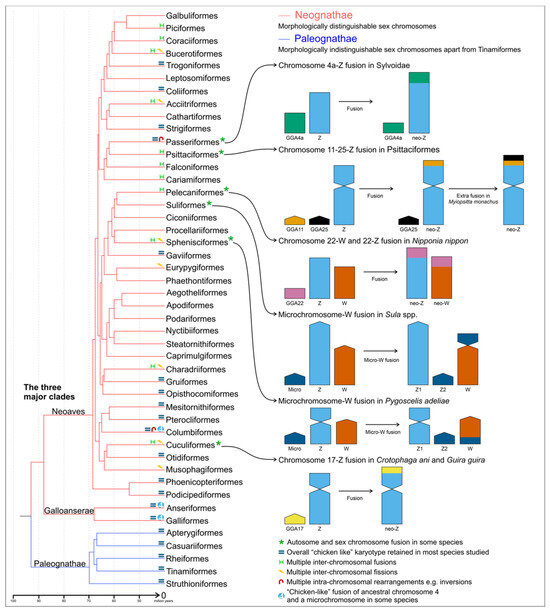
Throughout this review, we will refer to
Figure 1, the basis of which is the most recent phylogenetic tree as outlined above. As the various sections unfold, the relevance of the symbols, etc., will become apparent. In all cases, we map the observed changes in overall chromosomal structure (and in that of individual chromosomes) to the phylogenetic tree. Changes are usually made with reference to a universal common avian karyotype, which is very similar to the chicken (
Gallus gallus, Galliformes) (e.g., [
10]; see also
Section 2). A common theme throughout this review is the apparent stability of the avian genome in chromosomal terms (with exceptions) compared to mammalian genomes, which undergo interchromosomal rearrangements far more regularly.
Figure 1. Contemporary avian phylogenetic tree and overview of the chromosomal changes that have occurred throughout evolution. Phylogenetic tree based on refs. [
3,
4] with all other artwork de novo by the authors. Orders where the “chicken-like” ancestral karyotype is largely retained are indicated alongside examples of rapid fission, fusion and inversion. The convergent chromosome 4 (present in chicken (
Gallus gallus, Galliformes)) is noted, as are specific changes pertaining to the sex chromosomes.
This entry is adapted from the peer-reviewed paper 10.3390/encyclopedia6060130