
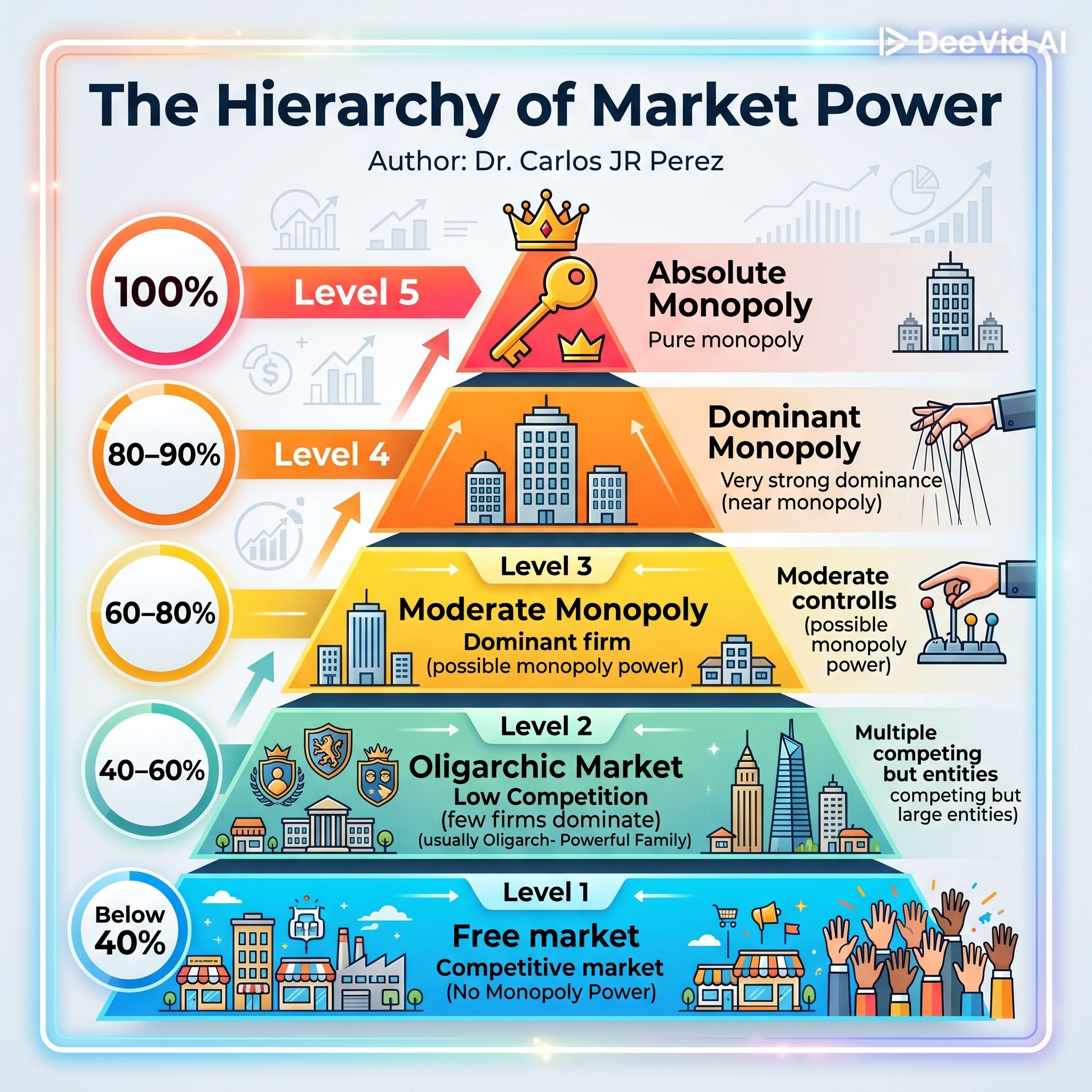
The Market Power Hierarchy Framework is a structured analytical model that conceptualizes market power as a progressive continuum rather than a binary distinction between competition and monopoly. It organizes firms into five distinct levels based on their degree of market dominance, typically measured through market share, control over resources, and influence on market outcomes. By transforming a continuous spectrum into defined stages, the framework provides a clearer and more practical approach to understanding how power operates within economic systems. At its core, the framework is based on the principle that increases in market share do not lead to linear increases in power. Instead, as firms move up the hierarchy, their influence expands in scope and complexity. A firm with moderate dominance may still face competitive constraints, while a highly dominant firm can shape pricing structures, influence consumer behavior, and control access to the market itself. This shift reflects a transition from reactive competition to proactive market control. The hierarchy is divided into five levels: Free Market (below 40% market share), Oligarchic Market (40–60%), Moderate Monopoly (60–80%), Dominant Monopoly (80–90%), and Absolute Monopoly (100%). Each level corresponds to distinct patterns of firm behavior, competitive pressure, and economic outcomes. Lower levels are characterized by high competition, price sensitivity, and continuous innovation, while higher levels exhibit increased pricing power, stronger barriers to entry, and greater stability of market position. A key contribution of the framework is its integration of structural and behavioral analysis. It not only identifies where a firm stands within the market, but also explains how that position influences decision-making. As dominance increases, firms experience reduced competitive pressure, allowing them to shift focus from short-term survival to long-term strategic control. This includes the use of pricing strategies, investment in barriers to entry, and expansion into complementary markets.
The framework also emphasizes the role of reinforcing mechanisms that sustain market power over time. These include economies of scale, brand loyalty, control of key resources, network effects, and access to capital. In modern digital markets, platform-based business models and data accumulation further accelerate the concentration of power, enabling firms to establish self-reinforcing dominance through user networks and ecosystem control. In addition to theoretical insight, the Market Power Hierarchy Framework has practical applications in policy analysis, business strategy, and market evaluation. It can be used to assess the competitive environment of an industry, predict firm behavior, and evaluate the potential impact of regulation. By identifying the level of dominance, policymakers can better determine when intervention is necessary to preserve competition and protect consumer welfare. Overall, the framework provides a comprehensive approach to understanding market dynamics in both traditional and modern economies. It highlights that market power is not a fixed condition, but an evolving process shaped by strategic behavior, structural advantages, and external conditions. As such, it offers a valuable tool for analyzing how firms gain, maintain, and exercise control within increasingly complex economic environments.
- Market Power Hierarchy Framewor
- The Hierarchy of Market Power
- market power
- monopoly
- competition
- oligopoly
- market dominance
- barriers to entry
- market structure
1. Introduction
References
- Bain, J. S. Barriers to New Competition; Harvard University Press: Cambridge, MA, USA, 1956.
- Porter, M. E. Competitive Strategy; Free Press: New York, NY, USA, 1980.
- Schumpeter, J. A. Capitalism, Socialism and Democracy; Harper & Brothers: New York, NY, USA, 1942.
- Stigler, G. J. The Economics of Scale. Journal of Law and Economics 1958, 1, 54–71.