
The superconducting transition temperature (Tc) of the graphite intercalation compound CaC6 is investigated using the Roeser–Huber (RH) formalism. Symmetric superconducting paths and phonon-mediated interactions with neighboring atoms are considered to evaluate the lowest energy levels Δ(0), revealing slight anisotropy between in-plane and out-of-plane directions consistent with experimental observations. Calculations are performed using both rhombohedral and hexagonal crystallographic representations. The resulting values Tccalc = 10.4 K and 10.9 K agree well with the experimental Tcexp = 11.5 K. The results confirm that RH superconducting channels are representation-independent and demonstrate the capability of the RH formalism to describe superconductivity in complex crystal structures.
- Graphite intercalation compounds
- CaC6
- graphene
- superconducting transition
- Tc
- Roeser-Huber formalism
- superconducting paths
Entry
Calcium-Intercalated Graphite (CaC₆) and Superconductivity
Subjects: Condensed matter physics, Superconductivity
View times: ---
Submitted by:
Michael Koblischka, A. Koblischka-Veneva
Definition
The superconducting transition temperature (Tc) of the graphite intercalation compound CaC6 is investigated using the Roeser–Huber (RH) formalism. Symmetric superconducting paths and phonon-mediated interactions with neighboring atoms are considered to evaluate the lowest energy levels Δ(0), revealing slight anisotropy between in-plane and out-of-plane directions consistent with experimental observations. Calculations are performed using both rhombohedral and hexagonal crystallographic representations. The resulting values Tccalc = 10.4 K and 10.9 K agree well with the experimental Tcexp = 11.5 K. The results confirm that RH superconducting channels are representation-independent and demonstrate the capability of the RH formalism to describe superconductivity in complex crystal structures.
1. Introduction
Calcium-intercalated graphite (CaC₆) is a member of the class of graphite intercalation compounds (GICs), materials formed by inserting metal atoms or molecules between the graphene layers of graphite [1-3]. These layered systems have attracted considerable attention because the intercalation process strongly modifies the electronic structure of graphite, leading to emergent phenomena such as metallic conductivity and superconductivity [4-12].
CaC₆ became particularly important after the discovery of superconductivity at a comparatively high transition temperature for a GIC, Tc ≈ 11.5 K [4]. Owing to its relatively high Tc among graphite intercalation compounds and its well-defined layered structure, CaC₆ continues to play a central role in studies of superconductivity in carbon-based materials and serves as a benchmark system for testing theoretical descriptions of superconducting pairing mechanisms.
Structurally, CaC₆ crystallizes in a layered arrangement in which calcium atoms occupy the interlayer galleries between graphene sheets. The compound is commonly described by a rhombohedral crystal structure (space group R-3m), although an equivalent hexagonal representation is often used for structural analysis [5]. In both descriptions, the periodic stacking of graphene layers and intercalant atoms creates well-defined crystallographic pathways that influence the motion of charge carriers.
The superconducting properties of CaC₆ are generally attributed to phonon-mediated pairing involving both the carbon lattice and the intercalated calcium atoms. Experimental studies have reported a slightly anisotropic superconducting energy gap, reflecting the layered nature of the electronic structure. Because of these characteristics, CaC₆ serves as a model system for investigating superconductivity in intercalated and low-dimensional materials.
Various theoretical approaches have been applied to describe superconductivity in CaC₆. Among them, the Roeser–Huber (RH) formalism provides a framework in which superconducting transition temperatures are derived from geometrically defined carrier paths within the crystal lattice together with interactions with nearby atoms [13-15]. This method enables the analysis of superconductivity in materials with complex crystal structures by linking lattice geometry, carrier motion, and phonon coupling.
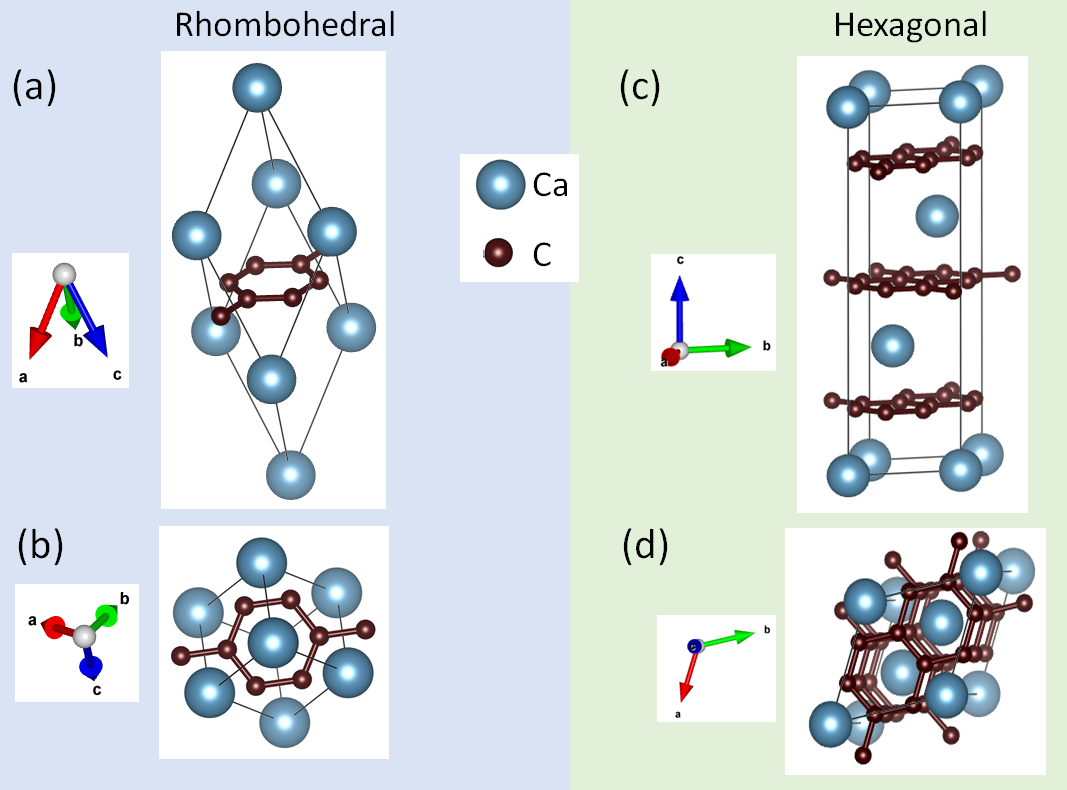
Figure 1. (a,b) give the rhombohedral unit cell of CaC6 as drawn first by Emery et al. [5]. One must note here that this is not the primitive cell, see text. (a) is a view along the [001]-direction which is often seen in the literature, and (b) gives the cell slightly off the [111]-direction. (c,d) present the hexagonal cell of CaC6 illustrating the graphene layers and the stacking of the Ca atoms. (d) shows a view slightly off the [001]-direction enabling the view of channel-like arrangements.
CaC6 is the only member of the GIC with a rhombohedral unit cell (space group R-3m) with the lattice parameters a = b = 0.517 nm, α = 49.55° [5]. This primitive rhombohedral contains a single calcium atom and six carbon atoms per unit cell. The carbon atoms form a graphitic planar hexagon located in the median plane of the cell with an in-plane C–C distance of approximately 1.42 Å, which is very close to the C–C bond length in pristine graphene or graphite. In contrast, the calcium atom occupies a special Wyckoff position at the origin:
Carbon: 6 atoms 6g (1/6 5/6 1/2) Calcium: 1 atom 1a (0 0 0)
This information enables the plotting of the structure using software like Crystalmaker [22] or VESTA [23]. The primitive rhombohedral cell is correct for symmetry analysis, but it does not allow for searching superconducting paths following the RH logic. Thus, the construction of supercells is required. In Ref. [5], another representation of the rhombohedral cell was given (their Fig. 7), which is now often used in the literature. However, we must note here that this figure is not a direct real-space plot of a CIF unit cell, but represents a schematic symmetry diagram, which is drawn in a projected metric, emphasizing Wyckoff connectivity and topology, but is not intended to preserve Euclidean angles or lattice vectors. Having this in mind, one can carefully look at this figure which allows to visualize some of the important channels for the path analysis. Figures 1a, b show the commonly used rhombohedral representation of CaC6; in (a) the full cell is shown, and (b) gives the view in [111]-direction. While this diagram reflects the correct symmetry, it is a schematic projection rather than a strict Euclidean representation of the primitive rhombohedral cell.
In contrast, rhombohedral crystals are often represented using a hexagonal unit cell that is three times larger in volume. In this description, the lattice parameters of CaC6 are a = 0.4333 nm and c = 1.3572 nm. Since the interlayer spacing between carbon sheets is d = 0.4524 nm, we obtain c = 3d = 1.3572 nm. In this representation, the shortest Ca–Ca distance in the intercalant layer is a = 0.4333 nm, and the closest C–C distance is dCC = 0.1444 nm. The Wyckhof positions for this hexagonal structure were determined in Ref. [5] are:
Carbon: 18 atoms 18g (1/3 0 1/2) Calcium: 3 atoms 3a (0 0 0)
Slightly different values were reported by Wang et al. [24] with a = 0.43054 nm and c = 13.1205 nm. The hexagonal CaC6 cell is shown in Fig. 1c (view along [100]) and Fig. 1d (view slightly off the [001]-direction).
2. The RH formalism applied to CaC6
A detailed discussion of the Roeser–Huber (RH) formalism, as applied to various elements and alloys, has been presented previously in Refs. [13-15]. Therefore, we summarize here only the most relevant steps.
Superconductivity in the RH formalism is seen as a resonance effect between the charge carrier wave formed by Cooper pairs with the de Broglie wavelength, λcc, which moves through the crystal lattice. The RH framework postulates that the superconducting transition corresponds to the lowest standing-wave resonance of paired charge carriers confined to an effective path length, x. This picture can be straightforwardly understood when interpreting the superconducting transition seen in a resistance measurement as an integrated resonance curve. The underlying physics is given by the particle-in-box (PiB) principle of quantum mechanics [25].
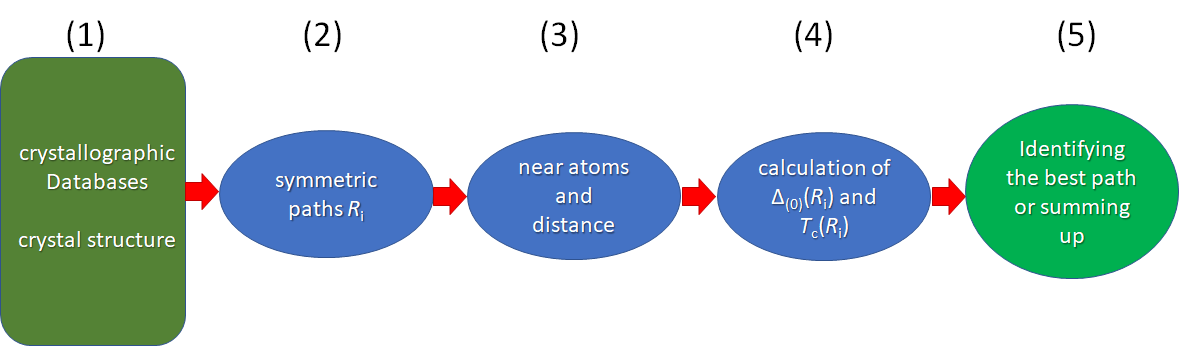
Figure 2. Schematic illustration of the steps required in the RH formalism to obtain the data required for the calculation of the superconducting transition temperature, Tc.
The lowest energy level and the superconducting transition temperature are given by eq. (1) [13-15]

where kB = Boltzmann’s constant, h = Planck’s constant, and ML = η ・ 2me with me denoting the free electron mass. η is a parameter reflecting the Fermi and Debye temperatures of the material, yielding η = 918.1 [16,17]. According to the resonance view, Tccalc corresponds to the mean field TcMF determined by the maximum of the derivative, dR/dT. The effective resonance length, x, is defined purely by geometric considerations. For each crystallographic direction Ri – hereafter referred to as a superconducting path – the two factors, n1 and n2, must be determined to obtain a complete description of the energy Δ(0) and the corresponding transition temperature, Tc(0). The parameter n1 = NL/NA is defined as the ratio of NL, the number of electrons participating in the superconducting state, to NA, the number of passed, near atoms encountered along the superconducting path within the crystal lattice. In Refs. [13-15], atoms were counted as “near” when the condition lcalc/x ≤ 0.5 was fulfilled. The parameter lcalc represents the perpendicular distance of an atom to the selected superconducting path. Thus, the passed, near atoms must be searched within a cylinder around the vector x with radius lcalc. For more complex lattices, a standing sinusoidal wave model for the Cooper-pair de Broglie wavelength was introduced in Ref. [16] as eq. (2):

and eq. (3):

with hE denoting the distance of the plane in which the passing atoms are located to the atom from which the superconductivity originates. Thus, for CaC6 with the presence of several graphene layers, both criteria must be evaluated.
The second parameter, n2, characterizes the relation between symmetry-equivalent paths oriented along the same crystallographic direction. The factor n2 becomes particularly important in complex superconducting structures where multiple superconducting paths coexist and are associated with different atomic species. Both parameters must be evaluated for each possible superconducting path. For CaC6, this situation does not arise, since superconductivity is assumed to be carried exclusively by the calcium sublattice.
Consequently, only a single type of superconducting path is present, and therefore n2 = 1. In this way, the longstanding idea of directly linking superconductivity to the underlying crystal lattice [26] finds a natural realization within the RH framework. It should be noted that the superconducting pairing interaction may involve multiple phonon modes (vibrational modes of the lattice), each contributing differently to the overall electron–phonon coupling. Such behavior is characteristic of complex crystal structures, for example the graphite intercalation compounds (GICs) [3] and A15-type [27] superconductors, where several optical and acoustic phonon branches interact with the conduction electrons. Within the RH framework, this multimode phonon coupling is effectively incorporated through the counting of the near, passed atoms along a given superconducting path, which serves as a geometric measure of the local vibrational environment experienced by the superconducting wave. The required crystallographic data come from respective databases [28–30], enabling the RH formalism to be integrated straightforwardly into machine-learning frameworks for predictive superconductivity studies [18-21].
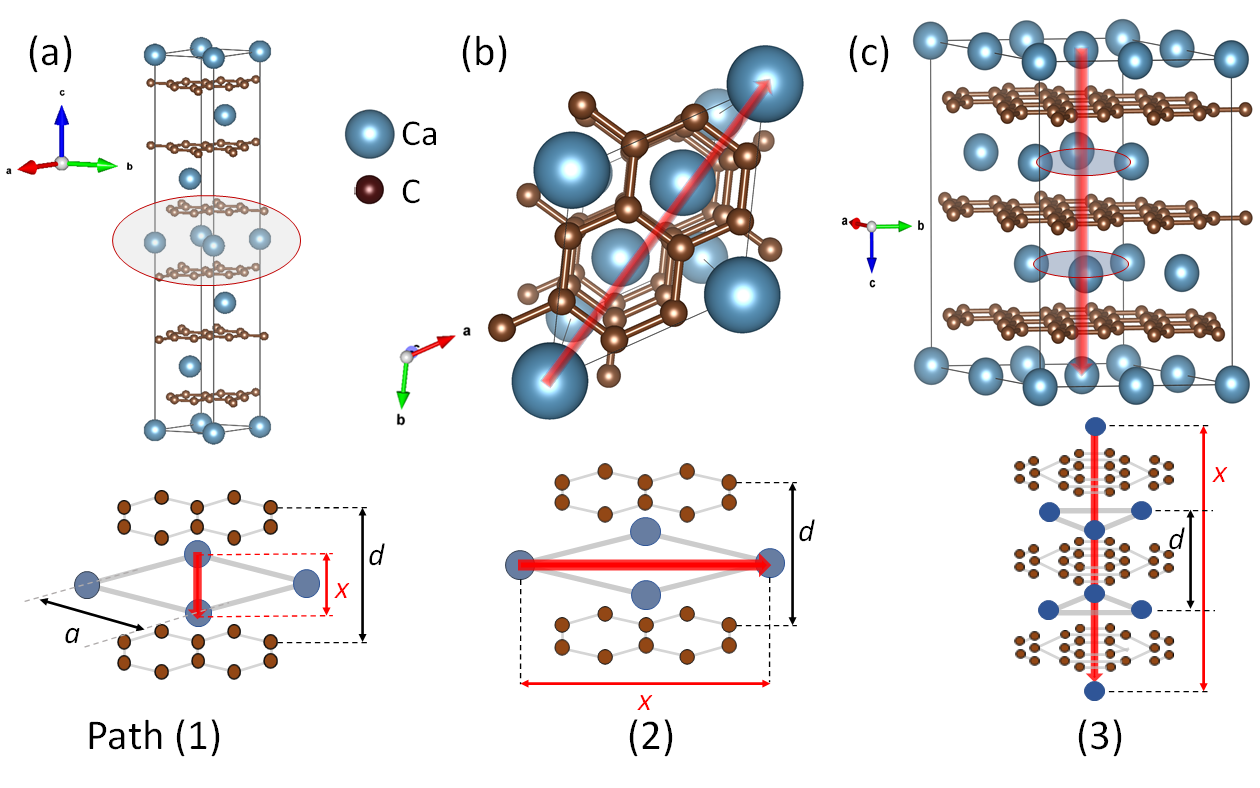
Figure 3. The superconducting paths for the hexagonal unit cell of CaC6. The upper row presents various views of the hexagonal cell; the lower row gives schematic figures of each possible superconducting path (marked by red arrows) which allow for proper counting of NA. (a) gives a 1 x 1 x 2 supercell, (b) a view in [001]-direction enabling the view of channel-like arrangements, and (c) gives a 2 x 2 x 1 supercell with the red rings indicating the triangles of Ca-atoms. The paths (1) and (2) are located within the (a,b)-plane, path (3) goes along the (c)-axis.
Table 1 gives the calculation steps for Δ(0) and Tccalc for the hexagonal crystal lattice using the RH formalism (eq. (1)).
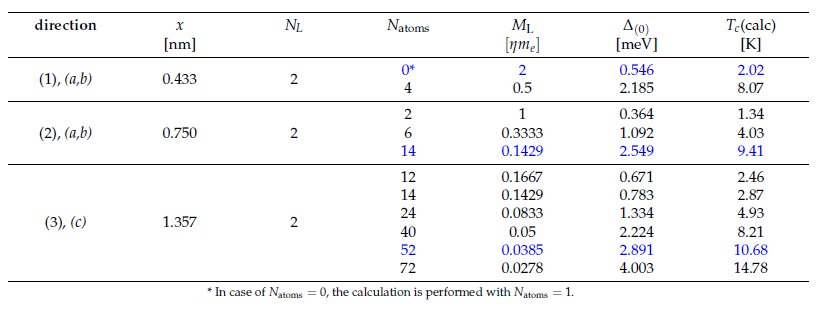
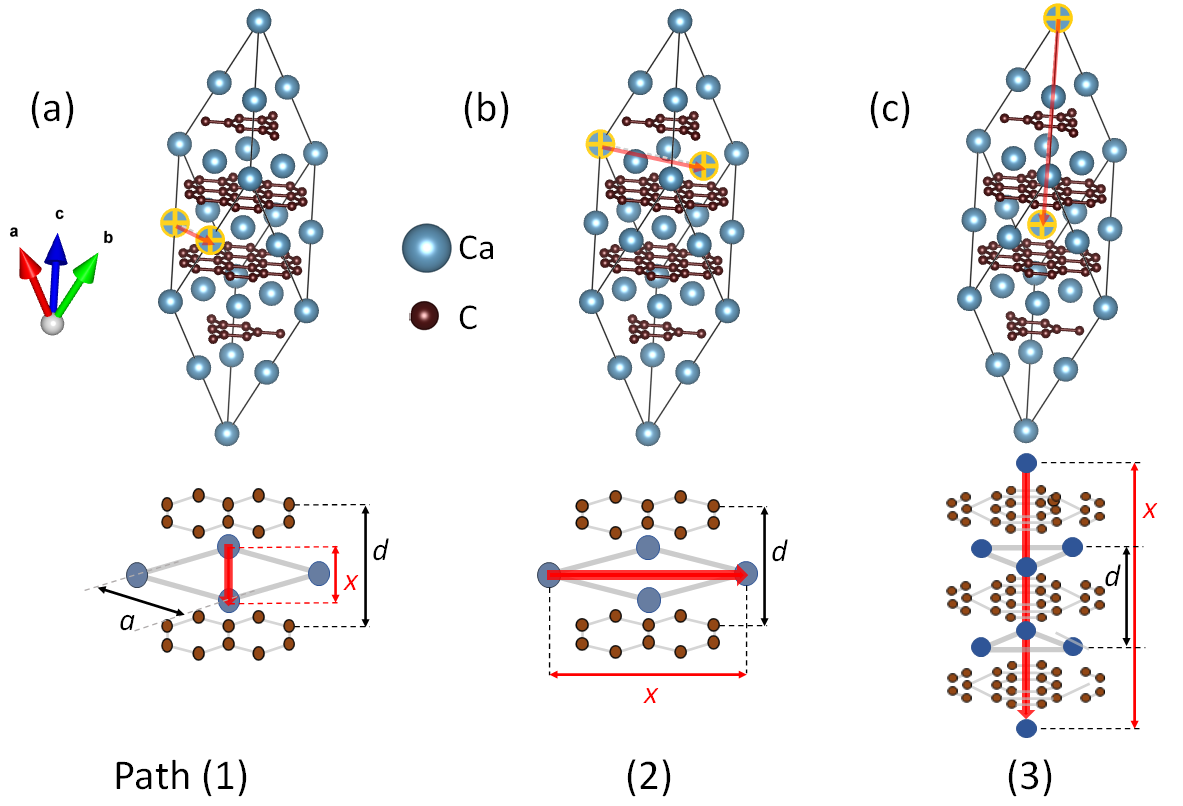
Figure 4. The superconducting paths for the rhombohedral unit cell of CaC6. The upper row presents a 2 × 2 × 2 supercell; the lower row schematic figures of each possible superconducting path (marked by red arrows) which allow for proper counting of NA. The paths (1) and (2) are located within the (a,b)-plane, path (3) goes along the (c)-axis. Note also that especially for path (3) the supercell is still incomplete to get full information on the passed, near atoms.
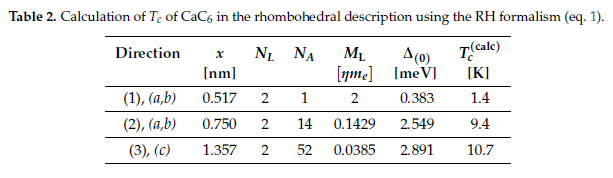
Table 2 summarizes the RH calculation of rhombohedral CaC6. The calcium atoms donate their two outer electrons to the graphene, so NL = 2 [23]. Tccalc is obtained from the sum of directions (1)+(2), so 10.8 K. This value is quite similar to the one of the c-axis direction (path 3), but is only slightly larger.
Table 2 gives the calculation steps for Δ(0) and Tccalc for the hexagonal crystal lattice.
3. Conclusions and Outlook
The present analysis demonstrates that the Roeser–Huber formalism provides a consistent and representation-independent framework for analyzing superconducting pathways in crystalline materials. A systematic evaluation of superconducting paths in CaC6 using both rhombohedral and hexagonal crystallographic descriptions shows that, despite geometric differences between the unit-cell representations, all essential RH parameters—including path multiplicities and near-atom environments—remain invariant. This confirms that the RH description captures intrinsic structural properties of superconductivity rather than artifacts arising from a particular crystallographic representation.
An important conceptual outcome of the present work is the identification of the geometric path-counting scheme as the most robust component of the RH approach. The decisive physical information is encoded in the counting of passed and near atoms along symmetry-allowed superconducting channels, which determines the effective resonance environment experienced by Cooper pairs. While the calculated transition temperature depends on the resonance length x, the analysis highlights that longer paths can still produce higher Tc values if they involve a larger number of participating near atoms. Such effects illustrate the flexibility of the RH framework in capturing the interplay between lattice geometry and superconducting coupling.
From a broader perspective, these results emphasize that the RH formalism provides a compact, physically interpretable descriptor of superconducting materials derived directly from crystallographic geometry. The key quantities—translational path length, multiplicity, and near-atom environment—can be determined automatically from structural data and therefore form a low-dimensional feature set suitable for computational analysis. This property makes the RH formalism particularly attractive for integration into machine-learning–based materials discovery.
In the context of data-driven searches for new superconductors, RH-derived descriptors could serve as structured input features in machine-learning models that screen large crystallographic databases. Because these descriptors are explicitly linked to symmetry relations and real-space connectivity, they offer a level of physical interpretability that is often absent in purely statistical or composition-based feature sets. Consequently, the RH framework may act as a bridge between physically motivated analytical models and modern machine-learning strategies, enabling hybrid approaches in which symmetry-allowed superconducting channels guide automated materials screening.
The demonstrated representation independence of the RH formalism further supports its use in such automated workflows. As shown for CaC₆, equivalent physical results are obtained when the analysis is performed using different crystallographic settings, provided that all symmetry-related paths are properly identified. This robustness ensures that RH descriptors remain stable across diverse structural databases where different unit-cell conventions are commonly used.
Future work may therefore focus on implementing automated RH path detection and near-atom counting algorithms for high-throughput crystallographic datasets. Such developments could open a systematic route toward machine-learning-assisted discovery of new superconducting materials, in which the RH formalism supplies physically grounded structural descriptors that guide the exploration of complex crystal structures.
This entry is adapted from 10.3390/met13061140
References
- Dresselhaus, M.S.; Dresselhaus, G. Intercalation compounds of graphite. Adv. Phys. 1981, 30, 139-326.
- Enoki, T.; Suzuki, M.; Endo, M. Graphite Intercalation Compounds and Applications. Oxford University Press: Oxford, U.K., 2003.
- Smith, R.P.; Weller, T.E.; Howard, C.A.; Dean, M.P.M.; Rahnejat, K.C.; Saxena, S.S.; Ellerby, M. Superconductivity in graphite intercalation compounds. Phys. C 2015, 514, 50-58.
- Weller, T.E.; Ellerby, M.; Saxena, S.S.; Smith, R.P.; Skipper, N.T. Superconductivity in the intercalated graphite compounds C6Yb and C6Ca. Nat. Phys. 2005, 1, 39-41.
- Emery, N.; Hérold, C.; Lagrange, P. Structural study and crystal chemistry of the first stage calcium graphite intercalation compound. J. Solid State Chem. 2005, 178, 2947-2952.
- Emery, N.; Hérold, C.; d’Astuto, M.; Garcia, V.; Bellin, C.; Marêché, J.F.; Lagrange, P.; Loupias, G. Superconductivity of Bulk CaC6. Phys. Rev. Lett. 2005, 95, 087003.
- Emery, N.; Hérold, C.; Marêché, J.-F.; Lagrange, P. Synthesis and superconducting properties of CaC6. Sci. Technol. Adv. Mater. 2008, 9, 044102.
- Calandra, M.; Mauri, F. Theoretical Explanation of Superconductivity in C6Ca. Phys. Rev. Lett. 2005, 95, 237002.
- Ludbrook, B.M.; Levy, G.; Nigge, P.; Zonno, M.; Schneider, M.; Dvorak, D.J.; Veenstra, C.N.; Zhdanovich, S.; Wong, D.; Dosanjh, P.; Straßer, C.; Stöhr, A.; Forti, S.; Ast, C.R.; Starke, U.; Damascelli, A. Evidence for superconductivity in Li-decorated monolayer graphene. PNAS 2015, 112(38), 11795-11799.
- Gholami, R.; Moradian, R.; Moradian, S.; Pickett, W.E. Superconducting Phases in Lithium Decorated Graphene LiC6. Sci. Rep. 2018, 8, 13795.
- Sergeyev, D.; Duisenova, A.; Embergenov, Zh. Modeling of electrotransport properties of Li-intercalated graphene film. J. Phys.: Conf. Ser. 2021, 2140, 012025.
- Profeta, G.; Calandra, M.; Mauri, F. Phonon-mediated superconductivity in graphene by lithium deposition. Nature Phys. 2012, 8, 131-134.
- Roeser, H.P.; Haslam, D.T.; Lopez, J.S.; Stepper, M.; von Schoenermark, M.F.; Huber, F.M.; Nikoghosyan, A.S. Correlation between transition temperature and crystal structure of niobium, vanadium, tantalum and mercury superconductors. Acta Astronaut. 2010, 67, 1333-1336.
- Koblischka, M.R.; Roth, S.; Koblischka-Veneva, A.; Karwoth, T.; Wiederhold, A.; Zeng, X.L.; Fasoulas, S.; Murakami, M. Relation between Crystal Structure and Transition Temperature of Superconducting Metals and Alloys. Metals 2020, 10, 158.
- Koblischka, M.R.; Koblischka-Veneva, A. Calculation of Tc of Superconducting Elements with the Roeser–Huber Formalism. Metals 2022, 12, 337.
- M.R. Koblischka, A. Koblischka-Veneva, Superconductivity in the Intercalated Graphite Compound CaC6 and the Roeser–Huber Formalism. Metals 2025, 15, 1367.
- M.R. Koblischka, A. Koblischka-Veneva, Geometric Resonance Analysis of superconductivity in CaC6: Hexagonal and Rhombohedral Descriptions in the Roeser–Huber Framework. Crystals 2026, 16, 184.
- Merchant, A.; Batzner, S.; Schoenholz, S.S.; Aykol, M.; Cheon, G.; Cubuk, E.D. Scaling deep learning for materials discovery. Nature 2023, 624, 80-85.
- Gashmard, H.; Shakeripour, H.; Alaei, M. Predicting superconducting transition temperature through advanced machine learning and innovative feature engineering. Sci. Rep. 2024, 143965.
- Zeni, C.; Pinsler, R.; Zügner, D.; Fowler, A.; Horton, M.; Fu, X.; Wang, Z.; Shysheya, A.; Crabbé, J.; Ueda, S.; Sordillo, R.; Sun, L.; Smith, J.; Nguyen, B.; Schulz, H.; Lewis, S.; Huang, C-W.; Lu, Z.; Zhou, Y.; Yang, H.; Hao, H.; Li, J.; Yang, C.; Li, W.; Tomioka, R.; Xie, T. A generative model for inorganic materials design. Nature 2025, 639, 624-632.
- Adiga, S.; Waghmare, U.V. Accelerating the Search for Superconductors Using Machine Learning. Comput. Mater. Sci. 2026, 263, 114453.
- CrystalMaker Software Ltd., Begbroke, Oxfordshire, OX5 1PF, U.K. https://crystalmaker.com/
- Momma, K.; Izumi, F. VESTA 3 for three-dimensional visualization of crystal, volumetric and morphology data. J. Appl. Crystallogr. 2011, 44, 1272-1276.
- Wang, B.; Bianconi, A.; Mackinnon, I.D.R.; Alarco, J.A. Superlattice delineated Fermi surface nesting and electron-phonon coupling in CaC6. Crystals 2024, 14, 499.
- Rohlf, J.W. Modern Physics from α to Z0; Wiley: New York, NY, USA, 1994.
- Buckel, W.; Kleiner, R. Supraleitung. Grundlagen und Anwendungen, 7th ed.;Wiley-VCH: Weinheim, Germany, 2013. (In German)
- Stewart, G.R. Superconductivity in the A15 structure. Physica C 2015, 514, 28–35.
- ICDD. ICDD PDF Data Base; ICDD: Newtown Square, PA, USA, 2025.
- Materials Project Database V2019.05. Available online: https://materialsproject.org/ (accessed on 15 February 2026).
- Crystallography Open Database (COD). Available online: https://www.crystallography.net/cod/index.php (accessed on 15 February 2026).
This entry is adapted from the peer-reviewed paper https://doi.org/10.3390/ma12060853