Your browser does not fully support modern features. Please upgrade for a smoother experience.

Please note this is an old version of this entry, which may differ significantly from the current revision.
Subjects:
Construction & Building Technology
The concept of ‘thrust line’ has its roots in historical contributions that laid the foundation for the development of modern tools useful for the limit analysis of masonry arches and vaults. This concept can be traced back to two different, but related, notions: ‘line of resistance’ and ‘line of pressure’. In this paper, both historical contributions and recent developments of the thrust line method will be discussed with a focus on those formulations which take into account the material’s properties, in particular compressive strength.
- masonry arch
- limit analysis
- thrust line
- compressive strength
- line of pressure
- line of resistance
This paper aims to examine the historical roots of the thrust line concept, developed in the context of 19th-century studies on the static analysis of masonry arches, focusing on those contributions capable of taking into account the masonry strength, placing them as a basis for possible modern developments.
1.1. Limit Analysis of Masonry Structures
To better understand how this topic can be framed from a theoretical point of view, it may be necessary to first review the approaches related to the structural analysis of unreinforced masonry structures, a crucial problem in contemporary structural mechanics due to the complex mechanical behaviour of masonry, a heterogeneous material with low tensile strength and good compressive strength [1,2,3,4].
As is well known, different approaches are used to address this matter. In the recent scientific literature, discrete element (DEM) [5,6,7] and finite element methods (FEM) are available as powerful tools to capture the mechanical response of a masonry structure under gravitational or seismic loads by taking into account the blocks arrangement, the material properties, the features of the interfaces, and the presence of reinforcements, sometimes with reference to specific case studies or to interpret experimental tests [8,9,10]. For a comprehensive discussion of modelling strategies for masonry characterization and analysis of unreinforced masonry structures, the interested reader is referred to [11,12,13].
However, as observed among others by [12], when modelling the structural behaviour of masonry using refined formulations, several mechanical parameters must be considered, sometimes affected by uncertainties or difficult to determine. Furthermore, these methods can be computationally demanding. For this reason, simple approaches based on the static and kinematic theorem of limit analysis are still considered valuable in engineering practice today for rapidly assessing masonry structures, providing useful information for conservation purposes [14]. The objective of classical limit analysis is to assess structural safety and/or determine the maximum load-bearing capacity of a structure. Starting from the fundamental contribution by Kooharian [15], Jacques Heyman [16,17,18] transferred the philosophy of plastic theory from the steel to the stone skeleton, studying the mechanics of masonry structures in the theoretical background of limit analysis. Re-evaluating pre-elastic contributions [19], he assumed simplifying hypotheses on the masonry material (zero tensile strength, infinite compressive strength, no sliding between the blocks). Considering these assumptions, ref. [20] offers an overview of the theoretical aspects of limit analysis applied to masonry structures, in particular arches, vaults, and domes. Heyman’s no-tension model has been widely and successfully used to examine the stability of masonry systems by exploiting both the static and kinematic theorems of limit analysis: on the one hand, his well-known safe theorem made it possible to re-evaluate the idea of thrust line and to leverage graphical statics to assess the equilibrium of masonry arches and vaults using both classical [21,22] and computational approaches [23,24]; on the other, kinematic analysis was applicable to examine possible collapse modes of both vaulted structures and masonry buildings under gravitational or seismic loads [25,26,27,28].
Although Heyman limit analysis [16,17,18] has proven to be a reliable technique for the structural analysis of masonry structures, a number of scholars (see, for example [29]) observe that such a simplified approach does not take into account important factors that should be considered to avoid overestimating the load-bearing capacity of an unreinforced masonry structure, such as the possibility of sliding between the masonry blocks, and masonry crushing.
Given the complexity of the theoretical background of studies on the structural response of masonry structures, only briefly outlined above, and observing that limit analysis plays a crucial role, this paper seeks to draw the readers’ attention to an important topic: the relationship between the thrust line method, framed in the static theorem of limit analysis, and the introduction of material strength in the structural analysis of masonry arches.
The subject offers the opportunity to explore the intriguing historical context in which the concept of thrust line emerged, between limit analysis and elastic analysis, a framework with theoretical inconsistencies, as will be described in Section 1.2. Considering a limited compressive strength allows one to overcome the simplifications due to the classical Heyman’s approach, which reduce the analysis of masonry arch structures to an essentially geometric problem [21]. Although it is recognized that taking into account material characteristics, like strength, is not always necessary to evaluate a masonry structure’s stability [21,24], it can be significant when it comes to conservation aspects, such as damage [30,31,32] and reinforcement techniques [33]. The influence of a limited strength on the structural response of masonry arches and bridges is also confirmed by experimental investigations, as described by [31]. Considering strength is essential to examine the effects of material properties on the collapse behaviour of masonry structures [32,34] and to perform rigorous structural assessment of large masonry vaults or domes; see, for example, the large-scale masonry arch bridge studied by [35] and the Global Vipassana Pagoda in Mumbai [36,37].
Investigating the relationship between thrust line and compressive strength offers the opportunity to critically examine the so-called Méry method, which is still widely used in engineering practice, highlighting the current misinterpretation of the original approach proposed by the author [38].
Finally, state-of-the-art reviews on the main historical contributions based on the thrust line approach [39,40] focus on the equilibrium conditions and mathematical developments of the method, while an analysis on the relationship between thrust line and strength in a historical perspective is missing. This paper aims to contribute in this direction.
1.2. Historical Context in Which the Thrust Line Method for Masonry Arches Was Developed: A Focus on Compressive Strength
As is well known [39,40,41,42], the thrust line method starts from pre-elastic theories on masonry arches, which model masonry arches as assemblies of rigid blocks with unilateral constraints at the interfaces, by implicitly assuming zero tensile strength and infinite compressive strength, with the possibility of easily considering the presence of finite cohesion or finite friction [19,38,43,44]. Capturing the effects of material strength using the thrust line method is more complex.
Before delving into a detailed analysis of the topic, it is recalled that in the historical literature on pre-elastic theories of arch structures, two important lines of research can be identified: the kinematic approach, grounded in the contributions of de la Hire [45] and Mascheroni [46], and the static approach, within which the concept of pressure curve develops. The well-known method of maximis and minimis, proposed by Coulomb [19], can be regarded as the foundation of the structural assessment of masonry arches according to a ‘static’ approach. Coulomb considers a symmetric arch subjected to symmetric load conditions, Figure 1a. For symmetry, only one half of the arch can be studied. At the crown section aG acts an eccentric horizontal thrust, f, whose position is defined by point f. To focus on ‘rotational’ equilibrium, a simplified version of Coulomb’s approach is briefly reviewed, by assuming unlimited compressive strength, zero tensile strength, infinite friction, and infinite cohesion between the voussoirs. The equilibrium of the arch’s portion between the crown section aG and any joint Mm (Figure 1a) is respected if the internal force at joint Mm passes through a point internal to the joint itself. For each position f of the crown thrust, f, the limit condition related to the single joint corresponds to the reaction passing through joint’s end points, M or m. Equilibrium relations allow for determining a minimum and a maximum value for f, depending on whether the resultant reaction at joint Mm passes through point M (𝑓𝑚𝑖𝑛) or m (𝑓𝑚𝑎𝑥). By repeating this procedure for any joint Mm, the arch is safe if a range exists for the values of the thrust, i.e., if max𝑓𝑚𝑖𝑛≤min𝑓𝑚𝑎𝑥.
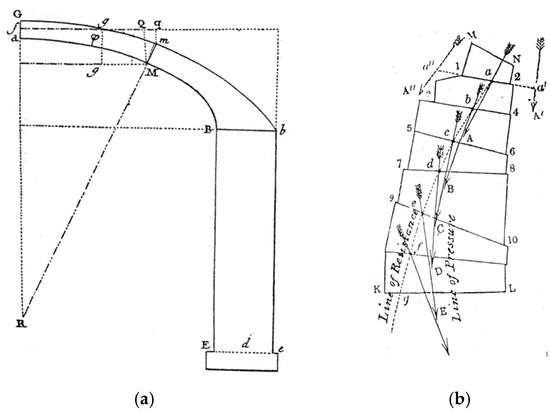
Figure 1. The half arch considered by Coulomb (1776) to impose the equilibrium conditions of the arch’s portion between the ideal vertical crown section aG and any joint Mm [19] (a). The concepts of ‘line of resistance’, defined by points a, b, c, …, and ‘line of pressure’, defined by points A, B, C, …, according to Moseley (1843), drawn from [44] (b).
Coulomb’s method served as the basis for the introduction of the graphical method of thrust line, declined through the concepts of ‘line of pressure’ and ‘line of resistance’ [44], which were later widely employed by scholars examining the mechanical behaviour of masonry arches. According to [38,43,44], the ‘line of resistance’ is defined as the polygon whose vertexes are the centres of pressures of the internal compressive forces at adjacent joints; the ‘line of pressure’ is related to the funicular polygon corresponding to the masonry arch and is defined as the envelope of the lines of actions of the compressive internal forces acting on adjacent joints (see Figure 1b).
Examining the past scientific literature, studies based on the notion of thrust line that consider the compressive strength of masonry have developed in a very interesting context that is worth exploring to understand the theoretical assumptions, sometimes contradictory, within which they are framed.
On the one hand, thrust line method harks back to pre-elastic theories, from the Hooke’s anagram on the inverted catenary [47], corresponding to what will be called ‘line of pressure’, to the modelling of the arch as a system of rigid blocks subject to unilateral constraints [19,45] at the joints, which will lead to the idea of ‘line of resistance’. It is precisely with reference to this pre-elastic context that the thrust line notion can be modernly classified within the scope of limit analysis [16,17,18]. Starting from the formalization provided by Gerstner [43] and Moseley [44], it becomes a powerful tool to illustrate the equilibrium of the arch. With reference to the notion of ‘line of resistance’ (Figure 1b), the intersection point between the thrust line and each joint provides information on the critical joints: when the ‘line of resistance’ intersects a joint at the extreme edges (intrados or extrados), a local limit equilibrium condition is attained; from a kinematic point of view, this condition corresponds to possible mutual rotations between the voussoirs, i.e., to the formation of a plastic hinge. With reference to the concept of ‘line of pressure’, the inclination of the internal reaction provides information on the possibility of sliding, assuming a finite friction coefficient at the interfaces. In this regard, it is worth remembering that, according to modern developments in limit analysis, considering finite friction is a delicate matter, since it corresponds to a non-standard plastic behaviour [48,49,50,51]. Assuming that there is no sliding between the voussoirs, the arch is stable if it is possible to identify any thrust line passing completely inside it, as already recognized by Moseley [44] based on the Coulomb equilibrium approach [19]. This finding is crucial because it states that it is sufficient to find one of the infinitely many statically admissible thrust lines to assess the stability of the arch. Determining the ‘true’ thrust line is not required. This observation allowed Heyman [16,17,18] to re-evaluate pre-elastic approaches by framing them within the context of limit analysis through the well-known safe theorem.
On the other hand, during the historical period in which the thrust line method was conceived, the theory of linear elasticity began to be formulated. Navier [52], Cauchy [53], Poisson [54], and Lamé and Clapeyron [55] contributed to the formulation of the theory of elastic bodies and began to consider the strength of materials. The masonry arch was a strange object: it was still studied within the framework of equilibrium analysis, following the approach based on Coulomb’s method [19]; the ‘elastic’ context, however, influenced the treatment of the thrust line method, with some contradictions. Paradoxically, in the 19th century, the theoretical value of the pre-elastic static approach in which the thrust line method was developed was not acknowledged: indeed, the concern of scholars and engineers became to remove the indeterminacy of the solution, that is, to determine the ‘true’ thrust line by introducing unclear criteria, a priori or experimentally derived [56,57,58,59,60,61]. These procedures were inconsistent with the theoretical background of both limit analysis, according to which, for a stable structure, there exist infinitely many statically admissible solutions, and elastic analysis, according to which the ‘true’ thrust line cannot be determined by considering only the equilibrium equations.
Gradually, thanks to the contributions of Navier [52], Barlow [56], Crotti [62], and later, Castigliano [63,64], a theoretical path emerges whereby the ‘true’ thrust line can be found only by considering the arch as an elastic hyperstatic system, correctly applying the theory of elasticity, appropriately adapted to also consider the stress–strain relationship for the masonry material and the constraint kinematic conditions at the arch’s springing. The interested reader is referred to previous reviews on this topic [41,42,65,66,67,68,69].
The context in which limited compressive strength is introduced into the thrust line method is therefore complex, straddling limit analysis and elastic analysis. In historical contributions, the same theoretical inconsistencies that emerged regarding the determination of the ‘true’ thrust line are also found in the definition of the flexural capacity of arch cross-sections when considering strength, since the limit distribution of stresses along the cross-section’s depth is assumed to be linear. Here, too, elastic analysis influences the thrust line method, which instead would fall within the scope of limit analysis.
In this ‘elastic’ perspective, two main approaches are followed. The first, also known as the ‘middle third’ method, devised by Navier himself [52,68], considers zero tensile strength and infinite compressive strength; furthermore, any cross-section is supposed to be entirely compressed. The ‘limit’ condition is attained when the distribution of the stresses along the joint’s depth is triangular, with a nil value of the stress at the intrados or extrados point of the joint (the section is not partialized). The second approach instead considers a limit value for the compressive strength of masonry: the maximum compressive stress is reached at the joint’s extrados or intrados, and its magnitude must not exceed the limit value, 𝜎𝑐. This value could coincide with the compressive strength of masonry or be interpreted as a permissible stress, in agreement with the elastic theory.
Starting from these ‘elastic’ assumptions, in the second part of his memoir [38], Méry exploits the concept of ‘line of resistance’ to impose a limit on the compressive strength of masonry. Méry refers to a linear distribution of the stresses along the joint’s depth, according to the linear elastic theory; assuming that the tensile strength is nil, he admits that the section partializes, as shown in Figure 2a,b.
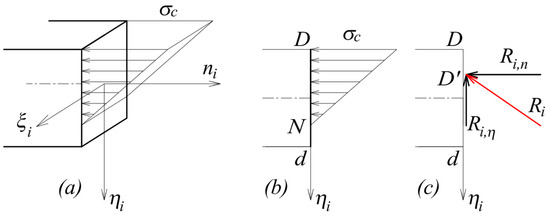
Figure 2. Distribution of the normal stresses at any joint i (‘limit’ condition according to Méry): 𝜎𝑐 is the compressive strength. The axes of inertia are denoted as 𝜉𝑖 and 𝜂𝑖; the vector 𝒏𝑖 is normal to the joint (a). Notation adopted by Méry for any joint i: dD is the joint’s depth; ND corresponds to the compressed portion of the joint (b); the resultant reaction, 𝑅𝑖 (of components 𝑅𝑖,𝑛 and 𝑅𝑖,𝜂) passes through point D′ (c) [38].
The analysis is conducted by considering a generic thrust line lying inside the thickness of the arch; see, for example, the curve 𝛽𝛿𝛼 in Figure 3, right, drawn from the original [38]. Let assume that, at any joint i, indicated by Méry as joint dD, such thrust line passes through point D′; see Figure 2c and Figure 3 left. The minimum distance of the centre of pressure from the end D, i.e., the segment D′D, is determined by considering the resultant reaction at any joint i, 𝑅𝑖, of components 𝑅𝑖,𝑛 and 𝑅𝑖,𝜂, normal and tangent to the joint dD, respectively (Figure 2c). Given the linear distribution of the normal stresses, 𝑁𝐷=3 𝐷𝐷’; the reaction, 𝑅𝑖 (and then, the thrust line under examination) is compatible with 𝜎𝑐 if:
𝐷𝐷’≥23 𝑅𝑖,𝑛𝜎𝑐.
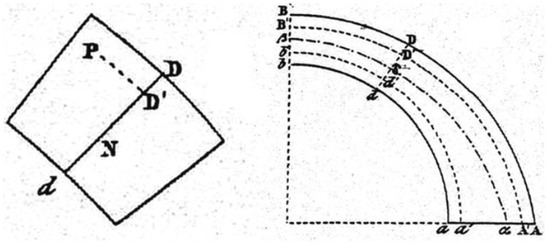
Figure 3. Méry contribution. Joint dD: centre of pressure, D′, and compressed portion of the joint, ND (left). Masonry arch: Extrados, BDA; intrados, bda; generic thrust line lying inside the thickness of the arch, 𝛽𝛿𝛼; the limits imposed by Méry to consider the finite compressive strength of masonry, B′D′A′ and b′d′a′ (right). Drawn from [38].
This entry is adapted from the peer-reviewed paper https://doi.org/10.3390/encyclopedia6030057
This entry is offline, you can click here to edit this entry!