You're using an outdated browser. Please upgrade to a modern browser for the best experience.
Illustrated Guide to the Main Macroalgae: History
Please note this is an old version of this entry, which may differ significantly from the current revision.
Contributor: Leonel Pereira

The Portuguese Atlantic continental coast serves as a biogeographic transition zone where numerous macroalgal species reach their distribution limits, making it an especially intriguing area for studying shifts in species distribution. This region features sandy beaches and rocky outcrops that serve as habitats for a diverse range of organisms, including macroalgae. This illustrated guide aims to provide a simple and accessible overview of some of the most representative macroalgae species found along this coastline, specifically those designed for non-specialists in seaweed identification. Rather than offering a detailed identification key, the guide introduces key aspects of macroalgae—such as pigment composition, taxonomic classification, morphology, branching types, habitat on rocky shores, and potential human uses—in a clear and approachable format. Each species is accompanied by a photographic image, a general morphological description, and information about its typical habitat. Additionally, icons indicate whether a species has potential human applications or is considered non-indigenous. Species are categorized into green, brown, or red macroalgae based on their color and morphological characteristics.

  • Rhodophyta
  • Chlorophyta
  • Heterokontophyta
  • biodiversity
  • ecology
  • uses
The coastal regions of Portugal host a rich and diverse macroalgal flora, shaped by Atlantic currents, ecological gradients, and historical biogeographic patterns. Despite this biological richness, there remains a gap in field-ready resources tailored specifically to the Portuguese Atlantic coast. This guide aims to fill that gap by providing an accessible, visually driven tool for the identification of macroalgae in this particular region [1].
While several identification guides exist at broader European or global scales, many are limited in geographic specificity, taxonomic updates, or usability in field conditions. Furthermore, taxonomic challenges—such as cryptic species, morphological plasticity, and shifting classifications—continue to complicate accurate identification. This work attempts to navigate these complexities, offering a regional perspective that integrates updated taxonomic insights and highlights species of some ecological and economic significance [2].
Although various identification guides for macroalgae exist at European and global scales, many are characterized by limitations that reduce their effectiveness in regional applications—especially along the Portuguese Atlantic coast. Some guides are outdated, relying on obsolete taxonomic frameworks, while others lack sufficient visual support, hindering field usability for non-specialists. Moreover, many resources either overlook region-specific species or present general descriptions that do not account for local morphological variations [3].
The selection of species featured in this guide was driven by several scientific and practical criteria, including ecological representativeness, regional abundance, taxonomic clarity, and relevance to biodiversity monitoring. Special attention was given to species frequently encountered along the Portuguese Atlantic coast, as well as those with key roles in habitat formation, nutrient cycling, or invasive dynamics. This approach ensures the guide remains both field-relevant and educational, serving stakeholders ranging from researchers and students [4].
Nonetheless, macroalgal identification is not without its uncertainties. Morphological plasticity—often influenced by environmental factors such as light exposure, wave action, or substrate type—can result in misleading visual traits. Additionally, cryptic species and recent taxonomic revisions challenge the reliability of traditional diagnostic features. To navigate these complexities, the guide incorporates updated nomenclature and highlights traits prone to variation or misinterpretation [5].
By grounding the guide in current trends of phycological research and biodiversity science—including biomonitoring programs, climate-related distribution shifts, and invasive species tracking—it contributes to broader efforts to assess and manage marine ecosystems [6]. The work aligns with national and European goals in coastal ecology and opens avenues for future refinement through citizen science and collaborative taxonomic updates [7].
A persistent challenge in macroalgal taxonomy lies in the high degree of morphological plasticity exhibited by many species, which can vary substantially depending on environmental conditions such as light exposure, water motion, and substrate type. This plasticity often obscures species boundaries and complicates identification based solely on external features [8]. These complexities underscore the need for regionally adapted guides that integrate morphological detail and offer updated nomenclature, with clear illustrations presented to support field and lab-based identification [9][10]. This field guide seeks to respond to these gaps, enhancing accuracy and accessibility in macroalgae identification along the Portuguese coast.
The ecological richness of the occidental Atlantic Portuguese coast is reflected in the high diversity of macroalgal species it supports, many of which are endemic or hold biogeographic significance within the Atlantic realm. This richness, however, exists alongside pronounced vulnerability—pressures from climate change, invasive species, and anthropogenic impacts threaten the integrity of coastal habitats and the delicate balance of macroalgal communities. As such, documenting and monitoring this biodiversity is not only scientifically valuable but also vital for informed coastal management [11][12][13].
By focusing on the Portuguese Atlantic continental coast, this guide contributes not only to local biodiversity monitoring but also to broader efforts in managing invasive species, supporting sustainable resource use, and fostering scientific literacy among students, researchers, and coastal stakeholders.

Overview of Macroalgal Diversity and Taxonomy

Macroalgae are macroscopic algae, visible to the naked eye, and exhibit a wide range of sizes—some species measure just a few centimeters, while others can grow to lengths of 50 m or more. They inhabit seawater and estuarine environments, typically anchoring themselves to hard substrates, particularly rocky surfaces [14].
There are many different species of macroalgae (between 7500 and 10,000 species) that also present a great diversity of shapes and colors. All macroalgae are primary producers, that is, they perform photosynthesis, because they contain chlorophylls and other accessory pigments. The coloration of a given species results from the combination of the different pigments presents in its cells [14].

Pigmentary Composition and Classification of Macroalgae

Macroalgae display a wide range of colorations, yet all contain chlorophyll. This pigment resides within small organelles called plastids, which are responsible for the green coloration found in most plants. The color of a macroalga is simply the visible expression of the unique combination of pigments present within its cells [14].
The phyla and classes of macroalgae are primarily defined, in practice, by their specific pigment composition. Macroalgae belong to the Domain Eukarya and are classified within the Kingdoms Plantae (green and red algae) and Chromista (brown algae), respectively. Although classification systems have varied significantly over time and among different authors, there is general consensus that can be elaborated as follows:
Green macroalgae (Chlorophyta phylum) could efficiently absorb red and blue color while reflecting green color. They are algae that contain chlorophyll a and b, carotenes and xanthophylls. Its reserve substance is starch and contains cellulose in its cell walls [12].
Brown macroalgae (Heterokontophyta phylum) are grouped in the class Phaeophyceae. These algae present a characteristic greenish-brown color due to the presence of chlorophyll a and c, tannins and carotenoids where fucoxanthin predominates, responsible for the brownish coloration [15].
Red macroalgae (Rhodophyta phylum) can efficiently absorb green and blue color and reflect slightly reddish radiation. Its photosynthetic pigments contain chlorophyll a, phycobilins (R-phycocyanin and R-phycoerythrin) and carotenoids (β-carotene, lutein and zeaxanthin) [16].

Morphological Types

The shape, or morphology, of the thallus (macroalgal body; plural: thalli) is a key feature used to distinguish between different macroalgae species. In addition, each species has a distinct consistency or texture to touch, which further aids in identification. This guide primarily relies on these characteristics.
Most thalli are erect, especially when submerged, although some species have prostrated thalli, forming thin disks or crust-like structures that adhere closely to the substrate. In some macroalgae, the thallus is divided into the frond—the upright portion—comprising the stipe and the blade, and a typically discrete attachment organ, which may appear as a small disk or a tuft of fine, elongated, colorless filaments known as rhizoids. Only large macroalgae possess a more robust attachment structure, made up of curved elements called a hapteron [9].
Some algae are filamentous, with fronds reduced to filaments composed of cells arranged end to end. These filaments may be either straight or branched. Typically, thalli are massive, meaning they possess a compact structure, although they can still exhibit a soft consistency and delicate texture [11].
The consistency and texture of thalli to touch are highly diverse. They can be cartilaginous (resembling cartilage), leathery or coriaceous (resembling leather), mucilaginous (similar to mucilage), spongy (like a sponge), among others. Some thalli, known as calcareous, have a rock-hard consistency due to their cells being impregnated with calcium carbonate [11].
While some thalli possess cylindrical axes, others are flattened or form hollow tubes. Certain thalli develop into monostromatic or polystromatic blades or sheets—composed of one or multiple layers of cells, respectively—and may be thin, moderately thick, or even coriaceous. These blades can be orbicular or elongated, undivided or segmented, lobed or deeply divided into laciniate forms resembling ribbons, straps, or belts. In some cases, they may be traversed by visible nerves or veins [14].

Branching Types

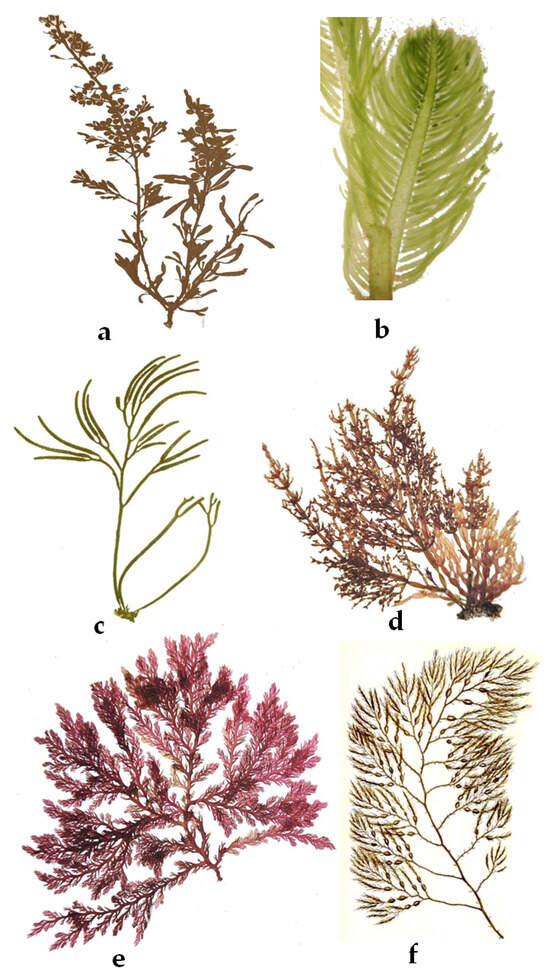
Another way of distinguishing the various species of macroalgae is to observe what kind of branching they have (Figure 1).
Figure 1. Branching types: (a) irregular; (b) opposite; (c) dichotomous; (d) whorled; (e) pectinate. Reprinted from [17]. (f) Alternate, reprinted from [18]; public domain.

The Habitat of Rocky Shores

Macroalgae live generally immersed (inside the water) and fixed to a substrate. The richest sites on the macroalgae are the rocky coasts, but it is also common to find specimens on sandy coasts or bays exposed to the beat of the waves, which were detached from the substrate by the action of the sea and then dragged by the current. Several species also live in estuaries because they tolerate salinity gradients.
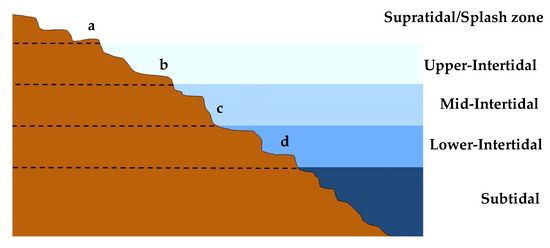
In rocky coastal areas, macroalgae living in the tidal range are subject to extreme ecological conditions (strong waves, sudden changes in temperature, salinity, sunshine, etc.). Their ability to adapt to the action of various ecological factors, in particular their ability to emerge (outside the water) by the descent of the tide, causes the different species to be distributed differently at different levels of the coastline (vertical zonation). Coastal zonation is divided into the following areas [9] (Figure 2):
Figure 2. Coastal zonation: (a)—mean high water spring tides; (b)—mean high water neap tides; (c)—mean low water neap tides; (d)—mean low water spring tides. Reprinted from [9].
(1) Supratidal Zone or Splash Zone: This is located between the mean level of high tide of the spring tides and the lower limit of terrestrial vegetation. This area is subject to splashes caused by the force of the waves, having a variable height, depending on the exposure to the waves of the coast. It is generally a poor area in number of species, and where marine lichens tend to predominate.
(2) Intertidal Zone: This is located between the upper and lower mean levels of the spring tides. It is the area where the ecological factors act more influence, being a place for multiple habitats, being the richest in number of species. Within this zone, the cycles of spring and neap tides determine a series of different horizons (intertidal zonation).
(3) Subtidal: This is located below the lowest level of the spring tides, extending to the level where the incident light is enough for the survival of the macroalgae. This zone is always immersed.

Non-Indigenous Algae on the Western Portuguese Coast
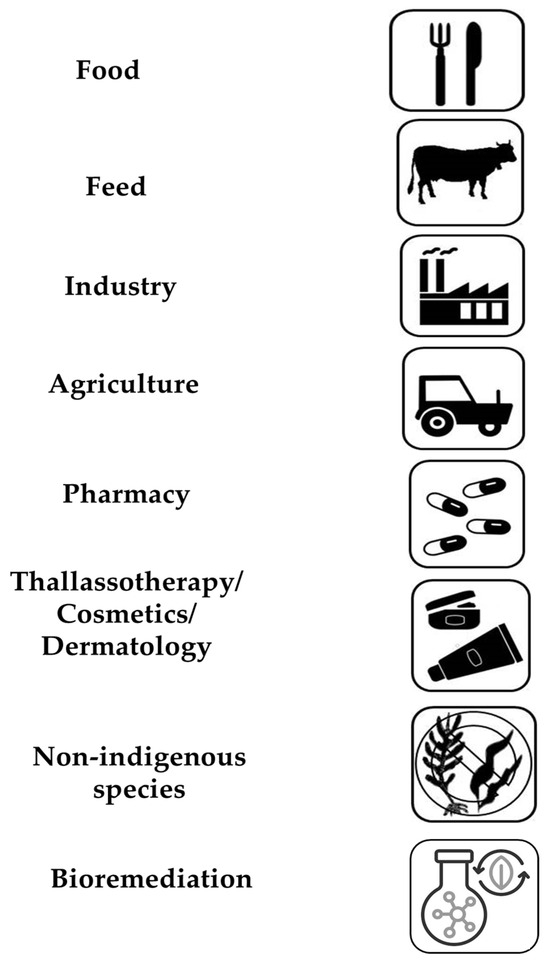
The western Portuguese coast has seen the introduction of several non-indigenous algal species (Figure 3), primarily through maritime activities and aquaculture. Among the most notable are Asparagopsis armata (Rhodophyta) and Sargassum muticum (Phaeophyceae), which have established themselves in intertidal and subtidal zones. These invasive species can outcompete native flora, alter habitat structures, and impact local biodiversity. Their presence highlights the need for ongoing monitoring and management strategies to mitigate ecological disruption and preserve the integrity of coastal marine ecosystems [12][13].
Figure 3. Illustrated icons representing key aspects of macroalgae’s potential uses by humans and its relevance to non-indigenous species, adapted from [9][12].

Uses

Nowadays, the macroalgae offers many possibilities for commercial use, with a wide range of applications. Many tons of macroalgae are harvested annually around the world, with China and Japan leading in consumption. However, macroalgae are utilized in many countries for a wide range of purposes, including human food, animal feed, agriculture, and medicine due to their therapeutic properties. The growing global demand for macroalgae has also led to their increasing exploitation in the industrial sector [14][15][16][19][20].
Potential uses of macroalgae by man include (see Figure 3).
(a) Human food and animal feed—this is certainly the best-known use worldwide. Sea vegetables, as macroalgae are often called, are a staple in the cuisine of many Eastern countries. In contrast, their use for self-consumption in Western countries was historically associated with poverty. Yet macroalgae stand in stark contrast to many modern processed foods—they are natural, nutrient-rich, and low in fat. Although approximately 50% of the dry weight of macroalgae consists of carbohydrates, humans lack the enzymes required to break down these long molecular chains. As a result, they are not absorbed by the digestive system and instead function like water-soluble fibers. Macroalgae are considered exceptional dietary supplements due to their high content of minerals, vitamins, and structural polysaccharides (fibers), which support intestinal transit and may help reduce blood cholesterol levels [21].
(b) Agriculture—the use of macroalgae as fertilizers is one of their oldest traditional applications. Certain species from the Corallinaceae family are also used to correct the pH of acidic soils, while simultaneously enhancing crop yields by supplying essential elements such as magnesium, strontium, boron, and iron. The two main macroalgal mixtures traditionally used as fertilizers are known as “Moliço” and “Sargaço” [22][23][24].
(c) Industry—the earliest industrial uses of macroalgae aimed to obtain calcium carbonate, produce soft drinks, and manufacture glass and soap. Macroalgae was also used for extracting iodine and certain dyes. Today, their industrial application is primarily focused on the production of phycocolloids—organic compounds that, when mixed with water, form colloidal systems capable of producing firm gels at room temperature [21].
(d) Pharmaceutical, Medicine, Thalassotherapy, Cosmetics, Dermatology—phycocolloids play a key role in the pharmaceutical industry due to their stabilizing and thickening properties, as well as their ability to yield compounds with antiviral, antibacterial, and antitumoral effects. Agar is notable for its medicinal applications, while carrageenans can inhibit the herpes virus and human papillomavirus (HPV), and are also used in hair care for their ability to bond with keratin. Alginic acid, extracted from brown algae such as Laminaria, Fucus, and Ascophyllum, is valued for its stability across varying pH and salinity levels, aiding in rapid healing and neutralizing heavy metals in cases of ingestion-related intoxication. Green macroalgae are traditionally used as anti-worm agents; red macroalgae serve as anticoagulants and are used to treat parasitic infections, gastritis, and diarrhea; and brown macroalgae are applied in the treatment of menstrual disorders, hypertension, skin diseases, syphilis, and gastric ulcers, also exhibiting anticoagulant properties [20][25].

This entry is adapted from the peer-reviewed paper 10.3390/encyclopedia5040176

References

  1. Araújo, R.; Sousa-Pinto, I.; Bárbara, I.; Quintino, V. Macroalgal communities of intertidal rock pools in the northwest coast of Portugal. Acta Oecologica 2006, 30, 192–202.
  2. Verbruggen, H. Morphological complexity, plasticity, and species diagnosability in the application of old species names in DNA-based taxonomies. J. Phycol. 2014, 50, 26–31.
  3. Vasconcelos, R.P.; Reis-Santos, P.; Fonseca, V.; Maia, A.; Ruano, M.; França, S.; Vinagre, C.; Costa, M.J.; Cabral, H. Assessing anthropogenic pressures on estuarine fish nurseries along the Portuguese coast: A multi-metric index and conceptual approach. Sci. Total Environ. 2007, 374, 199–215.
  4. Gaspar, R.; Pereira, L.; Neto, J.M. Ecological reference conditions and quality states of marine macroalgae sensu Water Framework Directive: An example from the intertidal rocky shores of the Portuguese coastal waters. Ecol. Indic. 2012, 19, 24–38.
  5. Stewart, H.L.; Carpenter, R.C. The Effects of Morphology and Water Flow on Photosynthesis of Marine Macroalgae. Ecology 2003, 84, 2999–3012.
  6. Carpenter, R.C. Competition Among Marine Macroalgae: A Physiological Perspective. J. Phycol. 1990, 26, 6–12.
  7. Jurkus, E.; Povilanskas, R.; Taminskas, J. Current Trends and Issues in Research on Biodiversity Conservation and Tourism Sustainability. Sustainability 2022, 14, 3342.
  8. Bellgrove, A.; McKenzie, P.F.; Cameron, H.; Pocklington, J.B. Restoring rocky intertidal communities: Lessons from a benthic macroalgal ecosystem engineer. Mar. Pollut. Bull. 2017, 117, 17–27.
  9. Gaspar, R.; Fonseca, R.; Pereira, L. Illustrated Guide to the Macroalgae of Buarcos Bay, Figueira da Foz, Portugal; University of Coimbra: Coimbra, Portugal, 2020; 130p.
  10. Pereira, L. Guia Ilustrado das Macroalgas—Conhecer e Reconhecer Algumas Espécies da Flora Portuguesa; Coimbra University Press: Coimbra, Portugal, 2009; 90p.
  11. Bhuyan, M.; Islam, T.; Nabi, M.; Kunda, M. Pictorial Dictionary of Seaweed. 2023. Bangladesh Oceanographic Research Institute, 184p. Available online: https://www.researchgate.net/publication/378076262_Pictorial_Dictionary_of_Seaweed (accessed on 19 September 2025).
  12. Pereira, L. Guia Ilustrado das Macroalgas Marinhas das Praias Rochosas da Figueira da Foz, Portugal/Illustrated Guide to the Marine Macroalgae of the Rocky Shores of Figueira da Foz, Portugal, 1ª Edição/Edition ed; CFE—Centre for Functional Ecology: Science for People & Planet—Marine Resources, Conservation and Technology—Marine Algae Lab: Coimbra, Portugal, 2025; in press.
  13. Pereira, L. Non-indigenous seaweeds in the Iberian Peninsula, Macaronesia Islands (Madeira, Azores, Canary Islands) and Balearic Islands: Biodiversity, ecological impact, invasion dynamics, and potential industrial applications. Algal Res. 2024, 78, 103407.
  14. Macreadie, P.I.; Jarvis, J.; Trevathan-Tackett, S.M.; Bellgrove, A. Seagrasses and Macroalgae: Importance, Vulnerability and Impacts. In Climate Change Impacts on Fisheries and Aquaculture; John Wiley & Sons: New York, NY, USA, 2017; pp. 729–770.
  15. Yoon, H.S.; Andersen, R.A.; Boo, S.M.; Bhattacharya, D. Stramenopiles. In Encyclopedia of Microbiology, 3rd ed.; Schaechter, M., Ed.; Academic Press: Oxford, UK, 2009; pp. 721–731.
  16. Yoon, H.S.; Zuccarello, G.C.; Bhattacharya, D. Evolutionary History and Taxonomy of Red Algae. In Red Algae in the Genomic Age; Seckbach, J., Chapman, D.J., Eds.; Springer: Dordrecht, The Netherlands, 2010; pp. 25–42.
  17. Pereira, L. Portuguese Seaweeds Website. Available online: http://www.flordeutopia.pt/macoi/ (accessed on 16 August 2025).
  18. Harvey, W.H. Phycologia Britânica; Several Volumes; Reeve & Benham: London, UK, 1851.
  19. Pereira, L. Edible Seaweeds of the World, 1st ed.; CRC Press: Boca Raton, FL, USA, 2016; 442p, ISBN 9-781498-73047.
  20. Pereira, L. Therapeutic and Nutritional Uses of Algae. CRC Press: Boca Raton, FL, USA, 2018; 560p, ISBN 9781498755382.
  21. Leandro, A.; Pereira, L.; Gonçalves, A.M.M. Diverse Applications of Marine Macroalgae. Mar. Drugs 2020, 18, 17.
  22. Prisa, D.; Fresco, R.; Jamal, A.; Saeed, M.F.; Spagnuolo, D. Exploring the Potential of Macroalgae for Sustainable Crop Production in Agriculture. Life 2024, 14, 1263.
  23. Pereira, L. Littoral of Viana do Castelo—ALGAE (Bilingual). Câmara Municipal de Viana do Castelo: Viana do Castelo, Portugal, 2010; 68p, ISBN 978-972-588-217-7.
  24. Pereira, L. Littoral of Viana do Castelo—ALGAE. Uses in Agriculture, Gastronomy and Food Industry (Bilingual); Câmara Municipal de Viana do Castelo: Viana do Castelo, Portugal, 2010; 68p, ISBN 978-972-588-218-4.
  25. Kalasariya, H.S.; Yadav, V.K.; Yadav, K.K.; Tirth, V.; Algahtani, A.; Islam, S.; Gupta, N.; Jeon, B.-H. Seaweed-Based Molecules and Their Potential Biological Activities: An Eco-Sustainable Cosmetics. Molecules 2021, 26, 5313.
More
This entry is offline, you can click here to edit this entry!
Academic Video Service