
The coelacanth is a rare and ancient lineage of lobe-finned fish belonging to the class Actinistia. Once thought to have been extinct for over 65 million years, the rediscovery of the coelacanth in 1938 off the coast of South Africa challenged prevailing assumptions about the fossil record and the dynamics of extinction. This "living fossil" provides invaluable insights into vertebrate evolution, particularly the transition from aquatic to terrestrial life.
- coelacanth
- living fossil
- Latimeria chalumnae
1. Taxonomy and Evolutionary History
Coelacanths belong to the order Coelacanthiformes within the class Actinistia. Two extant species are currently recognized: Latimeria chalumnae, located in the western Indian Ocean near the Comoro Islands and South Africa, and Latimeria menadoensis, discovered near Sulawesi, Indonesia, in 1997 [1][2]. Fossil evidence indicates that coelacanths first appeared approximately 400 million years ago, reaching peak diversity during the Devonian period [3].
Coelacanths display structural traits that are considered intermediate between fish and early tetrapods. Their lobed fins, supported by a central skeletal axis, resemble the early limb bones of tetrapods and are an important example of preadaptation for terrestrial locomotion. Molecular studies further confirm that coelacanths are more closely related to tetrapods than to most ray-finned fishes, making them a critical model for understanding vertebrate evolution.
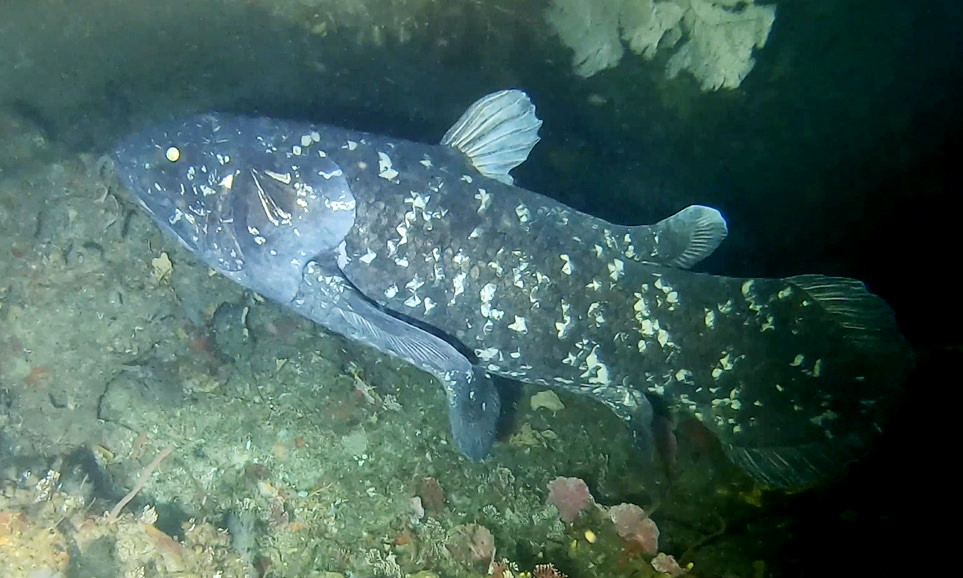
Source: By Bruce A.S. Henderson - Fraser, Michael D.; Henderson, Bruce A.S.; Carstens, Pieter B.; Fraser, Alan D.; Henderson, Benjamin S.; Dukes, Marc D.; Bruton, Michael N. (26 March 2020). "Live coelacanth discovered off the KwaZulu-Natal South Coast, South Africa". South African Journal of Science. 116 (3/4 March/April 2020). doi:10.17159/sajs.2020/7806 © 2020. The Author(s). Published under a Creative Commons Attribution Licence., CC BY 4.0, https://commons.wikimedia.org/w/index.php?curid=88732486
2. Fossil Record
Coelacanths are well represented in the fossil record from the Devonian to the Cretaceous periods. Their morphological stability over hundreds of millions of years makes them an example of evolutionary stasis. Fossils show little change in the overall body plan, cranial structure, and fin morphology, although species-specific variations existed in scale patterns and cranial bone structure [3].
The fossil record also demonstrates that coelacanths were once widely distributed in both marine and freshwater environments. Their decline in diversity after the Cretaceous coincides with the rise of more modern fish lineages, suggesting ecological competition and environmental shifts may have influenced their survival.
3. Morphology and Anatomy
Coelacanths possess several distinctive anatomical traits:
-
Intracranial joint: This hinge in the skull allows the upper jaw to move independently, enabling the fish to open its mouth widely for prey capture.
-
Lobed fins: Pectoral and pelvic fins are lobed and supported by bones homologous to tetrapod limbs. This structure facilitates a "walking" motion along the sea floor.
-
Cosmoid scales: Thick, enamel-like scales provide protection from predators and parasites.
-
Notochord and swim bladder: The notochord is filled with oil, and the swim bladder contains fat instead of gas, aiding buoyancy in deep-sea habitats.
-
Electrosensory system: The rostral organ detects weak bioelectric signals from prey, an adaptation to low-light environments.
4. Biomechanics and Locomotion
Coelacanths employ a unique locomotor pattern that combines undulations of the body with the synchronized motion of their lobed fins. Studies using high-speed videography indicate that these fish can maneuver slowly and precisely along reef structures, demonstrating a walking-like gait that may resemble the limb-based locomotion of early tetrapods.
The robust skeletal structure of the fins and the ability to rotate them independently provides insights into how vertebrates may have adapted limbs for terrestrial movement. This makes coelacanths a living model for studying the evolutionary transition from water to land.
5. Behavior and Ecology
Primarily nocturnal predators, coelacanths feed on fish, cephalopods, and crustaceans. Their slow metabolism and deep-sea habitat contribute to long lifespans, estimated at 60–80 years or more [2]. Coelacanths often reside in underwater caves and steep reef slopes, where low-light and high-pressure conditions require specialized sensory adaptations.
Their social behavior is not well understood due to the difficulty of direct observation. However, evidence suggests solitary or small-group dwelling, with limited migration between habitat patches [3].
6. Reproductive Biology
Coelacanths are ovoviviparous, with internal fertilization and live birth. Females carry embryos for up to five years, one of the longest gestation periods among vertebrates. This strategy produces fully formed juveniles capable of independent survival at birth. Low reproductive rates and late sexual maturity heighten their vulnerability to environmental pressures.
Embryonic development has been studied through occasional discoveries of gravid females. These observations reveal that coelacanths invest heavily in each offspring, an evolutionary strategy associated with K-selected species.
7. Phylogenetics and Molecular Insights
Genomic studies of Latimeria chalumnae and L. menadoensis have illuminated coelacanth evolutionary history. Conserved gene sequences indicate slow molecular evolution relative to other vertebrates [1]. Notably, coelacanth genomes retain regulatory elements associated with limb development, providing a genetic link to the evolution of tetrapod limbs.
Phylogenetic analyses also confirm that coelacanths form a sister group to lungfishes and tetrapods, highlighting their unique position in vertebrate evolution. This phylogenetic placement underpins much of the interest in coelacanths as models for evolutionary developmental biology.
8. Sensory Biology and Feeding Ecology
Coelacanths have highly specialized sensory systems adapted to deep-sea environments. The electrosensory rostral organ, combined with a lateral-line system, allows detection of prey in low-light conditions. The intracranial joint supports the ingestion of relatively large prey, while the slow-swimming, ambush-predator strategy minimizes energy expenditure.
Their diet and hunting behavior influence deep-sea community dynamics, positioning coelacanths as apex mesopredators within their ecological niche [2][3].
9. Conservation Challenges
Coelacanths are classified as Critically Endangered by the IUCN. Threats include habitat disturbance, bycatch in deep-sea fisheries, and climate-induced shifts in oceanic conditions. Limited distribution and low reproductive output exacerbate the risk of population decline.
Conservation strategies include:
-
Establishment of marine protected areas
-
Long-term population monitoring
-
International collaboration for habitat protection
-
Public education on the ecological and evolutionary significance of coelacanths
Despite these efforts, challenges remain due to the deep-sea habitats and elusive behavior of these fish.
10. Scientific and Evolutionary Significance
The coelacanth is a key model for understanding vertebrate evolution. Its lobed fins, skeletal morphology, and genetic features provide insight into the water-to-land transition. Long-term genomic stability demonstrates evolutionary stasis, yet the retention of tetrapod-like features emphasizes their intermediate evolutionary position.
Studying coelacanths informs comparative anatomy, developmental biology, deep-sea ecology, and conservation biology. Their existence demonstrates the complexity of evolutionary persistence and the significance of "living fossils" in understanding life's history.
References
- Pallavicini, A., et al. (2013). Analysis of the transcriptome of the Indonesian coelacanth Latimeria menadoensis. BMC Genomics, 14, 538. https://doi.org/10.1186/1471-2164-14-538.
- Holder, M. T., et al. (1999). Two living species of coelacanths? Proceedings of the National Academy of Sciences, 96(22), 12616–12621. https://doi.org/10.1073/pnas.96.22.12616.
- Casane, D., & Laurenti, P. (2013). Why coelacanths are not 'living fossils': a review of molecular and morphological data. BioEssays, 35(4), 332–338. https://doi.org/10.1002/bies.201200145.