You're using an outdated browser. Please upgrade to a modern browser for the best experience.
Federalism: A Comprehensive Review of Its Evolution, Typologies, and Contemporary Issues: History
Please note this is an old version of this entry, which may differ significantly from the current revision.
Contributor: Lingkai Kong

This study is intended to conduct a comprehensive review of federalism. This study starts from the institutional aspect and analyzes how federalism, as a compound structure, divides power between the central and local governments. Then, this study mentions that federalism also has its normative connotations, which are traceable to the theological concept of a covenant. We also elaborate on how the success of the United States’ federalism strengthened its institutional aspect while overshadowing the older covenant tradition. Next, this study presents a typological framework of federalism, introducing concepts such as coming-together federalism and holding-together federalism; dual federalism and cooperative federalism; decentralization and non-centralization; and asymmetrical federalism, non-territorial autonomy, and consociationalism, presidential and parliamentary federalism, as well as democratic federalism and authoritarian federalism/facade federalism. Next, this study compares monist federalism with multinational federalism. Then, this study examines the specific applications of federalism in fiscal, environmental, health-care, and social-welfare policies. By reviewing the history, theoretical origins, institutional development, and contemporary manifestations of federalism, this study provides a roadmap for scholars in the field of federal studies. Finally, this study also puts forward several testable hypotheses, aiming to provide operational research agendas for future studies.

  • federalism
  • institution
  • normative
  • autonomy
As a “compound” form of government [1][2][3][4], federalism is widely used in countries that wish to maintain local autonomy within a unified national framework, as a tool for regional integration, and sometimes as a mechanism for conflict management [5][6]. In general, federalism combines a central government with regional sub-governments—provinces, states, cantons, territories, etc.—within a single political system and divides power between the two levels [2][7][8]. This arrangement is not merely a power distribution but provides constitutional legitimacy to each level of government [9]. Within the two government levels, federalism is always caught in the internal tensions between federal centralization and local autonomy [10][11].
On the other hand, the success of federalism largely depends on its ability to manage these internal tensions as political environments change [12][13]. Based on differentiated contexts, federalism has also developed derivative concepts—whether for resisting tyranny on the minority, namely defensive federalism [14]; for managing diversity [5][15][16]; or for safeguarding national welfare [17][18]. This study also focuses on the performance of federalism in specific policy areas, in fiscal, environmental, and social aspects.
In this review, Section 2 mainly elaborates on two ways of understanding federalism: as a political institution and as a political norm. It also shows how the later success of the American model reinforced its institutional aspect while overshadowing the normative dimension. Section 3 provides a typology of federal arrangements: coming-together federalism and holding-together federalism; dual federalism and cooperative federalism; decentralization and non-centralization; asymmetrical federalism; non-territorial autonomy and consociationalism; presidential federalism and parliamentary federalism; democratic federalism and authoritarian federalism/facade federalism; and monist federalism and multinational federalism. Section 4 focuses on the manifestations of federalism in finance, the environment, health, and social welfare. Section 5 concludes.
In this paper, besides the theoretical discussion, several comparative observations of federalism are listed (with a focus on the United States, Canada, Belgium, Spain, etc.). Given the limitations of space and the availability of materials, federal or quasi-federal practices in Africa, Latin America, and Asia have not been comprehensively covered in this paper. This paper acknowledges the limitations of the study and suggests greater geographical diversity in the conclusion.
This paper also attempts to integrate the following threads into a multidimensional perspective. First is the institutional dimension, which emphasizes the constitutional division of power and functions. Second is the normative/covenant dimension, which highlights the legitimacy of federalism as a contract and a community. Third is the dimension of normative pluralism and interactive practice, where we briefly mention how legal pluralism/constitutional pluralism has inspired cross-level procedural dialogue. Moreover, this paper attempts to raise several research questions that have not been fully addressed and to point out directions for follow-up research: How do the multiple ports of entry of cross-level rules change the political accessibility of minority groups? What are the long-term effects of asymmetrical arrangements and non-territorial autonomy in reducing the risk of violent separatism? In the context of increasing globalization and transnational rules, how does federalism interlock with international/regional constitutional pluralism and affect policy outcomes? After a comprehensive review of the entire paper, I will summarize several testable propositions in the conclusion for future researchers to refer to.
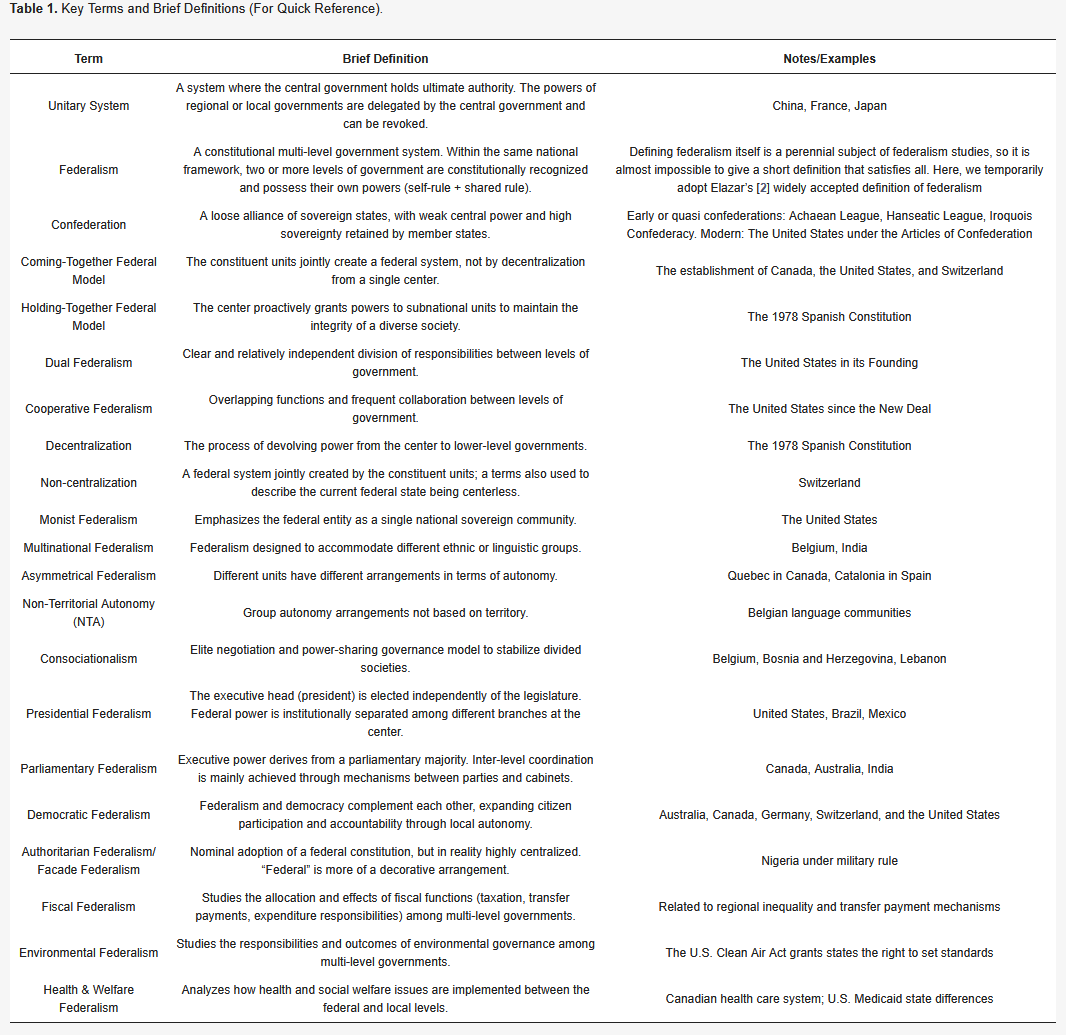
Although this paper attempts to cover the main dimensions of federalism research, it must be acknowledged that any topic is worth a separate study. What we provide is a panorama, a compass, for researchers of federalism. From this paper, we can understand the basic research questions in this field and continue to promote in-depth communication in this area. Before proceeding with the main text, readers may refer to Table 1 below for a quick reference to the terms frequently used in the text.
Table 1. Key Terms and Brief Definitions (For Quick Reference). 
 

This entry is adapted from the peer-reviewed paper https://doi.org/10.3390/encyclopedia5040156

References

  1. Elazar, D.J. Federalism and Consociational Regimes. Publius J. Fed. 1985, 15, 17–34.
  2. Elazar, D.J. Exploring Federalism, 1st ed.; University of Alabama Press: Tuscaloosa, AL, USA, 1987; ISBN 978-0-8173-0575-8.
  3. Hüglin, T.O. Yet the Age of Anarchism? Publius J. Fed. 1985, 15, 101–112.
  4. Zuckert, M.P. Federalism and the Founding: Toward a Reinterpretation of the Constitutional Convention. Rev. Polit. 1986, 48, 166–210.
  5. Karmis, D.; MacLure, J. Two Escape Routes from the Paradigm of Monistic Authenticity: Post-Imperialist and Federal Perspectives on Plural and Complex Identities. Ethn. Racial Stud. 2001, 24, 361–385.
  6. Requejo, F. National Pluralism and Federalism. Four Potential Scenarios for Spanish Plurinational Democracy. Perspect. Eur. Politics Soc. 2001, 2, 305–327.
  7. Chryssochoou, D.N. Federalism and Democracy Reconsidered. Reg. Fed. Stud. 1998, 8, 1–20.
  8. Filippov, M.; Shvetsova, O. Federalism, Democracy, and Democratization. In Federal Dynamics: Continuity, Change, and the Varieties of Federalism; Benz, A., Broschek, J., Eds.; Oxford University Press: Oxford, UK, 2013; pp. 167–185. ISBN 978-0-19-965299-0.
  9. Guzina, D. Federalism and Regional Autonomy. In Oxford Research Encyclopedia of International Studies; Oxford University Press: Oxford, UK, 2010; ISBN 978-0-19-084662-6.
  10. Moreno, L.; Arriba, A.; Serrano, A. Multiple Identities in Decentralized Spain: The Case of Catalonia. Reg. Fed. Stud. 1998, 8, 65–88.
  11. Covell, M. Regionalization and Economic Crisis in Belgium: The Variable Origins of Centrifugal and Centripetal Forces. Can. J. Polit. Sci. 1986, 19, 261–281.
  12. Benz, A.; Sonnicksen, J. (Eds.) Federal Democracies at Work: Varieties of Complex Government, 1st ed.; University of Toronto Press: Toronto, ON, Canada; Buffalo, NY, USA; London, UK, 2021; ISBN 978-1-4875-0900-2.
  13. Sayers, A.M.; Banfield, A.C. The Evolution of Federalism and Executive Power in Canada and Australia. In Federal Dynamics: Continuity, Change, and the Varieties of Federalism; Benz, A., Broschek, J., Eds.; Oxford University Press: Oxford, UK, 2013; pp. 185–205. ISBN 978-0-19-965299-0.
  14. Requejo, F.; Sanjaume-Calvet, M. Defensive Federalism: Protecting Territorial Minorities from the “Tyranny of the Majority”, 1st ed.; Routledge: London, UK, 2022; ISBN 978-1-003-29606-5.
  15. Karmis, D.; Gagnon, A.-G. Federalism, Federation and Collective Identities in Canada and Belgium: Different Routes, Similar Fragmentation. In Multinational Democracies; Gagnon, A.-G., Tully, J., Eds.; Cambridge University Press: Cambridge, UK, 2001; pp. 137–175. ISBN 978-0-511-52157-7.
  16. Kymlicka, W. Federalism, Nationalism, and Multiculturalism. In Theories of Federalism: A Reader; Karmis, D., Norman, W., Eds.; Palgrave Macmillan US: New York, NY, USA, 2005; pp. 269–292. ISBN 978-0-312-29581-3.
  17. Béland, D.; Lecours, A. Does Nationalism Trigger Welfare-State Disintegration? Social Policy and Territorial Mobilization in Belgium and Canada. Environ. Plann. C. 2010, 28, 420–434.
  18. Hale, G.E. Canadian Federalism and the Challenge of North American Integration. Can. Public Adm. 2004, 47, 497–524.
More
This entry is offline, you can click here to edit this entry!
Academic Video Service