You're using an outdated browser. Please upgrade to a modern browser for the best experience.
Urine Organic Acid Testing in the Clinical Laboratory: History
Please note this is an old version of this entry, which may differ significantly from the current revision.

Organic acidurias, a subgroup of inborn errors of metabolism (IEMs), are characterized by the accumulation of non-amine-containing, low-molecular-weight organic acids (OAs) in urine and/or plasma due to defects in specific metabolic pathways. Early diagnosis can be critical to enable timely intervention to prevent irreversible neurological injury or death. Therefore, urine organic acid (UOA) testing plays an indispensable role in the differential diagnosis of symptomatic individuals and the follow-up of abnormal newborn screen results. Historically, gas chromatography-mass spectrometry (GC-MS) has been the gold standard method, with well-established protocols for sample preparation and result interpretation. Recent advances in liquid chromatography-mass spectrometry (LC-MS), including both triple quadrupole and high-resolution Quadrupole Time-of-Flight (QTOF) platforms, have enabled UOA analysis with simplified workflows and improved coverage to diagnose a broader array of IEMs. This review summarizes the evolution of UOA testing from manual colorimetric assays to mass spectrometry-based platforms, highlights the analytical and interpretative considerations of GC-MS, and explores emerging LC-MS technologies and bioinformatics tools that offer enhanced diagnostic capabilities and efficiency for the future of IEM testing.

  • urine organic acid
  • inborn errors of metabolism
  • organic aciduria
  • gas chromatography
  • liquid chromatography
  • mass spectrometry
Inborn errors of metabolism (IEMs) are a diverse group of genetic disorders resulting from defects in biochemical pathways critical for the synthesis, breakdown, or transport of essential metabolites or nutrients. Organic acidurias, also known as organic acidemias, represent a subset of IEMs characterized by the abnormal accumulation of organic acids (OAs) in urine and/or blood [1][2][3]. These disorders can lead to a broad spectrum of symptoms, including metabolic acidosis, seizure, poor feeding, vomiting, developmental delay, irreversible neurological injury, and, in some cases, death [4]. Although symptoms mostly present in the first few weeks of life, late-onset or milder forms may emerge during adolescence or adulthood.
Individually, organic acidurias are rare, with incidences ranging from 1 in 10,000 to over 1 in 1,000,000 live births. Collectively, however, their incidence is estimated to be 1 in 3000 live births [5]. To date, more than 65 distinct organic acidurias have been described [5], and the Society for the Study of Inborn Errors of Metabolism (SSIEM) classifies them into 19 major groups.
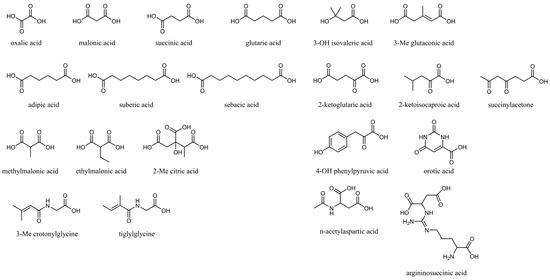
Chemically, OAs are non-amine-containing, low-molecular-weight molecules [1] containing one or more carboxylic acid groups [4]. They may be linear or branched with a varying number of carbon chain lengths and may carry a variety of functional groups such as keto, hydroxy, and phenyl groups. Table 1 shows the basic nomenclature of common monocarboxylic and dicarboxylic acids with varying numbers of carbon atoms, and 
Figure 1 illustrates a subset of common OAs in blood and urine

Table 1. Nomenclature of the most common monocarboxylic acids and dicarboxylic acids, with linear or branched backbone and different numbers of carbon atoms.

Number of Carbon Atoms

Monocarboxylic acid (linear)

Monocarboxylic acid (branched)

Dicarboxylic acid (linear)

2

Acetic acid


Oxalic acid

3

Propionic acid


Malonic acid

4

Butyric acid

Isobutyric acid

Succinic acid

5

Valeric acid

Isovaleric acid

Glutaric acid

2-Methylbutyric acid

6

Hexanoic (caproic) acid


Adipic acid

7

Heptanoic (enanthic) acid


Pimelic acid

8

Octanoic (caprylic) acid


Suberic acid

9

Nonanoic (pelargonic) acid


Azelaic acid

10

Decanoic (capric) acid


Sebacic acid

Physiologically, OAs are intermediates or end products of a large number of metabolic pathways, including those involved in the metabolism of amino acids, carbohydrates, vitamins, neurotransmitters, lipids, sterols, and nucleic acids [1][4]. Consequently, a detailed evaluation of the OA profile is necessary to identify the abnormal accumulation of one or more compounds due to enzymatic or transporter defects, supporting the diagnosis of not only organic acidurias but also a wide range of IEMs.
Importantly, while many organic acidurias are associated with irreversible damage and can be fatal if untreated, they can be effectively managed with relatively simple and cost-effective interventions such as dietary restrictions or supplements. As such, early diagnosis and prompt treatments are critical, and several organic acidurias have been incorporated into mandated newborn screening programs.
Urine is the preferred specimen for OA analysis because most OAs are hydrophilic and are rapidly excreted into urine. Urine organic acids (UOA) analysis evaluates hundreds of substances for patterns indicative of disrupted metabolic pathways [1]. Paired with other clinical tests such as the plasma acylcarnitine test, plasma amino acid test, and molecular sequencing, UOA analysis plays a critical role not only in the differential diagnosis of positive newborn screening results but also in identifying organic acidurias and IEMs not captured by the current newborn screening programs.
Gas Chromatography-Mass Spectrometry (GC-MS) has served as the gold standard method for UOA analysis for several decades and continues to be widely used in most clinical laboratories. However, the inherent limitations, such as labor-intensive sample preparation and limited availability of instruments, have motivated the development of novel Liquid Chromatography-Mass Spectrometry (LC-MS) methods. These emerging approaches offer simplified workflows and reduced sample volume requirements while providing comparable analytical performance.
In this review, we provide a historical perspective on the emergence of UOA analysis for the diagnosis of IEMs, with a focus on urine organic acidurias. We review the principles and procedures of classical GC-MS methods and recent advancements in LC-MS methods, as well as targeted and untargeted applications for expanded diagnostic capabilities [6].

This entry is adapted from the peer-reviewed paper 10.3390/encyclopedia5030153

References

  1. Gallagher, R.C.; Pollard, L.; Scott, A.I.; Huguenin, S.; Goodman, S.; Sun, Q. Laboratory analysis of organic acids, 2018 update: A technical standard of the American College of Medical Genetics and Genomics (ACMG). Genet. Med. 2018, 20, 683–691.
  2. Scott, D.F.; Clinton Frazee III, C.; Garg, U. Screening of Organic Acidurias by Gas Chromatography–Mass Spectrometry (GC–MS). Clin. Appl. Mass Spectrom. Biomol. Anal. Methods Protoc. 2022, 2546, 321–333.
  3. Blau, N.; Duran, M.; Gibson, K.M. (Eds.) Laboratory Guide to the Methods in Biochemical Genetics; Springer-Verlag Berlin and Heidelberg GmbH & Co. K: Berlin/Heidelberg, Germany, 2008; pp. 137–169. Available online: https://download.e-bookshelf.de/download/0000/0126/29/L-G-0000012629-0002345710.pdf (accessed on 15 August 2025).
  4. Carling, R.S.; Barski, R.; Hogg, S.L.; Witek, K.; Moat, S.J. UK Metabolic Biochemistry Network Recommendations for the Analysis of Urinary Organic Acids by Gas Chromatography Mass Spectrometry. 2018. Available online: https://metbio.net/wp-content/uploads/MetBio-Guideline-TENU402189-30-11-2020.pdf (accessed on 15 August 2025).
  5. Knerr, I.; Vockley, J.; Gibson, K.M. Disorders of Leucine, Isoleucine, and Valine Metabolism. In Physician’s Guide to the Diagnosis, Treatment, and Follow-Up of Inherited Metabolic Diseases; Blau, N., Duran, M., Gibson, K., Dionisi Vici, C., Eds.; Springer: Berlin/Heidelberg, Germany, 2014; pp. 103–141.
  6. Kumps, A.; Duez, P.; Mardens, Y. Metabolic, nutritional, iatrogenic, and artifactual sources of urinary organic acids: A comprehensive table. Clin. Chem. 2002, 48, 708–717.
More
This entry is offline, you can click here to edit this entry!
Academic Video Service