
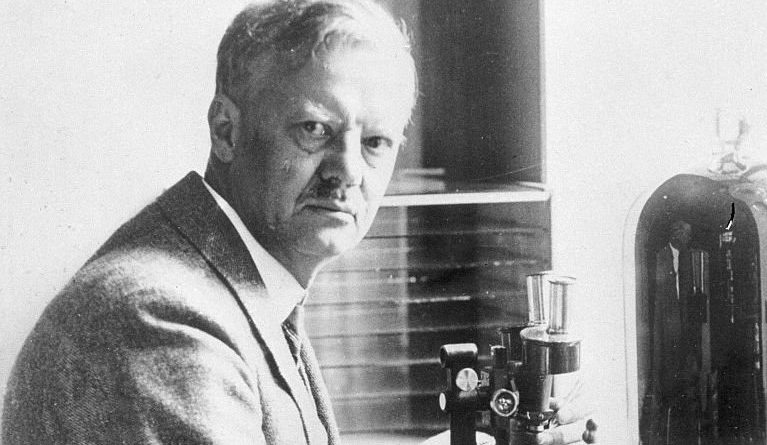
Hans Spemann (27 June 1869 – 9 September 1941) was a pioneering German embryologist and Nobel laureate renowned for his groundbreaking work in experimental embryology. His discovery of the "organizer effect" (now known as embryonic induction) revolutionized understanding of embryonic development and earned him the Nobel Prize in Physiology or Medicine in 1935. Spemann's research laid the foundation for modern developmental biology and concepts such as cellular differentiation and cloning. Despite his scientific achievements, his final years were marred by the political turmoil of Nazi Germany, leading to his death in 1941 under circumstances that remain historically debated.
- Hans Spemann
- embryology
- Nobel laureate
- embryonic induction
1. Early Life and Education
Hans Spemann was born on June 27, 1869, in Stuttgart, Germany, into a cultured middle-class family. His father, Wilhelm Spemann, was a publisher, which provided young Hans with exposure to intellectual and academic environments from an early age. Although initially interested in literature and the arts, Spemann later shifted his focus to the natural sciences [1].
He studied medicine and natural sciences at several German universities, including Heidelberg, Munich, and Würzburg. At Würzburg, he came under the influence of renowned zoologists and embryologists such as Theodor Boveri and Julius Sachs. Spemann’s training was marked by a combination of morphological studies and experimental approaches, preparing him for his later breakthroughs in embryology [2].
After completing his medical studies in 1895, Spemann pursued his doctorate in zoology. His doctoral research focused on embryonic development in amphibians, a model organism that would remain central throughout his career.
2. Academic Career
Spemann held a series of academic appointments at German universities, including Würzburg, Rostock, and Freiburg. His teaching career emphasized zoology, histology, and embryology, and he became known for his ability to combine detailed observation with innovative experimental techniques.
In 1908, Spemann was appointed professor of zoology at the University of Rostock. Later, he joined the University of Freiburg, where he would remain for the rest of his career. Freiburg became a hub of experimental embryology during Spemann’s tenure, attracting many young scientists who would later become influential figures in biology.
3. Experimental Embryology and Research Contributions
3.1. The Discovery of the Organizer
Spemann’s most celebrated achievement was the discovery of the “organizer effect” in embryonic development. Working with his doctoral student Hilde Mangold, he conducted transplantation experiments on amphibian embryos in the early 1920s. They demonstrated that a specific region of the embryo, the dorsal lip of the blastopore, could induce the development of an entire secondary embryonic axis when transplanted into another embryo [3].
This region, termed the “Spemann–Mangold organizer,” provided the first evidence of embryonic induction—the process by which one group of cells influences the developmental fate of another. The experiment revealed that development was not simply preprogrammed in the egg but could be orchestrated by cellular interactions and signaling mechanisms.
3.2. Microsurgical Techniques
Spemann was also known for his development of microsurgical methods in embryology. Using fine hair loops (famously fashioned from his daughter’s hair) and other innovative tools, he was able to manipulate and transplant small embryonic tissues with great precision. These methods revolutionized experimental embryology, allowing researchers to explore cellular fate, tissue interactions, and the plasticity of early embryos [4].
3.3. Nuclear Transplantation
Another of Spemann’s important contributions was his exploration of nuclear transplantation. In 1938, he proposed what he called the “fantastical experiment,” which anticipated later research in cloning. He suggested that it might be possible to replace the nucleus of an egg cell with a nucleus from a differentiated cell, thereby reprogramming it to embryonic development. Although he did not perform the experiment himself, his ideas foreshadowed the discovery of nuclear reprogramming and cloning in the twentieth century [5].
4. Nobel Prize in Physiology or Medicine (1935)
Hans Spemann was awarded the Nobel Prize in Physiology or Medicine in 1935 for his discovery of the organizer effect. This recognition placed him among the foremost biologists of his time. His work not only transformed embryology but also provided a foundation for the emerging field of developmental biology.
The Nobel Committee praised Spemann’s elegant experimental approach, his demonstration of embryonic induction, and the implications of his findings for understanding cell differentiation and morphogenesis. His recognition highlighted the centrality of experimental embryology to twentieth-century biology [6].
5. Influence on Developmental Biology
Spemann’s research redefined the study of embryonic development. The discovery of the organizer inspired subsequent generations of developmental biologists to investigate the molecular signals underlying induction.
In later decades, scientists discovered that growth factors and signaling pathways, such as BMP, Wnt, and Nodal, mediate organizer activity. These discoveries provided molecular explanations for phenomena that Spemann and Mangold had first demonstrated experimentally. Spemann’s work thus bridged classical embryology with modern molecular biology [7].
6. Legacy in Cloning and Stem Cell Research
Spemann’s concept of nuclear reprogramming anticipated breakthroughs in cloning and stem cell biology. The famous experiments of John Gurdon in the 1960s, in which nuclei from differentiated frog cells were transplanted into enucleated eggs to produce viable embryos, directly tested Spemann’s proposed “fantastical experiment.”
Decades later, the cloning of Dolly the sheep in 1996 by Ian Wilmut and colleagues further validated Spemann’s insights. His recognition that the nucleus retained developmental potential even after differentiation continues to shape stem cell research and regenerative medicine today [8].
7. Later Life and Death
Spemann remained at Freiburg until his retirement in 1937. His final years were marked by continued intellectual engagement, though he withdrew from active laboratory research. He maintained correspondence with colleagues and reflected on the broader implications of his work for biology and philosophy.
Hans Spemann died on September 9, 1941, in Freiburg im Breisgau, Germany. His death marked the end of a career that had profoundly influenced the life sciences.
8. Legacy and Commemoration
Hans Spemann is remembered as the “father of experimental embryology.” His contributions are recognized in textbooks of biology and medicine worldwide. The term “organizer” remains a central concept in developmental biology, and his name is associated with a transformative period in the history of life sciences.
Numerous awards, lectures, and research centers have been named in his honor. His work continues to inspire research into developmental mechanisms, tissue engineering, and regenerative therapies.
References
- Hamburger, V. Hans Spemann on Experimental Embryology. Oxford University Press, 1988.
- Maienschein, J. Transforming Traditions in American Biology, 1880–1915. Johns Hopkins University Press, 1991.
- Spemann, H., Mangold, H. “Über Induktion von Embryonalanlagen durch Implantation artfremder Organisatoren.” Wilhelm Roux’ Archiv für Entwicklungsmechanik der Organismen, 1924, 100(3–4): 599–638.
- Sander, K. “The organizer concept and modern embryology: A historical perspective.” International Journal of Developmental Biology, 1991, 35(1): 1–12.
- Spemann, H. Embryonic Development and Induction. Yale University Press, 1938
- obel Prize Committee. Hans Spemann: Nobel Lecture. NobelPrize.org, 1935. https://www.nobelprize.org/prizes/medicine/1935/spemann/lecture/.
- De Robertis, E. M., Sasai, Y. “A common plan for dorsoventral patterning in Bilateria.” Nature, 1996, 380: 37–40. doi:10.1038/380037a0.
- Gurdon, J. B. “The developmental capacity of nuclei taken from intestinal epithelium cells of feeding tadpoles.” Journal of Embryology and Experimental Morphology, 1962, 10: 622–640.