The intensified exposure to high temperature in urban areas, resulting from the combination of heat waves and the urban heat island (UHI) effect, necessitates a deeper understanding of the climate–health relationship. This knowledge directly influences the strategies employed by policy makers and urban planners in their efforts to regenerate cities and protect their population. Nature-based solutions and the widely accepted 15 min city model, characterized by a polycentric structure, should drive the implementation of effective adaptation policies, especially given the persistent delay in mitigation efforts. However, it is less clear whether current or future policies are adequately structured to broadly address the complex forms of social vulnerability. A prime example of this complexity is the demographic shift observed since the mid-20th century, characterized by a relative increase in the elderly population, and a shrinking youth demographic. While extensive literature addresses the physiological impacts of heat wave on human health, evidence regarding the neuro-psychological and cognitive implications for elderly individuals, who frequently suffer from chronic diseases, remains less comprehensive and more fragmented. The purpose of this concise review is to emphasize that crucial findings on the climate–health relationship, particularly concerning the elderly, have often been developed within disciplinary silos. The lack of comprehensive interdisciplinary integration coupled with an incomplete understanding of the full spectrum of vulnerabilities (encompassing both physiological and cognitive) may lead to urban policies that are egalitarian in principle but fail to achieve true equity in practice. This review aims to bridge this gap by highlighting the need for a more integrated approach to urban policy and regeneration.
The relationship between meteorology and climate on the health and behavior of living beings has been a subject of interest since the earliest days of medicine. Today, influences on health are undeniably linked to rapid urbanization, and the changing demographic structure of high-income countries, particularly the increasing proportion of elderly individuals. Climatic phenomena, both large-scale and local, can lead to significant physical and neurological impairments in large sections of the population. Economic, social, and health determinants of fragility undoubtedly exacerbate these phenomena. Urban climate has been proven to contribute to the onset of pathologies. However, the neuro-psychological aspect of this contribution remains in the specialist sphere, finding few connections in the master plan organization of cities. This literature review aims to highlight which aspects of neurological disorder are attributable to interaction with the local climate, with a particular focus on elderly. This allows for a subsequent analysis of urban regeneration techniques that could mitigate, if not prevent, such impacts on the more vulnerable segments of the population.
A significant number of studies are focusing on urban climates and their impact on the well-being of the resident population. However, despite substantial improvements in our understanding of urban climate since Howard’s pioneering 1833 study (which effectively created the discipline) [
1], how urbanization and climate change will interact in the future remains uncertain. Cities are a clear and present danger, a potential source of air, water, and soil pollutants. It is vital to acknowledge the impact of various environmental factors, including heat islands, CO
2 domes, particulate matter, and ozone, on human health. The lack of parks and green spaces and the distance urban residents feel from the natural world can have adverse physio-psychological effects [
2,
3]. Thus, creating a “climate resilient” urban environment requires us to integrate scientific knowledge and management skills.
Addressing urban resilience requires a broader system of governance. This governance must encompass the city’s performance as a built environment, its ability to withstand and absorb the effects of environmental hazards, and its ability to reduce the exposure of the population, especially its most vulnerable members, to health risks [
4,
5]. Global change presents us with the opportunity to address the problem of understanding and controlling urban processes from the perspective of an “ecology of the city” [
6,
7,
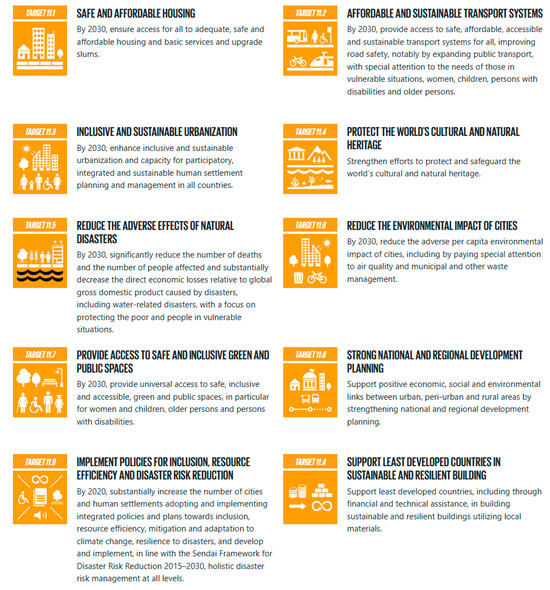
8]. This perspective aligns with international frameworks such as the United Nations Sustainable Development Goal 11 (SDG#11), “Sustainable cities and Communities”, which advocates for inclusive, safe, resilient, and sustainable human settlements (
Figure 1) [
9].
Figure 1. Specific targets of Sustainable Development Goal 11 (SDG#11) of U.N. Sustainability Agenda 2020–2030. Adapted from [
9].
Specific targets for SDG#11, like enhancing inclusive and sustainable urbanization, are directly relevant to fostering healthier cities and protecting fragile. It is vital to recognize that not all cities can provide an ideal environment for the elderly, especially in large cities. This is the conclusion of the European Commission report on the quality of life in European Cities 2024. In Europe, the proportion of people aged 65 and over went up from 18% in 2012 to 21% in 2022, and is expected to be 24% in 2030 and up to 29% in 2050. It is encouraging to see that the development of elder
-friendly cities has become a key urban planning goal. Only 78% of them think that their city is a good place to grow old. This opinion varies widely among European regions. There is higher acceptance in the north and west then in the east and south. Cities’ size is a key factor: smaller cities are clearly more welcoming for the elderly than larger ones. About 83% of elderly in cities with a population of less then 250,000 say they are satisfied, compared with 75% in cities with a population of between 1 and 5 million inhabitants [
10]. This demographic trend, which characterizes all industrially advanced countries, suggests a future that will undoubtedly present social and health issues, as well as economic ones. We must consider a comprehensive prevention approach, which could include structural modifications to our cities. This can be done in line with the UN Sustainability Agenda 2020–2030 (
Figure 1) and the World Health Organization (WHO) recommendations provided in the One-Health Approach [
11].
This entry is adapted from the peer-reviewed paper 10.3390/encyclopedia5030140