
Rudolf Ludwig Carl Virchow (13 October 1821 – 5 September 1902) was a renowned German physician, pathologist, anthropologist, and statesman, widely celebrated as the "Father of Modern Pathology." Born in Schivelbein, Prussia (now Świdwin, Poland), he revolutionized medicine by establishing that diseases originate at the cellular level, famously declaring that "every cell arises from another existing cell." Beyond his scientific achievements, Virchow was a dedicated public health reformer and politician, advocating for social medicine and significantly improving Berlin's sanitation systems. He passed away in Berlin at the age of 80.
- Rudolf Virchow
- physician
- pathologist
- anthropologist
1. Early Life and Education (1821–1845)
Born on October 13, 1821, in Schivelbein, Pomerania (now Świdwin, Poland), Rudolf Virchow was the only child of a small-town farmer and local treasurer. Demonstrating academic promise from a young age, he developed a fluency in multiple languages, including Latin, Greek, Hebrew, French, Italian, and Arabic. This linguistic prowess foreshadowed a lifetime of immense scholarly output.
In 1839, he entered the Friedrich-Wilhelm Institute in Berlin on a military scholarship, which committed him to serve as an army surgeon after graduation. He studied medicine at the University of Berlin under influential figures like Johannes Müller, a pioneer in experimental physiology. Virchow graduated as a doctor of medicine in 1843 with a thesis on rheumatism, displaying early on his meticulous approach to correlating clinical symptoms with anatomical changes.
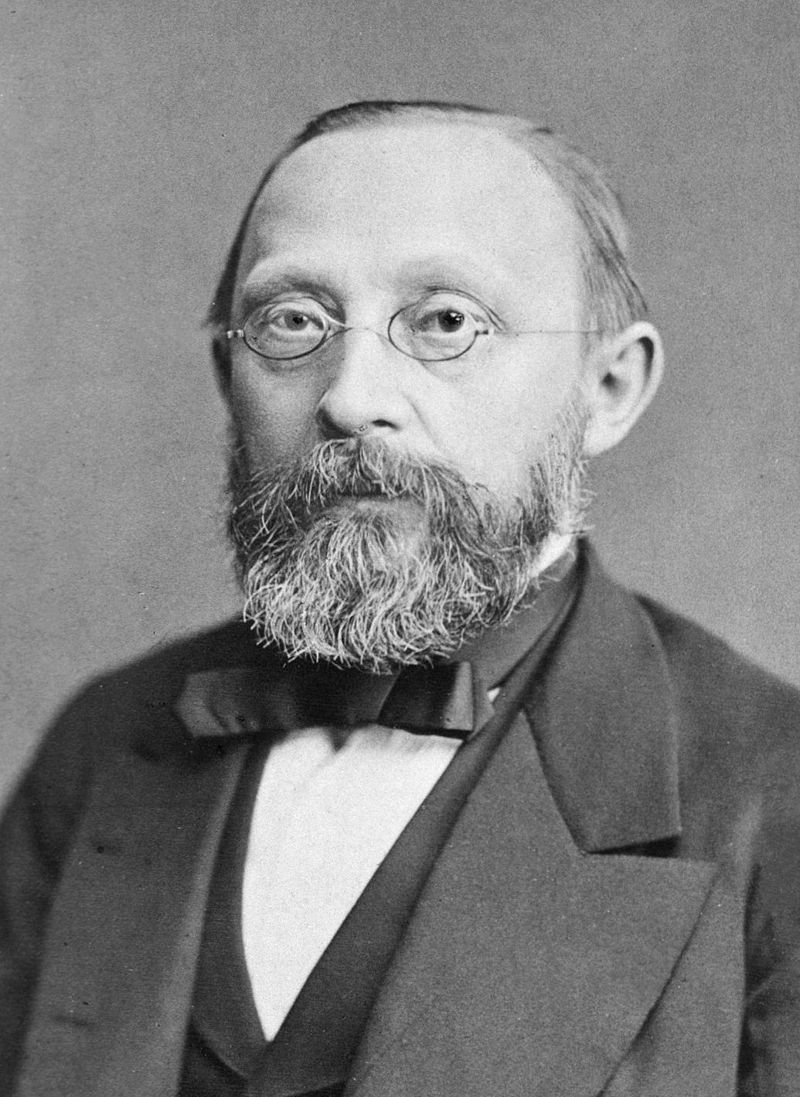
Source: By Unknown author - http://ihm.nlm.nih.gov/images/B25666, Public Domain, https://commons.wikimedia.org/w/index.php?curid=19353800
2. The Catalyst of Revolution: Virchow and Public Health (1845–1849)
Virchow's career began at the Charité Hospital in Berlin, where he worked as a prosector (one who performs anatomical dissections for demonstration). His exceptional skill in pathology quickly became apparent. However, a pivotal event in 1847–1848 shifted his focus from the laboratory to the broader social landscape [1].
The Prussian government sent the 26-year-old Virchow to investigate a devastating typhus epidemic in Upper Silesia, a region of intense poverty. His report was radical and transformative. While he detailed the medical aspects of the disease, he concluded that the epidemic's root causes were not primarily biological but profoundly social: abject poverty, famine, lack of hygiene, political disenfranchisement, and the absence of education. He famously argued that the epidemic was perpetuated by these conditions and could only be prevented through "full and unlimited democracy" and social justice, including measures like progressive taxation, separation of church and state, and Polish autonomy [2].
This experience crystallized his lifelong belief that "medicine is a social science, and politics is nothing else but medicine on a large scale." For Virchow, the physician's duty was to be the natural advocate for the poor, and disease was often a manifestation of social failure. Upon returning to Berlin, energized by the revolutions sweeping Europe in 1848, he co-founded the journal Medical Reform to advance these ideas and participated actively in the democratic movement. His political activities led to his dismissal from the Charité in 1849, a testament to the threat his views posed to the conservative establishment.
3. The Würzburg Years and the Foundation of Cellular Pathology (1849–1856)
Exiled from Berlin, Virchow accepted the chair of Pathological Anatomy at the University of Würzburg. This period of forced academic retreat proved to be his most scientifically fruitful. Freed from the political tumult of the capital, he dedicated himself to microscopic research, building on the work of others like Matthias Schleiden and Theodor Schwann (who proposed the cell theory) and John Goodsir, who suggested the cell was the center of pathological activity [3].
Through relentless observation, Virchow synthesized and refined these ideas into a coherent, powerful new system of medicine. His monumental contributions during this period include:
-
Cellular Pathology (Die Cellularpathologie): Virchow definitively shifted the seat of disease from tissues or organs (as argued by Bichat) to the cell. He established that all diseases are ultimately the result of changes in normal cells—that illness is "life under changed conditions." This was a paradigm shift of the highest order.
-
Omnis cellula e cellula: Rejecting spontaneous generation, Virchow's famous aphorism asserted that cells can only arise from the division of pre-existing cells. This principle placed pathology and biology on a solid scientific footing, displacing mystical and vitalistic theories of life and disease.
-
The Rejection of Humoralism: For over two millennia, Western medicine had been dominated by Galen's humoral theory, which attributed disease to an imbalance of bodily fluids (humors). Virchow's cellular theory provided a tangible, observable alternative, rendering humoralism obsolete.
-
Systematic Classification of Disease: He provided precise cellular descriptions for numerous diseases, including cancer, inflammation, thrombosis, embolism, and amyloidosis. He coined many terms still used today, such as leukemia (from the Greek leukos meaning "white" and haima meaning "blood"), thrombosis, and embolism.
His work in Würzburg established his international reputation as the leading pathological anatomist of his generation.
4. Return to Berlin and Scientific Eminence (1856–1902)
In 1856, Virchow was lured back to Berlin with a specially created chair of Pathological Anatomy, a new institute built to his specifications, and a reappointment at the Charité Hospital. He would remain there for the rest of his life.
His return marked the beginning of an era of unparalleled influence. He published his magnum opus, Die Cellularpathologie in ihrer Begründung auf physiologische und pathologische Gewebelehre (Cellular Pathology as Based upon Physiological and Pathological Histology) in 1858, a collection of 20 lectures that systematically laid out his new medical doctrine. The book became an instant international classic, translated into numerous languages, and fundamentally shaped medical education worldwide.
At his Berlin institute, he became the central figure in European medicine. He trained thousands of students from across the globe, creating a school of disciples who spread his cellular doctrine. His Friday lectures and pathological demonstrations were major intellectual events. He continued his research, making significant contributions to the understanding of trichinosis (leading to meat inspection laws), tumors, and parasitic diseases.
5. The Statesman and Public Health Reformer
Virchow never abandoned the social medicine ideals he formed in Silesia. His scientific stature gave him a powerful platform for political advocacy. He served as a member of the Berlin city council for over 40 years, where he pioneered modern public health measures. His efforts were instrumental in:
-
Designing and implementing modern sewer and water systems for Berlin.
-
Advocating for the compulsory inspection of schoolchildren for signs of neglect and disease.
-
Introducing standards for meat inspection.
-
Designing modern hospital architecture to improve light, ventilation, and hygiene.
On the national stage, he was a co-founder and long-time leader of the German Progressive Party, serving in the Prussian Diet and the Reichstag for decades. A staunch liberal and anticlerical, he was a fierce opponent of Otto von Bismarck. Their rivalry was legendary; Bismarck once challenged him to a duel (which the pragmatic Virchow wisely declined by insisting it be fought with sausages—one poisoned). Virchow opposed Bismarck's excessive military budgets, arguing the funds were better spent on education and social welfare—a direct application of his medical philosophy to the body politic.
6. Contributions to Anthropology and Archaeology
Virchow's intellectual energy seemed boundless. In his later decades, he applied his meticulous empirical method to the nascent fields of anthropology and archaeology. He:
-
Co-founded the German Anthropological Society and the Berlin Society for Anthropology, Ethnology, and Prehistory.
-
Conducted extensive craniometric studies, amassing a huge collection of skulls. While his work was descriptive and classificatory, it was later misappropriated by others to support racist and nationalist ideologies, a development he would have likely opposed given his liberal, anti-nationalist politics.
-
Was a key early excavator of Troy with Heinrich Schliemann, applying scientific rigor to the site's analysis. He correctly identified the "burnt city" as the likely Homeric Troy but urged caution against Schliemann's more sensationalist claims.
-
Took a strong public stand against the anti-scientific nature of Ernst Haeckel's theories of recapitulation and his popular but speculative Darwinism, advocating for caution and evidence over grand narrative.
7. Legacy and Death
Rudolf Virchow died on September 5, 1902, in Berlin, from heart failure after jumping from a moving streetcar. His death was met with international mourning. He was given a state funeral, an honor reflecting his status as a national institution.
His legacy is multifaceted and profound:
-
In Medicine: He is the foundational figure of modern scientific medicine. His cellular theory of pathology is the bedrock upon which all subsequent medical research, from microbiology to oncology, is built. He transformed the physician's role from a passive observer of symptoms to an active investigator of cellular cause.
-
In Public Health: He is a patriarch of social medicine and public health, tirelessly arguing that society has a responsibility to provide the conditions for health. His work laid the groundwork for the modern welfare state's health initiatives.
-
As a Polymath: He exemplified the 19th-century ideal of the universal scholar, making significant contributions across multiple disciplines and demonstrating how a rigorous scientific mindset could be applied to social and historical problems.
Despite his immense stature, he was not without his blind spots. He was slow to accept germ theory, viewing bacteria as consequences rather than causes of disease, and he remained skeptical of Darwin's theory of evolution by natural selection, favoring a more mechanistic view of biological change. However, these stances, often seen as obstinacy, were rooted in his extreme commitment to empirical proof and his resistance to what he viewed as speculative leaps beyond observable data.
In conclusion, Rudolf Virchow was more than a doctor; he was an architect of the modern world. He provided the fundamental logic of modern disease analysis and tirelessly fought for the principle that health is a human right secured not just by doctors in clinics, but by citizens in a just and democratic society. His life remains a powerful model of the scientist engaged with the world.
References
- Rudolf Virchow: Integrating Medicine and Social Reform for Public Health. (2023). PubMed Central. Retrieved from https://pubmed.ncbi.nlm.nih.gov/39347120/.
- Rudolf Virchow: Integrating Medicine and Social Reform for Public Health. (2023). Cureus. Retrieved from https://www.cureus.com/articles/282641-rudolf-virchow-integrating-medicine-and-social-reform-for-public-health
- Rudolf Virchow: Pathologist, anthropologist, and social thinker. (2017). HEKINT. Retrieved from https://hekint.org/2017/01/29/rudolf-virchow-pathologist-anthropologist-and-social-thinker/.