
Wombats are medium-sized, burrowing marsupials native to Australia, belonging to the family Vombatidae. Distinguished by their robust build, short limbs, and backward-facing pouch, wombats are primarily nocturnal herbivores that play a significant role in soil turnover and ecosystem functioning. They are notable for producing cube-shaped feces and exhibit highly specialized adaptations for a fossorial lifestyle.
- Wombats
- Vombatidae
- soil turnover
1. Taxonomy and Classification
The wombat family (Vombatidae) is a distinct lineage within the order Diprotodontia, which also includes kangaroos, wallabies, and koalas. The family currently comprises three extant species:
-
Common wombat (Vombatus ursinus) – Distributed widely across southeastern Australia, including Tasmania.
-
Southern hairy-nosed wombat (Lasiorhinus latifrons) – Inhabits semi-arid regions of South Australia, with a smaller distribution in southwestern New South Wales and western Victoria.
-
Northern hairy-nosed wombat (Lasiorhinus krefftii) – One of the rarest mammals in the world, confined to a protected area in central Queensland.
Genetic and morphological analyses indicate that wombats diverged from their closest living relative, the koala (Phascolarctos cinereus), approximately 40 million years ago during the Oligocene period [1][2]. Fossil evidence from the Riversleigh World Heritage Area in Queensland reveals the existence of numerous extinct wombat species, some of which, such as Phascolonus gigas, were considerably larger than modern wombats.
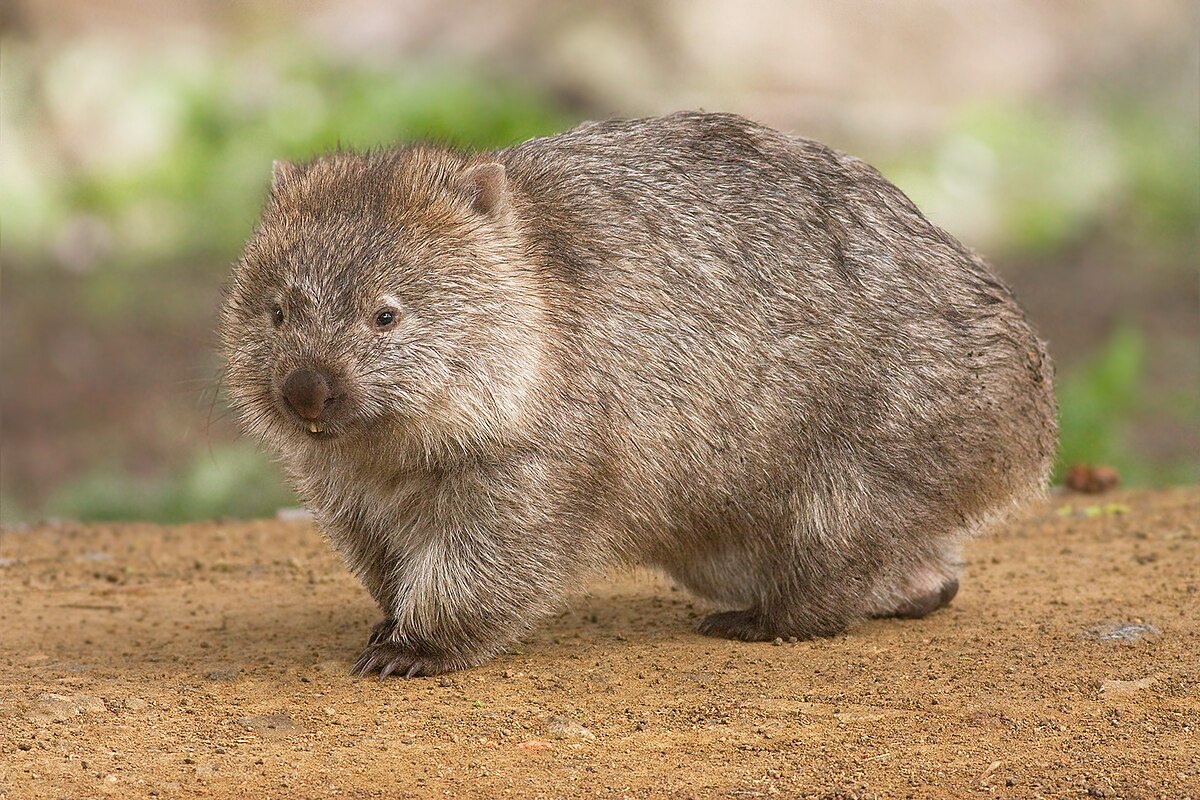
Source: Door JJ Harrison - Eigen werk, CC BY-SA 3.0, https://commons.wikimedia.org/w/index.php?curid=8661812
2. Anatomy and Morphology
Wombats measure between 80–120 cm in length, with a weight range of 20–40 kg, although body size varies among species and with environmental conditions. They have a compact, muscular build that supports their burrowing lifestyle.
Skeletal and Muscular Adaptations
The wombat’s skeleton is characterized by a robust pectoral girdle, short but powerful forelimbs, and flattened claws designed for digging. The skull is broad with strong masseter and temporalis muscles, enabling efficient chewing of tough vegetation.
Dentition
Unlike most marsupials, wombats have continuously growing incisors, similar to rodents. These incisors, paired with large diastemata (gaps between teeth), facilitate gnawing and cutting plant material.
Digestive System
Wombats are hindgut fermenters, relying on microbial digestion in an enlarged cecum and colon to process fibrous plant matter. The digestion process is extremely slow—up to 14 days—which maximizes nutrient absorption .
Unique Features
-
Backward-facing pouch to prevent soil from entering while digging.
-
Cube-shaped feces formed through differential elasticity of the intestinal walls and water reabsorption (Yang et al., 2018).
-
Low metabolic rate—approximately two-thirds that of other mammals of similar size—which reduces food requirements and supports survival in nutrient-poor habitats.
3. Distribution and Habitat
Wombats occupy a variety of habitats across southern and eastern Australia:
-
Common wombat: Prefers temperate forests, alpine regions, and coastal scrub. Burrows are often dug into slopes or along creek banks.
-
Southern hairy-nosed wombat: Occupies semi-arid grasslands and open woodlands with sandy soils that allow deep burrowing.
-
Northern hairy-nosed wombat: Found in sandy, eucalypt-dominated woodlands with native grasses, particularly Aristida and Bothriochloa species, which are primary food sources.
Burrow systems, sometimes exceeding 30 meters in length and 3.5 meters in depth, create stable microclimates that protect wombats from temperature extremes and predators.
4. Behavior and Ecology
Wombats are largely solitary and nocturnal, emerging at dusk to feed on native grasses, sedges, roots, and tubers. They possess a keen sense of smell and relatively poor eyesight.
Social and Territorial Behavior
Territories are demarcated using scent from anal glands and strategically placed feces. Cube-shaped droppings are often deposited on elevated surfaces, such as logs or rocks, to increase scent dispersal.
Burrowing Ecology
Burrows serve as thermal refuges, maintaining a relatively constant internal temperature and humidity. They also reduce predation risk from dingoes, foxes, and domestic dogs.
Reproduction
Breeding typically occurs year-round in favorable climates, but in arid regions it coincides with resource availability. Gestation lasts approximately 20–30 days, followed by 6–8 months of pouch development and several additional months of maternal care.
5. Conservation Status
The IUCN Red List categorizes:
-
Vombatus ursinus as Least Concern.
-
Lasiorhinus latifrons as Near Threatened, mainly due to habitat loss and fragmentation.
-
Lasiorhinus krefftii as Critically Endangered, with intensive conservation programs in place (IUCN, 2023).
Threats include:
-
Habitat destruction from agriculture and urban expansion.
-
Competition with livestock for grazing resources.
-
Vehicle collisions, particularly in rural areas.
-
Disease, notably sarcoptic mange, which causes significant morbidity and mortality in some populations.
6. Cultural and Economic Significance
In Aboriginal cultures, wombats appear in Dreamtime narratives as resilient, resourceful creatures. They are also emblematic in Australian folklore and children's literature.
Economically, wombats sometimes come into conflict with agriculture when burrows damage fences or compete for pasture. However, they also contribute positively by aerating soil and influencing plant regeneration patterns.
7. Research and Scientific Importance
Wombats are model organisms for:
-
Marsupial physiology—particularly slow metabolism and low-nutrient diet adaptation.
-
Biomechanics—studies on cube-shaped feces have implications for manufacturing processes involving extrusion and material shaping [3].
-
Wildlife disease ecology—research on sarcoptic mange has informed broader veterinary and conservation strategies.
8. Future Directions in Conservation
Conservation strategies include:
-
Expanding habitat corridors for genetic diversity.
-
Managing disease outbreaks through targeted treatment programs.
-
Public education campaigns to reduce vehicle collisions and improve coexistence.
-
Continued monitoring using camera traps, GPS tracking, and environmental DNA (eDNA) techniques.
References
- Wells, R. T. (1989). Wombats. In D. W. Walton & B. J. Richardson (Eds.), Fauna of Australia, Volume 1B (pp. 755–771). Australian Government Publishing Service.
- Musser, A. M. (2005). Vombatiformes. In D. W. Macdonald (Ed.), The Encyclopedia of Mammals (2nd ed., pp. 852–855). Oxford University Press.
- Yang, P. J., et al. (2018). How do wombats make cubed poo? Soft Matter, 14(24), 5352–5358.