
Henry Ford was an American industrialist, founder of the Ford Motor Company, and a pivotal figure in the development of modern industrial manufacturing techniques, including the moving assembly line. His innovations in mass production, the introduction of the Model T, and the institution of the $5 workday transformed the global economy, making automobiles affordable to the mass public. Ford's work laid the groundwork for modern consumer society by integrating efficiency into manufacturing and creating new standards for industrial labor.
- Henry Ford
- Model T
- Ford Motor Company
1. Early Life and Background
Henry Ford was born on July 30, 1863, in Dearborn, Michigan. The son of William Ford, a farmer, and Mary Litogot Ford, Henry developed an early interest in mechanics. As a teenager, Ford left the farm to pursue a career in engineering. He worked as an apprentice machinist in Detroit, where he developed skills that would shape his future.
At the age of 23, Ford joined the Detroit Edison Company, where he quickly advanced to become the company’s chief engineer. It was during this period that he began experimenting with internal combustion engines, which would lead him to build his first automobile in 1896, the Quadricycle. Ford’s early experimentation was a precursor to the major breakthroughs that would follow in the automotive industry [1].
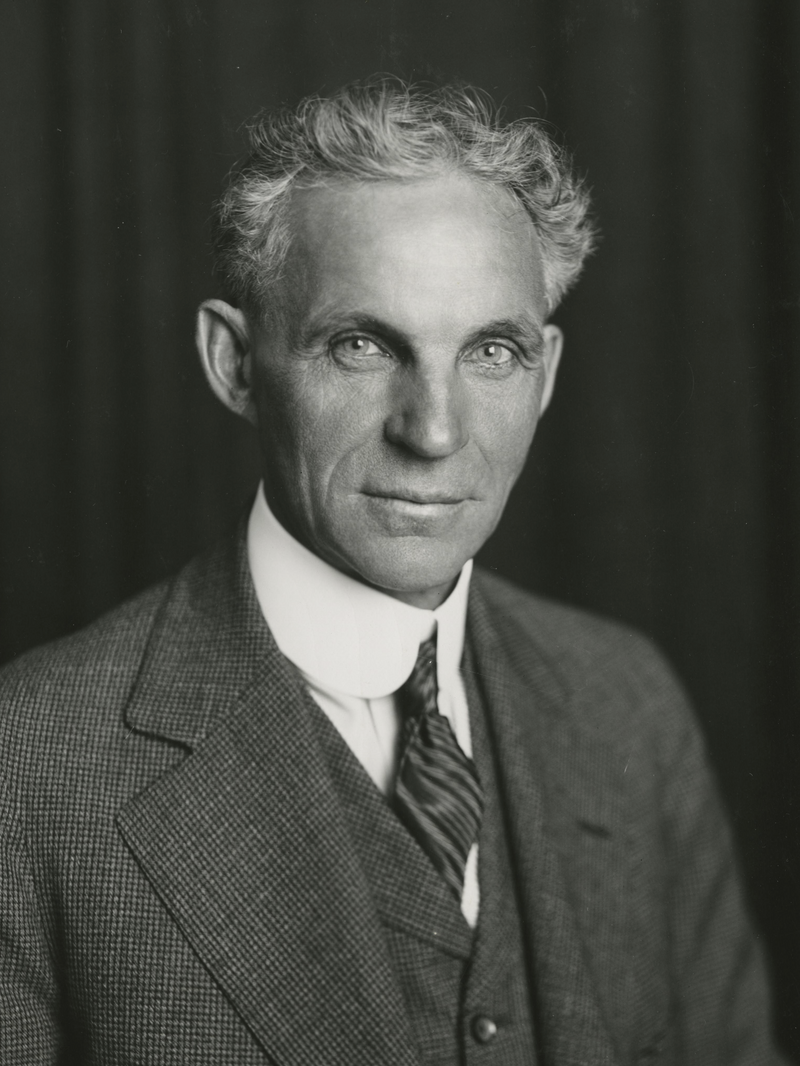
Source: By Ford Motor Company. Photographic Department - The Henry Ford Collections, Object ID: 64.167.833.P.2973, Public Domain, https://commons.wikimedia.org/w/index.php?curid=167426437
2. The Birth of Ford Motor Company
Ford founded the Ford Motor Company on June 16, 1903. The company was capitalized at $500,000, with contributions from several investors. Early on, the company faced challenges, but its breakthrough came with the introduction of the Model T in 1908. Unlike earlier cars, the Model T was affordable, durable, and easy to operate.
The Model T became an enormous success, selling millions of units and making Ford a household name. At $850, the car was more affordable than most models on the market, which typically cost over $2,000. Ford’s ability to mass-produce the Model T was made possible by his introduction of the moving assembly line in 1913 [2].
3. The Moving Assembly Line and Mass Production
In 1913, Ford revolutionized manufacturing by introducing the moving assembly line at the Highland Park Plant in Detroit. This innovation reduced the time to assemble a car from over 12 hours to just 93 minutes. The assembly line’s efficiency allowed Ford to lower production costs significantly, making automobiles more affordable. Ford's innovation created a new standard for mass production that spread across industries worldwide.
The moving assembly line not only transformed the automotive industry but also contributed to the creation of the modern consumer economy. It was a significant factor in Ford's ability to keep prices low, thereby expanding the market for cars and increasing his company's profits [3].
4. The $5 Workday and Labor Relations
In 1914, Ford made a bold move by introducing the $5 workday, more than double the average industrial wage at the time. The $5 wage was revolutionary because it not only improved workers' living conditions but also allowed them to afford the very cars they were producing. Ford believed that paying workers well would reduce turnover and increase productivity, both of which proved to be true.
Ford’s decision to increase wages and reduce working hours was a key moment in industrial labor history. The $5 workday became a cornerstone of Ford’s labor philosophy, although it did not come without controversy. Ford was anti-union and sought to maintain strict control over his workers, which led to tensions with labor groups and critics [4].
5. Expansion of Ford Motor Company
The success of the Model T allowed Ford to expand his company’s reach both nationally and internationally. By 1917, Ford introduced the Fordson tractor, which brought his engineering prowess into agricultural equipment. The company also began producing a variety of industrial machinery.
During both World War I and World War II, Ford contributed to the war effort by converting his factories to produce military vehicles and equipment. Ford’s factories were critical to the success of the U.S. military, as his manufacturing facilities were able to quickly retool for military production. The B-24 Liberator bombers, produced by Ford’s Willow Run Plant, became a symbol of Ford’s contribution to the war effort [5].
6. Philosophies and Ideologies
Henry Ford was known for his unconventional views on politics and labor. A strong anti-unionist, Ford believed in maintaining direct control over his workforce. He implemented a series of paternalistic policies, including the $5 workday, in an attempt to cultivate loyalty from his workers. However, Ford’s views were not limited to labor. He also espoused anti-Semitic beliefs, which he publicly expressed in his newspaper The Dearborn Independent. Ford later distanced himself from these views, but his association with anti-Semitic ideas has been a controversial aspect of his legacy.
Ford was also a strong advocate for American isolationism during the early stages of World War II. However, after the attack on Pearl Harbor in 1941, he shifted his views and fully supported the war effort, with his company contributing to the production of military equipment. His personal beliefs, particularly his early opposition to war and his controversial views on race, make him a polarizing figure in American history [6].
7. Legacy and Impact
Henry Ford’s contributions to modern manufacturing are unparalleled. His innovations in mass production, particularly the moving assembly line, helped make the automobile affordable for the average consumer and laid the foundation for the modern consumer economy. Ford's model of efficient, large-scale production has been adopted by industries worldwide and remains a core principle in manufacturing today.
Beyond his industrial achievements, Ford’s personal legacy also includes the Ford Foundation, which was established in 1936 and has since become one of the world’s largest philanthropic organizations. The foundation has focused on improving human welfare globally, addressing issues such as poverty, education, and public health.
Ford’s reputation, however, is complicated by his controversial personal beliefs. His anti-Semitic views and his stance on labor relations continue to be subjects of criticism. Despite this, his role in shaping the automobile industry and modern industrial practices remains significant [7].
8. Conclusion
Henry Ford was a visionary industrialist whose innovations in automobile production, labor practices, and consumerism had a profound impact on the global economy. While his personal beliefs and opposition to labor unions were often controversial, his legacy as a pioneer in the automobile industry and mass production is undeniable. Ford’s contributions to the manufacturing industry and his enduring influence on modern business practices cement his place as one of the most important figures in industrial history.
References
- Ford, H. My Life and Work. 1922.
- Nevins, A., & Hill, F. E. Ford: The Times, The Man, The Company. 1957.
- Kleiner, B. H. "The History of the Ford Motor Company," Journal of Business History, 1991.
- Cohen, L. A Consumers' Republic: The Politics of Mass Consumption in Postwar America. 2004.
- Rinehart, R. Ford and the Fordist Revolution in the United States. 1986.
- Atkinson, J. Fordism and Modern Industry. 2012.
- Kline, S. Henry Ford and the Automobile Revolution. 2003.