
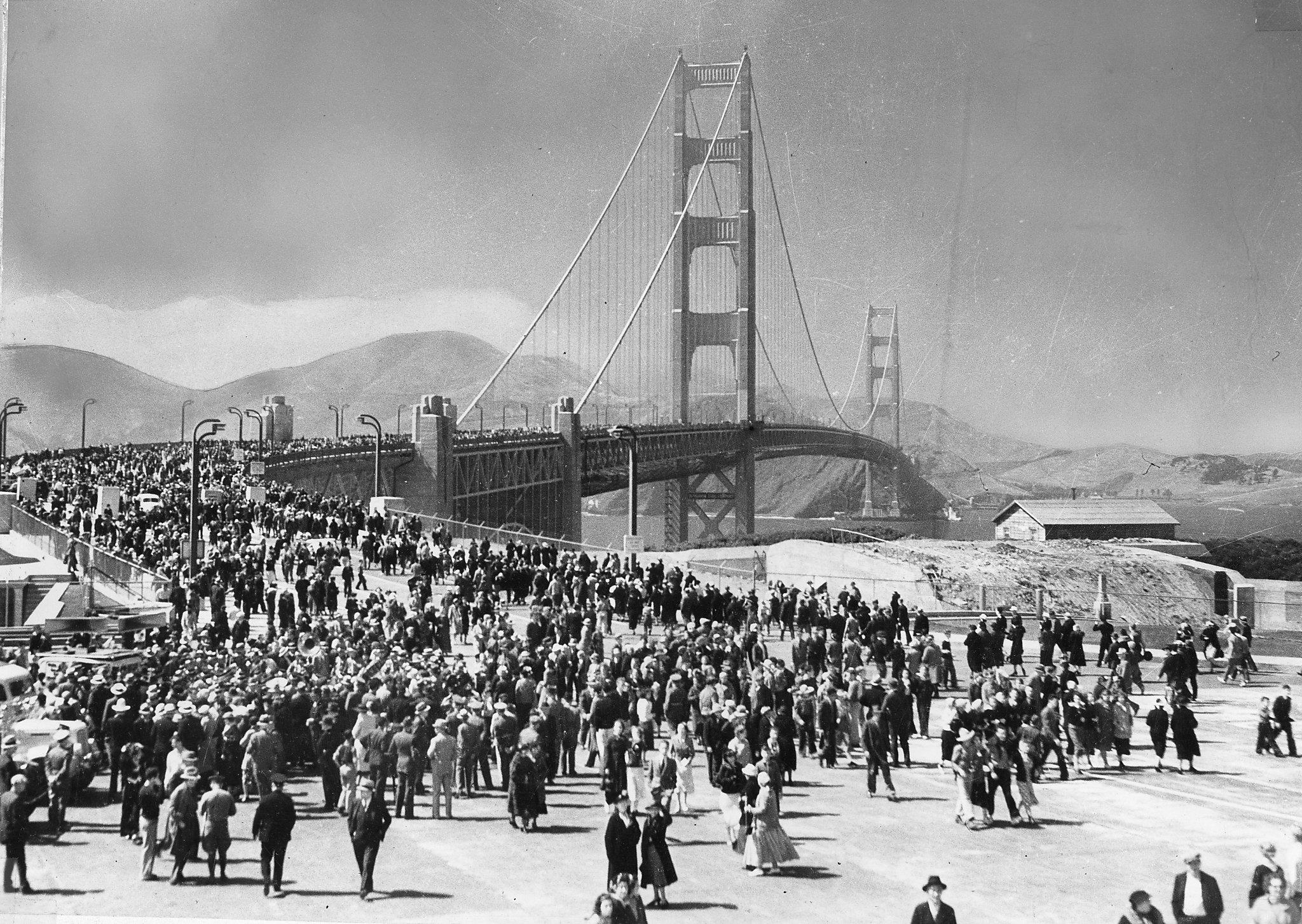
On May 27, 1937, San Francisco's Golden Gate Bridge was officially opened to the public for "Pedestrian Day," marking the start of a week-long celebration known as the "Golden Gate Bridge Fiesta." This event inaugurated one of the most iconic and enduring feats of civil engineering in the 20th century. Spanning the mile-wide Golden Gate Strait—the entrance to the San Francisco Bay from the Pacific Ocean—the bridge connected San Francisco with Marin County and fundamentally reshaped transportation and regional development in California. Beyond its technical brilliance, the Golden Gate Bridge came to symbolize human ambition, resilience during economic hardship, and the transformative power of infrastructure.
- Golden Gate Bridge
- Golden Gate Bridge Fiesta
1. Background and Conception
Prior to the bridge's construction, the only practical way to travel between San Francisco and Marin County was by ferry. While the service was commercially operated and well-patronized, especially by the Sausalito Ferry Company (later purchased by Southern Pacific), it was neither quick nor weatherproof, and the bottleneck began to limit economic and population growth in the region.
The idea of a bridge across the Golden Gate Strait had been discussed as early as the 1870s, but it wasn’t until the 1920s that momentum built in earnest. One of the bridge's greatest early champions was Joseph Strauss, a Chicago-based engineer who initially proposed a cantilever-suspension hybrid design. Though visionary, Strauss's original concept was not aesthetically or structurally ideal for the challenges posed by the site. Over time, the final design emerged from collaboration with engineer Leon Moisseiff, who championed the more graceful suspension approach; Charles Alton Ellis, a gifted structural engineer who calculated much of the bridge's design; and Irving Morrow, an architect who added Art Deco elements and selected the now-iconic “International Orange” paint [1].
Despite public skepticism about its feasibility—given the area's deep waters, strong tides, high winds, fog, and seismic instability—Strauss’s team persisted. The design was not only technically sound, but beautiful, representing a rare blend of engineering and artistry [2].
Source: San Francisco Chronicle
2. Financing and Construction
The estimated cost for building the Golden Gate Bridge was $27 million, a staggering figure during the Great Depression. Funding came not from federal programs but from local initiative. In 1930, voters in six Bay Area counties approved a $35 million bond initiative. The financial viability was secured when Bank of America, under A.P. Giannini, agreed to underwrite the bonds—one of the largest private financial undertakings of its kind at the time [3].
Construction began on January 5, 1933, with site preparation including the excavation of anchorages and tower foundations in deep, treacherous waters. Special innovations such as movable safety nets suspended beneath the work areas saved 19 lives—though 11 men were lost during the four-year construction period. The use of prefabricated cable wires, spun into place by engineers from the John A. Roebling's Sons Company, allowed for greater efficiency and strength [4].
When completed in 1937, the Golden Gate Bridge had a main span of 4,200 feet, making it the longest suspension bridge in the world at the time. Its twin towers rose to 746 feet, making them the tallest structures west of the Mississippi River. The bridge’s total length was about 1.7 miles, and the clearance below was 220 feet at mid-span to allow the passage of large ocean-going vessels [2].
3. Opening Day and Public Reception
The bridge officially opened to pedestrian traffic on May 27, 1937. Roughly 200,000 people walked, roller-skated, and even danced across it during the festive “Pedestrian Day.” The following day, President Franklin D. Roosevelt, via telegraph from Washington D.C., signaled the official opening of the bridge to vehicle traffic.
Celebrations included a flotilla of ships, air shows, concerts, parades, and a grand display of civic pride. The event signified more than an engineering achievement; it was a moment of collective optimism during the lingering shadows of the Depression [3][5].
4. Cultural and Historical Impact
The Golden Gate Bridge quickly assumed mythic status in American culture. It became a defining feature of San Francisco’s skyline and has appeared in countless films, documentaries, and literary works. With its distinctive hue and harmonious proportions, the bridge was hailed as a marriage of function and form. Its Art Deco styling, choice of materials, and vibrant color reflected modernist aspirations while remaining sensitive to its dramatic natural setting [2].
The bridge was designated as one of the “Seven Wonders of the Modern World” by the American Society of Civil Engineers in 1994 [4]. It is widely regarded as an enduring symbol of American creativity and perseverance.
5. Preservation, Engineering Upgrades, and Legacy
Despite its elegance, the Golden Gate Bridge was never static. Over the decades, the bridge underwent seismic retrofitting to withstand potential major earthquakes, especially after the 1989 Loma Prieta Earthquake. Innovations have included tower reinforcement, roadway replacement with lighter orthotropic deck panels, and the addition of suicide deterrent systems.
Moreover, as traffic patterns evolved, the bridge incorporated reversible lanes and congestion pricing to manage its load. Over 112,000 vehicles cross it daily, making it both a historical monument and a living artery of commerce and commuting.
In the 21st century, efforts to balance preservation with safety and sustainability have ensured the bridge remains functional while honoring its original grandeur. It is also central to the Golden Gate National Recreation Area, one of the largest urban parks in the world.
6. Conclusion
The opening of the Golden Gate Bridge on May 27, 1937, was not merely the launch of a transportation facility—it was a celebration of engineering excellence, community determination, and visionary leadership. It endures as a global icon and a tribute to the human spirit, a structure that continues to inspire awe nearly a century after its completion.
References
- Van der Zee, John. The Gate: The True Story of the Design and Construction of the Golden Gate Bridge. Simon & Schuster, 1986.
- Scott, James. The Golden Gate: The History and Legacy of America’s Most Iconic Bridge. Charles River Editors, 2015.
- Golden Gate Bridge Highway and Transportation District. “Bridge History and Facts.” https://www.goldengate.org/
- American Society of Civil Engineers. “Seven Wonders of the Modern World.” ASCE, 1994. https://www.asce.org/
- National Park Service. “Golden Gate National Recreation Area.” https://www.nps.gov/goga/index.htm