
The Execution of Anne Boleyn refers to the judicial beheading of Anne Boleyn, the second wife of King Henry VIII of England, on May 19, 1536, at the Tower of London. Accused of adultery, incest, and high treason—charges now widely considered to have been fabricated—her death marked a significant moment in Tudor history. It underscored the volatility of the English royal court, the growing authoritarianism of Henry VIII, and the dangers faced by women in positions of political influence. Anne's execution also paved the way for Henry’s third marriage and altered the line of succession, though her daughter, Elizabeth I, would later become one of England's greatest monarchs.
- Anne Boleyn
- Execution
- Tower of London
- Royal succession
1. Introduction
On May 19, 1536, Anne Boleyn, the second wife of King Henry VIII of England, was executed by beheading at the Tower of London. Her death marked one of the most infamous and controversial episodes in English history, symbolizing the deadly interplay of power, politics, gender, and religion during the Tudor era. Accused of adultery, incest, and high treason, Anne’s fall was swift and brutal. Yet modern scholarship has widely regarded the charges against her as false, manipulated by political factions at court.
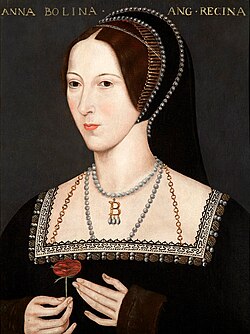
Source: By English school - https://thetudortravelguide.com/2019/09/21/hever-castle/, Public Domain, https://commons.wikimedia.org/w/index.php?curid=106756494
2. Anne Boleyn's Rise: The Architect of a Kingdom's Religious Upheaval
Born around 1501 to Thomas Boleyn, later Earl of Wiltshire, and Elizabeth Howard, Anne Boleyn received a cosmopolitan education in the Netherlands and France, where she acquired fluency in French, a deep knowledge of court etiquette, and an appreciation for humanist ideals [1].
Upon returning to England, she served as a lady-in-waiting to Queen Catherine of Aragon, the Spanish-born first wife of King Henry VIII. Henry became captivated by Anne in the mid-1520s. Her refusal to become his mistress elevated her status; she insisted on marriage, which led Henry to seek an annulment from Catherine.
When Pope Clement VII refused to annul Henry’s first marriage, the king initiated a break with the Roman Catholic Church, leading to the English Reformation and the establishment of the Church of England under royal supremacy. Henry and Anne married in January 1533, and she was crowned queen in June. In September 1533, Anne gave birth to Elizabeth, a daughter rather than the hoped-for male heir.
“The birth of a daughter disappointed Henry, but he remained publicly supportive of Anne for a time. However, repeated miscarriages and political tensions weakened her position at court.”
— Warnicke, The Rise and Fall of Anne Boleyn [2]
3. Political Intrigue and Downfall
Anne’s reign lasted only three years. Her assertiveness and involvement in political matters—highly unusual for a queen consort—won her enemies, particularly among conservatives at court and those loyal to Catherine of Aragon.
Chief among her rivals was Thomas Cromwell, Henry’s chief minister and a key architect of the Reformation. By 1536, Anne had suffered multiple miscarriages, including the loss of a male fetus in January, coinciding with the death of Catherine of Aragon. With Henry’s attention turning toward Jane Seymour, one of Anne’s ladies-in-waiting, Cromwell saw an opportunity to remove Anne.
In April 1536, Cromwell orchestrated a case against the queen. A series of men, including her brother George Boleyn and courtiers such as Mark Smeaton and Sir Henry Norris, were accused of adultery with her. Some were tortured; Smeaton confessed under duress. The evidence was thin, but Henry, perhaps eager to remarry and sire a male heir, gave his approval.
Anne was arrested on May 2, 1536, and imprisoned in the Tower. She was tried by a panel of peers, many of whom had personal or political interests in her downfall. Despite her eloquent defense, she was found guilty of treason.
“The charges were politically motivated and deeply flawed... there was a calculated move by Cromwell and others to eliminate Anne as a threat.”
— Bernard, Anne Boleyn: Fatal Attractions [3]
4. Execution at the Tower
On the morning of May 19, 1536, Anne was led to a scaffold erected on Tower Green. She wore a grey damask gown with a crimson petticoat, symbolizing martyrdom. Despite the enormity of the moment, she remained composed and delivered a final speech:
“I die a good Christian woman… I do not accuse any man, nor anything done against me... I pray God save the King and send him long to reign over you.”
— Recorded in the Letters and Papers, Foreign and Domestic, of the Reign of Henry VIII [4]
A skilled French swordsman, brought specially from Calais, was appointed to perform the execution instead of the usual axe. With one clean stroke, Anne was decapitated. Her body was buried in an unmarked grave in the Chapel of St Peter ad Vincula, located within the Tower grounds. A marble slab now marks her resting place.
5. Aftermath and Long-Term Legacy
Just eleven days after Anne’s execution, Henry married Jane Seymour. Within a year, Jane gave birth to Edward VI, Henry's long-desired son. Anne’s daughter Elizabeth was declared illegitimate, though her fortunes would dramatically change.
In 1558, Elizabeth ascended the throne as Elizabeth I, reigning for 45 years. Her era witnessed England’s emergence as a global power, the flourishing of English drama, and relative internal stability. Historians widely credit Elizabeth’s political brilliance to her mother’s legacy of intelligence, resolve, and political acumen.
“Anne Boleyn’s bloodline ultimately secured the future of the Tudor dynasty through Elizabeth’s reign.”
— Starkey, Six Wives: The Queens of Henry VIII (2003)
6. Modern Interpretations and Cultural Influence
Anne Boleyn has become a central figure in both historical scholarship and popular culture. Modern historians increasingly view her as a victim of political machination, her fall engineered by powerful men threatened by her influence and frustrated by her inability to bear a son.
She is portrayed variously as a schemer, a feminist icon, a martyr, and a tragic queen. Novels such as Hilary Mantel’s Wolf Hall and Philippa Gregory’s The Other Boleyn Girl, along with adaptations like The Tudors and Anne of the Thousand Days, continue to explore her legacy.
Recent research and feminist historiography have sought to reframe Anne as a woman of considerable wit, intellect, and agency in a world that denied such roles to women.
7. Conclusion
The execution of Anne Boleyn on May 19, 1536, is more than a historical footnote—it is a lens into the turbulence of Tudor politics, the early modern struggles for religious authority, and the precarious status of women in power. Her death did not end her influence. Through her daughter Elizabeth, Anne Boleyn left an indelible mark on English and world history. Today, she remains one of the most studied and debated figures of the 16th century.
References
- Ives, Eric. The Life and Death of Anne Boleyn. Wiley-Blackwell, 2004.ISBN: 9781405134637
- Warnicke, Retha M. The Rise and Fall of Anne Boleyn: Family Politics at the Court of Henry VIII. Cambridge University Press, 1989.
- Bernard, G.W. Anne Boleyn: Fatal Attractions. Yale University Press, 2010. ISBN: 9780300162455
- Starkey, David. Six Wives: The Queens of Henry VIII. Harper Perennial, 2003. ISBN: 9780060005504