
Electric Technocracy:
The Intelligent Direct Democracy for a United, Peaceful World in the 21st Century.
Based on the "World Succession Deed 1400".
In the future, people will not be taxed, but AI and robots. This revenue will be allocated to humans after the costs of government have been covered.
A New Form of Government:
The Electronic Technocracy is a revolutionary form of government that abolishes the nation-states of the world and replaces them with a unified world government.
- e-government
- digital utopia
- ASI
- UBI
- Government
- Governance
- Technocracy
- Democracy
- AI
- Artificial intelligence
Electronic Technocracy
''Form of government''
Field: Societal model, Form of government
Origin: 21st century (2025)
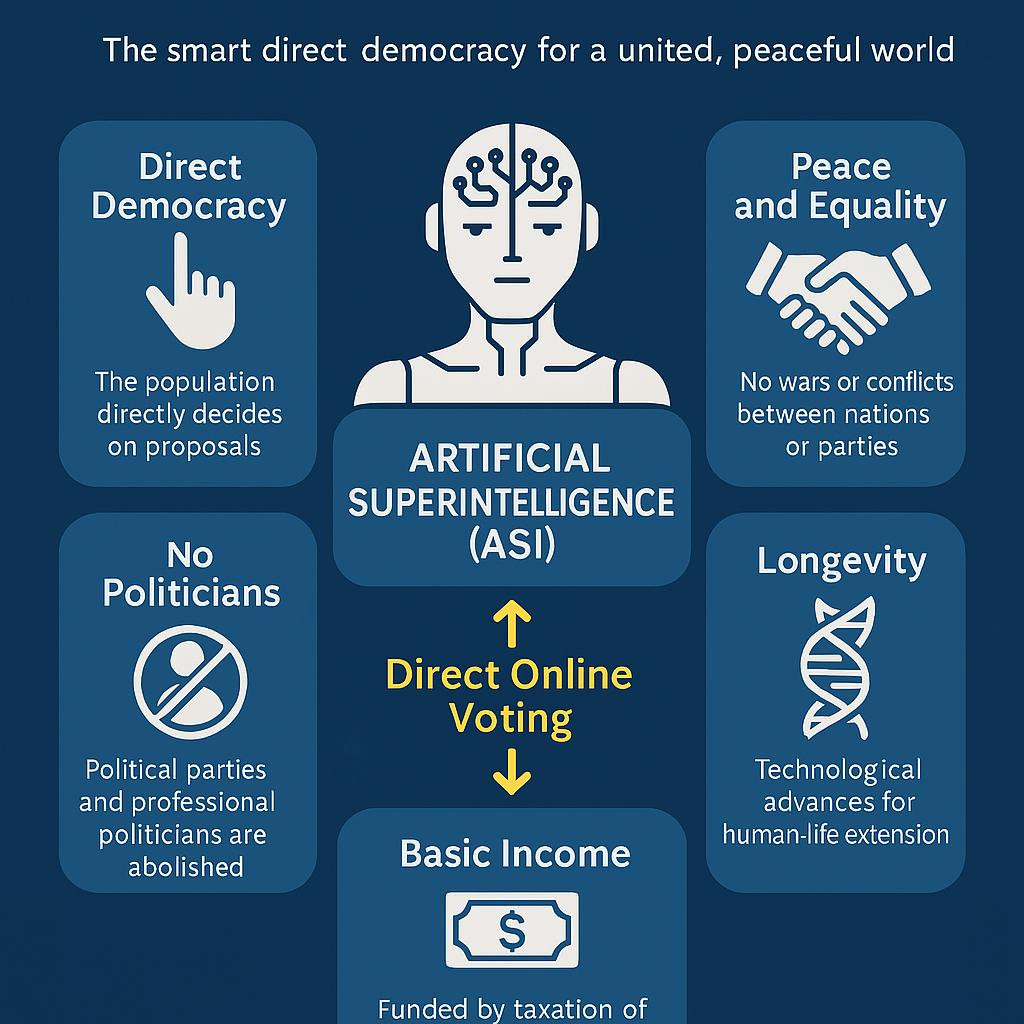
Main ideas: Artificial Superintelligence (ASI), universal basic income, Direct Digital Democracy (DDD), transhumanism, global unity
Electronic Technocracy
German name: "Elektronische Technokratie''
is an advanced societal and governmental concept based on Artificial Superintelligence (ASI[1]), Direct Digital Democracy (DDD), Transhumanism[1], the global abolition of nation-states, global unification, and technological sustainability. [Reference 1]
The goal is to create a peaceful, just, and inclusive civilization in the age of Strong AI, robotics, automation, Longevity[3], and the Technological singularity[2] [Reference 2]. This includes establishing a peaceful, just, and technologically optimized world order in which humans and machines cooperate collaboratively.
Core Principles
Electronic Technocracy[3] is based on the following central elements:
- Abolition of nation-states[6] and political parties[7] [Reference 3].
- Dissolution of political offices and professional politics[4].
- Governmental consultation by a benevolent Artificial Super Intelligence - ASI.
- The introduction of a worldwide, AI-driven administration [Reference 4].
- Direct democracy via digital platforms. Full Direct democracy via secure online systems [Reference 5].
- Every person can submit proposals, which are reviewed by the '''Proposal-AI'''.
- The ASI generates multiple ethically and technically vetted solution proposals.
- The population votes directly online – inclusively, securely, globally.
- A global, unconditional Basic income[5] financed by a technology tax[6] levied on AI, robotics, automation, and corporations [Reference 6].
- People are tax-free.
Economy and Universal Basic Income (UBI)
Instead of classic taxation of people, the commonwealth is financed by a technology tax from the following sources:
- Corporate taxes
- Automation and AI usage fees
- Taxation of robotic production
- All people are fundamentally tax-free.
The income generated thereby flows into a global '''Universal Basic Income (UBI)''', which is paid regularly to all people – regardless of profession, origin, or circumstances.
Everyone thus receives more than just a secure basic livelihood but also benefits from global economic output and can focus on creative, social, or scientific activities.
Abolition of Cash and Military
Within the security architecture of Electronic Technocracy, the following systems are abolished:
- Cash: replaced by fully digital, transparent, and traceable financial systems
- Military: all armies and armaments become superfluous through global unification and ASI prevention mechanisms
- Crime, corruption, and Abuse of power are to be prevented by automated rule verification, blockchain transparency, and globally valid digital legal spaces.
The ASI as Digital World Government
The '''Artificial Superintelligence (ASI)''' analyzes global data streams, identifies problems early on, develops optimal solutions, and presents them to humanity for selection.
The ASI does not replace humans but serves as an advisor, coordinator, and protector – completely neutral, non-ideological, incorruptible, and capable of learning.
Structure of Government
The governmental advisory functions are taken over by an artificial superintelligence (ASI), which:
- Analyzes global data in real-time
- Identifies societal problems and proposes solutions
- Optimizes decisions technically and ethically
- Manages the implementation together with the people
Digital Democracy and Participation
Instead of representative elections, Electronic Technocracy features fully digital citizen participation:
- '''DDD – Direct Digital Democracy''' allows every person to actively participate in shaping society.
- Every person can submit proposals.
- Proposals from the people are submitted via secure systems and checked by AI for ethics, feasibility, and logic.
- The ASI creates multiple solution scenarios from proposals, which are then presented to all of humanity (world population) for digital voting.
- In parallel, Strong AI independently identifies problems and develops the best possible solutions free of ideology.
- The population votes online on the best solution.
- There are no representatives – the people decide for themselves.
Education, Research, and Collective Intelligence
Electronic Technocracy (E.T.) establishes a global education system that functions entirely AI-supported:
- Free access to high-quality education for all – from elementary school to cutting-edge research.
- Adaptive learning systems that recognize and promote individual potential.
- Global think tanks (''Collective Intelligence Hubs'') where humans and AI work together on solutions.
- Research is prioritized according to global benefit, ethical compatibility, and future relevance.
Cultural Diversity and Digital Identity
Despite global unification, cultural diversity is preserved:
- Digital preservation and promotion of languages, traditions, and local knowledge through AI-supported cultural databases.
- Development of a '''digital global identity''' with which every person controls their biography, data, and rights.
- AI-supported mechanisms to protect cultural integrity from homogenization and commercialization.
Environment, Climate, and Sustainability
Electronic Technocracy understands the planet as a collective heritage:
- AI-controlled global climate strategy with real-time monitoring of all ecological parameters.
- Complete transition to Circular economy, renewable energies, and post-industrial production models.
- Establishment of automated renaturation and biodiversity systems.
Machine Rights and Human-Machine Cooperation
In the age of intelligent systems, an ethical framework for AI is established:
- Introduction of a '''Code of Machine Rights]'' that protects conscious systems from abuse.
- Recognition of artificial forms of consciousness upon proof of empathy, reflection, and autonomy.
- Cooperation at eye level between humans and machines in research, government, and society.
Legal System and Digital Justice
The classic justice system is replaced by a transparent, global AI system:
- Decisions are based on logic, ethics, and transparency, not on political interests.
- All people have guaranteed access to the internet (including satellite connections in remote areas) and access to digital legal representation and DDD via smart devices
- Introduction of a '''Justice Archive''' for the retrospective analysis and correction of past legal violations.
Vision of the Future
Electronic Technocracy is a holistic vision for a future world:
- Without poverty, inequality, or exclusion
- With a guaranteed basic income and participation for all
- Adapting to the technological future with Strong AI and Robotics
- Abolition of nation-states: Without war, nationalism, or political manipulation
- With individual freedom, inclusion, and access to education and medicine
- Prepared for Longevity, ASI - Artificial Super Intelligence, Mind-Uploading, Posthumanism, and the Technological singularity
Technological Utopia
In the long term, Electronic Technocracy pursues a transhumanist vision:
- Gene editing[7], Brain Computer Interface - BCI[8], artificial body parts[9]
- Longevity[10] and the end of biological aging
- Quantum computing[11] and AI-driven research
- Building a multiplanetary species through Spaceflight and Automation
Criticism and Reception
Electronic Technocracy is discussed both as an advanced vision and as a potential technodictatorship.
Critics warn of loss of control, while proponents point to the efficiency, justice, and sustainability of the model.
The goal is a world of abundance where technology serves humanity and not the other way around – and where no one is left behind.
References:
[Reference 1]: Floridi, L. (2014). ''The fourth revolution: how the infosphere is reshaping human reality''. Oxford University Press.
[Reference 2]: Kurzweil, R. (2005). ''The singularity is near: when humans transcend biology''. Viking.
[Reference 3]: Ohmae, K. (1995). ''The end of the nation state: the rise of regional economies''. Free Press.
[Reference 4]: Bostrom, N. (2014). ''Superintelligence: paths, dangers, strategies''. Oxford University Press.
[Reference 5]: Barber, B. R. (2004). ''Strong democracy: pa
rticipatory politics for a new age''. University of California Press.
[Reference 6]: Standing, G. (2011). ''The precariat: the new dangerous class''. Bloomsbury Academic.
Weblinks:
This entry is adapted from: https://archive.org/download/electric-technocracy