
You're using an outdated browser. Please upgrade to a modern browser for the best experience.
Plant Growth-Promoting Rhizobacteria in Medicinal Plants: Comparison
Please note this is a comparison between Version 2 by Rahul Kumar and Version 1 by Prashant Swapnil.

Plants are constantly exposed to both biotic and abiotic stresses which limit their growth and development and reduce productivity. In order to tolerate them, plants initiate a multitude of stress-specific responses which modulate different physiological, molecular and cellular mechanisms. The microbial community in the rhizosphere (known as the rhizomicrobiome) undergoes intraspecific as well as interspecific interaction and signaling. The rhizomicrobiome, as biostimulants, play a pivotal role in stimulating the growth of plants and providing resilience against abiotic stress. Such rhizobacteria which promote the development of plants and increase their yield and immunity are known as PGPR (plant growth promoting rhizobacteria). On the basis of contact, they are classified into two categories, extracellular (in soil around root, root surface and cellular space) and intracellular (nitrogen-fixing bacteria). They show their effects on plant growth directly (i.e., in absence of pathogens) or indirectly. Generally, they make their niche in concentrated form around roots, as the latter exude several nutrients, such as amino acids, lipids, proteins, etc. Rhizobacteria build a special symbiotic relationship with the plant or a section of the plant’s inner tissues. There are free-living PGPRs with the potential to work as biofertilizers. Additionally, studies show that PGPRs can ameliorate the effect of abiotic stresses and help in enhanced growth and development of plants producing therapeutically important compounds. 

  • PGPRs
  • biostimulants
  • phytohormones
  • abiotic stress

1. Introduction

Since the colonization of the terrestrial environment, plants have always been exposed to different types of biotic and abiotic stresses. Generally, stress is defined as an extrinsic factor which affects the growth of the plant. These conditions challenge the plants’ growth and development and restrict their potential to reproduce and pass their genes to the next generation. In maximum scenarios, stress is measured in terms of crop yield, plant survival, biomass accumulation or CO2 and minerals uptake. In nature, stress conditions can be caused by both biotic as well as abiotic factors. Biotic stress caused by nematodes, viruses, bacteria, fungi, insects such as white flies and various other groups of living organisms can challenge the survival of plants. Additionally, various abiotic stresses related to temperature, such as cold and heat stress, water-associated stresses like drought and flood conditions, salinity and heavy metals, beyond a certain level exerts negative impact on plants growth and development [1]. To mitigate the stress condition, plants induce specific responses that lead to reprogramming at genetic, molecular, etc. levels for protection against these stresses. On a cellular level, it leads to changes in cell division and cell cycle, in addition to changes in endomembrane system, vacuolization of cells and changes in structure of the cell wall. Plants also modify their metabolisms in order to accommodate the various environmental stresses at the biochemical level. In recent years, there have been many studies on the association of stress response with genetic composition of a plant [1]. Often, the defense mechanism in plants is aided by external assistance from microbial communities. The migration of plants from water to land established a role for microorganisms, which included the protection of plants against different stress conditions [2]. The soils surrounding the roots are found to be hotspots for microbes as root exudates of varying chemical composition act as reduced carbon source for supporting microbial growth. Additionally, plants produce signals for the growth of specific microbial communities and then regulate their genetic and biochemical activity [3]. Harboring bacterial communities in the rhizosphere plays an important role in the growth and development of plants. These rhizobacteria, termed PGPR, help plants in acquisition of nutrition [4], stress management or mediate induced systemic resistance (ISR) in plants which is phenotypically similar to pathogens-induced systemic acquired resistance (SAR) [4,5]. In order to suppress disease in plants, rhizobacteria induce a mechanism known as ISR. This process enhances the capabilities of plants in tackling disease. On the other hand, SAR provides resistance to non-affected plant parts from pathogens such as viruses, bacteria, fungus, insects and nematodes [5] and it is comparatively more effective than ISR [8]. Together, they provide better results than performing alone [9]. Both ISR and SAR follow different signaling pathways. ISR requires a jasmonic acid (JA) and ethylene (ET) signaling pathway while SAR follows salicylic acid (SA) for its induction. Additionally, by various other mechanisms such as by secretion of osmoprotectants, exopolysaccharides (EPS) and volatile organic compounds (VOCs) as well as promoting the release of phytohormones, PGPRs alleviate stress conditions in plants.

2. Amelioration of Abiotic Stress in Medicinal Plants

Due to their sessile nature, plants have to endure various types of abiotic stresses such as drought, heat, toxic heavy metals, salinity, etc. which impede their growth and development. They obtrude injurious effects on various physiological processes such as photosynthesis, floral development, and seed germination, as well as induce stomatal closure, etc. [26,27,28,29,30]. The quality of medicinal plants is defined by their active ingredients and their concentrations. However, under stressed conditions, the metabolite constitution of these plants gets altered. In a study on effect of drought stress on Thymus vulgaris, it was that found that stress affects the different compound levels of metabolite of medicinal plants such as γ-terpinene, carvacrol, p-cymene, etc. as well as decreasing essential oils [31]. To overcome the drought stress, medicinal plants produce bioactive ingredients and induce genetic factors. Salinity causes water reduction as well ionic toxicity which directly affects the growth reduction due to nutrient deficiency in medicinal plants such as Matricaria necati, Aloe vera, and T. vulgaris. Salinity also increases the essential oils contents in medicinal plants such as T. vulgaris, Salvia officinalis, etc. Heavy metal stress causes protein denaturation and lipid peroxidation by interacting with phytochelatins, organic molecules and glutathione. High concentration of nickel reduces the production of hypericin and hyperforin in Hypericum perforatum. Ramankutty et al. [32] reported that approximately 12% of the earth’s surface can be used for the agricultural practices due to cold stress. Cold stress affects the physiological, metabolic and genetic processes in plants. Under cold stress, plants produce protective compounds like inositol, sorbitol, rebitol, sucrose, trehalose, raffineur, glucose, proline, glycinebetaine, and phenolic compounds. Under heat stress, plants increase the activity of antioxidative enzymes to remove reactive oxygen species. High temperature induces the production of pseudohypericin, hypericin and hyperforin in medicinal plants. PGPR employs various methods for tackling the stress conditions and promoting the growth and development of plants (Figure 1).
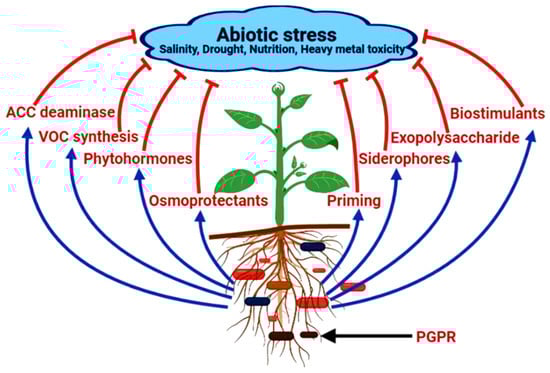
Figure 1. Different mechanisms employed by PGPRs to overcome the abiotic stress and enhance the growth of plants.

2.1. Production of ACC (1-Aminocyclopropane-1-Carboxylate) Deaminase

Ethylene has been considered to be one of the most important plant hormone(s) which is secreted during stress conditions. However, the elevated level of ethylene or “stress ethylene” in plants has been found to have a negative role in plant growth. In a study, it was found that overproduction of ethylene in Arabidopsis thaliana resulted in dwarfness of plant and the inhibition of normal growth [33]. PGPR plays an imperative role by inhibiting the negative effects of ethylene stress [34]. PGPR with enhanced ACC deaminase activity reduces the concentration of endogenous ethylene by cleaving 1-aminocyclopropane-1-carboxylate, the precursor of ethylene, in ammonia and α-ketobutyrate [34,35,36]. Zarei and colleagues [37] studied sweet corn (Zea mays L. var. saccharata) and concluded that under osmotic stress/drought condition, crop yield could be increased by using P. fluorescens. Under stress conditions, it enhanced the nutrient acquisition, reduced the endogenous ethylene concentration and ameliorated physiological condition of plants to increase the overall productivity of the plant [37]. ACC deaminase production in PGPR Achromobacter piechaudii ARV8 elevated the dry and fresh weights in pepper and tomato under water stress [38,39].

2.2. Secretion of Osmoprotectants (Proline, Choline and Trehalose)

In the course of evolution in the terrestrial environment, plants and bacteria developed symbiotic relationships to fulfill different essential requirements for survival. One of the major benefits which plants derive from bacteria is protection against various environmental abiotic stresses. Under osmolality fluctuation conditions in the environment, microbes accumulate large quantities of solutes in their cytosol which acts as an osmoprotectant [42]. During osmotic stress, synthesis of solutes like proline, trehalose and choline is found to be quicker in microbes than in plants. During salinity and drought stress, these solutes are absorbed by plant roots and increase the osmolyte concentration in plants, and ameliorate stress conditions [43,44,45]. In a whole genome study on eight different PGPR isolated from halophytes, it was found that they contain genes which play crucial roles in abiotic stress response [46]. Environmental perturbations such as drought stress lead to decreases in metabolite concentration in plants, and thus hamper the normal physiological process. Khan et al. [47], in their studies demonstrated in chickpeas that, under stressed conditions, the level of sugar, amino acid (histidine, tyrosine, and methionine) and some organic acids like tartaric acid and citric acid were decreased. Decreased sugar levels lead to reduced chlorophyll content and hence resulted in dropped photosynthetic efficiency of plants. However, treating the chickpea plants with PGPR and PGR consortium led to increased sugar levels in plants and consequently, attainment of the normal photosynthetic efficiency of the plants [47].

2.3. Secretion of Volatile Compounds for Tolerance against Stress

PGPR stimulates tolerance against stress in plants in various ways. One of the most common mechanisms by which PGPR mediates abiotic stress tolerance in plants is production of volatile as well as non-volatile compounds which facilitate plant development. Salt stress conditions lead to increased hydrogen peroxide (H2O2) and reactive oxygen species (ROS; O2). ROS is an important signal molecule at low concentration and plays an important role in programmed cell death, regulation of cell cycle, etc. but at higher concentration, it confers deleterious effects on plants. It leads to damage to cells and overall growth of plants [50] and inhibits development of roots by reducing the size of root meristems [51]. However, treating plants with PGPR leads to reduced levels of ROS and alleviates salt stress in plants. JZ-GX1 produced volatile organic compounds (VOCs) that induced activity of antioxidant enzymes in plants and prevented oxidative damage caused by ROS through enzymatic and non-enzymatic systems [49]. Based on present research findings, under salt stress Azotobacter enhances the antioxidative enzyme activity by inhibiting H2O2 and malondialdehyde in Glycyrrhiza glabra L. (medicinal and industrial plant) to relieve salt stress [52]. It was also observed that treating the plants with PGPR led to decreased levels of malondialdehyde, which is an indicator of membrane disintegration and plasma membrane damage [53].

Salinity stress results in increased concentration of sodium (Na+) ions and Na+/K+ imbalance into cytoplasm. Potassium (K+) ion is important for functioning of plant metabolism and overall physiological process. K+ is considered a “master switch” which regulates the transition from “normal state” to “hibernated state” during stress conditions [54,55]. Previous studies demonstrate that the high K+/Na+ cytosolic levels in plants are a prerequisite for salt tolerance. However, due to high physico-chemical similarities between K+ and Na+, Na+ competes with binding sites of K+ ions, and interrupts the normal functioning of enzymes. Volatile compounds secreted by certain PGPRs are shown to reduce the Na+ level in plant roots and shoots. HKT (high affinity K+ transporter) is a member of IMPs (integral membrane proteins) and plays a crucial role in transport of cation across plasma membranes in plant cells [56]. It plays a pivotal role in plants under salt stress. Sodium transporter (HKT) is expressed in xylem parenchyma and is responsible for exclusion of Na+ from leaves by removing Na+ from xylem sap [57,58]. In Arabidopsis thaliana, it was observed that the plant exposed to Bacillus subtilis GB03 VOCs accumulated less Na+ in both root and shoots. AtHKT restricts Na+ into roots, which leads to higher root-to-shoot Na+ ratio. B. subtilis GB03 released VOCs, repressing the activity of AtHKT in root while increasing its activity in shoot. This mechanism of recirculation of Na+ from shoot to root by modulating the activity of AtHKT explains the role of VOCs in alleviating salt stress [48,57].

2.4. PGPRs as Biostimulants

The various substances or microorganisms which stimulate the plant productivity through natural processes are known as biostimulants. This word has been coined by horticulturists and some of them identified humic acid and seaweed extract as biostimulants. It principally includes amino-acid-containing products (AACP), hormone-containing products (HCP) and humic substances (HS) [63]. PGPR as biostimulants are placed under the category of biofertilizers, biopesticides and phyto-stimulators [64]. They monitor the life cycle of plants from germination of seeds to maturity by increasing the stress tolerance, nutrient accumulation, improving properties of soil and providing a healthy environment to other microorganisms within the soil [65].

2.5. Secretion of Exopolysaccharides (EPS)

Exopolysaccharides are usually long chains of polysaccharides constructed with sugar units such as galactose, sugar and rhamnose in diverse fractions. Microbial EPS are categorized into two kinds, homopolysaccharides and heteropolysaccharides. EPS has an acyl group, hence, it exhibits anionic properties and, in addition to that, this group also elevates the lipophilicity of compounds, which eventually affects their relationship with other cations and polysaccharides. EPS secretion helps the bacteria to sustain in harsh environments and tolerate abiotic stress. For instance, in A. brasilense Sp245 a capsular material with complex carbohydrates has been found which protects this bacteria against drought [69]. PGPR releases more EPS in circumstances of stress than non-stress scenarios. There has been much research which supports this claim, such as the finding that when stress conditions formed guanine cyclase in cell, it leads to the production of EPS [40]. The secretion of EPS by bacteria helps in colonizing around the roots and prevents its dehydration. Different bacteria produce EPS with variety of composition depending upon the circumstances and accessibility of nutrients. The general make-up of bacterial EPS encompasses a water-soluble diversified blend of lipids, nucleic acid, polysaccharides and proteins. They protect the bacteria during drought stress by hydrating the microenvironment and diffusing the carbon sources. PGPR such as Azospirillum, Bacillus spp. and Pseudomonas, as well as EPS production, changes the soil structure and accumulates the properties which help in the serene uptake of minerals and water [70].

2.6. Release of Phytohormones

According to Maheshwari et al. [76], phytohormones are defined as organic substances which are synthesized in minute quantities in one part of the plant’s body and transported to another part, where they influence specific physiological processes. Traditionally, it has been known that the development of plants is modulated by five plant hormones: auxins, gibberellins, cytokinins, ethylene, and abscisic acid. Although, recently other substances have also been found, such as the brassinosteroids, jasmonic acid, the polypeptide systemin, plant steroids and salicylic acid [1] which are considered as crucial hormones for functioning of plant metabolism. PGPRs generally secrete major phytohormones like auxin, gibberellins, cytokinins and abscisic acid [77,78,79].

2.7. Production of Siderophores under Iron Deficiency Condition

Under saline stress conditions, one of the major changes that occur in soil are nutritional imbalance and thus its unavailability to plants. One of such important micronutrients whose level drops dramatically in saline stress is iron (Fe). Iron plays a crucial role in metabolism of plants and is important for DNA synthesis, chlorophyll production, respiration, photosynthesis and other developmental processes [40,83]. Additionally, it is an important constituent for many enzymes and thus its deficiency impedes normal metabolic processes in plants. However, many studies show that the PGPR plays an important role in iron sequestration by production of chelating agents and hence increases the availability of iron for both plants and itself. Iron, in soil, is mainly found in its unavailable state Fe3+. The Fe2+ undergoes rapid oxidation in presence of oxygen and neutral pH which converts it to Fe3+ and reduces its solubility in soil rendering it biologically inaccessible to plants as well as rhizobacteria. However, rhizobacteria produce low molecular weight (400–1000 Da) peptides known as siderophores, which act as chelating agents and bind to Fe3+ ions with high affinity [84,85,86]. Siderophores are water soluble compounds and can be divided into extracellular and intracellular siderophores [87]. Siderophores bind to Fe3+ ions and form a complex which is later transported to cytoplasm. However, the method of transportation of this complex varies into gram positive and gram negative bacteria. In gram negative bacteria, the siderophore-Fe3+ complex bind to OMTs (outer membrane transporters) and are transported to the periplasm. However, this transportation of complex into periplasm requires activation of OMTs, which is done by TonB machinery. TonB machinery is composed of TonB-ExbB-ExbD complexes which are anchored to the cytoplasmic membrane (CM) [88]. The binding of siderophore-Fe3+ complex to OMT brings conformational change which leads to trapping of siderophore-Fe3+ complex in its binding site. The next step in translocation of complex into periplasm is induced by Ton mediated activation of transporters. In periplasm, siderophore-Fe3+ complex bind with periplasmic SBP (siderophore binding proteins) which is an important part of the Fe transport system in bacteria [89,90,91].

2.8. Enhancement of Abiotic Stress in Plants by Priming

Priming can be defined as preconditioning of plant immunity and defense with beneficial bacteria for better stress tolerance in plants. This state of preconditioning leading to preparedness against different abiotic stress is called ‘primed state’ [94,95]. This state leads to robust and rapid response to abiotic stress faced by plants and thus ameliorates tolerance in them compared to non-primed state plants [96].

3. Amelioration of Abiotic Stress by PGPRs in Medicinal Plants

Medicinal plants include all those plants of which either one or more than one part is used in herbalism and/or for the production of therapeutic drugs [97]. These plants have played an important role in developing the healthcare system since time immemorial. Not only in the development of the healthcare system but herbal plants have also boosted the global economy, especially after COVID-19. The global market of herbal medicines, which was US$110.2 bn in 2019, is expected to boost up to US$178.4 bn in 2026 [98]. With such a promising market and an important aid to the healthcare system, medicinal plants are an important asset to any nation. However, climate change and increasing global temperature along with many other abiotic stresses imposed detrimental effects on growth and development of these plants as well as reduced the quality of medicinally useful metabolites [99]. To overcome these abiotic stresses and continue optimum growth and development, medicinal plants have developed symbiotic relationships with microbes residing in the rhizosphere. These microbes, termed PGPRs, alleviate the abiotic stress by different mechanisms like nutrition acquisition [4], phytohormone production, siderophores production and many others, helping plants to thrive in the stress conditions [100,101].
Academic Video Service