1. Formation and Distribution of Acid Sulphate Soils in the Ganges Delta
The acidity developed is due neither to the organic acids nor to the leaching of cations but originates from the oxidation of pyrites (FeS
2) and other oxidizable sulphidic materials accumulated in the soils in the past
[1]. The tidal marshes and forest vegetation in the Ganges Delta favour a build-up of pyrites through a microbial reduction of sulphate salts in the soil, and this phenomenon may be represented by the equation given by van Breemen
[2].
ASS is active (or actual) if sulphide oxidation has been initiated and potentially active, if sulphide oxidation has yet to start. The critical step for the formation of ASS is the generation of sulphuric acid due to sulphide mineral oxidation
[3][4]. Pyrite oxidation in ASS may be a natural process (isostatic land rise and drought) or due to anthropogenic activities (groundwater pumping, drainage, and land excavation), resulting in the formation of sulphuric acid and subsequent soil acidification
[5][6][7]. The microbial oxidation of soil organic matter (SOM) using SO
42− ions as an electron sink produce H
2S gas, which in turn may produce FeS
2 in the soil.
When these soils are exposed for cultivation with the provision of drainage, aerobic environments develop in these soils; therefore, there is oxidation of the pyrites or other oxidizable sulphidic materials resulting in free sulphuric acid (H
2SO
4), thus creating severe soil acidity.
The pyrites (FeS
2) under strong oxidizing and acidic conditions in the presence of metallic cations form jarosite mottles and free acid.
The extensive occurrence of ASS in various parts of the Ganges Delta covering both Bangladesh and West Bengal, India have been reported
[11][12][13][14][15][16][17][18]. In the Bangladeshi part of the Ganges Delta, ASS exists in the Cox’s Bazar, Khulna, Bagerhat, and Satkhira districts, whereas in West Bengal, ASS existence has been reported in the Basanti, Canning I, and Gosaba blocks of the South 24 Parganas district (
Table 1).
3. Recent Case Study on Soil Profiles of Acid Sulphate Soils in the Ganges Delta
A recent soil profile study (
Table 4) by ICAR-Central Soil Salinity Research Institute, Regional Research Station located at Canning Town (West Bengal, India) under a cropping system intensification project (2016–2022) on Bali and Gosaba islands
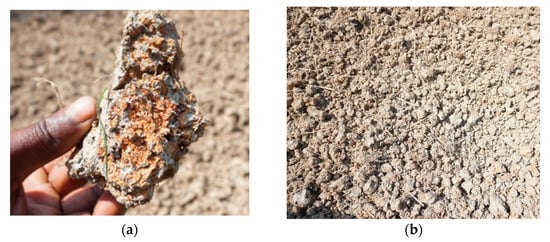
[28][29][30][31] reveals that soil acidity and salinity are critical constraints to crop production in the Sundarbans region; however, the surface soils are relatively less acidic compared to the subsurface soils. Subsurface soil acidity is more severe in the Bijoynagar area of Bali Island where the acid sulphate layer occurs beyond the 80 cm soil layer with severe soil acidity (pH below 3.5). Jarosite mottles are found in the subsurface layers, and when soil tillage brings these soil clods with mottles to the surface, constraints to crop production are further aggravated (
Figure 1a,b). Soils on Sonagaon are deficient in nitrogen and phosphorus, whereas on Bali, soils have moderate levels of N and P. Salinity stress affects crop production at both sites, and there are Al and Fe toxicities. Management strategies for these soils involving green manuring, rice cultivation, and application of lime/rock phosphate before sowing of the dry season crops at these sites are described
later in this paper.
Figure 1. Yellow jarosite mottles found in the plough layers of acid sulphate soils on Sonagaon and Gosaba islands, Sundarbans: (a) Soil clods containing mottles; (b) Surface-tilled soil layer with abundance of jarosite mottles. Source: Authors’ own collection from Sonagaon village on Gosaba island in the Indian part of the Ganges Delta.
The entire Ganges Delta receives unimodal monsoonal rain, which causes waterlogging, and subsequent to the withdrawal of the monsoon, there is a drying of the soil causing annual alternating wetting and drying cycles
[21]. These seasonal and alternating wet–dry conditions create reducing and oxidizing environments, which in turn facilitates the dissolution of oxides, hydroxides, carbonates, and adsorption/desorption processes in the soil resulting in higher concentrations of trace metals (Ba, Rb, V, Cr, Ni, As, Pb, Ga, Co, Cs, Nb, and W) and major oxides (Al
2O
3, Fe
2O
3, K
2O, and MgO) in the upper soil layers
[22]. Thus, the geographic situation of the coastal region, rainfall pattern, and congenial parent material favour the formation of acidic soils in the Ganges Delta.
2. Distinguishing Characteristics of Acid Sulphate Soils of the Ganges Delta
The soil pH of ASS in the West Bengal part of the Ganges Delta has been reported within 3.3–5.9 and an electrical conductivity of soil saturation extract (ECe) of 0.95–6.25 dS m
−1, and the exchangeable acidities of these soils have been contributed to both exchangeable H
+ and Al
3+ ions
[15]. However, a higher soil salinity (11.2 dS m
−1) in the surface soil layer (0–15 cm) is also reported
[11][23]. In some locations, subsurface (>100 cm soil depth) salinity (8.5–12.5 dS m
−1) was observed in these soils
[24]. These soils have a pH usually below 4 caused by the formation of sulphuric acid from the oxidation of pyrites (FeS
2) or other sulphidic parent materials. In the presence of metallic cations, there is the formation of jarosite [KFe
3(SO
4)
2(OH)
6] and free acids. Jarosite is a basic iron potassium sulphate produced by the action of sulphuric acid on aluminosilicate minerals and is found in an acidic horizon having a pH of 3.65–3.5 or less
[25]. Studies on ASS characteristics representing the Kamalkathi series situated in the Shamnagar thana of the Satkhira district of Bangladesh revealed the presence of jarosite mottles in the B22 (45–65 cm) horizon of the profile with a very low soil pH (3.4–4.0), confirming the classification as actual ASS
[14]. The jarosite mottles are the most important recognizing feature of these soils along with a very low pH. The presence of jarosites near the surface or root zone soil hampers the crop root growth as it makes the soil acidic with the rising water table. These are broadly categorised as actual acid sulphate soils when the pH is <4.0 and the sulphate (water soluble sulphate) content is about 5 g kg
−1 [26]. Potential acid sulphate soils are the soils under hydromorphic conditions due to poor drainage with high amounts of pyrites, and under these conditions, the pH may not be very low, but when these soils are drained or exposed to air, the oxidation results in the formation of acids, and, as a result, the pH goes down drastically. When brought under cultivation, these soils pose serious constraints to crop growth and development. In these soils, there is toxicity of iron, manganese, and aluminium and a deficiency of available phosphorus. In the Ganges Delta, these soils are locally called “
KOIMURO MATI” or “
KOSH MATI”. The exposed soils are dark grey in colour and silty clay loam to clay in texture with a very low pH (<4).
The ASS in the Indian part of the Ganges Delta region contains comparatively higher organic carbon (OC) in the Ap and BA horizons (0–70 cm), and because of depositions of organic matter
[27], the OC content decreases at the lower depths (
Table 2). However, in some areas, the presence of high OC at lower depths is observed due to the early deposition of organic matter in the soil
[12]. There is a wide variation of the Cation Exchange Capacity (CEC) of these soils, ranging from 19 to 27 cmol(p
+) kg
−1 or more due to variations in organic matter and clay content
[27]. Among the cations are Na
+ > Mg
2+ > Ca
2+ > K
+, and the anions are SO
42− > Cl
− > HCO
3− [27]. There is toxicity of water-soluble Fe, Al, and Mn. The phosphorus nutrition of crops in these soils is affected owing to a high soil P fixation capacity. A deficiency of micronutrients, such as Zn and Cu, is also observed; however, there is plenty of K in the soil due to K-containing salts, such as KCl and K
2SO
4, and a high S content due to the presence of sulphuric horizon. In the Bangladeshi part of the Ganges Delta, the characteristics of ASS (
Table 3) resemble to a great extent those in the West Bengal part, except the higher clay content and less soil salinity in the soil profile in the Bangladeshi part and a higher sodium content in the West Bengal part. However, soil salinity is a seasonal phenomenon in the coastal region, and it may vary with the time of soil sampling.
4. Problems of Acid Sulphate Soils of the Ganges Delta
The crop yield in the highly acidic saline soils (pH < 4.0) occasionally found in several places in this region is extremely poor
[27]. Many a time, crops on such soils show the visual toxicity and deficiency symptoms for several elements
[30]. Crop and animal husbandry are enterprises that depend on soil quality
[32] and encounter hinderances when there are acid saline soils. In an undisturbed state below the groundwater table, ASS are benign
[33], however, anthropogenic activities such as drainage for agriculture; aquaculture ponds; construction of canals/houses/industrial estates; and roads can disturb ASS and lead to the oxidation of the sulphides they contain. The consequence is the generation of sulphuric acid and the associated toxic metal ions (iron, manganese, and aluminium) coupled with a deficiency of nutrients, especially available phosphorus, due to high acidity; this causes a very poor yield of agricultural crops. The germination of seeds is affected resulting in a patchy population, stunted and deformed leaves, and poor root growth
[34]. Restricted root growth in the subsurface as a result of toxic levels of aluminium and a reduced uptake of other essential nutrients from the subsurface soils layers
[35] also contribute to salinity development. Poor root growth of trees in these soils makes them prone to uprooting/lodging under high winds during cyclones and storms
[36]. The major soil-related problems are described below.
4.1. Poor Physical Properties
Due to high acidity, in the pH range of 4.0–4.5, there is leaching of dissolved organic carbon
[37]. Since soil organic carbon (SOC) is positively related to soil macroaggregate formation
[38], a decrease in SOC has a negative impact on soil structure. The main source of dissolved organic carbon in soil usually originates from root exudates
[39]; therefore, the suppression of root growth in these soils hampers soil aggregation. Undisturbed soils have a steely blue-grey colour, and oxidised soils are quite dry with a burning appearance of a dark to pale brown colour
[40]. Yellow and orange mottles are also visible, yellow due to jarosites and orange due to other iron oxide minerals
[41]. Sparse vegetation in such soil is due to stunted root growth and low soil microbial activity
[42].
4.2. Nutrient Deficiencies and Toxicities
Nutrient deficiency and/or toxicity issues in this region are very location-specific. However, in general, most acid saline soils in the Ganges Delta show a deficiency of phosphorus, calcium, and sometimes potassium, whereas levels of exchangeable magnesium may be high
[43]. In the Bangladeshi part of this region, there are reports of phosphorus, calcium, and magnesium deficiencies
[44]. There is also toxicity of aluminium, manganese, and iron observed due to an increase in the solubility and in the soil solution concentration of these ions. A toxic concentration of Al to the extent of 0.059 g kg
−1 in the soil is reported from the Dinajpur and Rangpur areas of Bangladesh
[45]. Al toxicity causes root deformity as it interferes with cell division in plant roots, decreases root respiration, increases cell wall rigidity, and interferes with the uptake and transport of Ca, Mg, K, P, and water to the plants
[46]. The soil solution Fe
2+ concentrations that significantly affect lowland rice yields vary from 10 to >2000 mg L
−1 [47]. The acidic solution dissolves aluminium and toxic heavy metals, such as arsenic, contained in the soil
[48] and poses problems to crop growth. The sequence of trace metal concentrations in the soils of Sundarbans was found to be in the order of Fe > Mn > Ni > Zn > Cr > Cu > Pb > Cd, while the toxicity sequence was Pb > Ni > Cd > Fe > Mn > Zn > Cu
[49]. Plant root development also suffers due to the toxic effect of gases (H
2S and CO
2) and organic acids
[50]. Phytotoxic organic acids, such as acetic acid, n-butyric acid, and propionic acid, accumulate in these soils
[51]. A substantial quantity of H
2S gas is often released from paddy fields in the coastal acid saline soil as a result of a reduction in the sulphate salts to sulphides
[52]. A part of the sulphides formed in the soil evolve as H
2S gas to the air causing environmental contamination
[53]. The H
2S gas emission from coastal marshes is observed over the whole year; however, the emission is higher in the plant-growing season than in the nongrowing season
[54]. The remaining part of the generated gas combines with the soluble metallic cations in the soil resulting in mostly insoluble metallic sulphides
[55] of which iron sulphide is the major one. These insoluble metallic sulphides coat the surface of rice roots and interfere in the process of nutrient uptake by the roots
[56]. Free hydrogen sulphide is highly toxic to flora and fauna and affects their growth
[50]. The deposited sulphides produce a dark shade to the paddy soil, which is commonly observed in most of the rice-growing areas in the coastal zone
[57]. The formation of sulphide (H
2S) gas due to a sulphate reduction, affects the root respiratory activity of the rice crop resulting in ‘
Akiochi’ disease
[58]. Plants become deficient in N, K, Si, and bases, and the iron content in plant tissues increases to toxic levels
[59]. Plants become prone to other diseases, such as brown spot and blast, caused by
Helminthosporium oryzae and
Pyricularia oryzae, respectively
[59].
4.3. Soil Salinity
Soil salinity is an inherent problem of the soils of the Ganges Delta due to the capillary rise of salts from the brackish groundwater present in shallow depths and the deposition of salts on the soil surface
[60]. The hydrology of polders in the Ganges Delta is complex, with water (and usually salt) exchanged amongst the atmosphere, the soil–water–plant system in the polder, the underlying groundwater, and the surrounding rivers
[61]. The severity of salinity is location-specific and variable by soil depth. The electrical conductivity of the saturation extract (ECe) ranges from 1.1 to 10.2 dSm
−1 on the surface and 1.0–13.3 dSm
−1 in the subsoils, which show an irregular distribution with different depths
[18]. However, the salt concentrations in the soil solution increase as the soil dries, and the resulting increase in the soil solution’s salt concentration (i.e., decrease in solute potential) limits crop water uptake even at higher levels of soil water
[29]. The ingress of saline river water during high tides due to breach of embankments caused by cyclones and other natural calamities also increases the soil salinity in the 0–80 cm soil depth range to 12.6–16.8 dSm
−1 [31]. Hinderances in drainage also accentuate the salinity issue in the Ganges Delta.
In ASSs of the coastal areas, some of the problems result from salinity as well as from acidity, particularly in dry seasons when acid-forming salts, such as rozenite (FeSO
4·4H
2O), form in crusts at the soil surface; this salinity is different from that which develops from the seawater source
[62]. In these soils, salts produced upon the oxidation of the sulphides may be more important than the direct addition from seawater
[63]. This high salinity due to high soluble chloride (Cl
−) concentrations (≤17 mg g
−1 soil) and high soluble sulphate (SO
42−) concentrations (≤17 mg g
−1 soil), in addition to the extremely low pH of the surface soils contributes to land denudation, instigation or perpetuation of pyrite oxidation, and ASS-related land scalding
[64]. Another notable feature in these soils is that the highest salinity usually coincides with the lowest pH, which is unusual in normal saline soils
[63][64]. The sulphate salts of Fe and Al referred to as acid salts
[65] cause both low pH (acidity) as well as osmotic stress similar to neutral salts, as well as toxicity effects on seed germination and plant growth due to excess Al and Fe
[64]. Therefore, if the salinity of coastal soils is only thought to originate from seawater, and reclamation practices are oriented towards blocking out seawater from these soils, a cycle of sulphide oxidation may be set off with disastrous acidity as well as salinity consequences for the soils and associated ecosystems
[63].
4.4. Variable Acidity in Variable Depths
The soil acidity (pH) measured with different methodology varied in the pH value in a 2:1 soil:water suspension > pH—KCl > pH—H
2O
2 [11]. The pH measured in the soil:water suspension showed the value of ≤4.0 at variable depths of 45–90 cm
[11], 25–130 cm, 0–140 cm, 136–196 cm
[12], and 67–150 cm
[18]. The pH of surface soils of the Indian part of the Ganges Delta categorized as <4.5, 4.5–6.0, 6.0–8.0, and >8.0 covered an approximate area of 0.04, 0.10, 0.70, and 0.02 Mha, respectively
[27].
4.5. Adverse Impact on Ecosystem and Biodiversity
The high acidic discharges upon the drainage of acid sulphate soils kill fish species and severely affects the biodiversity of wetlands with substantial death of mangroves
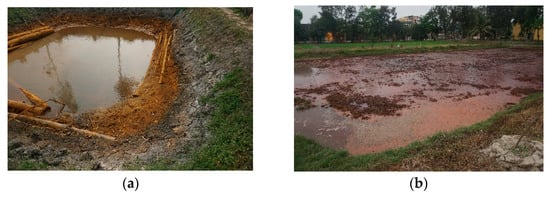
[59]. At Bijoynagar (Bali Island in the Ganges Delta) where the soil pH is <3.5 in the soil layers below a depth of 80 cm, the dried ponds in these areas had layers exposed and severe acidity, and nutrient toxicities were observed (
Figure 2a). Acid saline soils of the Ganges Delta are generally used for monocropping of rice during the
Kharif season. Following heavy rainfall, the acid and metal ions, including the arsenic present in the sediments forming the soils or those that exist as the chemical components of pyrite, drain into adjacent waterbodies. This water is not suitable to be used as irrigation water for cultivation in the area and degrades cultivated soils, aquatic ecosystems, infrastructure, and human health (
Figure 2b). Problems are faced when new land configuration is created, such as in order to establish new fish ponds or water harvesting structures. In such soils, there is insufficient growth of algae and plankton due to the poor condition of the pond water. Fish also grow more slowly and die suddenly, or they are prone to diseases and parasites
[25]. ASS is also a source of CO
2 emission due to microbial respiration (8.7–41.1%) as well as abiotic pathways of acidic dissolution and hydroxyl (OH) radical oxidation (14.6–27.6%) to CO
2 production
[66].
Figure 2. Adverse impact of acid sulphate soils on ecosystem: (a) Affected pond in the Bijoynagar village of Bali Island; (b) Cultivated soil with toxic effects of elements in Canning Block of South 24 Parganas. Source: Authors’ own collection from the farmers’ fields in the Indian Sundarbans region of the Ganges Delta