
WGe present a study on the taxonomy of eleven Thymus species, belonging tonetic diversity, evolution and phylogeny of twoThymus spections and occurring naturally in Bulgaria. Four DNA barcoding markers—matK, rbcL, trnH-psbA and ITS—were applied to discriminate the species and to reveal their phylogenetic relationships. The results showed that rbcL has the lowest discriminating power regarding the studied species, while the other markers yielded results fitting better ties have received considerable attention, with application of newly developed methods. DNA barcoding is one of the modern methods applied successfully to the existing taxonomic schemes based on morphological traits. However, even in the case of better performing markers, the results were not straightforward—morphologically distinct species belonging toy of various groups of living organisms. DNA barcoding has been successfully applied for identifying different sections were grouped together, and closely related species appeared genetically distinct. The results are typical for taxonomically complex groups, such as the genus Thymus, characterized in Bulgaria with great diversity, high percentage of endemism and still requiring a full and comprehensivepecies in commercial samples of herbs and for the identification of different Lamiaceae species. However, its application to infrageneric Thymus taxonomy dic study. The results are discussed in the light of unresolved taxonomic problems and application of DNA barcoding methodd not allow definite conclusions.
- genetic markers
- taxonomy
- medicinal plants
- phylogeny
- taxonomically complex groups (TCGs)
1. Introduction
2. Efficiency of PCR Amplification and Sequencing
| Barcode Region | N (Samples Tested) | Alignment Length (bp) | CPercentage of Amplification Efficiency | Percentage of Sequencing Efficiency (from Amplified Barcodes) | |||||||
|---|---|---|---|---|---|---|---|---|---|---|---|
| V | Pi | S | Average Pairwise Distance/SE | ||||||||
| matK | 14 | 760 | 100 | 100 | |||||||
| rbcL | 14 | 530 | 100 | ||||||||
| rbcL | 529 | 527 | 2 | 2 | 0 | 0.00127/0.00009 | |||||
| 100 | |||||||||||
| trnH-psbA | 351 | 333 | 16 | 10 | 6 | 0.13205/0.00371 | trnH-psbA | 14 | 350 | 100 | 100 |
| ITS | 14 | 619 | 93.4 | 93.4 |
3. Genetic Diversity of Thymus Species and Accessions
| DNA Barcode Region | Ns | |||||
|---|---|---|---|---|---|---|
| matK | ||||||
| 761 | 748 | 13 | 3 | 10 | 0.00342/0.00171 | |
| ITS | 618 | 604 | 14 | 2 | 12 | 0.00464/0.00144 |
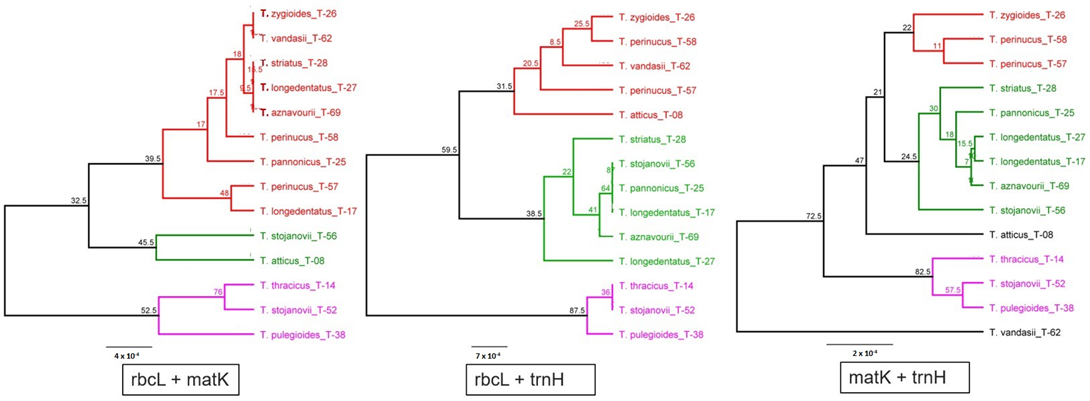
| rbcL+matK | 1290 | 1275 | 15 | 5 | 10 | 0.00230/0.00066 |
| rbcL+trnH-psbA | 880 | 860 | 18 | 12 | 6 | 0.00577/0.00147 |
| matK+trnH-psbA | 1112 | 1081 | 29 | 13 | 16 | 0.00748/0.00176 |
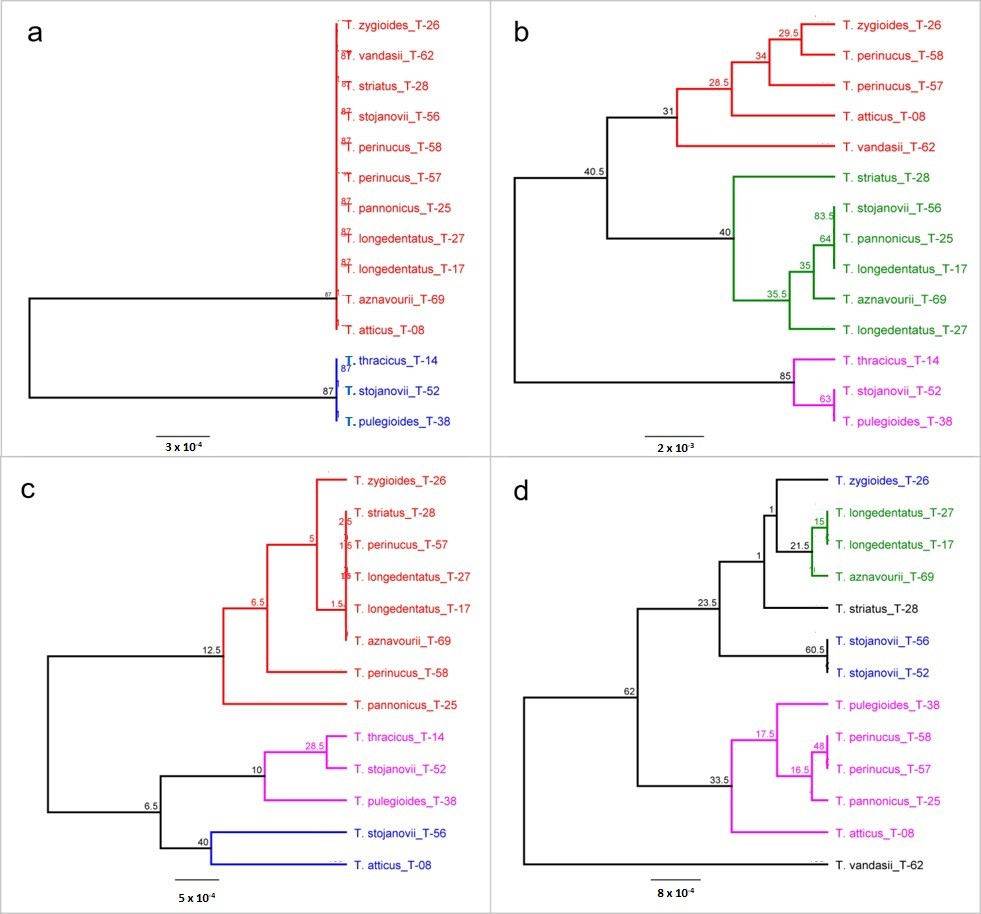
The other region (trnH-psbA) showed the highest level of genetic divergence (
Figure 1c). Three main groups were formed—two small and a bigger one. The first small group consisted of three species belonging to section Hyphodromi, and the second one combined species of section Serpyllum—similarly to rbcL tree topology. The larger group consisted of three species of section Serpyllum and two of section Hyphodromi. One species—T. vandasii—had a somewhat distinct position.c). Three main groups were formed—two small and a bigger one. The first small group consisted of three species belonging to section Hyphodromi, and the second one combined species of section Serpyllum—similarly to rbcL tree topology. The larger group consisted of three species of section Serpyllum and two of section Hyphodromi. One species—T. vandasii—had a somewhat distinct position.
The fourth DNA barcode region—ITS—yielded a construction consisting of three clusters and one species distant from the others (
Figure 1d). Again, like in the trnH-psbA region, this species was T. vandasii. The clusters combined species belonging to different sections—for example, the first small cluster consisted of T. zygioides (sect. Hyphodromi) and two accessions of T. stojanovii (sect. Serpyllum). However, it can be noted that here, different accessions of the same species clustered together, contrary to the other barcode regions.d). Again, like in the trnH-psbA region, this species was T. vandasii. The clusters combined species belonging to different sections—for example, the first small cluster consisted of T. zygioides (sect. Hyphodromi) and two accessions of T. stojanovii (sect. Serpyllum). However, it can be noted that here, different accessions of the same species clustered together, contrary to the other barcode regions.
References
- Federici, S.; Galimberti, A.; Bartolucci, F.; Bruni, I.; De Mattia, F.; Cortis, P.; Labra, M. DNA barcoding to analyse taxonomically complex groups in plants: The case of Thymus (Lamiaceae). Bot. J. Linn. Soc. 2013, 171, 687–699.
- Jalas, J. Notes on Thymus L. (Labiatae) in Europe. I. Supraspecific classification and nomenclature. Bot. J. Linn. Soc. 1971, 64, 199–215.
- Jalas, J. Thymus. In Flora Europaea; Tutin, T., Heywood, V.H., Burges, N.A., Moore, D.M., Valentine, D.H., Eds.; University Press: Cambridge, UK, 1972; Volume 3, pp. 172–182.
- Baden, C. Thymus L. In Mountain Flora of Greece; Strid, A., Tan, K., Eds.; Edinburgh University Press: Edinburgh, UK, 1986; pp. 139–165.
- Morales, R. The history, botany and taxonomy of genus Thymus. In Thyme. The Genus Thymus; Stahl-Biskup, E., Sáez, F., Eds.; Taylor & Francis: London, UK; New York, NY, USA, 2002; pp. 1–43.
- Bartolucci, F. Verso una revisione biosistematatica del genere Thymus L. In Italia: Considerazioni Nomenclaturali, Sistematiche e Criticità Tassonomica; Annali di Botanica: Rome, Italy, 2009; Volume 2010, pp. 135–148, Supplemento.
- Starr, J.R.; Naczi, R.F.C.; Chouinard, B.N. Plant DNA barcodes and species resolution in sedges (Carex, Cyperaceae). Mol. Ecol. Resour. 2009, 9 (Suppl. 1), 151–163.
- Markova, M. Thymus L. In Flora of PR Bulgaria; Velchev, V., Ed.; BAS: Sofia, Bulgaria, 1989; Volume 9, pp. 288–332. (In Bulgarian)
- Pavlova, D.; Kozuharova, E.K.; Dimitrov, D.S. The serpentine flora in the Eastern Rhodopes Mountains (Bulgaria). In Progress in Botanical Research: Proceedings of the 1st Balkan Botanical Congress; Tsekos, I., Moustakas, M., Eds.; Kluwer Acdemic Publishers: Dordrecht, The Netherlands, 1998; pp. 133–136.
- Stoyanov, S.; Marinov, Y. Thymus jalasianus (Lamiaceae), a new species from the serpentine area of the Eastern Rhodope Mountains, Bulgaria. Ann. Bot. Fenn. 2020, 57, 163–172.
- Stoyanov, S.; Marinov, Y. Thymus aznavourii (Lamiaceae): First records for Bulgarian and Greek flora. Compt. Rend. Acad. Bulg. Sci. Sci. Math. Nat. 2021, 74, 352–362.
- Aneva, I.; Zhelev, P.; Stoyanov, S.; Marinov, Y.; Georgieva, K. Survey on the distribution, diversity and phytochemistry of genus Thymus in Bulgaria. Ecol. Balk. 2018, 10, 101–110.
- Aneva, I.; Trendafilova, A.; Nikolova, M.; Todorova, M.; Georgieva, K. Essential oil composition of the Balkan endemic Thymus longedentatus (Degen & Urum.) Ronniger. BLACPMA 2019, 18, 197–203.
- Trendafilova, A.; Todorova, M.; Ivanova, V.; Zhelev, P.; Aneva, I. Essential oil composition of five Thymus species from Bulgaria. Chem. Biodivers. 2021, 18, e2100498.
- Sostarić, I.; Liber, Z.; Grdiša, M.; Marin, P.D.; Stevanović, Z.; Satović, Z. Genetic diversity and relationships among species of the genus Thymus L. (section Serpyllum). Flora 2012, 207, 654–661.
- Kulevanova, S.; Stoeva, T.; Ristić, M. The essential oil composition of Thymus tosevii and Thymus macedonicus from Bulgaria. Boll. Chim. Farm. 2000, 139, 85–88.
- Marin, P.D.; Grayer, R.J.; Kite, G.C.; Matevski, V. External leaf flavonoids of Thymus species from Macedonia. Biochem. Syst. Ecol. 2003, 31, 1291–1307.
- Damianova, S.; Tasheva, S.; Stoyanova, A.; Damianov, D. Investigation of extracts from Thyme (Thymus vulgaris L.) for application in cosmetics. J. Essent. Oil Bear. Plants 2008, 11, 443–450.
- Vidić, D.; Ćavar, S.; Solić, M.E.; Maksimović, M. Volatile constituents of two rare subspecies of Thymus praecox. Nat. Prod. Commun. 2010, 5, 1123–1126.
- Željković, S.Ć.; Maksimović, M. Chemical composition and bioactivity of essential oil from Thymus species in Balkan Peninsula. Phytochem. Rev. 2003, 14, 335–352.
- Tarayre, M.; Saumitou-Laprade, P.; Cuguenl, J.; Couvet, D.; Thompson, J. The spatial genetic structure of cytoplasmic (cpDNA) and nuclear (allozyme) markers within and among populations of the gynodioecious Thymus vulgaris (Labiatae) in southern France. Am. J. Bot. 1997, 84, 1675–1684.
- Thompson, J.D. Population structure and the spatial dynamics of genetic polymorphism in thyme. In Thyme. The Genus Thymus; Stahl-Biskup, E., Sáez, F., Eds.; Taylor & Francis: London, UK, 2002; pp. 44–74.
- Soorni, A.; Borna, T.; Alemardan, A.; Chakrabarti, M.; Hunt, A.G.; Bombarely, A. Transcriptome landscape variation in the genus Thymus. Genes 2019, 10, 620.
- Hebert, P.D.N.; Cywinska, A.; Ball, S.L.; de Waard, J.R. Biological identifications through DNA barcodes. Proc. R. Soc. Lond. B 2003, 270, 313–321.
- Hollingsworth, P.M.; Graham, S.W.; Little, D.P. Choosing and using a plant DNA barcode. PLoS ONE 2011, 6, e19254.
- Kress, W.J. Plant DNA barcodes: Applications today and in the future. J. Syst. Evol. 2017, 55, 291–307.
- Kress, W.J.; Erickson, D.L. (Eds.) DNA Barcodes: Methods and Protocols; Humana Press, Springer ScienceþPublishing Media, LLC: New York, NY, USA, 2012; p. 470.
- Bräuchler, C.; Meimberg, H.; Heubl, G. Molecular phylogeny of Menthinae (Lamiaceae, Nepetoideae, Mentheae)—Taxonomy, biogeography and conflicts. Mol. Phylogenet. Evol. 2010, 55, 501–523.
- Zhao, F.; Chen, Y.-P.; Salmaki, Y.; Drew, B.T.; Wilson, T.C.; Scheen, A.-C.; Celep, F.; Bräuchler, C.; Bendiksby, M.; Wang, Q.; et al. An updated tribal classification of Lamiaceae based on plastome phylogenomics. BMC Biol. 2021, 19, 2.
- Drew, B.T.; Sytsma, K.J. Phylogenetics, biogeography, and staminal evolution in the tribe Mentheae (Lamiaceae). Am. J. Bot. 2012, 99, 933–953.
- De Mattia, F.; Bruni, I.; Galimberti, A.; Cattaneo, F.; Casiraghi, M.; Labra, M. A comparative study of different DNA barcoding markers for the identification of some members of Lamiaceae. Food Res. Int. 2011, 44, 693–702.
- Theodoridis, S.; Stefanaki, A.; Tezcan, M.; Aki, C.; Kokkini, S.; Vlachonasios, K.E. DNA barcoding in native plants of the Labiatae (Lamiaceae) family from Chios Island (Greece) and the adjacent Çesme-Karaburun Peninsula (Turkey). Mol. Ecol. Resour. 2012, 12, 620–633.
- Abdolahinia, E.D.; Bashir, N.S.; Hagnazari, A.; Nazemiyeh, H.; Hejazi, M.S. A Comparative phenotypic and ITS based genotypic study in Thyme species (Thymus L. Lamiaceae). Int. J. Plant Res. 2011, 24, 102–113.
- Sonboli, A.; Mirjalili, M.H.; Bakhtiar, Z.; Jamzad, Z. Molecular authentication of Thymus persicus based on nrDNA ITS sequence data. Iran J. Bot. 2013, 19, 179–185.
- CBOL Plant Working Group. A DNA barcode for land plants. Proc. Natl. Acad. Sci. USA 2009, 206, 12794–12797.
- Lahaye, R.; van der Bank, M.; Bogarin, D.; Warner, J.; Pupulin, F.; Gigot, G.; Maurin, O.; Duthoit, S.; Barraclough, T.G.; Savolainen, V. DNA barcoding the floras of biodiversity hotspots. Proc. Natl. Acad. Sci. USA 2008, 105, 2923–2928.
- Newmaster, S.G.; Fazekas, A.J.; Steeves, A.D.; Janovec, J. Testing candidate plant barcode regions in the Myristicaceae. Mol. Ecol. Resour. 2008, 8, 480–490.
- Chen, S.; Yao, H.; Han, J.; Liu, C.; Song, J.; Shi, L.; Zhu, Y.; Ma, X.; Gao, T.; Pang, X.; et al. Validation of the ITS2 region as a novel DNA barcode for identifying medicinal plant species. PLoS ONE 2010, 5, e8613.
- Muellner, A.M.; Schaefer, H.; Lahaye, R. Evaluation of candidate DNA barcoding loci for economically important timber species of the mahogany family (Meliaceae). Mol. Ecol. Resour. 2011, 11, 450–460.
- Kress, W.J.; Erickson, D.L. A two-locus global DNA barcode for land plants: The coding rbcL gene complements the noncoding trnH-psbA spacer region. PLoS ONE 2007, 2, e508.
- Hollingsworth, M.L.; Clark, A.A.; Forrest, L.L.; Richardson, J.; Pennington, R.T.; Long, D.G.; Cowan, R.; Chase, M.W.; Gaudeul, M.; Hollingsworth, P.M. Selecting barcoding loci for plants: Evaluation of seven candidate loci with species-level sampling in three divergent groups of land plants. Mol. Ecol. Resour. 2009, 9, 439–457.
- Altschul, S.F.; Gish, W.; Miller, W.; Myers, E.W.; Lipman, D.J. Basic local alignment search tool. J. Mol. Biol. 1990, 215, 403–410.
- Rieseberg, L.H.; Wendel, J. Plant speciation—Rise of the poor cousins. New Phytol. 2004, 161, 1–21.
- Rieseberg, L.H.; Wood, T.E.; Baack, E.J. The nature of plant species. Nature 2006, 440, 524–527.
- Ennos, R.A.; French, G.C.; Hollingsworth, P.M. Conserving taxonomic complexity. Trends Ecol. Evol. 2005, 20, 164–168.