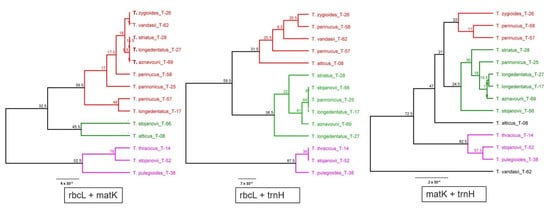
GWe presenetic diversity, evolution and phylogeny oft a study on the taxonomy of eleven Thymus species, belonging to two sections and occurring naturally in Bulgaria. Four ThymusDNA spebarcies have received considerable attention, with application of newly developed methods. DNA barcoding is one of the modern methods applied successfullyoding markers—matK, rbcL, trnH-psbA and ITS—were applied to discriminate the species and to reveal their phylogenetic relationships. The results showed that rbcL has the lowest discriminating power regarding the studied species, while the other markers yielded results fitting better to the existing taxonomy of various groups of living organisms. DNA barcoding has been successfully applied for identifyingic schemes based on morphological traits. However, even in the case of better performing markers, the results were not straightforward—morphologically distinct species belonging to different species in commercial samples of herbs and for the identification of different Lamiaceae species. However, its application to infragenericections were grouped together, and closely related species appeared genetically distinct. The results are typical for taxonomically complex groups, such as the genus Thymus, characterized in Bulgaria with great diversity, high percentage of endemism and still requiring a full and comprehensive Thymus taxonomic study did not allow definite conclusion. The results are discussed in the light of unresolved taxonomic problems and application of DNA barcoding methods.
- genetic markers
- taxonomy
- medicinal plants
- phylogeny
- taxonomically complex groups (TCGs)
1. Introduction
2. Efficiency of PCR Amplification and Sequencing
| Barcode Region | N (Samples Tested) | Alignment Length (bp) | Percentage of Amplification Efficiency | Percentage of Sequencing Efficiency (from Amplified Barcodes) | ||||||
|---|---|---|---|---|---|---|---|---|---|---|
| V | Pi | S | Average Pairwise Distance/SE | |||||||
| matK | 14 | 760 | 100 | 100 | ||||||
| rbcL | 529 | 527 | 2 | 2 | 0 | 0.00127/0.00009 | ||||
| rbcL | 14 | 530 | 100 | 100 | ||||||
| trnH-psbA | ||||||||||
| trnH-psbA | 351 | 333 | 16 | 10 | 6 | 0.13205/0.00371 | 14 | 350 | 100 | 100 |
| ITS | 14 | 619 | 93.4 | 93.4 |
3. Genetic Diversity of Thymus Species and Accessions
| DNA Barcode Region | Ns | C | ||||
|---|---|---|---|---|---|---|
| matK | ||||||
| 761 | 748 | 13 | 3 | 10 | 0.00342/0.00171 | |
| ITS | 618 | 604 | 14 | 2 | 12 | 0.00464/0.00144 |
| rbcL+matK | 1290 | 1275 | 15 | 5 | 10 | 0.00230/0.00066 |
| rbcL+trnH-psbA | 880 | 860 | 18 | 12 | 6 | 0.00577/0.00147 |
| matK+trnH-psbA | 1112 | 1081 | 29 | 13 | 16 | 0.00748/0.00176 |
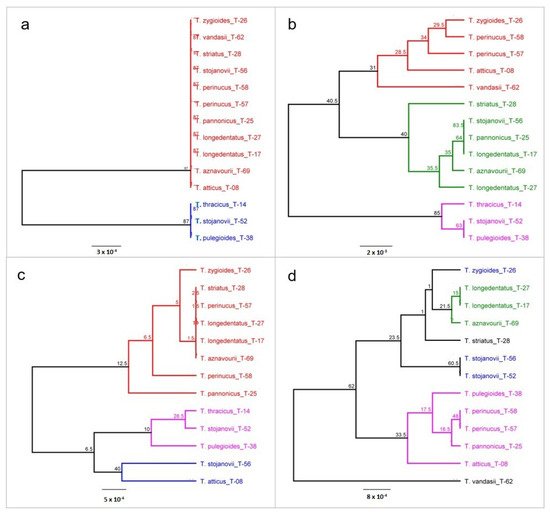
The other region (trnH-psbA) showed the highest level of genetic divergence (
The other region (trnH-psbA) showed the highest level of genetic divergence (Figure 1c). Three main groups were formed—two small and a bigger one. The first small group consisted of three species belonging to section Hyphodromi, and the second one combined species of section Serpyllum—similarly to rbcL tree topology. The larger group consisted of three species of section Serpyllum and two of section Hyphodromi. One species—T. vandasii—had a somewhat distinct position.
c). Three main groups were formed—two small and a bigger one. The first small group consisted of three species belonging to section Hyphodromi, and the second one combined species of section Serpyllum—similarly to rbcL tree topology. The larger group consisted of three species of section Serpyllum and two of section Hyphodromi. One species—T. vandasii—had a somewhat distinct position.The fourth DNA barcode region—ITS—yielded a construction consisting of three clusters and one species distant from the others (
The fourth DNA barcode region—ITS—yielded a construction consisting of three clusters and one species distant from the others (Figure 1d). Again, like in the trnH-psbA region, this species was T. vandasii. The clusters combined species belonging to different sections—for example, the first small cluster consisted of T. zygioides (sect. Hyphodromi) and two accessions of T. stojanovii (sect. Serpyllum). However, it can be noted that here, different accessions of the same species clustered together, contrary to the other barcode regions.
d). Again, like in the trnH-psbA region, this species was T. vandasii. The clusters combined species belonging to different sections—for example, the first small cluster consisted of T. zygioides (sect. Hyphodromi) and two accessions of T. stojanovii (sect. Serpyllum). However, it can be noted that here, different accessions of the same species clustered together, contrary to the other barcode regions.