
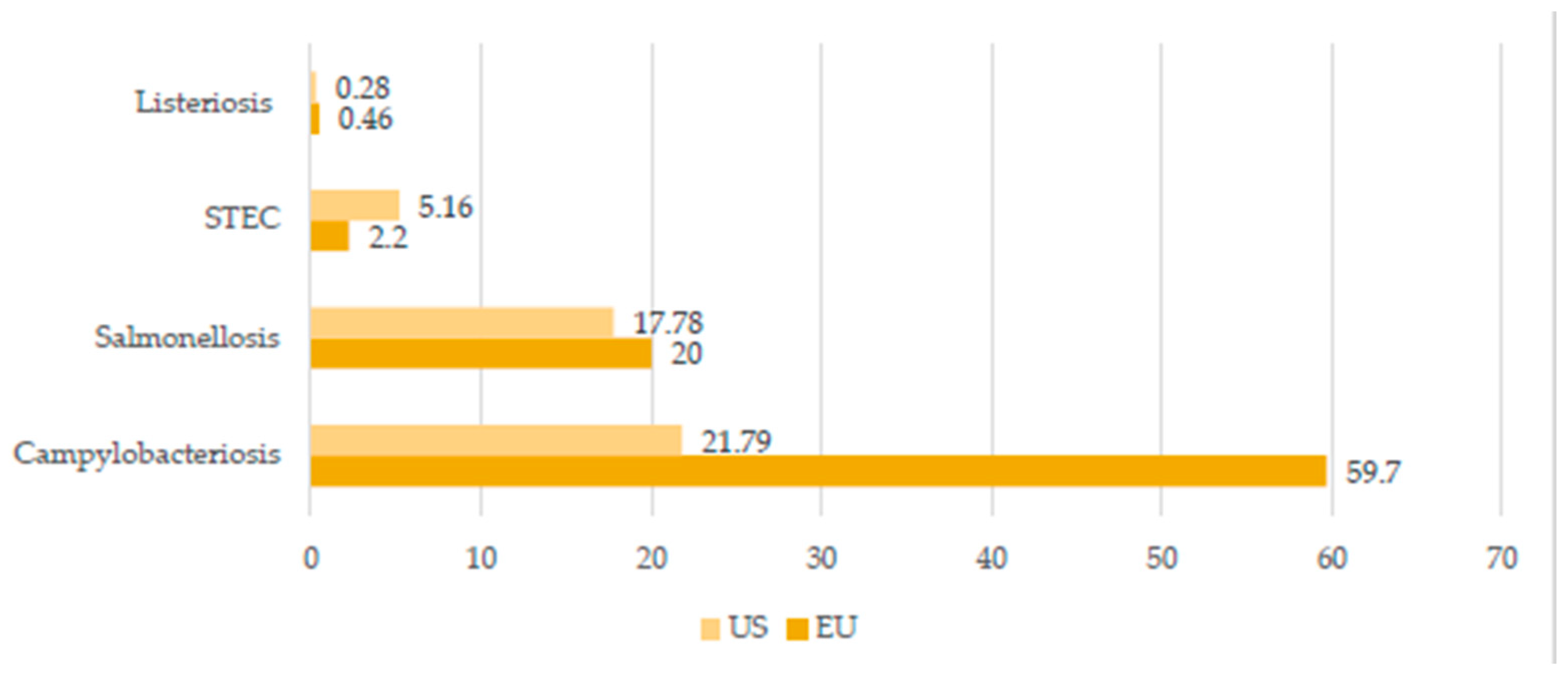
Human and animal health are intimately connected. This idea has been known for more than a century but now it has gained special importance because of the increasing threat from zoonoses. Zoonosis is defined as any infection naturally transmissible from vertebrate animals to humans. As the frequency and prevalence of zoonotic diseases increase worldwide, they become a real threat to public health. In addition, many of the newly discovered diseases have a zoonotic origin. Due to globalization and urbanization, some of these diseases have already spread all over the world, caused by the international flow of goods, people, and animals. However, special attention should be paid to farm animals since, apart from the direct contact, humans consume their products, such as meat, eggs, and milk. Therefore, zoonoses such as salmonellosis, campylobacteriosis, tuberculosis, swine and avian influenza, Q fever, brucellosis, Shiga-toxic Escherichia coli (STEC) infections, and listeriosis are crucial for both veterinary and human medicine. Consequently, in the suspicion of any zoonoses outbreak, the medical and veterinary services should closely cooperate to protect the public health.
- One Health
- zoonotic pathogens
- foodborne diseases
1. Background
| Disease | Aetiological Agent | Human Symptoms | Transmission Route | Epidemiology | References |
|---|---|---|---|---|---|
| Q fever | Coxiellaburnetti | Self-limited febrile illness, pneumonia, hepatitis, and endocarditis | Inhalation of aerosolized bacteria, ingestion, transfusion of blood, and sexual transmission | EU—950 human cases in 2019 USA—178 human cases in 2019 |
[5] [6] [15] |
| Brucellosis | Brucellaabortus, B. melitensis, B. canis, B. suis |
Systematic syndrome (fever, sweat, chills, and fatigue), located presentations (epididymoorchitis and spondylodiscitis), neurobrucellosis, and endocarditis | Contaminated food and dairy products, occupational contact, and inhalation | World—around 500,000 human cases per year EU—310 human cases in 2019 USA—80–120 cases annually |
[5] [6] [16] |
| Tuberculosis | Mycobacterium bovis M. caprae |
Generalized symptoms (fever, fatigue, arthralgia, and muscle pain), respiratory and cardiac complications, hepatitis, osteoarthritis, central nervous system dysfunction, and orchitis/epididymitis | Inhalation of aerosol, infected milk, dairy products, and meat | EU—147 human cases in 2019 USA—7174 human cases in 2020 |
[5] [17] [18] |
| Trichinellosis | Trichinella sp. | Diarrhea, abdominal pain at first, fever, myalgia, myocarditis, facial oedemas, and encephalitis | Ingestion of raw or undercooked muscle tissue containing encysted larvae | EU—96 human cases in 2019 USA—90 human cases during 2008–2012 |
[5] [6] [19] |
| Yersiniosis | Yersinia enterocolitica, Y. pseudotuberculosis |
Fever, vomiting, abdominal pain, and bloody diarrhea | Eating raw or undercooked pork; ingestion of dairy products, seafood, and vegetables; or drinking contaminated water | EU—6961 human cases USA—nearly 117,000 illnesses per year |
[5] [6] [20] |
| Swine influenza |
Swine influenza virus (SIV) |
Sneezing, coughing, difficult breathing, fever, lethargy, and decreased appetite | Contact with respiratory discharges or inhalation of exhalated aerosol by sick pig | No specific epidemiological data available, spread worldwide |
[21] [22] [23] |
| Salmonellosis | Salmonella sp. | Acute enterocolitis accompanied by inflammatory diarrhea, abdominal pain, fever, nausea, and vomiting | Ingestion of uncooked contaminated foods (eggs, milk, and meat), drinking contaminated water, direct contact with infected animals, their feces and environment, and human-to-human transmission through fecal–oral route | EU—87,923 human cases in 2019 USA—about 1.35 million human illnesses per year Sub-Saharan Africa—535,500 cases of non-typhoidal salmonellosis in 2019 |
[5] [6] [24] [25] |
2. Q Fever
3. Brucellosis
4. Tuberculosis Caused by Mycobacterium bovis and Mycobacterium caprae
Mycobacterium caprae and Mycobacterium bovis are members of the Mycobacterium tuberculosis complex and cause tuberculosis (TB) in animals and humans. M. caprae is isolated not only from goats but also from sheep, red deer, cattle, wild boar, the Siberian tiger, camel, bison, and humans [17]. M. caprae causes lesions and diseases like that of M. bovis but occurs only in a low proportion of human TB cases. Moreover, M. caprae is evolutionarily older than its epidemiological twin, M. bovis. This bacterium is not globally distributed but primarily restricted to European countries [43]. On the other hand, the most common host of M. bovis is cattle, but other mammals, such as marsupials, carnivores, pinnipeds, lagomorphs, rodents, and some avian species, could be also infected [44]. The main route of TB transmission in animals is via aerosol by the droplet nuclei generated during coughing and sneezing. Humans may be also infected through milk, dairy products, and by eating meat from infected animals [45]. The disease is manifested in humans by fever, fatigue, arthralgia, and muscle pain, and variety of other symptoms depending on the part of the body affected by the disease. WHO reported that in 2016, there were 147,000 new cases and 12,500 people died due to TB, but with no information of the potential zoonotic origin [18]. M. bovis is responsible only for 3.1% cases, with the exception for Tanzania, in which it reached 16% of TB in humans possibly due to poor zoohygienic conditions [46]. In 2019, most of the zoonotic TB human cases occurred in Africa (50%) and South-East Asia (31%). Globally, there were 140,000 human cases of zoonotic TB. However, the uncertainty level is estimated to be 69,800 to 235,000 [47]. While in Europe, TB is a rare infection with 147 confirmed cases in humans reported in 2019 in the EU. Between 2015 and 2019, 918 cases of TB were confirmed in the EU, including 54 caused by M. caprae [5]. The global distribution of zoonotic TB human cases in 2019 is presented in Figure 2. The most effective way to eliminate TB in farm animals is through implementation of eradication programs. In developed countries, infection with M. bovis is not common in cattle. This is related to compulsory tuberculin testing, the pasteurization of milk, and the removal of positive reactors [48]. Before the routine application of milk pasteurization in the United Kingdom (UK), M. bovis was isolated from 8% of churn milk samples from 3000-gallon tankers in 1945 [49]. In the 21st century, only 315 cases of human TB have been reported in the UK over a 10-year period [50]. However, it is important to note that cattle can become infected from wild mammals. This can also have an impact on the eradication of the disease. To date, the following have been identified as reservoirs of the mycobacteria around the world: brushtail possum and badger, European bison, African buffalo, wild boar, and white-tailed deer, among many others [51]. Research shows that Michigan deer may have infected surrounding cattle. Data indicate that while recording cases of the disease in wild deer between 1975 and 1994, infected animals were found in sixteen domestic cattle herds in four counties in the north-western part of the state [52]. Transmission from humans to cattle is also possible. M. bovis is usually transmitted directly by inhalation but also indirectly by hay and bedding contaminated with urine. In the Netherlands, humans were the source of transmission for 50 cattle herds [53]. Zoonotic M. bovis infections are mainly a problem in undeveloped countries. In the developing countries, due to the lack of control of zoonotic products, poor production hygiene, and outbreaks of other diseases (e.g., AIDS), the pathogen will continue to persist and remain a real challenge for public health in the future.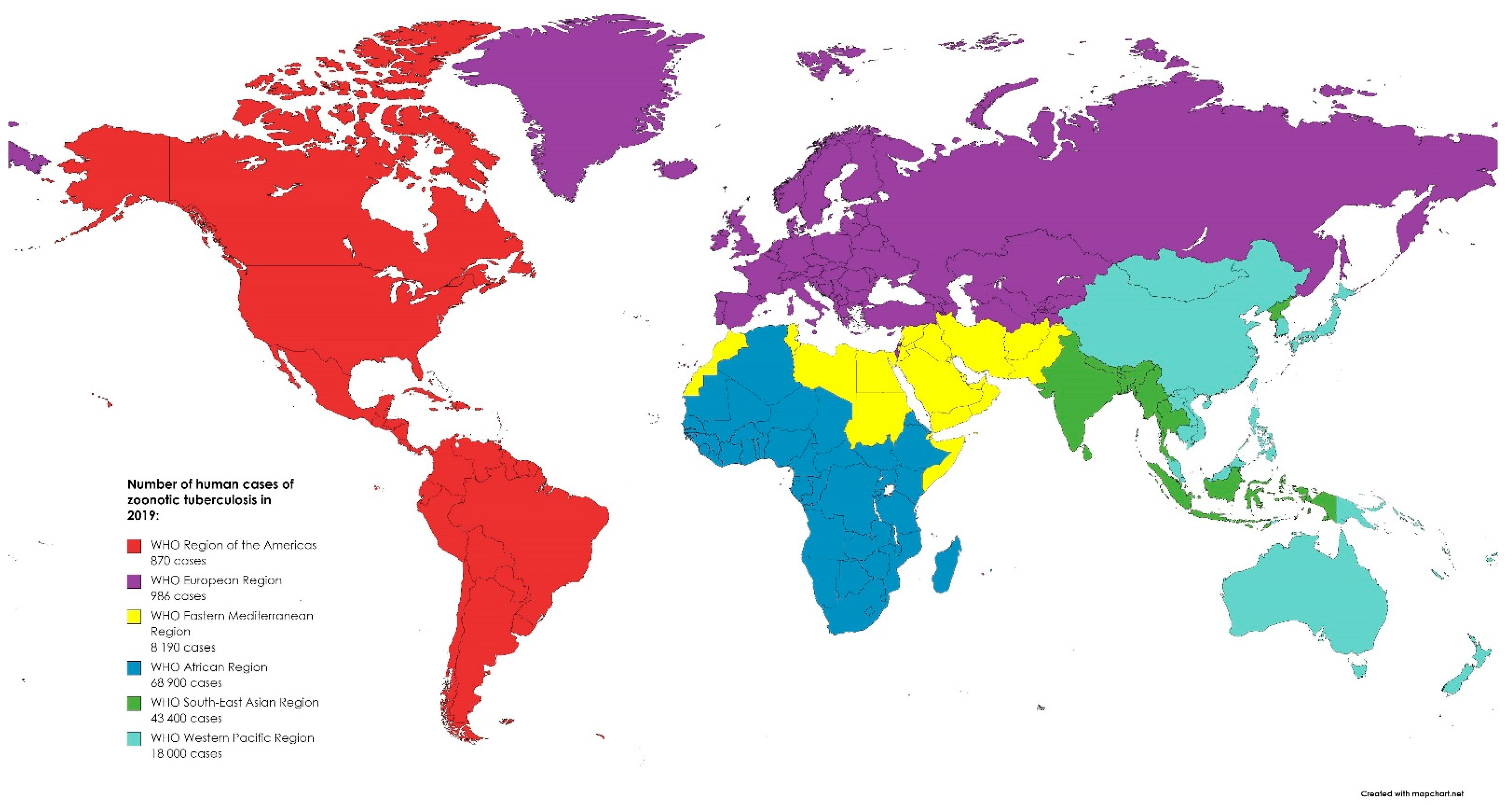 Figure 2. The global distribution of zoonotic tuberculosis human cases in 2019. Created based on data from [47].