
You're using an outdated browser. Please upgrade to a modern browser for the best experience.
Prostatectomy: Comparison
Please note this is a comparison between Version 1 by Ioanna Maria Grypari and Version 4 by Jessie Wu.

Prostate cancer is the second most common noncutaneous malignancy in men. Prostatectomy is a commonly used treatment modality for selected patients.Prostate’s ill defined borders and its vicinity with vital structures complicate the wide excision of the organ, resulting in positive margins of resection. Neoplastic infiltration of margins of resection in prostatectomy specimens affects patients’ prognosis. The surgical technique and surgeons’ expertise affect the incidence of margin positivity. The location and the extent of positive margins diversify the risk of recurrence, with basal infiltration and multifocal foci of positive margins behaving more aggressively. Pathologists are encouraged to thoroughly report the status of margins of resection, as they provide important information for patients’ prognosis and enable clinician to decide upon the most appropriate subsequent therapeutic steps.

  • prostate cancer
  • margins of resection
  • significance of marginal infiltration

1. Pathology

The prostate is partially enveloped by a capsule, consisting of a layer of smooth muscle bundles mainly arranged in a transverse plane, and collagen fibers, usually concentrated as a thin line at the external border [1][2][10,11]. The smooth muscle cells of the internal border of the capsule blend with the prostatic stroma [2][11]. The thickness of the capsule, the relative proportions of collagen and smooth muscle and the distance of the prostatic acini to the surface of the prostate vary significantly, even within different areas of the same gland [1][10]. Additionally, the capsule is missing in the anterior and anterolateral surfaces of the gland, even though its outer collagen region is consistently identified in most parts of the gland. [2][11] Thus, the prostatic capsule cannot be regarded as a well-defined anatomic structure, and the terms extracapsular extension, invasion of the capsule and capsule penetration are no longer accepted in prostatectomy reports, being replaced by the term extraprostatic extension [3][4][12,13].
To ensure precise assessment of the margins, at the Pathology Department, the whole surface of the prostate is inked with one or multiple colors depending on the pathologist preference and the department’s protocol (Figure 1a) [5][14]. Special considerations should be given to the grossing of the apex and the base. To reduce overestimation of positive margins, the cone method or a parallel/parasagittal sectioning is preferred for both anatomical areas over the trimming of a save block (Figure 1b) [5][14].
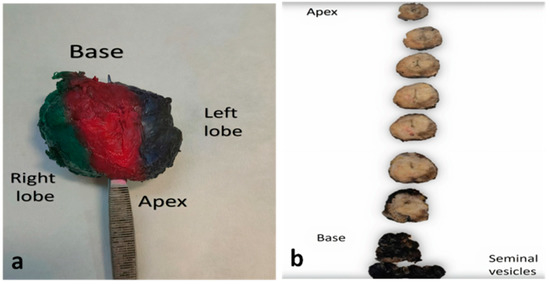
Figure 1. Gross handling of prostatectomy specimens (a) Prostate specimen, colored with different colors in each surface to help orientation. (b) Serial sectioning through the transverse axis from apex to base (margins colored with blank ink). Apex and base will be subsequently sectioned in a parallel (parasagittal) way (not shown).
A positive margin of resection (MOR) is defined as malignant glands in contact with the ink (Figure 2) [5][14], which means that the neoplasm extends to the area where the surgeon has dissected the tissue [6][15]. The presence of neoplastic cells close but not in contact with the surface of the prostate is not considered as a positive margin (Figure 2) no matter how close the cells are to the ink [7][16], as studies have shown that this has no prognostic significance [8][9][17,18].
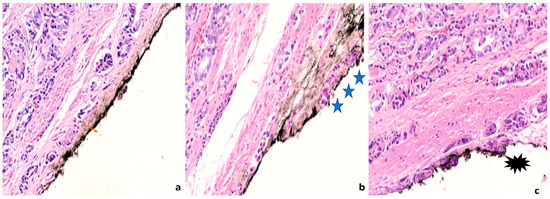
Figure 2. Definition of margin positivity (a) Neoplastic cells are close but not in contact with the ink. The distance between the inked margin and the neoplastic cells is pointed with a double-sided arrow. (b) Neoplastic cells are in contact with the ink. This is considered a positive margin. Three asterisks indicate the area of margin infiltration. (c) Cautery artifact in neoplastic cells in contact with the ink. An asterisk highlights the area of cautery effect. (400× magnification).
Practical issues regarding what is considered a positive margin are common. In the anterior surface of the prostate, the gland is surrounded by a fibromuscular stroma and its capsule is incomplete, thus, there is increased difficulty in recognizing the presence of extraprostatic extension and positive MOR [10][19]. In addition, cautery artifacts are frequent at the MORs (Figure 2) and may rarely pose difficulty in determining the nature of the cells that are present at the ink.
2. Clinical Significance of Positive Margins

Presence of positive margins is an independent adverse prognostic factor for recurrence [11][12][13][14][15][36,40,41,42,44], especially when accompanied by simultaneous EPE [10][19] and has been associated with higher mortality [16][17][45,46], although it does not seem to be the most important factor predicting cancer-related death [17][46]. Biochemical recurrence-free probability of patients with pT2 disease and positive margins has been shown to be similar to those of patients with T3a disease and negative margins. The same applies to patients with T3a and positive margins and those with T3b and negative margins [15][44]. Surprisingly, in pT3b stage, margin status was not predictive of biochemical recurrence [13][41], probably because the disease is driven by the aggressive nature of the neoplastic cells and not the positive margins. In contrast, in organ-confined disease, positive margins are associated with reduced biochemical recurrence-free survival independently of other adverse pathology characteristics [18][47]. Although data from prospective studies are lacking, these findings have been verified in a meta-analysis that included 41 retrospective cohort studies [19][48].
It is widely accepted that margin positivity is an important feature for deciding upon the next step after surgery [17][20][46,49]. Results from multi-institutional randomized trials have shown that there is a benefit of radiotherapy compared with active surveillance after prostatectomy regarding biochemical recurrence-free survival in patients with positive margins, though the overall survival is not improved [13][41]. In addition, margin status seems to be the best predictor of the positive effect of adjuvant radiotherapy after prostatectomy [21][50]. According to the latest guidelines of the European Society of Urologists, patients that show two of the three high-grade features (positive margins, pT3 stage and grade group 4 or 5) are candidates for adjuvant radiation therapy [22][20]. Similarly, the NCCN guidelines consider positive margins after radical prostatectomy, along with seminal vesicle invasion, extracapsular extension and detectable PSA as an indication for adjuvant radiotherapy [23][7].

3. Pathologic Features of Positive Margins with Clinical Significance

The significance of marginal invasion is not always predictive of patients’ clinical outcome, as prognosis depends on a variety of factors. This means that some positive margins will be a source of recurrence for the patient, whereas in other cases the neoplastic cells at the margin will not have any clinical significance. This is further supported by the fact that patients with positive margins after surgery that demonstrate undetectable PSA levels at its nadir have better biochemical recurrence-free survival compared to those with a detectable PSA nadir, and patients with positive margins that their PSA reaches its nadir at 3 months have better biochemical recurrence-free survival than patients that reached the PSA nadir in more than 6 months [20][49]. Studies have shown that it is not only the presence, but also the extent and location of the positive margins, as well as the Gleason Score of the tumor at the positive margin that is of significance, and may guide therapeutic interventions [24][51]. The latest College of American Pathologists protocols (revised in June 2021) have embodied the above-mentioned features in the pathology report [3][12].
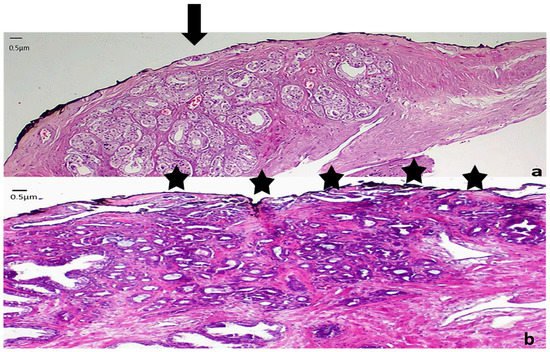
The length and number of areas with positive margins of resection have been correlated with the rate of biochemical recurrence [25][13][17][24][26][27][28][29][30][39,41,46,51,52,53,54,55,56]. A cutoff of 3 mm of linear extent of positive margins has been used in many studies to distinguish limited from extensive margin positivity, and is the cutoff recommended by the College of American Pathologists protocol [3][12]. Koskas et al. in a retroperspective study with an 8-year period of follow up demonstrated that extended or multifocal positive MOR is linked with earlier and higher rates of recurrence compared to limited positive margins [12][40]. They also found that Gleason score or pT stage does not influence in a statistical significant way the length of positive margins, whereas focal marginal infiltration does not affect the rate of biochemical recurrence [12][40]. Similarly, it has been shown that focal infiltration of MOR correlates with biochemical but not with clinical recurrence [22][20]. Extensive invasion of surgical margins is accompanied by a 35% chance of 5-year recurrence-free survival, compared with 60% for limited MOR and 87% for prostatectomies with organ-confined disease [7][16]. More recently, a lack of a significant difference in biochemical recurrence between patients with negative and short (<3 mm) (Figure 3) positive MOR has been shown [31][32][24,57]. In addition, when invasion of margins is unifocal, the biochemical-free period is not shortened [31][12][24,40]. The limited prognostic value of short and unifocal positive MOR may be accounted by a potential false interpretation of the margin, due to artifacts during the handling of the specimens. In addition, the few neoplastic cells remaining in the margins may not be not able to multiply and metastasize [32][57], and the cautery and ischemic effect of surgery may have destroyed the limited amount of neoplasm that has remained in the patient [7][16]. Taking into account these findings, the extension and the topography of positive MOR should be seriously considered when planning therapeutic interventions, as it is considered an independent adverse prognostic factor [15][44]. NCCN define as diffuse margins that are >10 mm or involving ≥ 3 sites [23][7]. A consideration for adjuvant treatment should be given for patients with extensive positive margins [22][20].
Figure 3. Representative images from low grade carcinomas with positive margins of different extent (a) Focal margin infiltration with neoplasm graded as PGG1. An arrow indicates the area of margin positivity (100× magnification) (b) Nonfocal margin infiltration with neoplasm graded as PGG1. Five asterisks point the area of margin positivity. (40× magnification).
Gleason score of the tumor at the positive margin has also been associated with the prognosis [33][34][35][36][58,59,60,61], albeit in some studies it has been found that it is not an independent factor [18][47]. A recent meta-analysis of 10 retrospective cohort studies, found that primary Gleason grade 4 or 5 at the margin was predictive of biochemical-free recurrence [37][62]. Prognostic grade group (PGG) 1 at the margin has been shown to have biochemical recurrence rates [35][60] and cancer-specific survival [36][61] equivalent to those of negative margins. Paradoxically, when Gleason score 6 tumors are accompanied by extensive (>3 mm) positive MOR, there might be an increased risk of recurrence [26][52]. That means that PGG1 tumor at the margin, especially when limited in extent, is not capable of progression, in concordance with the indolent nature of Gleason 6 tumors [38][63]. In contrast, PGG2-5 tumors at the margin have a higher rate of biochemical recurrence compared to PGG1 [37][62], and the presence of Gleason grade 4 at the margin in patients with Gleason score 7 tumors is associated with worse cancer-specific survival compared to the presence of Gleason grade 3 at the margin, independently of the tumor’s Gleason score and the use of adjuvant therapy [36][61]. These data support the report of the Gleason Score of the neoplastic glands that are present at the margin in the pathology assessment of prostatectomy specimens, also recommended by the College of American Pathologists [3][12].
Probability of margin positivity differs in the different areas of the prostate, as does its prognostic significance. Apex is the most common location for positive MOR, followed by the posterolateral and the posterior surface [7][10][39][11][12][13][26][16,19,21,36,40,41,52]. The frequent positivity of the margins at the apex is attributed to the lack of a clear plane of resection in this area, its close proximity to vital structures such as the dorsal venous complex and the neurovascular bundles and the agony of the surgeon to preserve the maximum length of the urethra, thus limiting the urological complications postoperatively [39][21]. In addition, the apex is surrounded by a very thin and fragile capsule where the benign glands are admixed with skeletal muscles, thus, it is prone to fragmentation during its handling by the surgeon [39][21]. The lack of periprostatic adipose tissue and the interminglement and graduate transition of the prostate parenchyma to the external urethral sphincter at the apex [1][10] make the definition of margin positivity and whether it is related to extraprostatic extension or intraprostatic excision difficult in this area [7][16].
Academic Video Service