
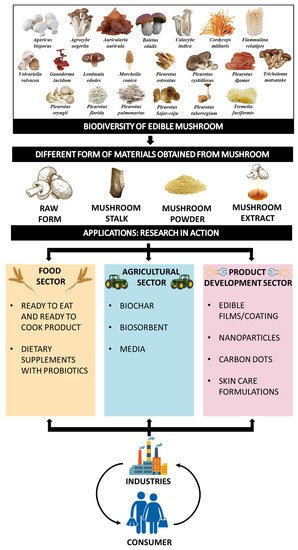
Currently, the food and agricultural sectors are concerned about environmental problems caused by raw material waste, and they are looking for strategies to reduce the growing amount of waste disposal. Now, approaches are being explored that could increment and provide value-added products from agricultural waste to contribute to the circular economy and environmental protection. Edible mushrooms have been globally appreciated for their medicinal properties and nutritional value, but during the mushroom production process nearly one-fifth of the mushroom gets wasted. Therefore, improper disposal of mushrooms and untreated residues can cause fungal disease. The residues of edible mushrooms, being rich in sterols, vitamin D2, amino acids, and polysaccharides, among others, makes it underutilized waste. Most of the published literature has primarily focused on the isolation of bioactive components of these edible mushrooms; however, utilization of waste or edible mushrooms themselves, for the production of value-added products, has remained an overlooked area. Waste of edible mushrooms also represents a disposal problem, but they are a rich source of important compounds, owing to their nutritional and functional properties. Researchers have started exploiting edible mushroom by-products/waste for value-added goods with applications in diverse fields. Bioactive compounds obtained from edible mushrooms are being used in media production and skincare formulations. Furthermore, diverse applications from edible mushrooms are also being explored, including the synthesis of biosorbent, biochar, edible films/coating, probiotics, nanoparticles and cosmetic products.
- edible mushrooms
- waste valorization
- food products
- industrial applications
1. Introduction
2. Edible Mushrooms Fortified in Ready-to-Eat and Ready-to-Cook Foods
| Edible Mushroom Common Name | Scientific Name | Food Product | Beneficial Effects | Reference |
|---|
| Edible Mushrooms Common Name | Scientific Name | Product Used | Compounds | Key Findings | References |
|---|---|---|---|---|---|
| Milky white | Calocybe indica | Cookies | Increase in protein, fiber, minerals and β-glucan, phenolic, flavonoids and antioxidants; decrease in starch, reduction in glycemic index | [17] | |
| White button | Agaricus bisporus | Fruit bars | Chitosan | Increased antioxidant capacity, ascorbic acid content, fungal growth prevention and firmness | [45] |
| ] | |||||
| Shiitake, Velvet shank | Lentinula edodes, Flammulina velutipes | ND | Insoluble dietary fibers | Highest tensile strength and an effective barrier to water vapor | [48] |
| Indian oyster | Pleurotus pulmonarius | ND | Flour | Significant barrier properties and mechanical strength | [49] |
4. Mushrooms as a Source of Prebiotics for Food Supplementation
| Edible Mushrooms Common Name | Scientific Name | Probiotic Used | Form of Mushroom Used | Applications | References | ||||||||||||
|---|---|---|---|---|---|---|---|---|---|---|---|---|---|---|---|---|---|
| White button | Agaricus bisporus | Probiotics mixture (Protexin 6 × 10 | 7 | CFU gm | −1 | ) | Powder | Lowered total cholesterol, LDL cholesterol, triglyceride concentrations, oxidative stress and dyslipidemia in hypercholesterolemic rats | [50] | ||||||||
| Oyster | Pleurotus sajor-caju | Biscuits | Increase in concentration of protein, dietary fiber, ash and reduction in carbohydrate | ||||||||||||||
| White button | Agaricus bisporus | [ | 19 | ] | |||||||||||||
| Fresh-cut melons | Chitosan | ||||||||||||||||
| Wood ear/Jew’s ear | Auricularia auricula | Lactobacillus acidophilus | La-5, | Bifidobacterium bifidum | Bb-12Enhance fruit firmness, inhibit off-flavors and reduce the microbial counts (up to 4 log CFU g | −1 | ). | [ | Extract | Enhancement in the survival rate of probiotics toabout 0.43 and 0.51 log CFU g | −1 | ; improved probiotic protection and functional properties of symbiotic yogurt47 | Shiitake | ||||
| [ | |||||||||||||||||
| 18 | |||||||||||||||||
| ] | |||||||||||||||||
| ] | |||||||||||||||||
| [ | 55 | ] | Velvet shank | Lentinula edodes | Chips | Improvement in quality attributes (color, sensory evaluation) | [ | Flammulina velutipes | 20] | ||||||||
| ND | Polysaccharide | High tensile strength, barrier property to water vapor and oxygen | [ | ||||||||||||||
| White button | Agaricus bisporus | 46 | Saccharomyces cerevisiae | Powder | Improvement in the meat quality with the incorporation of mushroom and probiotics in the broiler diet | [56] | Oyster | Pleurotus ostreatus | Biscuits | Enhancement of nutritional quality | |||||||
| Oyster | Pleurotus sajor-caju | Lactobacillus fermentum | OVL | [ | Powder21] | ||||||||||||
| Increase in neutrophil count in rats, decrease in lymphocyte count | [ | 57 | ] | ||||||||||||||
| Oyster | Pleurotus ostreatus | PrimaLac ( | Lactobacillus acidophilus, Lactobacillus casei, Bifidobacterium bifidium, Enterococcus faecium | ) | Powder | Decrease in abdominal fat on the carcass, increase in HDL concentration in plasma | [53] | ||||||||||
| Caterpillar | Cordyceps militaris | Lactobacillus plantarum | Spent mushroom substrate | Increase in the specific growth rate, weight gain, final weight in fish fed supplemented diets | [58] | ||||||||||||
| Shiitake | Lentinus edodes | 1.0 ×10 | 8 | CFU g | −1 | ( | Lactobacillus acidophilus | , | Lactobacillus casei | , | Bifidobacterium bifdium | , | Enterococcus faecium | ) | Extract | No weight gain in broiler chickens | [59] |
| King oyster | Pleurotus eryngii | Lactobacillus plantarum | Powder | Growth stimulation, immunity and disease resistance | [52] |
5. Edible Mushrooms Based Media
| Edible Mushrooms Common Name | Scientific Name | Media Composition | Purpose/Utilization | References |
|---|
| Edible Mushrooms Common Name | Scientific Name | Process and Conditions Required for Biochar Formation | Applications | References | |
|---|---|---|---|---|---|
| Velvet shank | Flammulina velutipes | Spent mushroom substrate, perlite, and vermiculite | Growing media for tomato and cucumber seedlings | ||
| Oyster, Shiitake | Pleurotus ostreatus | , | Lentinula edodes | [66 | Pyrolysis at 700 °C for 2 h] |
| Adsorbed 326mg g | −1 | and 398mg g | −1 | of lead Pb(II) from the water | [99] |
| Lingzhi |
| Edible Mushrooms Common Name | Scientific Name | Types of Nanoparticles Synthesized | Reaction Temperature/Time | Morphology | Size | Applications | References | |
|---|---|---|---|---|---|---|---|---|
| White button | Agaricus bisporus | Copper | RT/24 h | Spherical | 2–10 nm | Antibacterial activity against | Enterobacter aerogens | ; Antioxidant activity using DPPH, and ABTS; Anti-cancer activity against cancer cell lines SW620 (colon cancer) |
| White button, Oyster | Agaricus bisporus, Pleurotus ostreatus | Spent mushroom substrate, and Sphagnum peat | Growing media for tomato, courgette and pepper | [67] | ||||
| Velvet shank | Flammulina velutipes | Spent mushroom substrate, and chicken manure compost | Growing media for honeydew melon | [68] | ||||
| Velvet shank | Flammulina velutipes | Spent mushroom substrate, calcium carbonate, wheat bran, and yeast extract and inorganic salts | Production media for | Bacillus thuringiensis | [ | |||
| 76 | ||||||||
| ] | ||||||||
6. Edible Mushrooms Derived Biosorbents
| Edible Mushrooms Common Name | Scientific Name | Drying Temperature/Time | Applications | References |
|---|---|---|---|---|
| Staphylococcus aureus | ||||
| [ | ||||
| 117 | ||||
| ] | ||||
9. Edible Mushrooms Derived Carbon Dots
| Edible Mushrooms Common Name | Scientific Name | Production Conditions | Applications | References | |||||||||
|---|---|---|---|---|---|---|---|---|---|---|---|---|---|
| Oyster | Pleurotus florida | RT/24 h | |||||||||||
| Oyster | Pleurotus | sp. | Showed 100% removal of Fe | 2+ | Hydrothermal/120 °C/4 h from the water sample | Selective sensitivity for Pb | 2+ | ; Antibacterial activity against | Staphylococcus aureus, Klebsiella pneumoniae and Pseudomonas aeruginosa | ; Anti-cancer activity against breast cancer cells (MDA-MB-231)[79] | |||
| [ | 119 | ] | [ | 118] | White button | Agaricus bisporus | 80 °C/24 h | Successfully biosorbed Reactive Blue 49 dye (1.85 × 10 | −4 | mol g | −1 | ) from water | [80] |
| Velvet shank |
| Edible Mushrooms Common Name | Scientific Name | Product Base | Applications | References | ||||||||||||||||||||||||||
|---|---|---|---|---|---|---|---|---|---|---|---|---|---|---|---|---|---|---|---|---|---|---|---|---|---|---|---|---|---|---|
| White button, Oyster, Shiitake | Agaricus bisporus | , | Pleurotus ostreatus | , | Lentinula edodes | Cream | Anti-inflammatory; anti-tyrosinase; antioxidant and antibacterial activity | [128] | [127][107 | |||||||||||||||||||||
| Ganoderma lucidum | Pyrolysis at 650 °C for 2 h | Showed maximal adsorption against Pb2 | + | (262.76 mg g | −1 | ) and Cd | 2+ | (75.82 mg g | −1 | ) | [100] | |||||||||||||||||||
| ] | ||||||||||||||||||||||||||||||
| Brown oyster | Pleurotus cystidiosus | Gold | 29 °C/24 h | ND | ND | Antioxidant activity using DPPH, and ABTS | Flammulina velutipes | [108] | Hydrothermal/250 °C/4 h | Sensed Cr | ||||||||||||||||||||
| Lingzhi | 6+ | with a limit of detection 0.73 µM and volatile organic compounds | [ | 120] | [ | Ganoderma lucidum | 119] | |||||||||||||||||||||||
| Cream | Anti-tyrosinase; antioxidant and antibacterial activity | [ | 129 | ] | [128] | Oyster | Pleurotus ostreatus | 40 °C/24 h | Showed greater adsorption against Pb | 2+ | (85.91 mg g | −1 | ) in water | White button | Agaricus bisporus | Pyrolysis at 750 °C for 3 h | Showed maximal adsorption against Cu | 2+ | (65.2 mg g | −1 | ), Cd | 2+ | (76.3 mg g | −1 | ), and Zn | 2+ | (44.4 mg g | −1 | ) in water[81] | [101] |
| Oyster | Pleurotus florida | Gold | Oyster | Pleurotu | ssp.70 °C/1.5 h | Hydrothermal/200 °C/25 hSpherical | Sensed nitroarenes in water samples2–14 nm | Anti-cancer activity against cancer cell lines A-549 (Human lung carcinoma), K-562 (Human chronic myelogenous leukemia bone marrow), HeLa (Human cervix) and MDA-MB (Human adenocarcinoma mammary gland) | [121] | [120][109] | 69 | |||||||||||||||||||
| Oyster | Pleurotus ostreatus | ND | ND | Pyrolysis at 300 °C for 90 min | ||||||||||||||||||||||||||
| Cream | Skin fairness | [ | 130 | ] | ] | |||||||||||||||||||||||||
| [ | 129 | ] | Oyster | Pleurotus ostreatus | 60 °C/24 h | Biosorbed 3.8 mg g | Oyster | Paddy straw | Pleurotus ostreatus−1 | of Cd | 2+ | Showed maximal adsorption against Pb2 | + | (21.0 mg g | −1 | ), Cu | Volvariella volvacea2+ | (18.8 mg g | −1 | ), Cd | 2+ | (11.2 mg g | Hydrothermal/200 °C/25 h | −1 | ) and Ni | 2+ | (9.8 mg g | −1 | ) in water[82] | Gold[102] |
| 29 °C/24 h | Spherical | 22.9 nm | Sensed Pb | Antioxidant activity using DPPH, and ABTS | 2 | with limit of detection 12 nM and for Fe | [108] | 3+ | 16 nM | [122] | [121] | White button | Agaricus bisporus | Ketchup | Increase in ash content, crude fiber, protein, total soluble solids, and reducing sugars; decrease in total sugars | [ | Oyster22] | |||||||||||||
| Pleurotusf lorida | Spent mushroom substrate | Production media for lignocellulolytic enzymes | [ | 70 | ||||||||||||||||||||||||||
| Oyster, Black morels | ] | |||||||||||||||||||||||||||||
| ND | ND | Pyrolysis at 450 °C for 4 h | ||||||||||||||||||||||||||||
| Oyster | Pleurotus ostreatus | Gel | Anti-tyrosinase; antioxidant activity | [131] | [ | Pleurotus ostreatus | , | Morchella conica | RT/4 days | Adsorbed methylene blue (82.81 and 38.47 mg g | −1 | ) and for malachite green (64.13 and 39.28 mg g | −1 | ) | [83] | |||||||||||||||
| Oyster | Pleurotus sajor-caju | Showed maximal adsorption against crystal violet (1057mg g | −1 | ) in wastewater | [103] | |||||||||||||||||||||||||
| Gold | RT/12 h | Spherical | 16–18 nm | Anti-cancer activity against cancer cell lines HCT-116 (colon cancer) | [ | ND | ND | Hydrothermal/200 °C/6 h | Sensed hyaluronic acid and hyaluronidase | [123] | [122] | Oyster | Pleurotus ostreatus | Jam | Increase in total soluble solids, percent acidity and reducing sugar, decrease in pH and non-reducing sugar | Oyster | Pleurotus ostreatus | Spent mushroom substrate[23] | ||||||||||||
10. Edible Mushrooms Based Skin Care Formulations
| 130 | |||||||||||||||||||||||
| ] | |||||||||||||||||||||||
| Snow | |||||||||||||||||||||||
| Tremella fuciformis | Gel | Hand sanitizer | 110 | ] | [132] | [131] | |||||||||||||||||
| Velvet shank | Production media for | Lactococcus lactis | Flammulina velutipes | ND | ND[71 | Pyrolysis at 500 °C for 2 h] | Showed maximal adsorption against fluoride (36.5 mg g | −1 | ) in water | [104 | |||||||||||||
| King tuber | ] | Pleurotus tuber-regium | Selenium | White button | Agaricus bisporus | ||||||||||||||||||
| White button, Oyster | RT/24 h | Spherical | 91–102 nm | Agaricus bisporus | Anti-cancer activity against gastric adenocarcinoma AGS | , | [111] | Mushroom tikki and stuffed mushroom | Increase in protein, dietary fiber, antioxidant and phenolic components | [24] | |||||||||||||
| Lentinula edodes | Freeze-dried/24 h | ||||||||||||||||||||||
| Oyster | Oyster | Pleurotus ostreatus | Soup | Increase in nutritional value | |||||||||||||||||||
| 60 °C/24 h | Maximum removal capacity against copper ions was 15.56 mg g | −1 | [ | 84] | Oyster | Pleurotus ostreatusPleurotus ostreatus | SilverMaximum absorption against Congo red was 217.86 mg g | −1 | [25] | ||||||||||||||
| Spent mushroom substrate, paddy straw, and soybean cake | [ | 85 | ] | ||||||||||||||||||||
| 25 °C/48 h | Spherical | 17.5 nm | Anti-cancer activity against cancer cell lines HepG2 (human liver) and MCF-7 (breast) | [ | 112 | ] | Oyster | Pleurotus ostreatus | 78 °C/48 h | Showed maximum biosorption against uranium ion (19.95 mg g | −1 | ) | [86] | Chestnut | |||||||||
| Lingzhi | Ganoderma lucidum | Silver | ND/ND | Spherical | 15–22 nm | Antioxidant activity using DPPH; Antibacterial activity against | Staphylococcus aureus, | Enterococcus hirae, Bacillus cereus | , | Escherichia coli, Pseudomonas aeruginosa, | Legionella pneumophila | subsp. | Pneumophila | ; and antifungal activity against | Candida albicans | [113] | Oyster | Agrocybe aegerita | Snacks | Manipulation of glycemic response of individuals |
[26] | ||
| Pleurotus ostreatus | 80 °C/ND | ||||||||||||||||||||||
| Matsutake | Tricholoma matsutake | Showed maximum biosorption against Ni | 2+ | (20.71 mg g | −1 | ) | [ | Silver87] | |||||||||||||||
| RT/30 min | Spherical | 10–70 nm | Antibacterial activity against | Bacillus cereus | , | Escherichia coli | [114] | Oyster | Pleurotus sajur-caju | Biscuit | King trumpet | Pleurotus eryngii | Increase in the mineral content | 60 °C/24 h | Showed maximum biosorption against Pb | 2+ | (3.30 mg g | −1 | ) | ||||
| Milky white, Oyster, White button, Lingzhi | Calocybe indica | , | Pleurotus ostreatus | , | Agaricu sbisporus | , | Ganoderma lucidum | [27] | |||||||||||||||
| [ | 88 | ] | |||||||||||||||||||||
| Silver | RT/12 h | Spherical | 80–100 nm | Antibacterial activity against | Staphylococcus aureus | [ | Oyster | Pleurotus ostreatus | Vegetable mixture diets | Highly acceptable, nutritious, delicious, ready-to-eat diet | [14] | ||||||||||||
| Oyster | Pleurotus ostreatus | Processed cheese spreads | High moisture, ash and protein content, total viable counts and spore former bacteria was lower in processed cheese supplemented with mushrooms | [28] | |||||||||||||||||||
| Biopesticide ( | Trichoderma asperellum | ) development | [ | 72] | |||||||||||||||||||
| Shiitake | ND | ND | Spent mushroom substrate and peat moss | Growing media for Chinese kale | [73] | Oyster | |||||||||||||||||
| ND | ND | 115 | ] | Lingzhi | Ganoderma lucidum | 60 °C/72 h | Maximum biosorption against malachite green (40.65 mg g | −1 | ), safranine T (33.00 mg g | −1 | ), and methylene (22.37 mg g | −1 | ) | [89] | Pleurotus ostreatus | Biscuit | Higher moisture, protein, ash content, higher hardness, darker and redder in color | [29] | |||||
| Oyster | Pleurotus ostreatus | Spreadable processed cheese | Increase in total solids, protein, fibers and carbohydrates | [30] | |||||||||||||||||||
| Oyster | Pleurotus sajor-caju | chicken patty | Reduction in fat content, no change in protein and β-glucan | [31] | |||||||||||||||||||
| White button | Agaricus bisporus | Pasta | Improved antioxidant activity, increase moisture content, carbohydrates, decreased crude fiber, crude protein, and fat | [32] | |||||||||||||||||||
| Oyster | |||||||||||||||||||||||
| King trumpet | Pleurotus eryngii | 60 °C/24 h | Removed 88.38% of NO | Pleurotus sajor-caju | Cookies | High protein content, low-fat content, high fiber, minerals and vitamin content | [33] | ||||||||||||||||
| White button | Agaricus bisporus | Pasta | Decrease in the extent of starch degradation, increase in total phenolic content and antioxidant capacities | [34] | |||||||||||||||||||
| 3 | − | White jelly | Tremella fuciformis | Patty | Oil holding capacity of mushroom has a positive effect on cooking yield of patty as well as senses | [35] | |||||||||||||||||
| Oyster | Pleurotus ostreatus | Instant noodles | Increase in protein and fiber content | [36] | |||||||||||||||||||
| White button | Agaricus bisporus | Beef burgers | Reduction in the fat content of beef burgers | [37] | |||||||||||||||||||
| Spent mushroom substrate, perlite, and vermiculite | Growing media for lettuce seedlings | [ | 74 | ] | |||||||||||||||||||
| ND | ND | Spent mushroom substrate, polished rice, full-fat soybean, and rice bran | Production media for arachidonic acid by | Mortierella | sp. | [75] | Oyster | Pleurotus ostreatus | Instant soup premix | Rich in protein, crude fiber, minerals and low in fat, carbohydrate and energy value | [38] | ||||||||||||
| White button | |||||||||||||||||||||||
| ND | ND | Spent mushroom substrate, and poultry cooked bones | Agaricus bisporus | Sponge cake | Increase in apparent viscosity, volume, springiness and cohesiveness values | [39] | |||||||||||||||||
| Production media for solubilizationphosphate by | Bacillus megaterium | [ | [ | 90] |
7. Edible Mushrooms Derived Biochar
8. Edible Mushrooms Derived Nanoparticles (NPs)
| Pleurotus ostreatus | ||||||||||||||
| Cream | ||||||||||||||
| Anti-tyrosinase; antioxidant and antibacterial activity | ||||||||||||||
| [ | 133 | ] | [ | 132] | ||||||||||
| Pink oyster | ||||||||||||||
| Pleurotus djamor | ||||||||||||||
| Titanium oxide | RT/20 min | Spherical | 31 nm | Antibacterial activity against | Corynebacterium diphtheria | , | Pseudomonas fluorescens | , and | Staphylococcus aureus | ; Anti-cancer activity against cancer cell lines A-549 (Human lung carcinoma); larval toxicity against | Aedes aegypti | , | Culex quinquefasciatus | [116] |
| Pink oyster | Pleurotus djamor | Zinc oxide | RT/24 h | Sphere | 74.36 nm | Antioxidant activity using DPPH, ABTS, and H | 2 | O | 2 | ; larval toxicity against | Aedes aegypti | , | Culex quinquefasciatus | ; Antibacterial activity against |
| Oyster | ||||||||||||||
| Pleurotus sajor-caju | ||||||||||||||
| Biscuit | ||||||||||||||
| Reduction in starch pasting viscosities, starch gelatinization enthalpy value, increases in protein, crude fiber and mineral content | ||||||||||||||
| [ | ||||||||||||||
| 16 | ||||||||||||||
| ] | ||||||||||||||
| Corynebacterium diphtheria | , | Pseudomonas fluorescens | , and | Shiitake | Lentinula edodes | Noodles | Improvement in nutritional profile and reduction in the glycemic index of foods | |||||||
| King tuber | Pleurotus tuber-regium | Cookies | Higher protein, ash, crude fiber, water-soluble vitamins and minerals | [40] | ||||||||||
| Oyster | Pleurotus ostreatus | Noodles | Lower level of carbohydrate, fat, and sodium | [41] | ||||||||||
| King trumpet | Pleurotus eryngii | Sponge cake | Increase in ash and proteincontent | [42] | ||||||||||
| White button, Shitake, Porcini | Agaricus bisporus, Lentinula edodes, Boletus edulis | Pasta | High firmness and tensile strength | [43] |
3. Edible Mushrooms Based Films/Coatings
References
- Valverde, M.E.; Hernández-Pérez, T.; Paredes-López, O. Edible mushrooms: Improving human health and promoting quality life. Int. J. Microbiol. 2015, 2015, 376387.
- Chang, S.T.; Miles, P.G. Mushrooms: Cultivation, Nutritional Value, Medicinal Effect, and Environmental Impact, 2nd ed.; CRC Press: Boca Raton, FL, USA, 2008.
- Ergönül, P.G.; Akata, I.; Kalyoncu, F.; Ergönül, B. Fatty acid compositions of six wild edible mushroom species. Sci. World J. 2013, 2013, 163964.
- Guillamón, E.; García-Lafuente, A.; Lozano, M.; D’Arrigo, M.; Rostagno, M.A.; Villares, A.; Martínez, J.A. Edible mushrooms: Role in the prevention of cardiovascular diseases. Fitoterapia 2010, 81, 715–723.
- Longvah, T.; Deosthale, Y.G. Composition and nutritional studies on edible wild mushroom from Northeast India. Food Chem. 1998, 63, 331–334.
- Maga, J.A. Mushroom flavor. J. Agric. Food Chem. 1981, 29, 1–4.
- Mattila, P.; Konko, K.; Euvola, M.; Pihlava, J.; Astola, J.; Vahteristo, L. Contents of vitamins, mineral elements and some phenolic compound in cultivated mushrooms. J. Agric. Food Chem. 2001, 42, 2449–2453.
- Clifford, A.J.; Heid, M.K.; Peerson, J.M.; Bills, N.D. Bioavailability of food folates and evaluation of food matrix effects with a rat bioassay. J. Nutr. 1991, 121, 445–453.
- Bano, Z.; Rajarathnam, S. Pleurotus mushrooms. Part II. Chemical composition, nutritional value, post-harvest physiology, preservation, and role as human food. Crit. Rev. Food Sci. Nutr. 1988, 27, 87–158.
- Ribeiroa, B.; Pinhoa, P.G.; Andradea, P.B.; Baptistab, P.; Valentao, P. Fatty acid composition of wild edible mushrooms species: A comparative study. Microchem. J. 2009, 93, 29–35.
- Antunes, F.; Marçal, S.; Taofiq, O.; Morais, A.M.M.B.; Freitas, A.C.; Ferreira, I.C.F.R.; Pintado, M. Valorization of mushroom by-products as a source of value-added compounds and potential applications. Molecules 2020, 25, 2672.
- Lim, S.-H.; Lee, Y.-H.; Kang, H.-W. Efficient recovery of lignocellulolytic enzymes of spent mushroom compost from oyster mushrooms, Pleurotus spp., and potential use in dye decolorization. Mycobiology 2013, 41, 214–220.
- Mirabella, N.; Castellani, V.; Sala, S. Current options for the valorization of food manufacturing waste: A review. J. Clean Prod. 2014, 65, 28–41.
- Soliman, A.; Abbas, M.; Ahmed, S. Preparation, canning and evaluation process of vegetable mixture diets (ready-to-eat) supplemented with mushroom. Suez Canal Univ. J. Food Sci. 2017, 4, 19–28.
- Salehi, F. Characterization of different mushrooms powder and its application in bakery products: A review. Int. J. Food Prop. 2019, 22, 1375–1385.
- Ng, S.H.; Robert, S.D.; Ahmad, W.A.N.W.; Ishak, W.R.W. Incorporation of dietary fiber-rich oyster mushroom (Pleurotus sajor-caju) powder improves postprandial glycaemic response by interfering with starch granule structure and starch digestibility of biscuit. Food Chem. 2017, 227, 358–368.
- Rathore, H.; Sehwag, S.; Prasad, S.; Sharma, S. Technological, nutritional, functional and sensorial attributes of the cookies fortified with Calocybe indica mushroom. J. Food Meas. Charact. 2019, 13, 976–987.
- Wang, L.; Zhao, H.; Brennan, M.; Guan, W.; Liu, J.; Wang, M.; Brennan, C. In vitro gastric digestion antioxidant and cellular radical scavenging activities of wheat-shiitake noodles. Food Chem. 2020, 330, 127214.
- Prodhan, U.K.; Linkon, K.M.M.R.; Al-Amin, M.F.; Alam, M.J. Development and quality evaluation of mushroom (Pleurotus sajor-caju) enriched biscuits. Emir. J. Food Agric. 2015, 27, 542–547.
- Ren, A.; Pan, S.; Li, W.; Chen, G.; Duan, X. Effect of various pretreatments on quality attributes of vacuum-fried shiitake mushroom chips. J. Food Qual. 2018, 2018, 4510126.
- Farzana, T.; Mohajan, S. Effect of incorporation of soy flour to wheat flour on nutritional and sensory quality of biscuits fortified with mushroom. Food Sci. Nutr. 2015, 3, 363–369.
- Kumar, K.; Ray, A.B. Development and shelf-life evaluation of tomato-mushroom mixed ketchup. J. Food Sci. Technol. 2016, 53, 2236–2243.
- Khan, M.U.; Qazi, I.M.; Ahmed, I.; Ullah, S.; Khan, A.; Jamal, S. Development and quality evaluation of banana mushroom blended jam. Pak. J. Sci. Ind. Res. Ser. B 2017, 60, 11–18.
- Rachappa, P.; Sudharma, D.C.; Chauhan, O.P.; Patki, P.E.; Nagaraj, R.; Naik, S.; Naik, R. Development and evaluation of white button mushroom based snacks. J. Food Process. Technol. 2020, 11, 824.
- Mohajan, S.; Orchy, T.N.; Farzana, T. Effect of incorporation of soy flour on functional, nutritional, and sensory properties of mushroom–moringa-supplemented healthy soup. Food Sci. Nutr. 2018, 6, 549–556.
- Brennan, M.A.; Derbyshire, E.; Tiwari, B.K.; Brennan, C.S. Enrichment of extruded snack products with coproducts from chestnut mushroom (Agrocybe aegerita) production: Interactions between dietary fiber, physicochemical characteristics, and glycemic load. J. Agric. Food Chem. 2012, 60, 4396–4401.
- Bello, M.; Oluwamukomi, M.O.; Enujiugha, V.N. Nutrient composition and sensory properties of biscuit from mushroom-wheat composite flours. Arch. Curr. Res. Int. 2017, 9, 1–11.
- Khider, M.; Seoudi, O.; Abdelaliem, Y.F. Functional processed cheese spreads with high nutritional value as supplemented with fresh and dried mushrooms. Int. J. Nutr Food Sci. 2017, 6, 45–52.
- Cornelia, M.; Chandra, J. Utilization of white oyster mushroom powder (Pleurotus ostreatus (Jacq.) P. Kumm.) in the making of biscuit as emergency food product. Eurasia J. Biosci. 2019, 13, 1859–1866.
- Shalaby, S.M.; Mohamed, A.G.; Farahat, E.S. Preparation of functional and nutritional spreadable processed cheese fortified with vegetables and mushrooms. Int. J. Curr Res. 2018, 10, 74075–74082.
- Rosli, W.I.W.; Solihah, M.A. Nutritional composition and sensory properties of oyster mushroom-based patties packed with biodegradable packaging. Sains Malays. 2014, 43, 65–71.
- Chauhan, N.; Vaidya, D.; Gupta, A.; Pandit, A. Fortification of pasta with white button mushroom: Functional and rheological properties. Int. J. Food Ferment. Technol. 2017, 7, 87–96.
- Chaudhari, P.D.N.; Wandhekar, S.S.; Shaikh, A.A.; Devkatte, A.N. Preparation and characterization of cookies prepared from wheat flour fortified with mushroom (Pleurotussajor-caju) and spiced with cardamom. Int. J. Res. Anal. Rev. 2018, 5, 386–389.
- Lu, X.; Brennan, M.A.; Serventi, L.; Liu, J.; Guan, W.; Brennan, C.S. Addition of mushroom powder to pasta enhances the antioxidant content and modulates the predictive glycaemic response of pasta. Food Chem. 2018, 264, 199–209.
- Cha, M.H.; Heo, J.Y.; Lee, C.; Lo, Y.M.; Moon, B. Quality and sensory characterization of white jelly mushroom (Tremella fuciformis) as a meat substitute in pork patty formulation. J. Food Process. Preserv. 2014, 38, 2014–2019.
- Arora, B.; Kamal, S.; Sharma, V.P. Nutritional and quality characteristics of instant noodles supplemented with oyster mushroom (P. ostreatus). J. Food Process Preserv. 2018, 42, e13521.
- Patinho, I.; Saldaña, E.; Selani, M.M.; de Camargo, A.C.; Merlo, T.C.; Menegali, B.S.; Contreras-Castillo, C.J. Use of Agaricus bisporus mushroom in beef burgers: Antioxidant, flavor enhancer and fat replacing potential. Food Prod. Process Nutr. 2019, 1, 1–15.
- Srivastava, A.; Attri, B.; Verma, S. Development and evaluation of instant soup premix using oyster mushroom powder. Mushroom Res. 2019, 28, 65–69.
- Salehi, F.; Kashaninejad, M.; Asadi, F.; Najafi, A. Improvement of quality attributes of sponge cake using infrared dried button mushroom. J. Food Sci. Technol. 2016, 53, 1418–1423.
- Kolawole, F.L.; Akinwande, B.A.; Ade-Omowaye, B.I.O. Physicochemical properties of novel cookies produced from orange-fleshed sweet potato cookies enriched with sclerotium of edible mushroom (Pleurotus tuber-regium). J. Saudi Soc. Agric. Sci. 2020, 19, 174–178.
- Parvin, R.; Farzana, T.; Mohajan, S.; Rahman, H.; Rahman, S.S. Quality improvement of noodles with mushroom fortified and its comparison with local branded noodles. NFS J. 2020, 20, 37–42.
- Jeong, C.H.; Shim, K.H. Quality characteristics of sponge cakes with addition of Pleurotus eryngii mushroom powders. J. Korean Soc. Food Sci. Nutr. 2004, 33, 716–722.
- Lu, X.; Brennan, M.A.; Serventi, L.; Mason, S.; Brennan, C.S. How the inclusion of mushroom powder can affect the physicochemical characteristics of pasta. Int. J. Food Sci. Technol. 2016, 51, 2433–2439.
- Kumar, H.; Bhardwaj, K.; Sharma, R.; Nepovimova, E.; Kuča, K.; Dhanjal, D.S.; Kumar, D. Fruit and vegetable peels: Utilization of high value horticultural waste in novel industrial applications. Molecules 2020, 25, 2812.
- Bilbao-Sainz, C.; Chiou, B.-S.; Punotai, K.; Olson, D.; Williams, T.; Wood, D.; Rodov, V.; Poverenov, E.; McHugh, T. Layer-by-layer alginate and fungal chitosan based edible coatings applied to fruit bars. J. Food Sci. 2018, 83, 1880–1887.
- Du, H.; Hu, Q.; Yang, W.; Pei, F.; Kimatu, B.M.; Ma, N.; Zhao, L. Development, physiochemical characterization and forming mechanism of Flammulina velutipes polysaccharide-based edible films. Carbohydr. Polym. 2016, 152, 214–221.
- Poverenov, E.; Arnon-Rips, H.; Zaitsev, Y.; Bar, V.; Danay, O.; Horev, B.; Rodov, V. Potential of chitosan from mushroom waste to enhance quality and storability of fresh-cut melons. Food Chem. 2018, 268, 233–241.
- Zhang, K.; Wang, W.; Zhao, K.; Ma, Y.; Cheng, S.; Zhou, J.; Wu, Z. Producing a novel edible film from mushrooms (L. edodes and F. velutipes) by-products with a two-stage treatment namely grinding and bleaching. J. Food Eng. 2020, 275, 109862.
- Olufunmilola, O.M.; Shian, A.J.; Dooshima, I.B. Effects of plasticizer concentration and mushroom (Pleurotus pulmonarius) flour inclusion on the sensory, mechanical and barrier properties of cassava starch based edible films. Eur. J. Food Sci. Technol. 2019, 7, 47–62.
- Asad, F.; Anwar, H.; Yassine, H.M.; Ullah, M.I.; Kamran, Z.; Sohail, M.U. White button mushroom, Agaricus bisporus (Agaricomycetes), and a probiotics mixture supplementation correct dyslipidemia without influencing the colon microbiome profile in hypercholesterolemic rats. Int. J. Med. Mushrooms 2020, 22, 235–244.
- Synytsya, A.; Míčková, K.; Synytsya, A.; Jablonský, I.; Spěváček, J.; Erban, V.; Čopíková, J. Glucans from fruit bodies of cultivated mushrooms Pleurotus ostreatus and Pleurotus eryngii: Structure and potential prebiotic activity. Carbohydr. Polym. 2009, 76, 548–556.
- Van Doan, H.; Doolgindachbaporn, S.; Suksri, A. Effects of Eryngii mushroom (Pleurotus eryngii) and Lactobacillus plantarum on growth performance, immunity and disease resistance of Pangasius catfish (Pangasius bocourti, Sauvage 1880). Fish Physiol. Biochem. 2016, 42, 1427–1440.
- Daneshmand, A.; Sadeghi, G.H.; Karimi, A.; Vaziry, A. Effect of oyster mushroom (Pleurotus ostreatus) with and without probiotic on growth performance and some blood parameters of male broilers. Anim. Feed Sci. Techol. 2011, 170, 91–96.
- Gibson, G.R.; Roberfroid, M.B. Dietary modulation of the human colonic microbiota: Introducing the concept of probiotic. J. Nutr. 1995, 125, 1401–1412.
- Faraki, A.; Noori, N.; Gandomi, H.; Banuree, S.A.H.; Rahmani, F. Effect of Auricularia auricula aqueous extract on survival of Lactobacillus acidophilus La-5 and Bifidobacterium bifidum Bb-12 and on sensorial and functional properties of synbiotic yogurt. Food Sci. Nutr. 2020, 8, 1254–1263.
- Roy, D.; Fahim, A. The effect of different level of mushroom (Agaricus bisporus) and probiotics (Saccharomyces cerevisiae) on sensory evaluation of broiler meat. J. Entomol. Zool. Stud. 2019, 7, 347–349.
- Oyetayo, V.O.; Oyetayo, F.L. Hematological parameters of rats fed mushroom, Pleurotus sajor-caju diets and orogastrically dosed with probiotic Lactobacillus fermentum Ovl. Int. J. Probiotics Prebiotics 2007, 2, 39–42.
- Van Doan, H.; Hoseinifar, S.H.; Dawood, M.A.; Chitmanat, C.; Tayyamath, K. Effects of Cordyceps militaris spent mushroom substrate and Lactobacillus plantarum on mucosal, serum immunology and growth performance of Nile tilapia (Oreochromis niloticus). Fish Shellfish Immunol. 2017, 70, 87–94.
- Willis, W.L.; Isikhuemhen, O.S.; Ibrahim, S.A. Performance assessment of broiler chickens given mushroom extract alone or in combination with probiotics. Poult Sci. 2007, 86, 1856–1860.
- Soccol, C.R.; Vandenberghe, L.P.S. Overview of applied solid-state fermentation in Bazil. Biochem. Eng. J. 2008, 13, 205–218.
- Zhang, R.H.; Li, X.J.; Fadel, J.G. Oyster mushroom cultivation with rice and wheat straw. Bioresource Technol. 2002, 82, 277–284.
- Sanchez, J.E.; Royse, D.J. Scytalidium thermophilum- colonized grain, corncobs and chopped wheat straw substrates for the production of Agaricus bisporus. Bioresour. Technol. 2009, 100, 1670–1674.
- Semple, K.T.; Reid, B.J.; Fermor, T.R. Impact of composting strategies on the treatment of soils contaminated with organic pollutants. Environ. Pollut. 2001, 112, 269–283.
- Fidanza, M.A.; Sam fond, D.L.; Beyen, D.M.; Aurentz, D.J. Analysis of fresh mushroom compost. Hort. Technol. 2010, 20, 449–453.
- Rajput, R.; Prasad, G.; Chopra, A.K. Scenario of solid waste management in present Indian context. Casp. J. Environ. Sci. 2009, 7, 45–53.
- Run-Hua, Z.; Zeng-Qiang, D.; Zhi-Guo, L. Use of spent mushroom substrate as growing media for tomato and cucumber seedlings. Pedosphere 2012, 22, 333–342.
- Medina, E.; Paredes, C.; Pérez-Murcia, M.D.; Bustamante, M.A.; Moral, R. Spent mushroom substrates as component of growing media for germination and growth of horticultural plants. Bioresour. Technol. 2009, 100, 4227–4232.
- Tam, N.V.; Wang, C.H. Use of spent mushroom substrate and manure compost for honeydew melon seedlings. J. Plant. Growth Regul. 2015, 34, 417–424.
- Wu, S.; Lan, Y.; Huang, D.; Peng, Y.; Huang, Z.; Gelbič, I.; Carballar-Lejarazu, R.; Guan, X.; Zhang, L.; Zou, S. Use of spent mushroom substrate for production of Bacillus thuringiensis by solid-state fermentation. J. Econ. Entomol. 2014, 107, 137–143.
- Rajavat, A.S.; Rai, S.; Pandiyan, K.; Kushwaha, P.; Choudhary, P.; Kumar, M.; Chakdar, H.; Singh, A.; Karthikeyan, N.; Bagul, S.Y.; et al. Sustainable use of the spent mushroom substrate of Pleurotus florida for production of lignocellulolytic enzymes. J. Basic Microbiol. 2020, 60, 173–184.
- Qiao, J.J.; Zhang, Y.F.; Sun, L.F.; Liu, W.W.; Zhu, H.J.; Zhang, Z. Production of spent mushroom substrate hydrolysates useful for cultivation of Lactococcus lactis by dilute sulfuric acid, cellulase and xylanase treatment. Bioresour. Technol. 2011, 102, 8046–8051.
- Singh, G.; Tiwari, A.; Rathore, H.; Prasad, S.; Hariprasad, P.; Sharma, S. Valorization of paddy straw using de-oiled cakes for P. ostreatus cultivation and utilization of spent mushroom substrate for biopesticide development. Waste Biomass Valroi. 2021, 12, 333–346.
- Sendi, H.; Mohamed, M.T.M.; Anwar, M.P.; Saud, H.M. Spent mushroom waste as a media replacement for peat moss in kai-lan (Brassica oleracea var. Alboglabra) production. Sci. World J. 2013, 2013, 258562.
- Liu, C.J.; Duan, Y.L.; Jin, R.Z.; Han, Y.Y.; Hao, J.H.; Fan, S.X. Spent mushroom substrates as component of growing media for lettuce seedlings. In Proceedings of the 4th International Conference on Agricultural and Biological Sciences, Hangzhou, China, 26–29 June 2018; Volume 185, p. 012016.
- Antimanon, S.; Chamkhuy, W.; Sutthiwattanakul, S.; Laoteng, K. Efficient production of arachidonic acid of Mortierella sp. by solid-state fermentation using combinatorial medium with spent mushroom substrate. Chem. Pap. 2018, 72, 2899–2908.
- Wyciszkiewicz, M.; Saeid, A.; Samoraj, M.; Chojnacka, K. Solid-state solubilization of bones by B. megaterium in spent mushroom substrate as a medium for a phosphate enriched substrate. J. Chem. Technol. Biotechnol. 2017, 92, 1397–1405.
- Park, N.; Yun, Y.-S.; Park, J.M. The past, present, and future trends of biosorption. Biotechnol. Bioprocess. Eng. 2010, 15, 86–102.
- Abdi, O.; Kazemi, M. A review study of biosorption of heavy metals and comparison between different biosorbents. J. Mater. Environ. Sci. 2015, 6, 1386–1399.
- Menaga, D.; Rajakumar, S.; Ayyasamy, P.M. Spent mushroom substrate: A crucial biosorbent for the removal of ferrous iron from groundwater. SN Appl. Sci. 2021, 3, 32.
- Akar, S.T.; Gorgulu, A.; Kaynak, Z.; Anilan, B.; Akar, T. Biosorption of reactive blue 49 dye under batch and continuous mode using a mixed biosorbent of macro-fungus Agaricus bisporus and Thuja orientalis cones. Chem. Eng. J. 2009, 148, 26–34.
- Eliescu, A.; Georgescu, A.A.; Nicolescu, C.M.; Bumbac, M.; Cioateră, N.; Mureșeanu, M.; Buruleanu, L.C. Biosorption of Pb(II) from aqueous solution using mushroom (Pleurotus ostreatus) biomass and spent mushroom substrate. Anal. Lett. 2020, 53, 2292–2319.
- Tay, C.C.; Liew, H.H.; Yin, C.Y.; Abdul-Talib, S.; Surif, S.; Suhaimi, A.B.; Yong, S.K. Biosorption of cadmium ions using Pleurotus ostreatus: Growth kinetics, isotherm study and biosorption mechanism. Korean J. Chem. Eng. 2011, 28, 825–830.
- Yildirim, A.; Acay, H. Biosorption studies of mushrooms for two typical dyes. JOTCSA 2020, 7, 295–306.
- Qu, J.; Zang, T.; Gu, H.; Li, K.; Hu, Y.; Ren, G.; Xu, X.; Jin, Y. Biosorption of copper ions from aqueous solution by Flammulina velutipes spent substrate. BioResources 2015, 10, 8058–8075.
- Yang, K.; Li, Y.; Zheng, H.; Luan, X.; Li, H.; Wang, Y.; Du, Q.; Sui, K.; Li, H.; Xia, Y. Adsorption of Congo red with hydrothermal treated shiitake mushroom. Mater. Res. Express. 2020, 7, 015103.
- Zhao, S.; Liu, J.; Tu, H.; Li, F.; Li, X.; Yang, J.; Liao, J.; Yang, Y.; Liu, N.; Sun, Q. Characteristics of uranium biosorption from aqueous solutions on fungus Pleurotus ostreatus. Environ. Sci. Pollut. Res. 2016, 23, 24846–24856.
- Mahmood, T.; Khan, A.; Naeem, A.; Hamayun, M.; Muska, M.; Farooq, M.; Hussain, F. Adsorption of Ni(II) ions from aqueous solution onto a fungus Pleurotus ostreatus. Desalin. Water Treat. 2016, 57, 7209–7218.
- Amin, F.; Talpur, F.N.; Balouch, A.; Afridi, H.I.; Khaskheli, A.A. Efficient entrapping of toxic Pb(II) ions from aqueous system on a fixed-bed column of fungal biosorbent. Geol. Ecol. Landsc. 2018, 2, 39–44.
- Wu, J.; Zhang, T.; Chen, C.; Feng, L.; Su, X.; Zhou, L.; Chen, Y.; Xia, A.; Wang, X. Spent substrate of Ganodorma lucidumas a new bio-adsorbent for adsorption of three typical dyes. Bioresour. Technol. 2018, 266, 134–138.
- Amin, F.; Talpur, F.N.; Balouch, A.; Afridi, H.I.; Surhio, M.L. Statistical methodology for biosorption of nitrate (NO3−) ions from aqueous solution by Pleurotus eryngii fungal biomass. Model. Earth Syst. Environ. 2017, 3, 1101–1112.
- Lin, Y.; Munroe, P.; Joseph, S.; Henderson, R.; Ziolkowski, A. Water extractable organic carbon in untreated and chemical treated biochars. Chemosphere 2012, 87, 151–157.
- Cheng, C.H.; Lehmann, J.; Engelhard, M.H. Natural oxidation of black carbon in soils: Changes in molecular form and surface change along a climosequence. Geochim. Cosmochim. Acta 2008, 72, 1598–1610.
- Joseph, S.D.; Camps-Arbestain, M.; Lin, Y.; Munroe, P.; Chia, C.H.; Hook, J.; Van Zwieten, L.; Kimber, S.; Cowie, A.; Singh, B.P. An investigation into the reactions of biochar in soil. Aust. J. Soil Res. 2010, 48, 501–515.
- Bruun, E.W.; Hauggaard-Nielsen, H.; Ibrahim, N.; Egsgaard, H.; Ambus, P.; Jensen, P.A.; Dam-Johansen, K. Influence of fast pyrolysis temperature on biochar labile fraction and short-term carbon loss in a loamy soil. Biomass Bioenerg. 2011, 35, 1182–1189.
- Sohi, S.P.; Krull, E.; Lopez-Capel, E.; Bol, R. A review of biochar and its use and function in soil. Adv. Agron. 2010, 105, 47–82.
- Zhang, H.; Voroney, R.; Price, G. Effects of temperature and processing conditions on biochar chemical properties and their influence on soil C and N transformations. Soil Biol. Biochem. 2015, 83, 19–28.
- Schmidt, H.P.; Pandit, B.H.; Martinsen, V.; Cornelissen, G.; Conte, P.; Kammann, C.I. Fourfold increase in pumpkin yield in response to low-dosage root zone application of urine-enhanced biochar to a fertile tropical soil. Agriculture 2015, 5, 723–741.
- Kammann, C.I.; Schmidt, H.P.; Messerschmidt, N.; Linsel, S.; Steffens, D.; Müller, C.; Koyro, H.W.; Conte, P.; Joseph, S. Plant growth improvement mediated by nitrate capture in co-composted biochar. Sci. Rep. 2015, 5, 11080.
- Wu, Q.; Xian, Y.; He, Z.; Zhang, Q.; Wu, J.; Ynag, G.; Zhang, X.; Qi, H.; Ma, J.; Xiao, Y.; et al. Adsorption characteristics of Pb(II) using biochar derived from spent mushroom substrate. Sci Rep. 2019, 9, 15999.
- Chang, J.; Zhang, H.; Cheng, H.; Yan, Y.; Chang, M.; Cao, Y.; Huang, F.; Zhang, G.; Yan, M. Spent Ganoderma lucidum substrate derived biochar as a new bio-adsorbent for Pb2+/Cd2+ removal in water. Chemosphere 2020, 241, 125121.
- Zhang, G.; Liu, N.; Luo, Y.; Zhang, H.; Su, L.; Oh, K.; Cheng, H. Efficient removal of Cu(II), Zn(II), and Cd(II) from aqueous solutions by a mineral-rich biochar derived from a spent mushroom (Agaricus bisporus) substrate. Materials 2020, 14, 35.
- Wang, X.; Li, X.; Liu, G.; He, Y.; Chen, C.; Liu, X.; Li, G.; Gu, Y.; Zhao, Y. Mixed heavy metals removal from wastewater by discarded mushroom-stick biochar: Adsorption properties and mechanisms. Environ. Sci. Process. Impacts 2019, 21, 584–592.
- Sewu, D.D.; Jung, H.; Kim, S.S.; Lee, D.S.; Woo, S.H. Decolorization of cationic and anionic dye-laden wastewater by steam-activated biochar produced at an industrial-scale from spent mushroom substrate. Bioresour. Technol. 2019, 277, 77–86.
- Chen, G.J.; Peng, C.Y.; Fang, J.Y.; Dong, Y.Y.; Zhu, X.H.; Cai, H.M. Biosorption of fluoride from drinking water using spent mushroom compost biochar coated with aluminum hydroxide. Desalin Water Treat. 2016, 57, 12385–12395.
- Bhardwaj, K.; Sharma, A.; Tejwan, N.; Bhardwaj, S.; Bhardwaj, P.; Nepovimova, E.; Shami, A.; Kalia, A.; Kumar, A.; Abd-Elsalam, K.A.; et al. Pleurotus macro fungi-assisted nanoparticle synthesis and its potential applications: A review. J. Fungi 2020, 6, 351.
- Owaid, M.N.; Ibraheem, I.J. Mycosynthesis of nanoparticles using edible and medicinal mushrooms. Eur. J. Nanomed. 2017, 9, 5–23.
- Sriramulu, M.; Shanmugam, S.; Ponnusamy, V.K. Agaricus bisporus mediated biosynthesis of copper nanoparticles and its biological effects: An in-vitro study. Colloid Interface Sci. Commun. 2020, 35, 100254.
- Madhanraj, R.; Eyini, M.; Balaji, P. Antioxidant assay of gold and silver nanoparticles from edible Basidiomycetes mushroom fungi. Free Radic. Antioxid. 2017, 7, 137–142.
- Bhat, R.; Sharanabasava, V.G.; Deshpande, R.; Shetti, U.; Sanjeev, G.; Venkataraman, A. Photo-bio-synthesis of irregular shaped functionalized gold nanoparticles using edible mushroom Pleurotus florida and its anti-cancer evaluation. J. Photochem. B Biol. 2013, 125, 63–69.
- Chaturvedi, V.K.; Yadav, N.; Rai, N.K.; Abd Ellah, N.H.; Bohara, R.A.; Rehan, I.F.; Marraiki, N.; Batiha, G.E.S.; Hetta, H.F.; Singh, M.P. Pleurotus sajor-caju-mediated synthesis of silver and gold nanoparticles active against colon cancer cell lines: A new era of Herbonanoceutics. Molecules 2020, 25, 3091.
- Zeng, D.; Zhao, J.; Luk, K.H.; Cheung, S.T.; Wong, K.H.; Chen, T. Potentiation of in vivo anti-cancer efficacy of selenium nanoparticles by mushroom polysaccharides surface decoration. J. Agric. Food Chem. 2019, 67, 2865–2876.
- Ismail, A.F.M.; Ahmed, M.M.; Salem, A.A.M. Biosynthesis of silver nanoparticles using mushroom extracts: Induction of apoptosis in HepG2 and MCF-7 cells via caspases stimulation and regulation of BAX and Bcl-2 gene expressions. J. Pharm. Biomed. Sci. 2015, 5, 1–9.
- Aygün, A.; Özdemir, S.; Gülcan, M.; Cellat, K. Synthesis and Characterization of Reishi mushroom-mediated green synthesis of silver nanoparticles for the biochemical applications. J. Pharm. Biomed. Anal. 2020, 178, 112970.
- Anthony, K.J.P.; Murugan, M.; Jeyaraj, M.; Rathinam, N.K.; Sangiliyandi, G. Synthesis of silver nanoparticles using pine mushroom extract: A potential antimicrobial agent against E. coli and B. subtilis. J. Ind. Eng. Chem. 2014, 20, 2325–2331.
- Mirunalini, S.; Arulmozhi, V.; Deepalakshmi, K.; Krishnaveni, M. Intracellular biosynthesis and antibacterial activity of silver nanoparticles using edible mushrooms. Not. Sci. Biol. 2012, 4, 55–61.
- Manimaran, K.; Murugesan, S.; Ragavendran, C.; Balasubramani, G.; Natarajan, D.; Ganesan, A.; Seedevi, P. Biosynthesis of TiO2 nanoparticles using edible mushroom (Pleurotus djamor) extract: Mosquito larvicidal, histopathological, antibacterial and anti-cancer effect. J. Clust Sci. 2020, 1–12.
- Manimaran, K.; Balasubramani, G.; Ragavendran, C.; Natarajan, D.; Murugesan, S. Biological applications of synthesized ZnO nanoparticles using Pleurotus djamor against mosquito larvicidal, histopathology, antibacterial, antioxidant and anti-cancer effect. J. Clust. Sci. 2020, 1–13.
- Boobalan, T.; Sethupathi, M.; Sengottuvelan, N.; Kumar, P.; Balaji, P.; Gulyás, B.Z.; Padmanabhan, P.; Selvan, S.T.; Arun, A. Mushroom-derived carbon dots for toxic metal ion detection and as antibacterial and anti-cancer agents. ACS Appl. Nano Mater. 2020, 3, 5910–5919.
- Pacquiao, M.R.; de Luna, M.D.G.; Thongsai, N.; Kladsomboon, S.; Paoprasert, P. Highly fluorescent carbon dots from enokitake mushroom as multi-faceted optical nanomaterials for Cr6+ and VOC detection and imaging applications. Appl. Surf. Sci. 2018, 453, 192–203.
- Zulfajri, M.; Rasool, A.; Huang, G.G. A fluorescent sensor from oyster mushroom-carbon dots for sensing nitroarenes in aqueous solutions. New J. Chem. 2020, 44, 10525–10535.
- Zulfajri, M.; Liu, K.C.; Pu, Y.H.; Rasool, A.; Dayalan, S.; Huang, G.G. Utilization of carbon dots derived from Volvariella volvacea mushroom for a highly sensitive detection of Fe3+ and Pb2+ ions in aqueous solutions. Chemosensors 2020, 8, 47.
- Yang, Y.; Liu, M.; Wang, Y.; Wang, S.; Miao, H.; Yang, L. Carbon dots derived from fungus for sensing hyaluronic acid and hyaluronidase. Sens. Actuators B Chem. 2017, 251, 503–508.
- Millikan, L.E. Cosmetology, cosmetics, cosmeceuticals: Definitions and regulations. Clin. Dermatol. 2001, 19, 371–374.
- Antignac, E.; Nohynek, G.J.; Re, T.; Clouzeau, J.; Toutain, H. Safety of botanical ingredients in personal care products/cosmetics. Food Chem. Toxicol. 2011, 49, 324–341.
- Hyde, K.D.; Bahkali, A.H.; Moslem, M.A. Fungi-an unusual source for cosmetics. Fungal Divers. 2010, 43, 1–9.
- Camassola, M. Mushrooms-the incredible factory for enzymes and metabolites productions. Ferment. Technol. 2013, 2.
- Taofiq, O.; Heleno, S.A.; Calhelha, R.C.; Alves, M.J.; Barros, L.; Barreiro, M.F.; González-Paramás, A.M.; Ferreira, I.C.F.R. Development of mushroom-based cosmeceutical formulations with anti-inflammatory, anti-tyrosinase, antioxidant, and antibacterial properties. Molecules 2016, 21, 1372.
- Taofiq, O.; Heleno, S.A.; Calhelha, R.C.; Alves, M.J.; Barros, L.; González-Paramás, A.M.; Ferreira, I.C.F.R. The potential of Ganoderma lucidum extracts as bioactive ingredients in topical formulations, beyond its nutritional benefits. Food Chem. Toxicol. 2017, 108, 139–147.
- Gupta, N.; Dubey, A.; Prasad, P.; Roy, M. Formulation and evaluation of herbal fairness cream comprising hydroalcoholic extracts of Pleurotus ostreatus, Glycyrrhiza glabra and Camellia sinensis. UK J. Pharm. Biosci. 2015, 3, 41.
- Hapsari, R.; Elya, B.; Amin, J. Formulation and evaluation of antioxidant and tyrosinase inhibitory effect from gel containing the 70% ethanolic Pleurotus ostreatus extract. Int. J. Med. Arom. Plants 2012, 2, 135–140.
- Lourith, N.; Pungprom, S.; Kanlayavattanakul, M. Formulation and efficacy evaluation of the safe and efficient moisturizing snow mushroom hand sanitizer. J. Cosmet. Dermatol. 2021, 20, 554–560.
- Taofiq, O.; Heleno, S.A.; Calhelha, R.C.; Fernandes, I.P.; Alves, M.J.; Barros, L.; González-Paramás, A.M.; Ferreira, I.C.F.R. Mushroom-based cosmeceutical ingredients: Microencapsulation and in vitro release profile. Ind. Crops Prod. 2018, 124, 44–52.