
The use of nanoparticles is a multidisciplinary approach to provide UV blocking, antimicrobial, water repellent, colorant, flame retardant, sensing, and self-cleaning properties to textiles. Particularly, the antimicrobial textiles with improved functionalities find several applications, namely, in health and hygiene products, infection control, and barrier material. Depositing nanoparticles in textiles have been a promising strategy to achieve multifunctional materials. Particularly, antimicrobial properties are highly valuable due to the emergence of new pathogens and the spread of existing ones. Various techniques have been used by researchers to functionalize natural and synthetic fibers with AuNPs such as sputtering, electrostatic assembly, chemical reduction in solution, dip-coating, electroless plating, drop and dry, biosynthesis, and print pasting method.
- gold nanoparticles
- in situ
- textiles
- antibacterial properties
1. Gold Nanoparticles
Metal nanoparticles have demonstrated unique physical and chemical properties unlike those in their bulk state. This is attributed to the quantum size effect resulting in specific electronic structures [1][2]. For antimicrobial purposes, silver nanoparticles (AgNPs) have presented particular interest. However, in vitro studies have demonstrated their toxic effects on liver, neuronal, epithelial, and murine stem cells. AgNPs have also shown toxicity in aquatic organisms and accumulation in plants, which allow their introduction into the food chain. These facts triggered the research for other metals to obtain antimicrobial effects [3]. Gold nanoparticles (AuNPs) emerged as an alternative due to their higher biocompatibility and facility of surface functionalization [4]. Additionally, AuNPs present intense plasmon resonance and suitable electrical, magnetic, and thermal conductivity and chemical stability (either in atmospheric conditions or living tissues, being resistant to oxidation) [5]. In pharmacology, they present attractive anti-HIV, anti-angiogenesis, anti-malarial, anti-arthritic, and some antimicrobial activity. Biomedical applications include drug delivery, gene therapy, catalysts for medical therapy, and diagnostics [6][7]. Regarding the antimicrobial properties of the AuNPs, studies have demonstrated that several parameters condition its activity [8]. The abovementioned properties/activities of AuNPs are dependent on their physicochemical characteristics provided by the surface composition, size, and shape. During the AuNPs synthesis, variables such as the reaction temperature, stirring rate, the ratio of the gold to a reducing agent, and the use of stabilizing agents and surfactants influences the final characteristics of nanoparticles [9]. Specifically, the AuNPs surface, where the external atoms are bonded to the internal atoms, opens opportunities for interaction with donor–acceptor species or ligands, promoting variable surface charges. In addition, the use of low concentrations of surfactants is beneficial to obtain the desired morphologies and avoid agglomeration [9][10][11]. Another common approach is the AuNPs functionalization with molecules attached to their surface by chemisorption, electrostatic attraction, hydrophobic interaction, or chemical bonds. The head group of the ligands are able to improve the interaction of AuNPs and the external environment to improve the desired effects [12]. Thus, synthesizing AuNPs with specific characteristics is highly valued.
4), polyethylene glycol (PEG), hexadecyltrimethylammonium bromide (CTAB), trioctyl-phosphine (TOPO), and oleyl amine (OAm) showed to be toxic, harmful, irritating, flammable, or hazardous to the environment. Therefore, green synthesis methods were introduced recently, where chemical reducing agents are being replaced by plant extracts, bacteria, yeasts, fungi, and enzymes [13][14].
2. Methods to Prepare Textile Materials Functionalized with AuNPs
Figure 1.
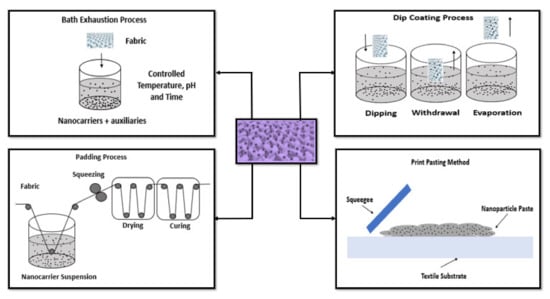
Exhaustion is one of the older process, in which the textile material is placed in the nanomaterial’s solution and the nanomaterials are adsorbed onto the surface of the fabric. Parameters such as exhaustion temperature, time, pH, concentration of nanomaterial solution, and addition of auxiliary agents play a crucial role in this process. Once the fabric is taken out from the solution, it is washed and dried [15][18]. The padding process is a traditional method and involves the use of a pair of rollers where the textile is immersed in a nanomaterial dispersion and then it is directed to move in between the rollers. This facilitates the penetration of nanomaterial into the textile and removes the excess of the solution from the textile. The pressure of the rollers and the speed of the fabric moves through the roller are vital in this procedure. Once the textile is passed out of the roller, it is then dried and cured, which helps to keep the nanomaterial on to the surface [15][19][20]. Dip coating is another impregnation method to coat nanoparticles on fibers or fabrics. The materials are dipped into the coating bath. The fibers/fabrics obtained are dried and may be cured, which enhance the adhesion between nanomaterial and the fibers/fabrics [15][21]. Electroless deposition is a common method used to deposit metal on nonconductive surfaces. It is based on surface charge activation and covers the layer with a catalyst. This process includes reduction of metallic ions to pure metal in the presence of a catalyst on to a surface. The electroless deposition will be carried out, as long as it is immersed in the bath. It is a simple technique and facilitates the adhesion of the nanoparticles onto the surface [15][22][23]. The print method was used by very few authors using a AuNPs paste made up of thickener, binder, and nanomaterial. The mixture can be applied via flat-to-flat method using a squeegee or screen printing on a curved surface using a rotating cylinder [15][24]. In the drop-wise deposition, the AuNPs are dispersed in a volatile liquid that is deposited by drop-on-demand ink jet heads. After that, the materials pass through a heating and evaporation process. In this final step, the particles deposition is promoted [25]. Immersion is a simple technique based on the direct dipping of the material into nanoparticles solution and subsequent diffusion. This process is time dependent and may require several minutes. The success of the deposition depends on the affinity between the materials surface and nanoparticles [26]. Sonication deposition is based on ability to generate acoustic cavities that undergo implosive collapse, discharging enormous energy in the form of high temperature and pressure. These facts produce shock waves, microjets, turbulence and shear forces that enhance the diffusion of nanoparticles and increase the kinetic energy of the system to overcome their ionic repulsion forces. Thereby, it reduces the deposition time and increases the surface coverage of nanoparticles [27]. Lastly, electrospinning also can be used to introduce nanoparticles into textile materials by mixing them with the polymer solution before the fiber formation. The polymer solution is charged and ejected through a spinneret under a high-voltage electric field that solidifies or coagulates to form filaments [28][29].
Table 1.
| Method for Synthesis of AuNPs | Deposition Method | Fabric/Textile | Precursor Salt | Reducing Agent | Stabilizing Agent | Additional Information | Size of NPs | Application | Reference |
|---|
| Chemical reduction | Drop-wise deposition | Cotton, silk, wool, polyester and nylon—F | Chloroauric acid (0.001 M) | Sodium borohydride solution of (0.1 M, 3 mL) | Sodium citrate 3 mL solution of 0.001 M | Sodium citrate also act as capping agent | n.a. | Wearable sensors | [30][48] |
| Chemical reduction | Padding | Cotton—F | Chloroauric acid (0.01 Wt %, 50 mL) | Trisodium citrate (1 wt%) | No stabilizing agent | Keratin coating (360 mL of keratin solution (10 mg/mL concentration). | 71.8 nm | Antimicrobial textiles | [31][49] |
| Chemical reduction | Printing and paste method | Polyester—F | Gold (III) chloride hydrate | Sodium citrate |
. Deshan Cheng et al. (2019) synthesized AuNPs via in situ synthesis reduction method and deposited them on cotton fabric by dip-coating. In this work, HAuCl
4 was used as the precursor salt and polydopamine (PDA) acted as reducing agent. AgNPs were deposited prior to the deposition of AuNPs, which acted as catalytic hotspots for enhancing the deposition of AuNPs [40]. Hongjun Liu et al. (2013) used HAuCl
4 to synthesize AuNPs on cotton fibers via in situ synthesis using the amine stabilizers and N-vinyl pyrrolidone (PVP) reductant in an aqueous medium. Fibers of cotton surface were first modified with (3-aminopropyl) triethoxy silane (ATS). The pre-treatment of the surface was found to be essential, without which a small amount of nonuniformly adsorbed AuNPs was formed on the fabric. The size of the nanoparticles was in the range of 2–7 nm and attained spherical shape [41]. Bharat Baruah et al. (2019) have focused on improving the catalytic activity of the fabrics combining zinc oxide (ZnO) and AuNPs. Hence, the fabric was coated with ZnO nanorods prior to the deposition of AuNPs. AuNPs was obtained by ex situ synthesis and citrate reduction method. AuNPs of the size 18.5 ± 2.8 nm were then deposited on cotton fabric coated with ZnO nanorods by the dip-coating method [42]. Hongjuan Ma et al. (2013) have functionalized PE/PP non-woven fabric by gold nanostructured microtubes, where AuNPs were in situ prepared after the grafting of 4-hydroxybutyl acrylate glycidyl ether onto the shell PE layer and posterior reaction with diethylamine. The tertiary amine groups covalently bonded onto the fabric are designed as the adsorbent for metal ions and reducing agent. Spherical-shaped nanoparticles with size of 5–20 nm were obtained in this study [43]. Richard P. Padbury et al. (2015) produced 14.6 ± 1.4 nm gold nanoparticles using HAuCl
4 as precursor salt. The sheets made up of nonwoven nylon-6 were soaked in NP solution and AuNPs are settled on the fabric [44]. It was observed that size and shape of nanoparticles depend upon reducing agent and concentration of the solution. These strategies produced functional textiles with improved properties, opening new perspectives for studies using combined approaches, able to provide the maximum AuNPs effect using low concentrations. Thus, improved methods may be obtained with reduced costs and environmental impact.
2.1.3. Chemical Reduction Method Using Thermal Treatment
4−) were heated at 85 °C in solution, and the AuNPs were in situ synthesized on silk fabric. Nanoparticles of size 21.3 ± 3.4 nm and different shapes were observed, and it was noticed that the concentration of the precursor in solution have influenced the shape of the nanoparticles and also improved thermal conductivity [45]. Jun Liu et al. (2016) have produced silk fabrics coated with gold nanoparticles. Gold nanoparticles were in situ synthesized on silk fabrics by heating precursor salt (HAuCl
4
2O). The AuNPs were deposited on the silk fabrics by immersion of fabrics in the solution and heating the solution at 85 ℃ for 60 min. Concentration of the precursor solution had an influence on the shape of the AuNPs and attained spherical, triangular nanoplates, truncated nano prisms, and polygonal shapes with varying concentrations [46]. Zhanyu Zhang et al. (2019) have synthesized AuNPs from HAuCl
4 by in situ process and maintaining pH value at 3. AuNPs coated the silk fabrics by immersion of fabric in solution and applying heat process [47]. These works showed the importance of functional groups in the fiber composition and how they can be used to obtain functional textiles and suggested novel studies using other protein fibers.
2.1.4. Green-Bio Synthesis
4
Acorus calamus rhizome as a reducing agent. Then, the cotton fabrics were coated by the pad-dry-cure method. The synthesized AuNPs were small and big spherical shape and had different sizes depending upon concentration of the solution [48]. Nabil A. Ibrahim et al. (2016) have biosynthesized AuNPs using HAuCl
4
2
(Streptomyces sp.)
2NPs or ZnONPs. The AuNPs were observed to have spherical shape with size in the range of 4–13 nm. The nanoparticles were deposited on to the knitted fabrics by sonication [49]. Bin Tang et al. (2017) have used in situ synthesis method to prepare AuNPs onto a cotton fabric using HAuCl
4 solutions at the concentrations of 0.025, 0.05, 0.075, 0.10, and 0.125 mM. Cellulose acted as reducing and stabilizing agents. The obtained AuNPs have exhibited different shapes depending on the content of gold such as spherical and triangular nanoplates with different sizes. The coated fabric displayed catalytic activity and improved UV protection [50]. To obtain a green approach, Jinlon Tao et al. (2018) functionalized cotton and polyester fabric by hybrid colloids of AuNPs and NRP (natural rubber particles), which was obtained through in situ synthesis of AuNPs in NRL (natural rubber latex) matrix. In this process, NRL act as both reducing and capping agent. HAuCl
4 solution and NRL was employed for obtaining AuNP@ NRP hybrid latex. The team induced the hierarchical nature into the material by the addition of NRL, which lead to the phenomena of hydrophobicity of the treated fabrics. The fabric surface was coated with AuNPs of size 31 nm using the dip and dry method [51]. P. Boomi et al. (2019) have functionalized cotton fabric using gold nanoparticles produced by green synthesis reduction method by maintaining pH value equal to 7. In this study, AuNPs were synthesized by reducing HAuCl
4
Coleus aromaticus leaf extract. The AuNPs were coated on the cotton fabric by immersion of the fabric in the colloidal solution. The obtained nanoparticles were of spherical and triangular shape and different sizes were measured [52]. Pandi Boomi et al. (2020) have synthesized AuNPs and deposited them on the cotton fabric to improve their antibacterial and anticancer properties. The gold nanoparticles were synthesized by green synthesis, where
Croton sparsiflorus
4 as precursor salt. The cotton fabric was coated with pristine leaf extract through the pad-dry-cure method. Different sizes between 16.6 and 17 nm were obtained using high concentration and low concentration solution, respectively [53]. Simone Haslinger et al. (2019) reported a novel strategy that was attempted for the first time. Noble metal nanoparticles were added into the cellulose pulp by a hydrothermal approach and subsequently subjected to dry-wet spin process. They have functionalized cellulose-based textiles with Au and AgNPs. In this study, bleached
birch prehydrolyzed kraft pulp
4 as precursor salt to synthesize AuNPs. These nanoparticles were incorporated into the textile by dry-jet wet spinning process, which improved the UV protection and helped to achieve bright colors [54]. Some attempts to use the combination of both chemical and green methodologies to study the synergetic effect of both methodologies have been performed. Velmurugan et al. (2016) synthesized AuNPs using in situ synthesis method onto leather, silk, and cotton fabrics by three different methods that include green, chemical, and a combination of green and chemical synthesis.
Ginkgo biloba
4
4
Ginkgo biloba
4 were used, and the obtained nanoparticles were deposited by immersion of the fabrics in the solution. TEM observations had revealed nanoparticles in the range of 10–75 nm with either rectangular, spherical, hexagonal with smooth edges, or roughly circular in shape [55]. The use of biological methods showed several advantages, but more studies are needed to solve reproducibility issues, understand the influence of AuNPs attached groups in the assigned properties, and implement them at the commercial level.
2.1.5. Electrochemical Synthesis
3 in the presence of HCl electrolyte. Later, AuNPs were electrodeposited onto the conductive textiles and the size of the nanoparticles was found with a mean diameter of 50 nm [58].
2.2. Functionalization of Fibers/Yarns/Threads with AuNPs
Table 2.
| Method for Synthesis of AuNPs | Deposition Method | Fabric/Textile | Precursor Salt | Reducing Agent | Stabilizing Agent | Additional Information | Size of NPs | Application | Reference |
|---|
| Photochemical reduction | Exhaustion | Silk and nylon—Fb | Tetrachloroauric acid (0.2 mM) | Trisodium citrate, D-malic acid disodium slat, and disodium tartrate (1 mM) | Trisodium citrate | Spherical and egg shapes were observed for heating method and photo chemical synthesis at pH = 4, respectively | Various sizes | Textile coloration | [57][75] | ||||||||||
| Chemical reduction | Soaked in solution | Cotton—T | Hydrogen tetrachloroaurate (0.65 mM) | Sodium citrate tribasic dihydrate | n.a. | SERS technique was used to detect and analyze adsorbed gold nanoparticles. | 20 and 60 nm | Diagnostics for surface-enhanced Raman scattering (SERS) spectroscopy | [59][77] | ||||||||||
| Chemical reduction | Immersion and capillary action | Cotton—T | Tetrachloroauric acid solution 2% (V/V) | Sodium citrate (2% (M/V)) | No stabilizing agent | One step green procedure | 13–20 nm | n.a. | Spherical shape; used HCl and NaOH for pH.Coloration, UV protection | 20–40 nm[24] | Surface-enhanced Raman scattering detection[42] | ||||||||
| [ | 60 | ] | [ | 78 | ] | Chemical reduction, seed-mediated growth | Immersion | Silk and cotton—F | Tetrachloroauric acid (0.01 M, 0.25 mL) Tetrachloroauric acid (0.01 M, 20 mL) |
Sodium borohydride (0.01 M, 0.6 mL) Ascorbic acid (0.1 M, 3.2 mL) |
CTAB (0.1 M) 9.75 mL CTAB (0.1 M) 400 mL |
Au nanorods with spherical shape. | 19 nm | Textile’s collation, UV protection, and antibacterial | [32][50 | ||||
| Chemical reduction | ] | ||||||||||||||||||
| Sonication | Cellulose—Fb | Tetrachloroauric (III) acid (0.5 mM, 20 mL) | Sodium squarate in water | Sodium squarate in water | AuNPs synthesized in water; Spherical in shape. | 21.01 nm | Catalysis | [ | 61][79] | In situ chemical reduction | Immersion and heating | Nylon—F | Tetrachloroauric (III) acid (0.05, 0.10, 0.15 and 0.20 mM) | Trisodium citrate | Trisodium citrate | pH value is in the range of 5.0–6.5 as per the concentration. | n.a. | UV blocking textiles | [33][51] |
| Chemical reduction | Immersion and stirring | Cotton—Y | Tetrachloroauric (III) acid (1 mM) | Trisodium citrate dihydrate (4 mM) | Citrate | Chemical reduction | Exhaustion | Soybean—KF | Tetrachloroauric acid 0.01% W/V | Sodium citrate dihydrate (1% W/V, 2 mL) | Chitosan | Treatment with chitosan; spherical shape. | 34.6 ± 0.5 nm | UV blocking and antimicrobial textiles | [34][52] | ||||
| pH 3–4. | 13 nm | Human motion sensor/wearable sensor | [ | 62 | ] | [ | 80 | ] | |||||||||||
| In situ chemical reduction | Soaking in solution | Silk fibroin—Fb | Tetrachloroauric (III) acid (10 mmol L−1) | Sulfonated polyaniline (20 mL of 5 wt %) | n.a. | Sulfonated polyaniline modified fibers catalytic reduction reaction of p-nitrophenol by NaBH4 |
50–100 nm | Catalysis | [63][81] | In situ chemical reduction | Impregnation | Cotton, silk, and wool—F | Hydrogen tetrachloroaurate (III) trihydrate | Sodium borohydride (1.3 g/L) | n.a. | AuNPs are mixed with other nanoparticles such as Ag and Pt; AuNPs have spherical shape. | 6.64 nm | Antimicrobial textiles | [35][53] |
| In situ chemical reduction | Immersion | Ramie—Fb | Tetrachloroauric (III) acid with different concentrations | Sodium borohydride | n.a. | AuNPs were synthesized in acidic condition, pH = 2–6. | n.a. | Textile coloration and antimicrobial textiles | [ | In situ synthesis, groups on silk | Immersion and constant shaking at 85 °C | Silk—F | Gold (III) chloride (0.5–2 mM) | Silk macro molecular chains | Silk fabric | Hydrogen peroxide used for activation of silk macro molecules. | 22–66 and 18–49 nm | Fabric coloration and antimicrobial properties | [36][54] |
| 64 | ] | [ | 82 | ] | |||||||||||||||
| In situ chemical reduction | Immersion and stirring | Cellulose—Fb | Tetracholoroaurate (0.5 mM) | Sodium rhodizonate | Sodium rhodizonate | Size depends on temperature; spherical shape. | 11 nm at 23 °C and 7 nm at 80 °C | Catalysis | [65][83] | In situ synthesis, sericin from silk | Soaking and sonication | Silk—F | Tetrachloroauric (III) acid (10 mg/mL, 500 mL) | Reduction by sericin from silk | n.a. | Spherical and ellipsoidal; pH = 12. | 11 ± 4 nm | ||
| Chemical reduction | Immersion and stirring | Cellulose—Fb | Gold chloride (AuCl3 | Antimicrobial textiles | ) | p-nitro-aniline (2 mM) Sodium borohydride (150 mM) | [ | 37 | ][55] | ||||||||||
| Cellulosic macromolecules | n.a. | 26.1 nm | Catalysis | [ | 66 | ] | [ | 84 | ] | Chemical reduction | Immersion | Polypropylene—NW | Tetrachloroauric Acid (1 mM) | Gallic acid (0.5 mM) | Without stabilizer | Surface activation by dielectric barrier discharge (DBD) and diffuse coplanar surface barrier discharge (DCSBD). | 20 nm | Antimicrobial textiles | |
| Chemical reduction | Electroless deposition | Gold/graphene—Y | [ | Tetrachloroauric (III) acid (1.6 mM) | 38 | ] | Hydroxylamine | [ | 56] | ||||||||||
| n.a. | Spherical to plate; dependent on reaction time. | 40 nm | Wearable electronics | [ | 67 | ] | [ | 85 | ] | n.a. | Deposition-precipitation | Poly(ethylene terephthalate—NW | Tetrachloroauric acid (5 mmol/L) | n.a. | n.a. | Fabric coated with ZrO2 fine particles before deposition of AuNPs at pH = 7 | n.a. | Air filter | [39][57] |
| Chemical reduction | Immersion | Regenerated cellulose—Fb | Gold (III) chloride triydrate (1 mM) | Trisodium citrate (1%, 2.2 mL) | Trisodium citrate | Fibers were grafted with positive charge; spherical shape | 40–50 nm | colorimetry and surface-enhanced Raman scattering (SERS) assays | [68][86] | In situ chemical reduction | Immersion | Cotton—F | Tetrachloroauric acid (10 mM) | Polydopamine (2 mg/mL) | n.a. | Treated with polydopamine before depositing nanoparticles; AgNPs were deposited prior to AuNPs at pH = 8.5. | n.a. | Catalysis | [40 |
| Chemical reduction | Sonication | Cotton—T | ] | Tetrachloroauric (III) acid (0.01%, W/V) | [ | 58 | ] | ||||||||||||
| Trisodium citrate | n.a. | AuNPs coated on CNTs | CNTs were functionalized with PDDA; homogenous surface. | 15 nm | Immunological chromatographic sensor | [ | 69 | ][87] | In situ chemical reduction | Immersion and stirring | Cotton—F | Hydrogen tetra-chloroaurate (III) trihydrate HAuCl4 (1 mL, 20 mM) | N-vinyl pyrrolidone (0.1 mL) | 1-Hexadecylamine | Surface modification by ATS is crucial for the formation of gold nano particles; spherical shaped. | 2–7 nm | Textile coloration | [ | |
| Chemical reduction | 41 | ] | Centrifugation | [ | 59 | ] | |||||||||||||
| Cotton—T | Tetrachloroauric (III) acid (0.01%, W/V) | Trisodium citrate | n.a. | AuNPs coated on CNTs | CNTs were functionalized with PDDA; homogenous surface. | 15 ± 3 nm | Immunological chromatographic sensor | [70][88] | Chemical reduction | Dip coating | Cotton—F | Sodium tetrachlorocuprate (III) dihydrate (1%, 90 µL) | Trisodium citrate (1%, 2.7 mL) | n.a. | Cotton fabric precoated with Zn nanorods before deposition of AuNPs. | 18.5 ± 2.8 nm | Photocatalysis | [42][60] | |
| In situ chemical reduction | Soaked in solution | Polyethylene-coated polypropylene—NW | Chloroauric acid | Amine groups grafted in textile surface | Amine groups grafted in textile surface | PE-coated PP fabric was used as a ligand and template; fabric is treated by the electron beam; spherical shape. | 5–20 nm | n.a. | [ | ||||||||||
| In situ green synthesis | Immersion | Cotton—Fb | Hydrogen tetrachloroaurate (III) hydrate (0.05 mM) | Osmanthus fragrans 10% (m/v) | Osmanthus fragrans | Spherical and hexagonal shape. | 40 and 60 nm | Heterogeneous catalyst | [71][89] | ||||||||||
| Biological reduction | Soaking | Silk—Fb | Tetrachloroauric acid (10−3 M) | Citrus paradisi extract | n.a. | Quasi-spherical | 30 nm | Textile coloration | [72][90] |
2.2.1. Chemical Reduction Method without Pre-Treatments on Fabrics
4 as precursor salt and sodium citrate tribasic dihydrate as a reducing agent. AuNPs of size of 20 and 60 nm were obtained and deposited on the cotton thread by soaking them individually in the solution of AuNPs. The cotton threads were treated with cationic polyacrylamide (CPAM) before the deposition of AuNPs [59]. Cristina Battesini Adamo et al. (2020) have synthesized spherical-shaped gold nanoparticles of size 20–40 nm using the Turkevich method. In this study, HAuCl
4 solution (30 wt%) and sodium citrate were used. The AuNPs were wicked on to the cotton thread by capillary action when threads were immersed in the solution [60]. Md. Tariqul Islam et al. (2016) have produced AuNPs with average size of 21.01 nm where HAuCl
4 was used as a precursor salt and sodium squarate in water was used as a reducing and stabilizing agent. The gold nanoparticles were synthesized in water and attached to the cellulose fibers by sonication [61]. Hyung Ju Park et al. (2016) have fabricated cotton yarns decorated with Au core-shell nanoparticle by a solution-based approach. The AuNPs were synthesized by a chemical reduction method where HAuCl
4 was used as a precursor salt solution and trisodium citrate dihydrate was used as a reducing agent and stabilizing agent. The solution was maintained at pH between 3 and 4, and the obtained nanoparticles were of the size 13 nm [62].
4 via in situ reduction method where sulfonated polyaniline acted as reducing agent. They were deposited by soaking fibers in the solution that contains AuNPs [63]. Bin Tang et al. (2015) have synthesized AuNPs through in situ synthesis using HAuCl
4
4. The pH value of the solution was maintained such that it had acidic condition. They were deposited on to the ramie fibers by immersion of fibers in the solution [64]. Tariqul Islam et al. (2017) have used in situ synthesis where HAuCl
4 was used as precursor salt and sodium rhodizonate was used as a reducing and stabilizing agent to produce AuNPs. The AuNPs were found to have spherical shape and the size of 7 and 11 nm. The stabilized AuNPs were readily adsorbed on cellulose fibers [65]. Hossam E. Emam et al. (2017) have used one-pot fabrication of AgNPs onto a cellulosic solid support. AuNPs of 26.1 nm were synthesized through green synthesis using gold chloride (AuCl
3
4 as reducing agent, and cellulosic macromolecules as stabilizing agent. They were deposited onto cellulose solid support by one-step method [66]. Yong Ju Yun et al. (2017) have fabricated gold/graphene yarns using a solution-based process to potentially use them for flexible and wearable electronics. HAuCl
4 was used as precursor salt and hydroxylamine was used as a reduced agent for the synthesis of AuNPs. They were deposited uniformly on the surface by electroless deposition and found to have from spherical shape to plate and grow vertically with time, the size of the AuNPs was 40 nm in diameter [67]. Qian Yu et al. (2018) have produced multifunctional cellulose fiber Au composites via decorating regenerated cellulose fiber with AuNPs. HAuCl
4 was used as a precursor salt and trisodium citrate was used as a reducing and stabilizing agent to produce gold nanoparticles following Natan’s method. The obtained spherical AuNPs with size of 40–50 nm were decorated on to the surface of cellulose fiber by the immersion of fibers in the solution of Au colloids. The fibers were grafted with positive charge according to the method proposed by Tabba and co-workers with some modifications [68].
2.2.2. Chemical Reduction Method with Pre-Treatments
4 solution and trisodium citrate by chemical reduction method. AuNPs were coated on the CNTs, which were priorly functionalized with poly(diallyldimethylammonium chloride) (PDDA) using sonication method, and these were deposited on to the cotton thread by soaking cotton threads in the solution that contains AuNPs/CNTs. To improve the wicking function of the cotton thread, chemical treatments are necessary to eliminate the surface contaminants [69]. Xiaobo Jia et al. (2017) have synthesized AuNPs with size of 15 ± 3 nm using HAuCl
4 solution and trisodium citrate by chemical reduction method. These nanoparticles are mixed with CNT and subsequently, the cotton thread device was constructed for carcinoembryonic antigen (CEA) detection. It was constructed by soaking the cotton thread in the solution containing AuNPs-coated CNTs that were previously functionalized with PDAA [70].
2.2.3. Reduction with Photochemical Treatments
4 as precursor salt and citrate, malate, and tartrate as reducing agents by heating and photochemistry processes. The solution was used to color silk and nylon fibers, and AuNPs were deposited using the exhaustion process. Nanoparticles were observed to have egg, spherical shape and various sizes depending on the type of reducing agent [57].
2.2.4. Green Synthesis
4
Osmanthus fragrans leaves as reducing and capping agent irradiated by natural sunlight to produce AuNPs. The cotton fibers were then immersed in the AuNPs solution, and they were deposited on the fabrics through in situ reduction in the presence of direct sunlight. Nanoparticles of size 40 and 60 nm in diameter were observed in TEM and appeared to have spherical and hexagonal shapes [71]. Victor Nolasco-Arizmendi et al. (2012) have synthesized AuNPs using HAuCl
4
citrus paradise extract as the reducing agent, and the AuNPs were deposited on the silk fabric by impregnating the fabric in the solution. Quasi-spherical-shaped nanoparticles were observed [72].